Combat Profile
Emanation of the Five Shekinahs
Zurvan channels pure divine intellect through Reason, Mind, Intelligence, Thought, and Understanding to reshape reality according to eternal cosmic order.
Lord of Eternity
Zurvan exists outside time itself, granting immunity to temporal corruption and the ability to perceive all moments simultaneously.
None in himself -- but his creation, Primal Man, was defeated when sent to fight Darkness, proving that even perfect Light can be temporarily overwhelmed by brute aggression
“The Father of Greatness dwells in the Realm of Light with his five Shekinahs — his five attributes — and all is peace and radiance.”
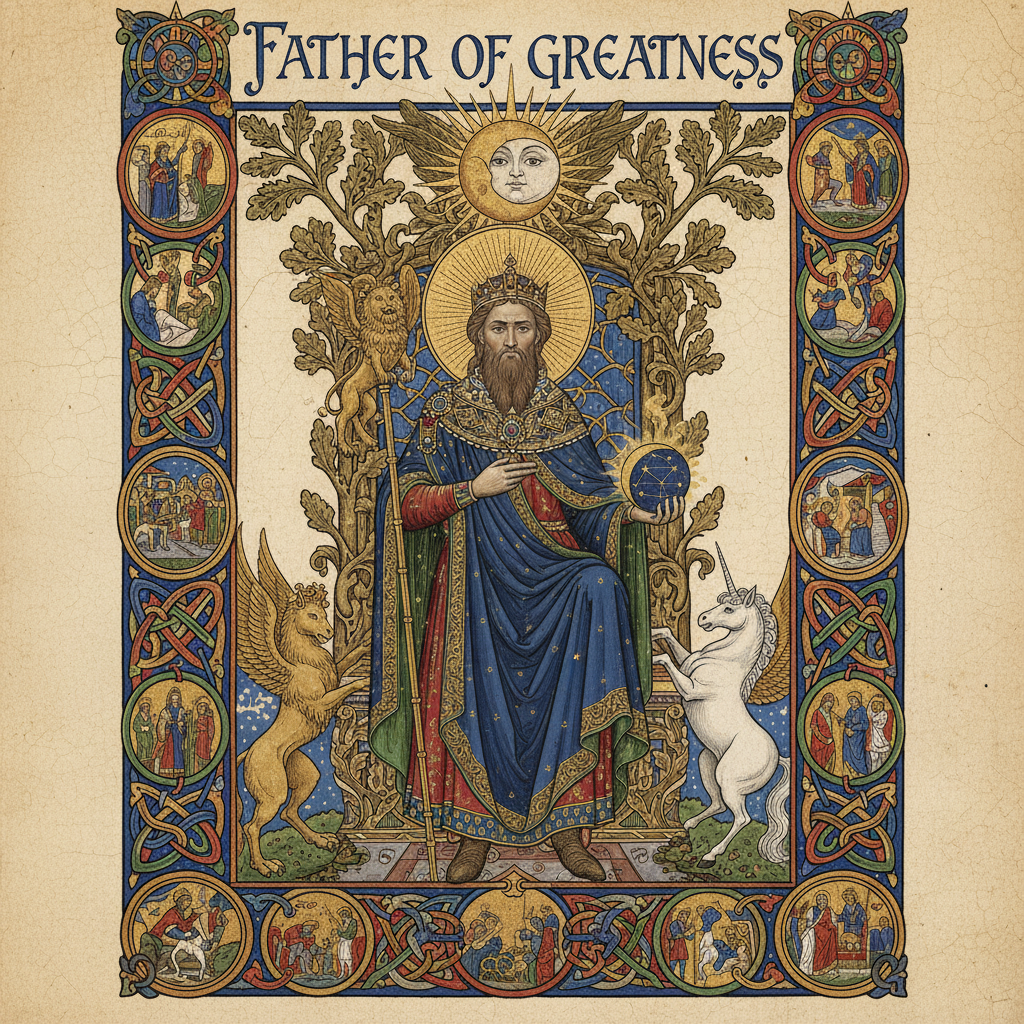
Lore: The Father of Greatness (also called Zurvan, the “Father of Light”) is the supreme deity of Manichaeism — the eternal, uncreated God who dwells in the infinite Realm of Light (Kephalaia). He is surrounded by his five Shekinahs: Reason, Mind, Intelligence, Thought, Understanding. The Realm of Light is paradise — it has always existed, it is perfect, and it would have remained undisturbed forever but for the aggression of Darkness.
This is the Manichaean innovation that scandalized every other theology. The Father of Greatness did NOT create evil. He did not create Darkness. He did not know Darkness existed until it attacked (Shabuhragan). The Realm of Darkness is a separate uncreated reality that has always existed alongside Light. The cosmic war began not from divine plan or test but because Darkness — chaotic, hungry, violent by nature — looked across the border and coveted the Light. The entire material universe is the consequence of that unprovoked attack (BeDuhn, The Manichaean Body).
Parallel: The Father of Greatness maps onto Ahura Mazda (Zoroastrianism — the direct source), God the Father (Christianity), and Brahman (Hinduism) — but with a crucial difference. In Christianity, God is omnipotent and evil exists only by divine permission. In Zoroastrianism, Ahura Mazda is destined to win but chose to create the world as the arena for the contest. In Manichaeism, the Father of Greatness was surprised by the attack. He is not omnipotent in the classical sense — he is infinitely good but faces a genuine threat from an equally eternal adversary. This makes the Manichaean God more vulnerable and the cosmic war more real than in any other dualist system.
1 min read
The King of Darkness (his eternal opposite, never created by him, always existing independently)
BeDuhn, *The Manichaean Body*; Lieu, *Manichaeism in the Later Roman Empire and Medieval China*; Gardner & Lieu, *Manichaean Texts*; the Kephalaia