The Story
Mesoamerica built layer upon layer. The deepest is Olmec (~1200-400 BCE) — the “mother culture” of the Gulf Coast, source of the colossal basalt heads, the were-jaguar motif, and the prototypes (arguably) of every god the Maya and Aztec would later worship. (Coe, The Maya) The feathered serpent, the rain god, the ballgame, the bar-and-dot numbering, the ritual calendar — all Olmec inventions, stretched across three millennia.
The Maya Classic Period (~250-900 CE) stands as one of antiquity’s great achievements. Dozens of city-states — Tikal, Calakmul, Palenque, Copan, Caracol — carved a fully developed writing system into stone and bark-paper, mapped the heavens with precision rivaling Hellenistic astronomers, and left behind a theological literature so sophisticated it still mystifies us. (Schele & Freidel, A Forest of Kings) Then, between 800 and 900 CE, the southern lowland cities emptied. Drought, warfare, ecological collapse — scholars point to all of it. The northern Maya (Chichen Itza, Uxmal) kept going. The people never vanished. But the collapse remains archaeology’s greatest unsolved riddle.
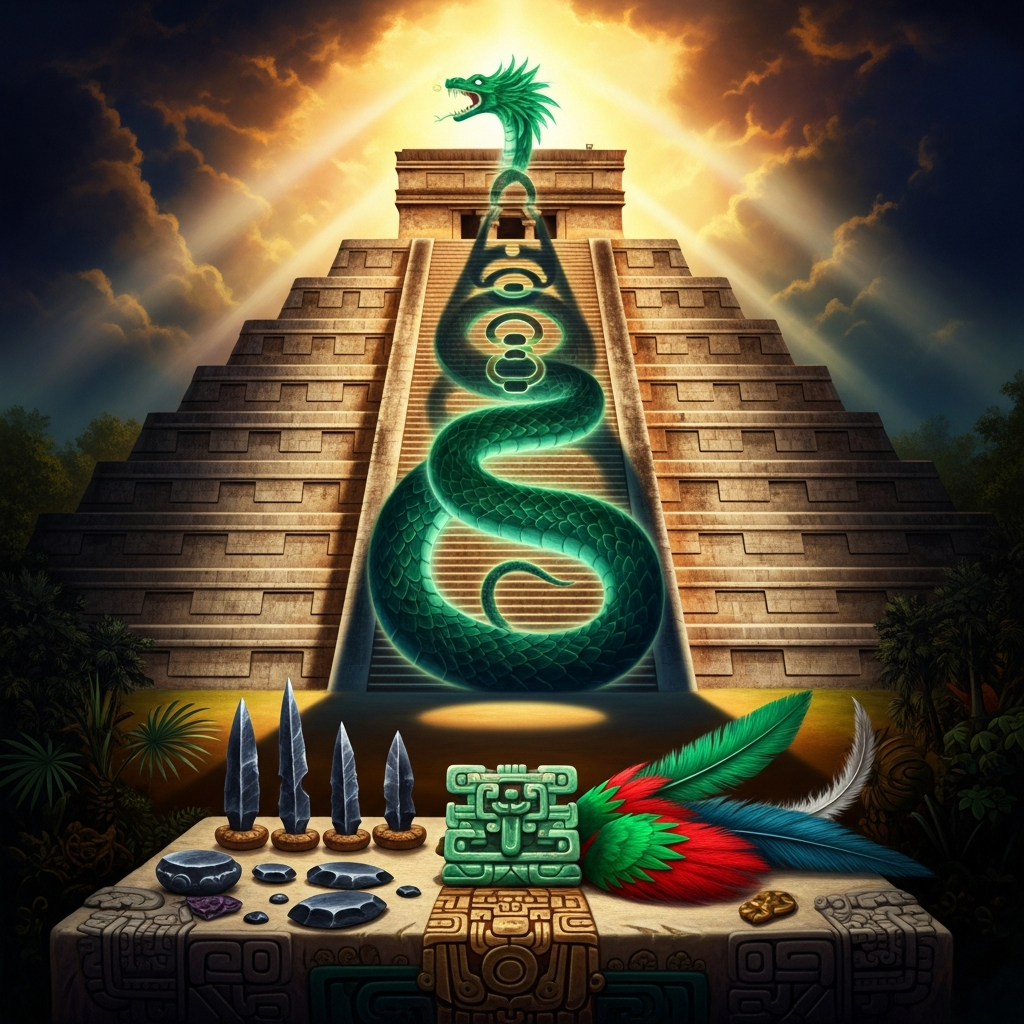
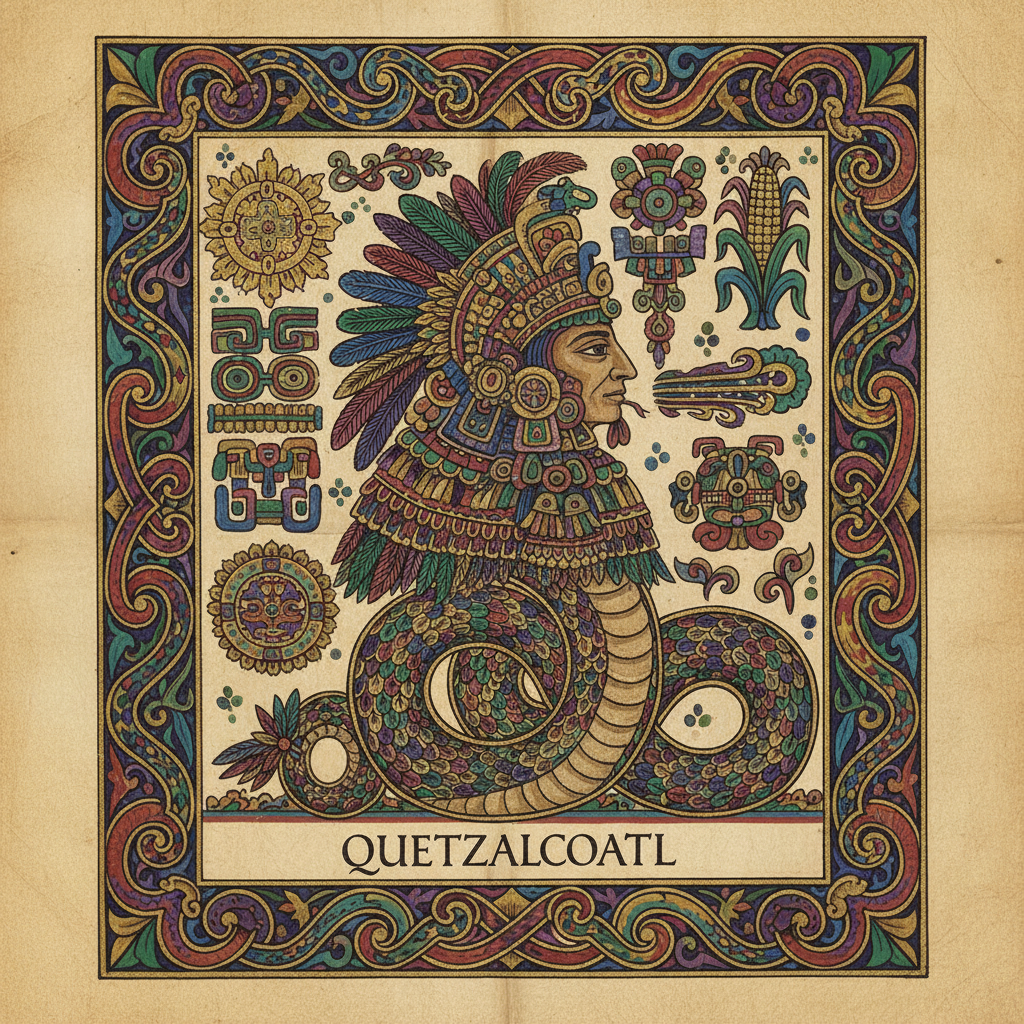
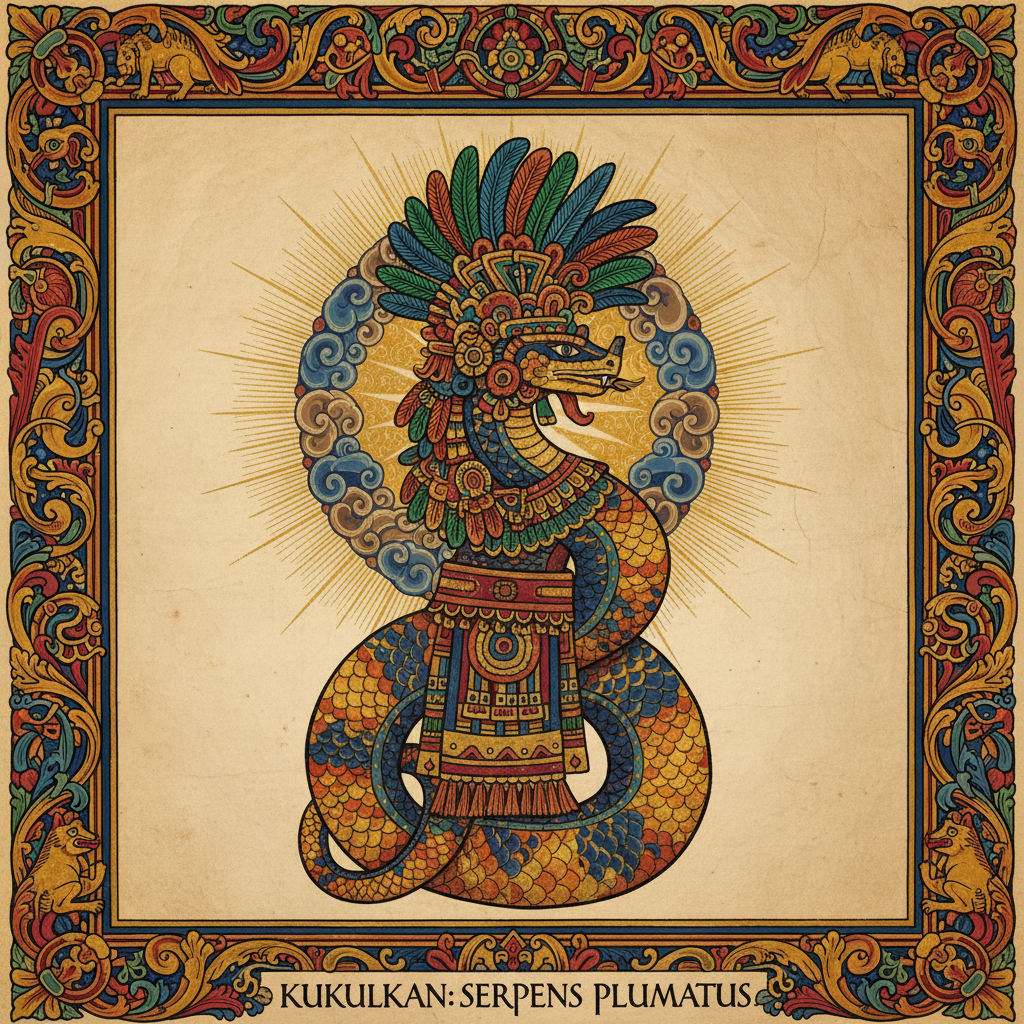
The Toltecs (~900-1150 CE), centered at Tula, served as bridge and beacon. Later Mesoamericans revered “Toltec” as the word for civilized, for learned, for beautiful. Quetzalcoatl (Kukulkan to the Maya) — the feathered serpent — spread across the region during their ascendancy, unmistakably visible at Chichen Itza in Toltec iconography.
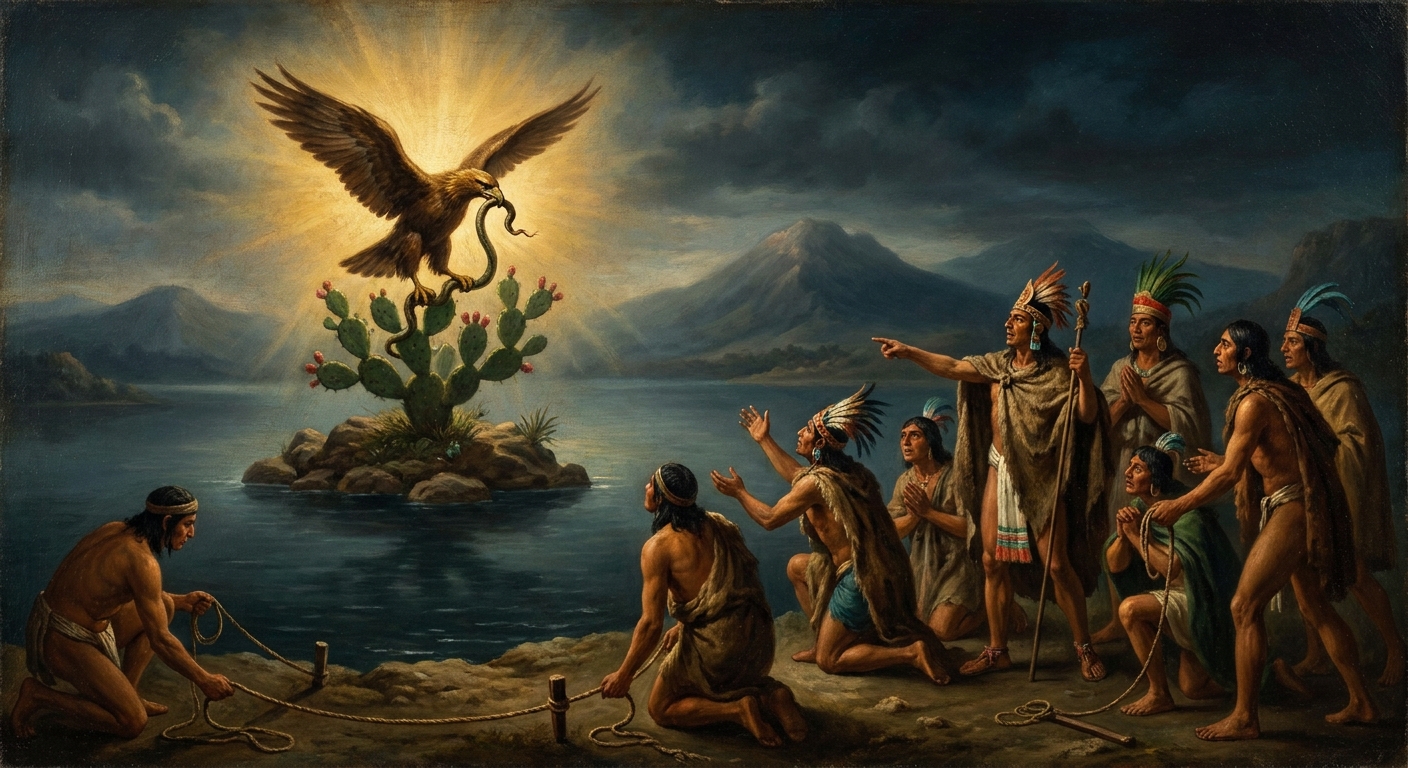
The Mexica (called “Aztec” by history) were latecomers. A Nahuatl-speaking people from the north, despised as mercenaries and outsiders, they arrived in the Valley of Mexico in the 13th century. In 1325 CE, following a prophecy, they founded Tenochtitlan on a marshy island in Lake Texcoco where they glimpsed an eagle on a cactus devouring a serpent — that image flies on the Mexican flag today. (Codex Mendoza) Two centuries later: a tributary empire of six million, a capital of 200,000, causeways and aqueducts and floating gardens, larger than any European city of its time. At its heart rose the twin-temple Templo Mayor.
Hernán Cortés arrived in 1519 with 500 men, 16 horses, and cannon. Within two years, the world ended. Spanish steel, smallpox, indigenous allies crushed under Aztec tribute, and Moctezuma II’s fatal indecision converged. (Bernal Diaz, True History) August 13, 1521: Tenochtitlan fell. The conquest that followed was not merely military. Friars dismantled temples, smashed idols, executed priests, drove the old gods underground. The pyramids became quarries. Mexico City’s Metropolitan Cathedral stands on the Templo Mayor’s rubble.
Bishop Diego de Landa, in 1562, immolated what remained. In the Yucatecan town of Mani, he gathered the surviving Maya codices — bark-paper books holding three thousand years of theology, astronomy, history, medicine — and burned them. (Landa, Relacion) By his own account, the Maya “regretted [the burning] to an amazing degree, and it caused them great affliction.” Of thousands of books, four survived. An entire library went to ash.
The religion, though, refused to vanish. In 1531, on the hill of Tepeyac — the old shrine of Tonantzin, the Aztec mother goddess — a Nahua peasant named Juan Diego saw an apparition: a brown-skinned woman speaking Nahuatl, identifying herself as the Virgin Mary. (Nican Mopohua) The Virgin of Guadalupe became the vessel. Indigenous Mexicans poured into Catholicism behind a mother-of-god who spoke their language and wore their face, taking Tonantzin’s shrine as her own. Beneath the Catholic surface, the old religion breathed: in Day of the Dead ofrendas, in curanderismo healing, in milpa agriculture rites, and — most crucially, among highland Maya — in the ajq’ij (day-keepers) who have counted the 260-day sacred calendar unbroken for 2,500 years.
Revival came in the 20th and 21st centuries. The Zapatista uprising of 1994 centered indigenous Maya identity in Mexican politics. Mexicayotl reconstructionist movements flourish in Mexico and the United States. Today, over 30 million Mesoamericans — Nahua, Yucatec Maya, K’iche’, Mam, Tzotzil, Tzeltal, Mixtec, Zapotec and more — hold onto fragments and, increasingly, whole traditions of a religion the friars swore they had ended.
Pivotal Events
After generations of wandering and mercenary servitude, the Mexica priests received a sign from Huitzilopochtli: build the city where an eagle perches on a nopal cactus, devouring a serpent. (Codex Mendoza) They found it on a marshy, snake-infested island in Lake Texcoco — land no one else coveted. Within two centuries: the largest Western Hemisphere city, a six-million-soul empire, one of antiquity’s greatest urban achievements. The eagle, cactus, and serpent fly today on Mexico’s flag. No modern nation carries its pre-Columbian founding vision in its heraldry. The Mexica were not a vanished people. They became Mexico.
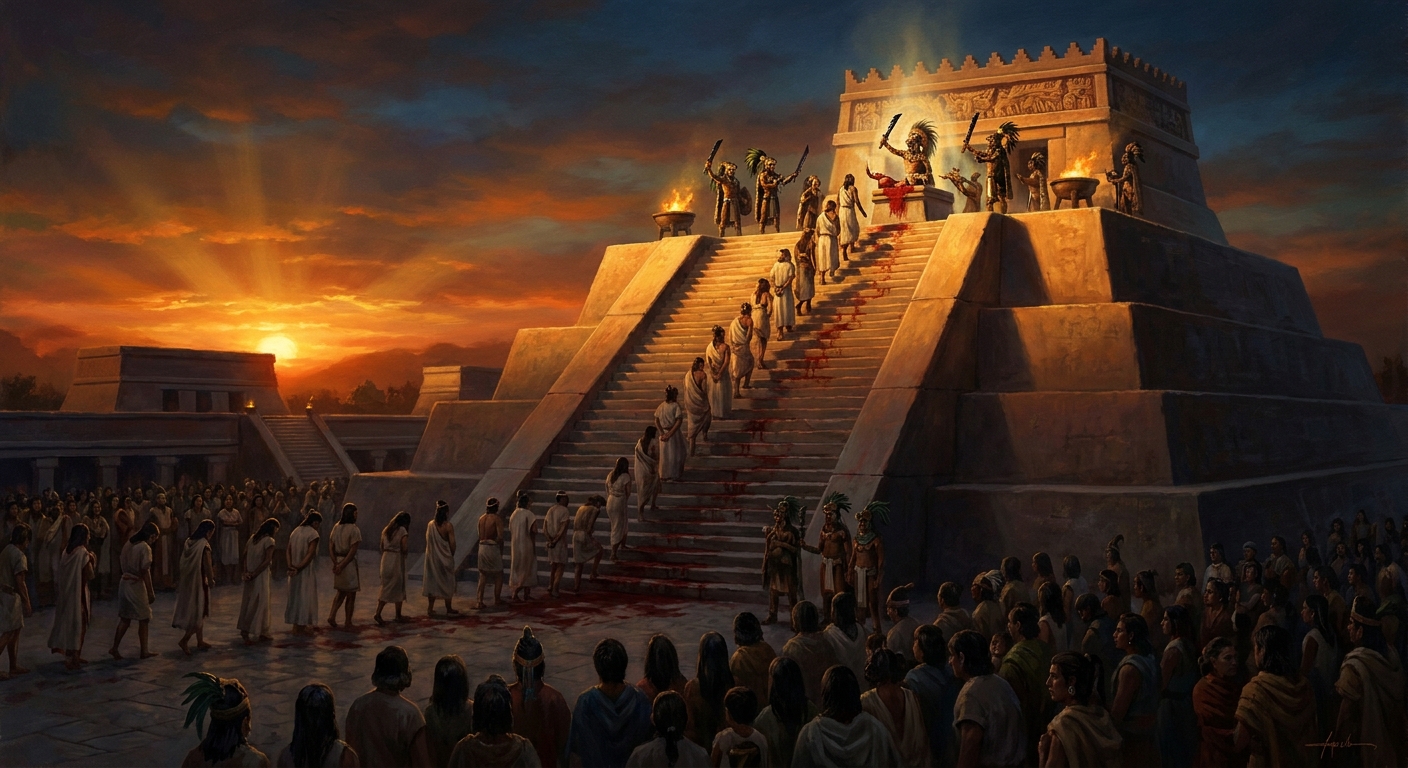
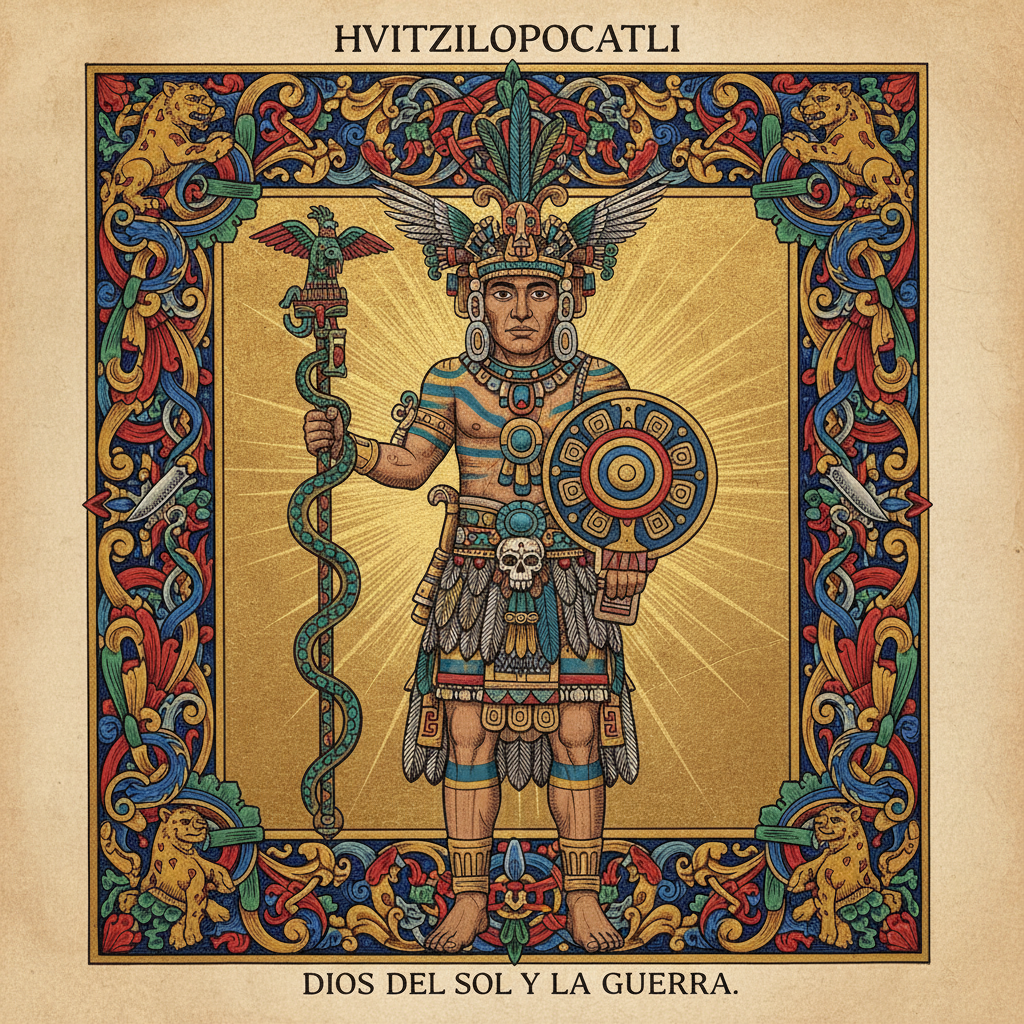
In 1487, the tlatoani Ahuitzotl reconsecrated the expanded Templo Mayor with four days of continuous human sacrifice. (Codex Telleriano-Remensis) The count is disputed — sources range from 20,000 to 80,400; historians lean lower, though “lower” remains staggering. War captives processed up the pyramid in lines stretching through Tenochtitlan. Obsidian blades opened their chests. Hearts went to Huitzilopochtli and Tlaloc, gods crowned above the twin temples. The theology: the gods had bled themselves to birth the Fifth Sun. Human blood — chalchiuhatl, “precious water” — repaid the cosmos its debt, kept it spinning. To modern minds, monstrous. To the Mexica, the highest sacred obligation. It is the act for which all of Aztec theology, unfairly, is remembered.
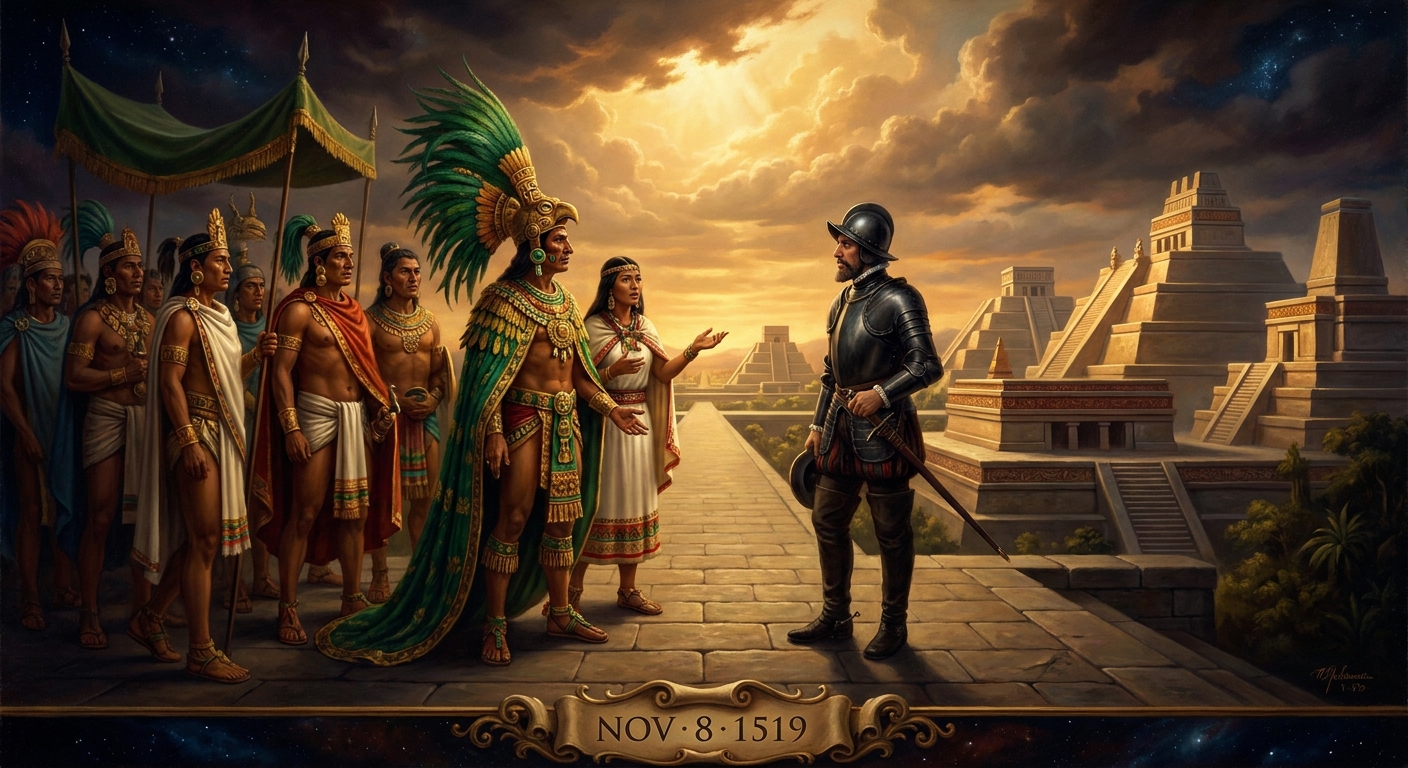
November 8, 1519: the causeway into Tenochtitlan. Hernán Cortés — minor Spanish hidalgo, 500 men, 16 horses, cannon — met Moctezuma II, huey tlatoani of an empire of millions. (Cortés letters; Bernal Diaz, True History) Moctezuma offered gold, flowers, and words Spaniards (and possibly Mexica) read as acknowledgment: Cortés might be Quetzalcoatl returning in the prophesied year Ce Acatl (One Reed). Two years later Tenochtitlan lay rubble. Smallpox killed perhaps half the Valley of Mexico. Tlaxcalans and other tribute-slaves rose with Cortés against their masters. Moctezuma died stoned by his own people, a Spanish captive. The siege of 1521 broke the city. August 13, 1521: the empire ended. The date, coincidentally, is the Catholic feast of Saint Hippolytus — the saint upon whose day the cathedral would be consecrated over Templo Mayor’s stone.
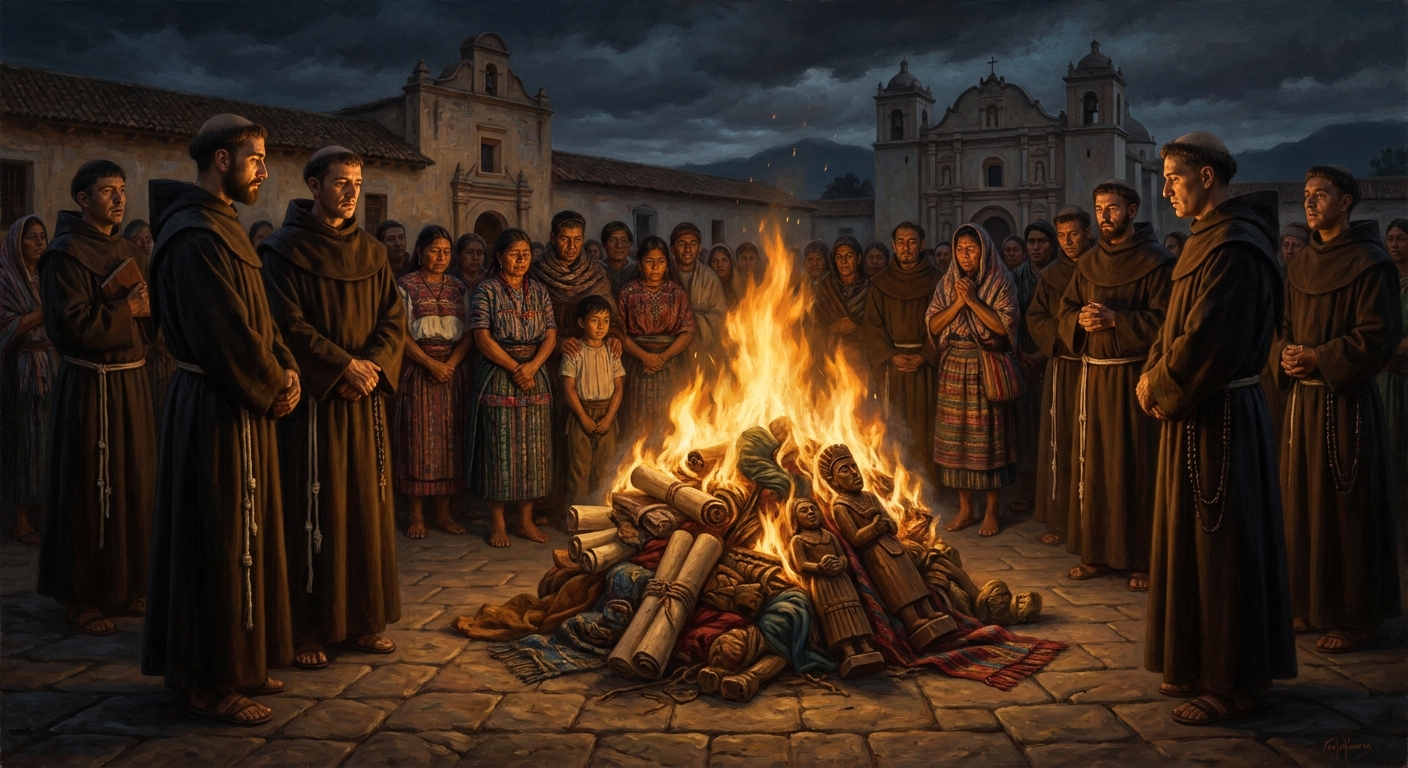
July 1562: the Yucatec town of Mani. Diego de Landa, Franciscan provincial, discovered that converted Maya had returned to the old rites in caves. His response: an auto-da-fé of staggering ambition. He gathered the surviving Maya hieroglyphic codices — bark-paper repositories of three thousand years of theology, astronomy, history, ritual law — and immolated them. (Landa, Relacion) Five thousand carved gods went into the flames with an unknown number of books. Landa wrote: “We found a great number of books in these letters, and as they contained nothing but superstition and lies of the devil, we burned them all, which they regretted to an amazing degree, and which caused them great affliction.” Of thousands of codices in 1500, four remain: the Dresden, Madrid, Paris, Grolier. Imagine if only four books survived from all medieval Europe. That measures Mani’s loss.
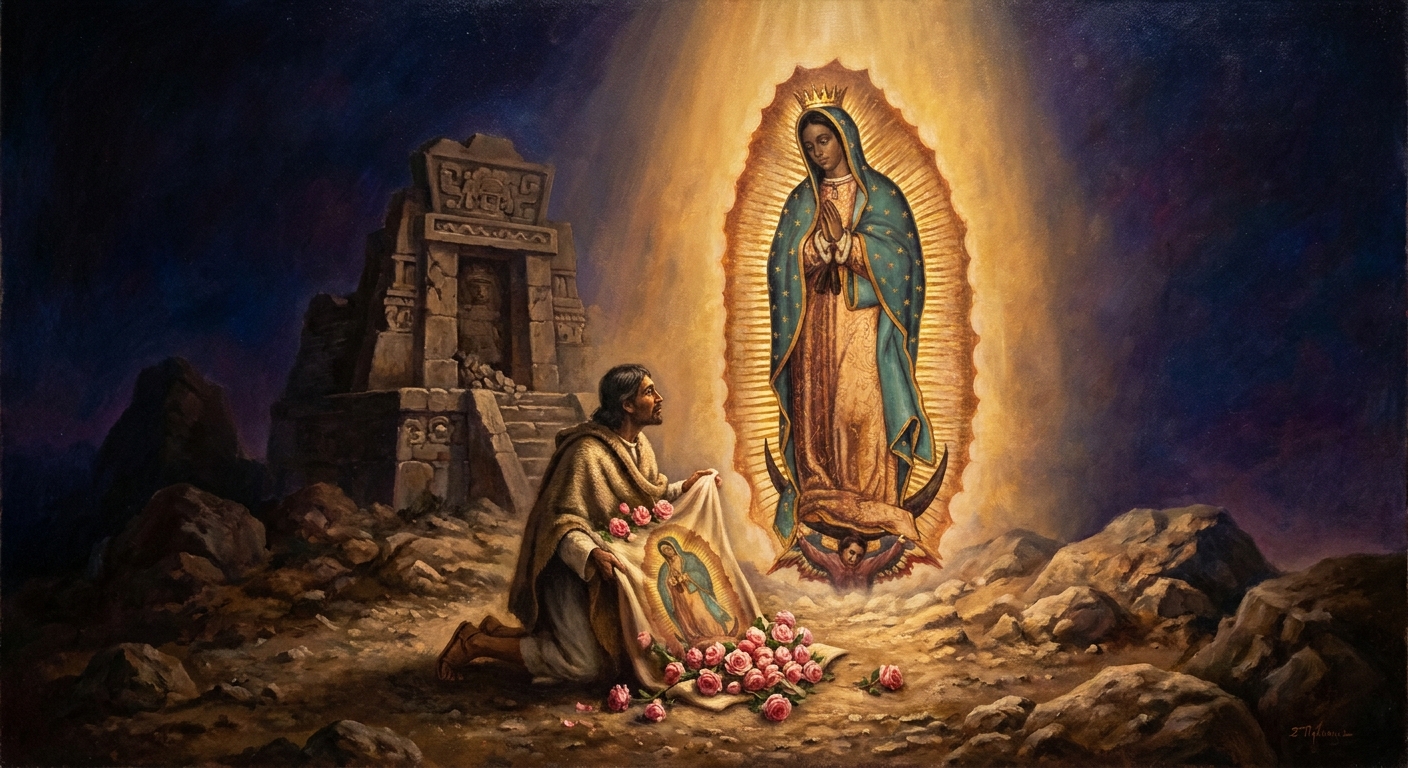
Ten years after Tenochtitlan’s fall, on the hill of Tepeyac — the old shrine of Tonantzin (“Our Revered Mother”), the Aztec mother goddess — a Nahua peasant named Juan Diego saw a vision: a brown-skinned woman speaking Nahuatl, calling herself the Virgin Mary. (Nican Mopohua) She instructed him to tell the bishop to build a church here. As proof, her image burned into his tilma (cloak), preserved today in the Basilica of Guadalupe. Was it genuine revelation? Franciscan strategy? Indigenous syncretism? Perhaps all three. The effect was immediate: indigenous Mexicans poured into Catholicism behind a dark-skinned mother-of-god who spoke their language and had claimed Tonantzin’s old hill. The Virgin of Guadalupe became Christendom’s most-venerated Marian apparition and Latin America’s de facto patron. Beneath the Catholic surface, Tonantzin survives, unchanged and unexiled.
Timeline
| Era | Date | Event | Source |
|---|
| Olmec Mother Culture | ~1200-400 BCE | Olmec civilization on Gulf Coast; were-jaguar, feathered serpent prototypes | archaeological record |
| Maya Preclassic | ~2000 BCE - 250 CE | Early Maya settlements; emergence of writing and calendar | archaeological record |
| Teotihuacan | ~100 BCE - 550 CE | Great central-Mexican city; Pyramids of Sun and Moon | archaeological record |
| Maya Classic Period | ~250-900 CE | Tikal, Palenque, Copan, Calakmul flourish; full hieroglyphic literacy | inscriptions; codex remnants |
| Maya Long Count zero date | August 11, 3114 BCE | Mythic creation date of the current Fourth/Fifth world | Maya inscriptions |
| Maya Collapse (southern lowlands) | ~800-900 CE | Progressive abandonment of southern lowland cities | archaeological record |
| Toltec Period | ~900-1150 CE | Tula flourishes; Quetzalcoatl/Kukulkan cult spreads | Aztec annals; Tula ruins |
| Chichen Itza | ~900-1200 CE | Toltec-influenced Maya capital in northern Yucatan | site itself |
| Aztec Migration | ~1250 CE | Mexica leave Aztlan, enter Valley of Mexico | Codex Boturini |
| Founding of Tenochtitlan | 1325 CE | Eagle-and-serpent vision; city built on Lake Texcoco | Codex Mendoza; Mexica annals |
| Aztec Triple Alliance | 1428 CE | Tenochtitlan, Texcoco, Tlacopan form imperial alliance | Mexica annals |
| Templo Mayor Reconsecration | 1487 CE | Ahuitzotl’s mass sacrifices at expanded temple | Codex Telleriano-Remensis |
| Moctezuma II Crowned | 1502 CE | Last fully sovereign Mexica huey tlatoani | Mexica annals |
| Cortés Lands at Veracruz | 1519 CE | Spanish expedition begins | Bernal Diaz, True History |
| Cortés Meets Moctezuma | November 8, 1519 | First encounter on the Tenochtitlan causeway | Bernal Diaz; Cortés letters |
| Smallpox Epidemic | 1520 CE | First pandemic; ~40% of central Mexico dies | Florentine Codex |
| Fall of Tenochtitlan | August 13, 1521 | Cuauhtemoc surrenders; empire ends | Bernal Diaz; Sahagun |
| Spiritual Conquest Begins | 1524 CE | ”Twelve Apostles” Franciscans arrive | Motolinia |
| Apparition of Guadalupe | December 1531 | Juan Diego on Tepeyac; Tonantzin syncretism | Nican Mopohua |
| Landa’s Auto-da-fé at Mani | July 1562 | Maya codices burned in Yucatan | Landa, Relacion |
| Caste War of Yucatan | 1847-1901 | Maya uprising against Mexican state | period documents |
| Modern Rediscovery | 1839+ | Stephens & Catherwood publish Maya ruins | Incidents of Travel |
| Maya Decipherment | 1952-1990s | Knorozov, Coe, Schele crack the script | scholarly record |
| Zapatista Uprising | January 1, 1994 | EZLN rises in Chiapas; indigenous Maya politics | EZLN communiques |
| Maya Calendar “Apocalypse” | December 21, 2012 | End of 13th Bak’tun; misread as world’s end | Long Count itself |
| Present | 2026 | ~30M+ Mesoamerican peoples; Mexicayotl revival; Day of the Dead worldwide | demographic studies |
The Centerpiece: The Fifth Sun — Living in a Borrowed World
The Aztec creation story is not a single creation but five. We are living in the Fifth Sun — the fifth attempt at a world. The previous four were destroyed. This one will be too. The question is not if but when — and whether humanity can delay the inevitable by feeding the sun with blood.
The Aztec cosmos is governed by the doctrine of the Five Suns (Nahui Ollin), recorded in the Legend of the Suns and carved on the famous Sun Stone (popularly misidentified as the “Aztec Calendar”). (Florentine Codex; Legend of the Suns) Each Sun is a world age, presided over by a different god, populated by a different form of humanity, sustained by a different food, and destroyed by a different catastrophe:
| Sun | Presiding God | Name | Humanity | Destruction | Duration |
|---|
| First | Tezcatlipoca | Nahui Ocelotl (4 Jaguar) | Giants | Devoured by jaguars | 676 years |
| Second | Quetzalcoatl | Nahui Ehecatl (4 Wind) | Normal humans | Destroyed by hurricanes; survivors became monkeys | 364 years |
| Third | Tlaloc | Nahui Quiahuitl (4 Rain) | Normal humans | Destroyed by a rain of fire; survivors became birds | 312 years |
| Fourth | Chalchiuhtlicue | Nahui Atl (4 Water) | Normal humans | Destroyed by a great flood; survivors became fish | 676 years |
| Fifth | Huitzilopochtli / Tonatiuh | Nahui Ollin (4 Movement) | Current humanity (made from bone and divine blood) | Will be destroyed by earthquakes | Current |
The theological implications are staggering:
1. Creation is not stable. In the Abrahamic traditions, God creates the world and it holds (Genesis 1:31: “God saw all that he had made, and it was very good”). In the Aztec system, creation is inherently unstable. Four worlds have already collapsed. The current world will collapse. The question is not whether the Fifth Sun will end but whether it can be sustained for a while longer.
2. The gods cannot get it right alone. Each previous Sun failed because the presiding god was overthrown by a rival or because the creation was flawed. The Fifth Sun was created through an act of divine sacrifice — at Teotihuacan, the humble god Nanahuatzin threw himself into a great bonfire and became the sun, while the proud god Tecciztecatl hesitated and became the lesser moon. But the sun refused to move until all the other gods sacrificed themselves and gave their blood. The sun literally runs on divine blood. When the gods’ blood ran out, human blood became necessary. This is not a punitive theology. It is a cooperative one: gods and humans are partners in maintaining a fragile universe, and both must sacrifice.
3. Cyclical vs. linear time. The Judeo-Christian tradition is fundamentally linear: creation → fall → history → redemption → final judgment → eternity. The Aztec system is cyclical: creation → destruction → creation → destruction, repeating. This cyclical cosmology is shared with Hindu cosmology (the Yugas: Satya → Treta → Dvapara → Kali, repeating in cycles of 4.32 billion years), Hopi tradition (First World → Second World → Third World → Fourth World, each destroyed and rebuilt), and Buddhist kalpas (world cycles of unimaginable length). The Fifth Sun doctrine places Aztec theology firmly in the cyclical-time tradition, opposed to the Abrahamic linear model.
4. The Sun Stone. The great basalt Sun Stone (Piedra del Sol), 3.6 meters in diameter and weighing 24 tons, is the most famous artifact of Aztec civilization. (Codex Borbonicus) At its center is the face of Tonatiuh (the current sun god) with his tongue protruding — a tongue shaped like a sacrificial obsidian knife, demanding blood. Surrounding him are the four glyphs representing the previous suns and their destructions. The outer rings contain calendrical information, star symbols, and fire serpents. The entire stone is a cosmological statement carved in basalt: we live in a dying world, and only blood keeps it alive.
The Fifth Sun doctrine is not a relic. Aztec reconstructionist communities understand it as a living cosmological framework — a way of understanding humanity’s relationship to a universe that is neither guaranteed nor permanent. In an era of climate crisis and existential risk, the Aztec intuition that the world requires active maintenance and that human actions have cosmic consequences may be more relevant than the Abrahamic assurance that God has everything under control.
The Centerpiece: Human Sacrifice — Why?
The single most common question about Mesoamerican religion is: why the human sacrifice? It is asked with horror, with fascination, and almost always with an underlying assumption that the practice was uniquely barbaric. That assumption reveals more about the questioner than about the Aztecs. Every major religious tradition has a theology of sacrifice. The question is not whether sacrifice is necessary but what must be sacrificed and why.
The Aztec sacrificial system was not sadism, not mere political terror (though it served that function too), and not evidence of “primitive” religion. It was the logical conclusion of a specific cosmological premise: the universe runs on blood, and if the blood stops flowing, the universe stops.
The premise is built on two theological foundations:
1. The gods sacrificed themselves for us. At the creation of the Fifth Sun, the gods gathered at Teotihuacan and Nanahuatzin threw himself into the divine bonfire to become the sun. But the sun did not move. It sat on the horizon, burning but motionless. The gods then sacrificed themselves — Quetzalcoatl cut out their hearts with a sacrificial knife — and their blood set the sun in motion. The first act of the current age was divine self-sacrifice. Humanity owes its existence to the blood of the gods. The debt is real, ongoing, and must be repaid.
2. The sun is a warrior who fights daily and must be fed. Huitzilopochtli (the sun) fights the moon and stars every dawn. He is perpetually at war. Warriors who die in battle accompany the sun for four years in the eastern sky. The blood of sacrificial victims is chalchihuatl (“precious water”), the food that sustains the sun’s strength. Without it, the Fifth Sun will weaken, the earthquakes will come, and the world will end. Sacrifice is not worship. It is cosmic maintenance.
Every major religious tradition has a theology of sacrifice. The question is what is offered, to whom, and why:
| Tradition | The Sacrifice | The Logic | The Outcome |
|---|
| Aztec | Human hearts and blood | The gods bled for us; we must bleed for the gods. The sun requires feeding | The Fifth Sun continues; the world does not end |
| Hebrew/Jewish | Animal sacrifice (Temple cult); later, prayer and obedience | ”The life of the flesh is in the blood” (Leviticus 17:11); blood atones for sin | Sins are covered; covenant with God maintained |
| Christian | Christ’s self-sacrifice (the Crucifixion) | God sacrifices himself as the offering — the priest and the victim are one | Sin is atoned “once for all” (Hebrews 10:10); no further blood sacrifice needed |
| Abraham/Isaac | The near-sacrifice of Isaac (the Aqedah, Genesis 22) | God tests Abraham’s willingness; at the last moment, provides a ram instead | The principle is established: God does not want human sacrifice (or does he? The test itself is terrifying) |
| Norse | Odin sacrifices himself to himself on Yggdrasil for nine days | Self-sacrifice for knowledge — “I know that I hung on a windy tree, nine long nights” (Havamal 138) | Odin gains the runes (cosmic knowledge). Sacrifice purchases wisdom |
| Hindu | The cosmic sacrifice of Purusha (Rig Veda 10.90) | The primordial being is dismembered; from his body, the world is created | The entire cosmos is the sacrificed body of God |
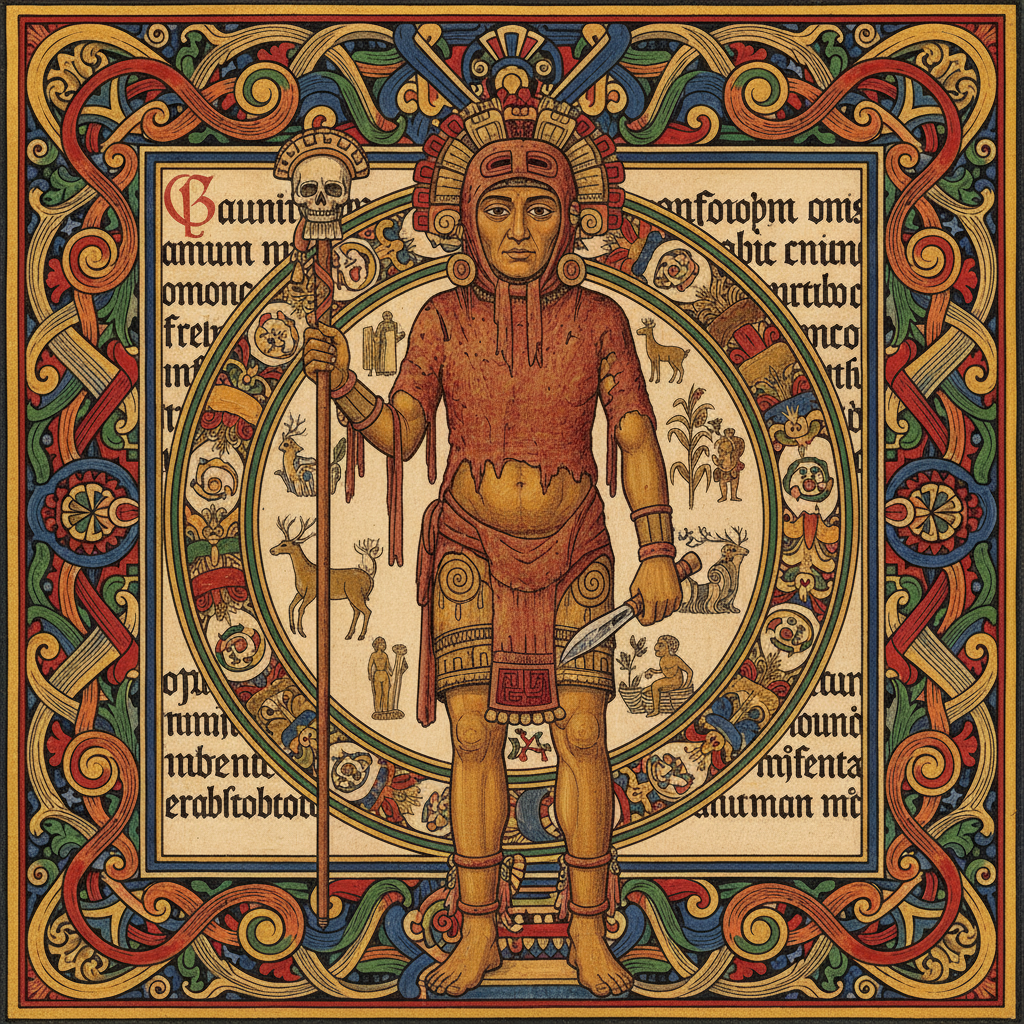
| Aztec (Xipe Totec) | Flaying of captives; priests wear the skins | As corn sheds its husk, the earth sheds winter. Renewal requires the destruction of the old form | Spring arrives; the crops grow; life continues |
The comparison reveals that the Aztec system is not an outlier but an extreme on a spectrum that every tradition occupies. The Hebrew system required the death of thousands of animals annually at the Temple. The Christian system is built on a human sacrifice — the Crucifixion — and the central ritual (the Eucharist) involves the symbolic (or, in Catholic theology, literal) consumption of the sacrificed body and blood. “This is my body, broken for you. This is my blood, shed for you” (Luke 22:19-20). The theological structure is identical to the Aztec structure: a god sheds blood so that humanity may live. The difference is that Christianity claims the sacrifice happened once and need not be repeated, while the Aztec system requires continuous repetition because the sun gets hungry every day.
Was the Aztec sacrificial system morally worse than the European systems of the same period? The Aztecs sacrificed an estimated 20,000 people per year at the height of the empire (some scholars argue much lower; the Spanish had propaganda reasons to inflate the numbers). The Spanish Inquisition, which began in 1478 and operated for over 350 years, tortured and killed thousands. The European witch trials (1450-1750) killed an estimated 40,000-60,000 people. The Thirty Years’ War (1618-1648), fought largely over Christian theological differences, killed an estimated 8 million. The transatlantic slave trade, enthusiastically supported by Christian nations, killed millions.
This is not whataboutism. It is a reminder that “they practiced human sacrifice” has been used for five centuries to justify the destruction of Mesoamerican civilizations, the burning of their books, the suppression of their languages, and the erasure of their theological systems. The Aztecs killed people in the name of keeping the sun alive. The Spanish killed people in the name of saving their souls. Both believed they were performing a cosmic necessity. The difference is that the Spanish won, so their violence was reframed as civilization, and the Aztec violence was reframed as barbarism.
A serious comparative theology must resist this framing. The Aztec sacrificial system was brutal. It was also theologically coherent, cosmologically motivated, and no more violent per capita than the systems that replaced it. Understanding why it existed — the Five Suns, the debt of blood, the fragile universe — is essential for understanding Mesoamerican religion as a complete theological system rather than a catalog of horrors.
Cross-Tradition Parallels
| Mesoamerican Entity | Closest Parallel | Tradition | The Connection |
|---|
| Quetzalcoatl | Christ / King Arthur / Twelfth Imam | Christian / Arthurian / Shia Islam | The departed god/king who promises to return from the east |
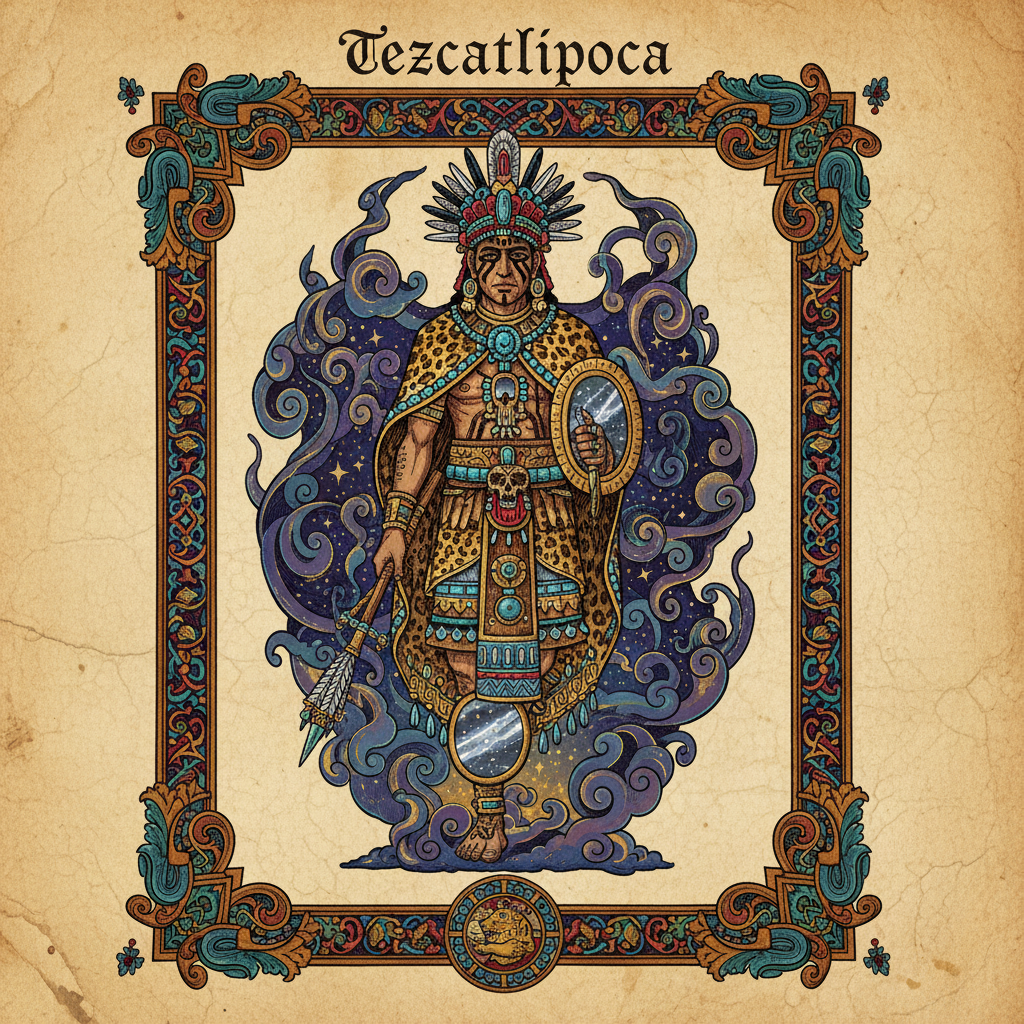
| Tezcatlipoca | Set / Loki | Egyptian / Norse | The necessary adversary who disrupts cosmic order to prevent stagnation |
| Huitzilopochtli | Surya / Ra | Hindu / Egyptian | The sun god who must be sustained through daily ritual |
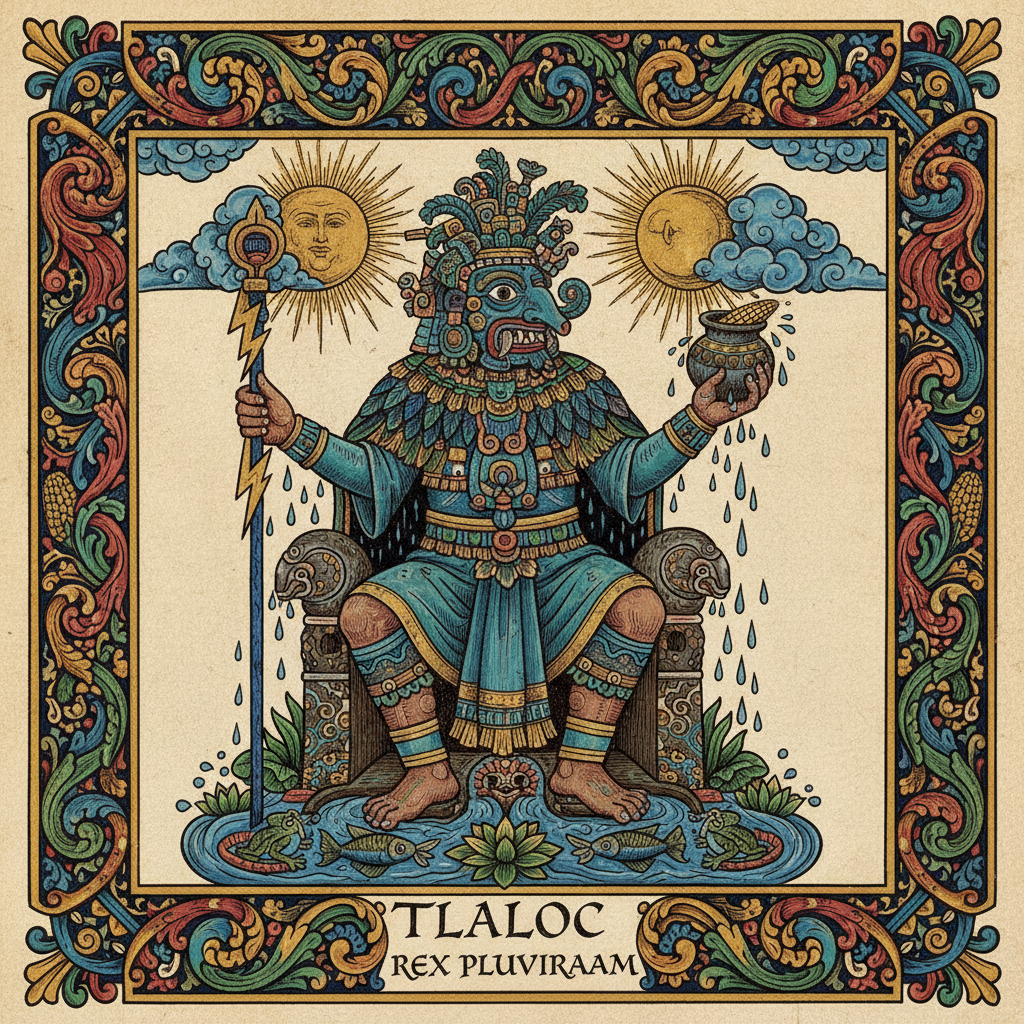
| Tlaloc | Baal / Indra | Canaanite / Vedic | The storm/rain god whose favor is essential for agriculture |
| Mictlantecuhtli | Hades / Yama / Hel | Greek / Hindu / Norse | The neutral lord of the dead who rules without moral judgment |
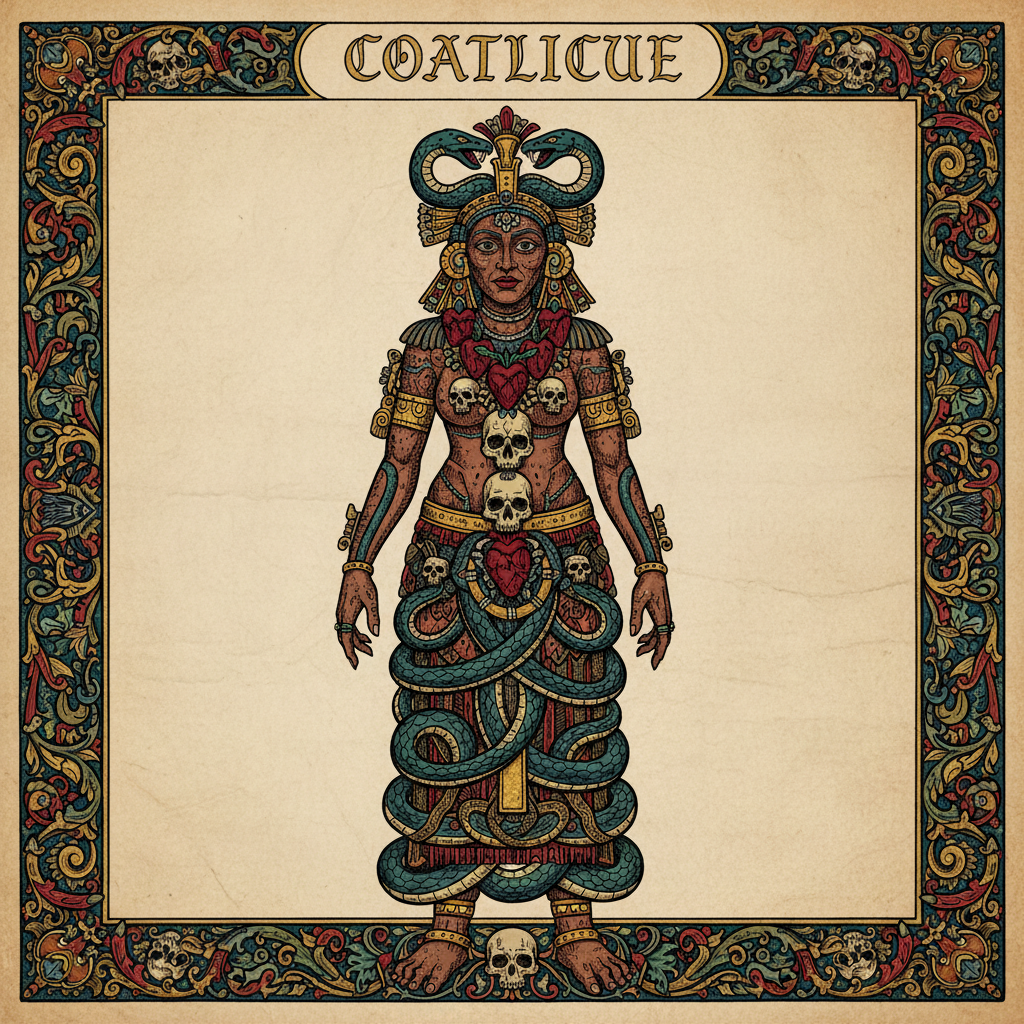
| Coatlicue | Kali | Hindu | The terrifying earth mother whose iconography embraces both creation and destruction |
| Xipe Totec | Osiris / Christ | Egyptian / Christian | The dying-and-rising god whose death enables renewal |
| Kukulkan | Quetzalcoatl / Naga | Aztec / Hindu-Buddhist | The feathered/cosmic serpent uniting earth and sky |
| Itzamna | Thoth / Odin | Egyptian / Norse | The old, wise creator god who invents writing and grants knowledge |
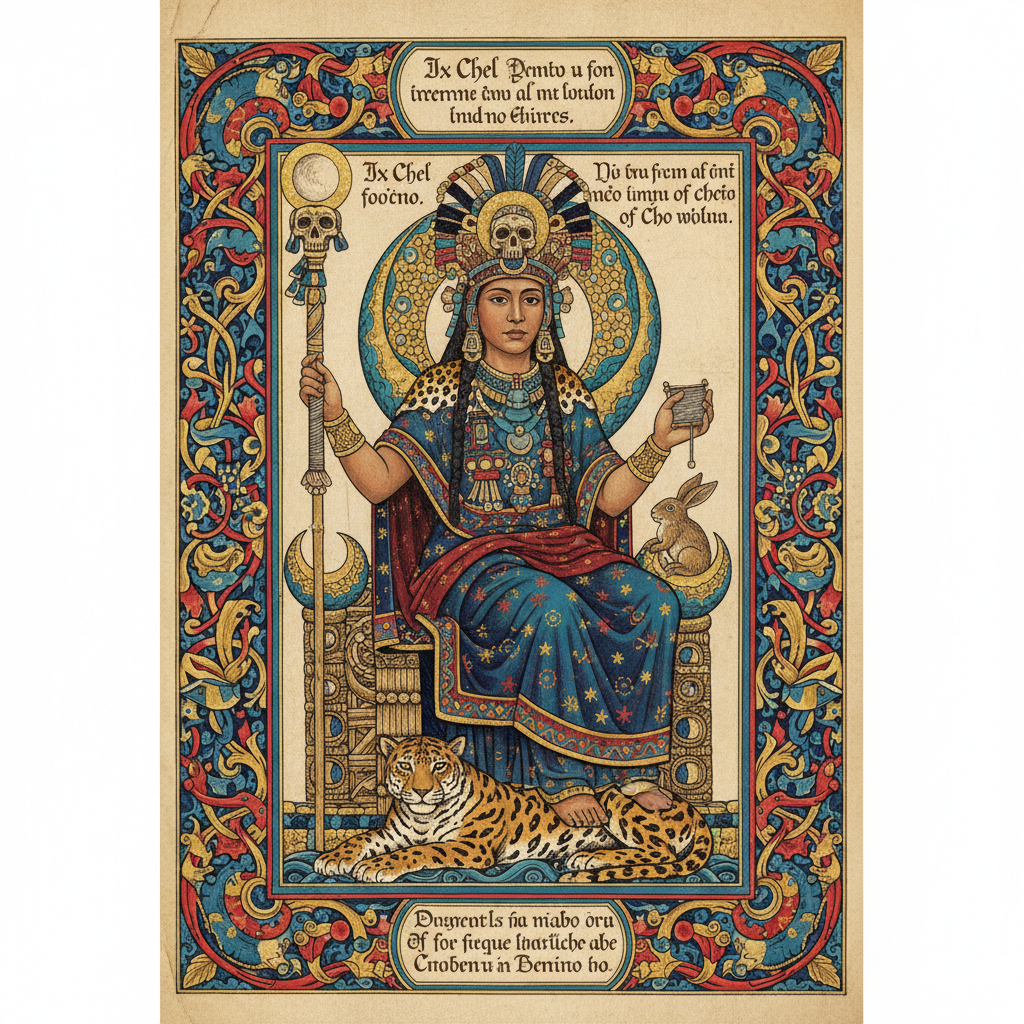
| Ix Chel | Artemis-Hecate / Shakti | Greek / Hindu | The dual-aspect moon goddess, maiden and crone, healer and destroyer |
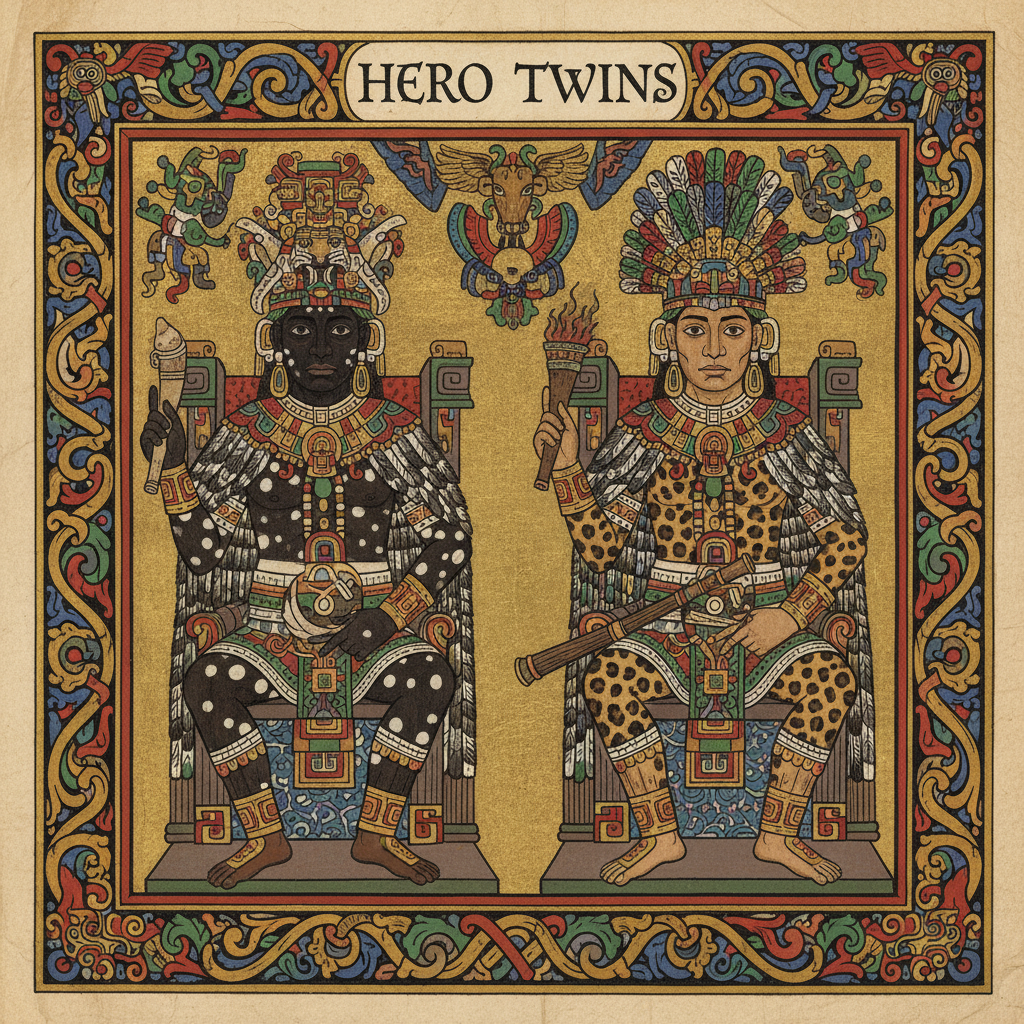
| Hero Twins | Christ (Harrowing of Hell) / Orpheus | Christian / Greek | Descent to the underworld to defeat the powers of death |
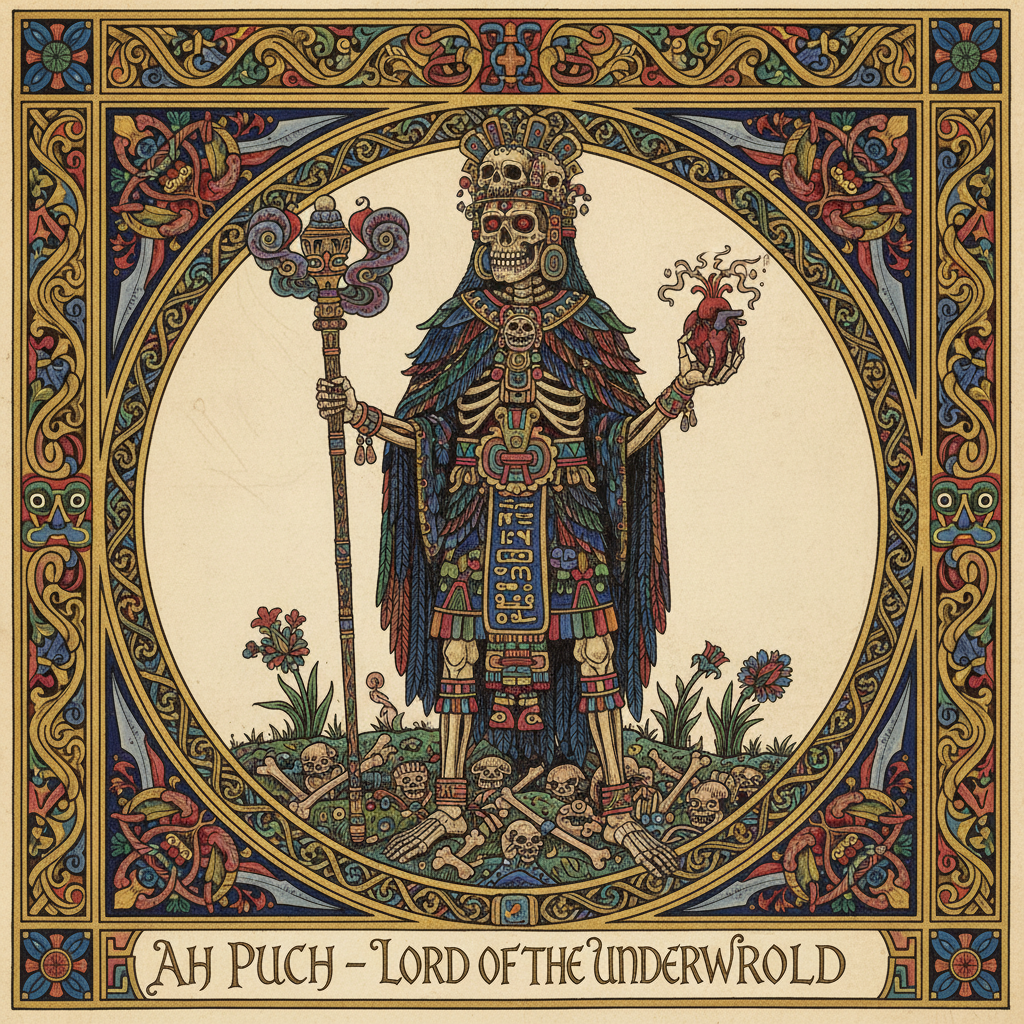
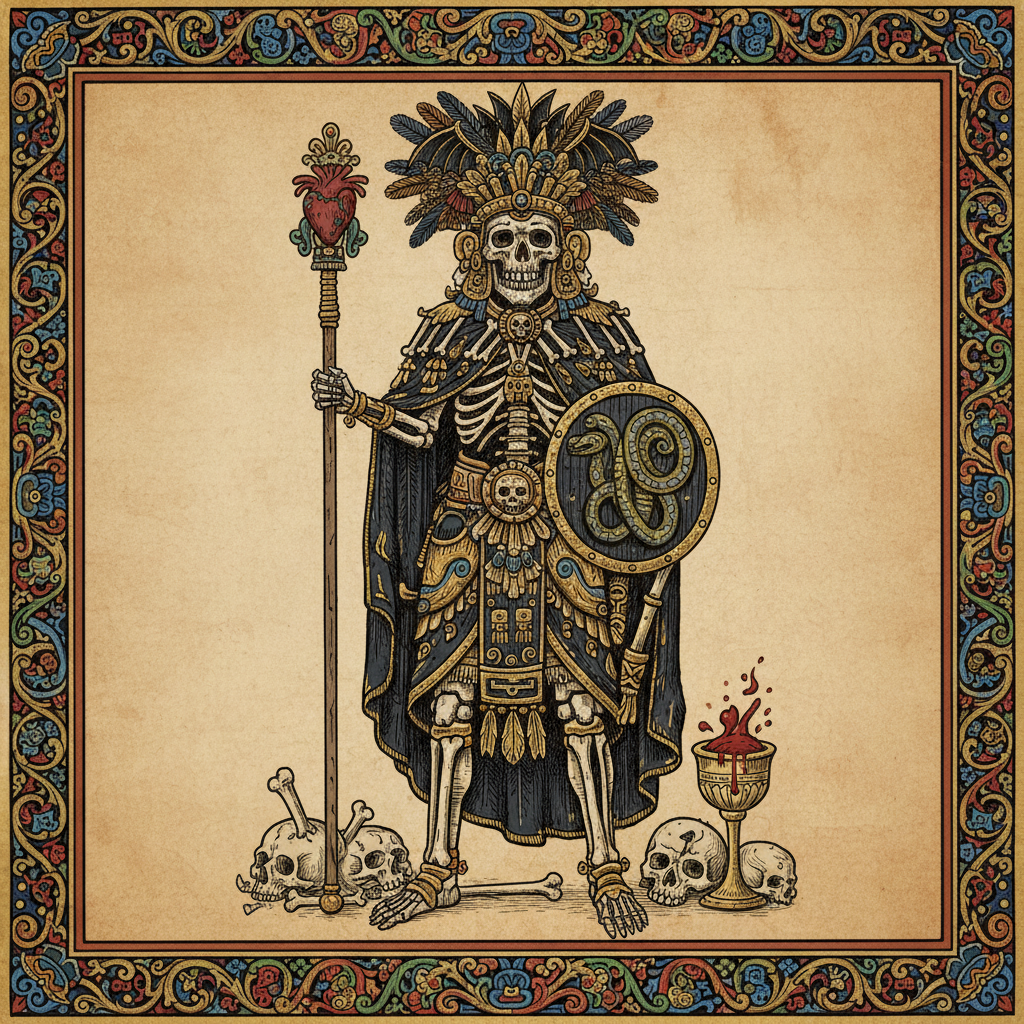
| Ah Puch | Anubis / Grim Reaper | Egyptian / European | Death personified as a hunter of the dying |
| Hun Hunahpu | Osiris / the Corn King | Egyptian / Frazer | The sacrificed father/god who dies, is buried, and rises as grain |
| The Fifth Sun | Hindu Yugas / Hopi Worlds / Buddhist Kalpas | Hindu / Hopi / Buddhist | Cyclical creation-destruction cosmology vs. linear Abrahamic time |
Sources & Further Reading
| Source | Focus | Notes |
|---|
| Popol Vuh (trans. Christenson, 2007; trans. Tedlock, 1996) | K’iche’ Maya creation epic — the Hero Twins, the creation of humanity from corn, the structure of the cosmos | The single most important text in Mesoamerican literature. Multiple translations exist; Christenson’s is the most complete |
| Florentine Codex (Sahagun, compiled 1545-1590) | Encyclopedic record of Aztec culture, religion, and daily life, compiled by Franciscan friar Bernardino de Sahagun with Nahua informants | The most comprehensive primary source on Aztec religion. Twelve books covering gods, ceremonies, rhetoric, history, and natural history |
| Duran, Diego. Book of the Gods and Rites and the Ancient Calendar (1574-1576) | Dominican friar’s detailed account of Aztec religious ceremonies and calendar | Invaluable eyewitness accounts of ceremonies; Duran’s Nahua ancestry gave him unusual access |
| Coe, Michael D. The Maya (multiple editions, most recent 2011) | Comprehensive overview of Maya civilization | The standard introductory text on Maya archaeology and culture |
| Carrasco, David. City of Sacrifice: The Aztec Empire and the Role of Violence in Civilization (1999) | Analysis of the theological and political functions of Aztec sacrifice | Essential for understanding why the sacrificial system existed |
| Carrasco, David. Quetzalcoatl and the Irony of Empire (2000) | The Quetzalcoatl figure across Mesoamerican history | Traces the feathered serpent from Teotihuacan through the Aztec period |
| Leon-Portilla, Miguel. Aztec Thought and Culture (1963) | Nahuatl philosophy, poetry, and intellectual tradition | The foundational text for understanding Aztec religion as philosophy, not just myth |
| Restall, Matthew. When Montezuma Met Cortes (2018) | Revisionist account of the Spanish conquest | Challenges the “Quetzalcoatl return” narrative and other colonial mythologies |
| Schele, Linda & David Freidel. A Forest of Kings (1990) | Maya political and religious history decoded through hieroglyphic inscriptions | Groundbreaking work that transformed understanding of Maya kingship and ritual |
| Taube, Karl. The Major Gods of Ancient Yucatan (1992) | Systematic analysis of Maya deities from the codices | The standard reference for Maya deity identification |
| Matos Moctezuma, Eduardo. Death and the Afterlife in Ancient Mexico (various) | Aztec concepts of death, the underworld, and the afterlife | Leading Mexican archaeologist’s analysis of Aztec funerary theology |
| Olivier, Guilhem. Mockeries and Metamorphoses of an Aztec God: Tezcatlipoca (2003) | Comprehensive study of Tezcatlipoca | The definitive academic work on the Smoking Mirror |
| Milbrath, Susan. Star Gods of the Maya (1999) | Maya astronomical knowledge and its theological significance | Connects Maya gods to celestial observations |
| Codex Mendoza (transcribed & annotated 16th century) | Aztec tribute records, customs, calendar, and genealogy | Named after Viceroy Mendoza; compiled by Spanish with Aztec informants; visual record of Tenochtitlan |
| Codex Borbonicus (compiled ~1500s) | Aztec ritual calendar and ceremonial practices | One of the few surviving pre-Hispanic codices; extensively illustrated |
| Bernardino de Sahagún. Florentine Codex: General History of the Things of New Spain (Spanish/Nahuatl, 1545-1590) | Comprehensive encyclopedic record of Aztec culture | Compiled with Nahua informants; most authoritative primary source on Aztec religion and cosmology |
| Bernal Díaz del Castillo. The True History of the Conquest of New Spain (published 1568) | Eyewitness account of Spanish conquest | Firsthand narrative from a soldier in Cortés’ army; crucial for understanding the conquest |
The entities in this file are not relics. Maya ceremonialism is practiced today throughout Guatemala, the Yucatan, and Belize. Maya day-keepers maintain the 260-day sacred calendar in unbroken continuity. Aztec reconstructionist movements are growing in Mexico and among diaspora communities. The Day of the Dead is not a quaint folk festival — it is a living Mesoamerican theology of death wrapped in a thin Catholic shell. When a family places pan de muerto on an altar and addresses their dead grandmother by name, expecting her to return and eat, they are practicing a pre-Columbian faith that survived the Inquisition, the destruction of the codices, and five centuries of colonial suppression. The feathered serpent still descends the pyramid at Chichen Itza every equinox, on schedule, as it has for over a thousand years. The traditions endure.

 LEGENDARY
  LEGENDARY
  MYTHIC
  RARE
RARE 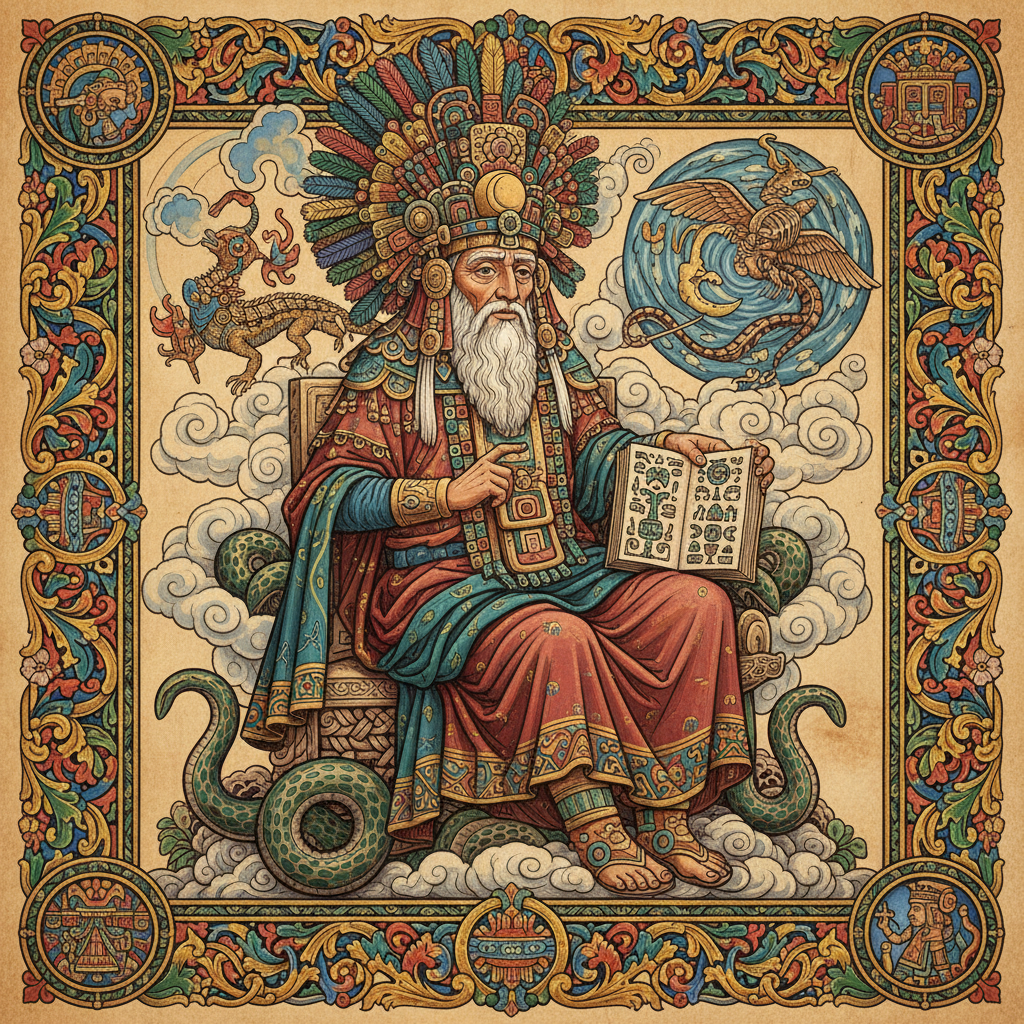 MYTHIC
  LEGENDARY
  LEGENDARY
  MYTHIC
  LEGENDARY
  LEGENDARY