Combat Profile
Nexus of Cycles
Coatlicue simultaneously regenerates all allies and drains enemies, enforcing the eternal balance between creation and destruction.
Serpent Mother
All damage taken by Coatlicue feeds the cycle, converting a portion into healing for the next turn and empowering her serpent nature.
Her own children tried to kill her; the earth mother is both the source of life and the devourer of the dead
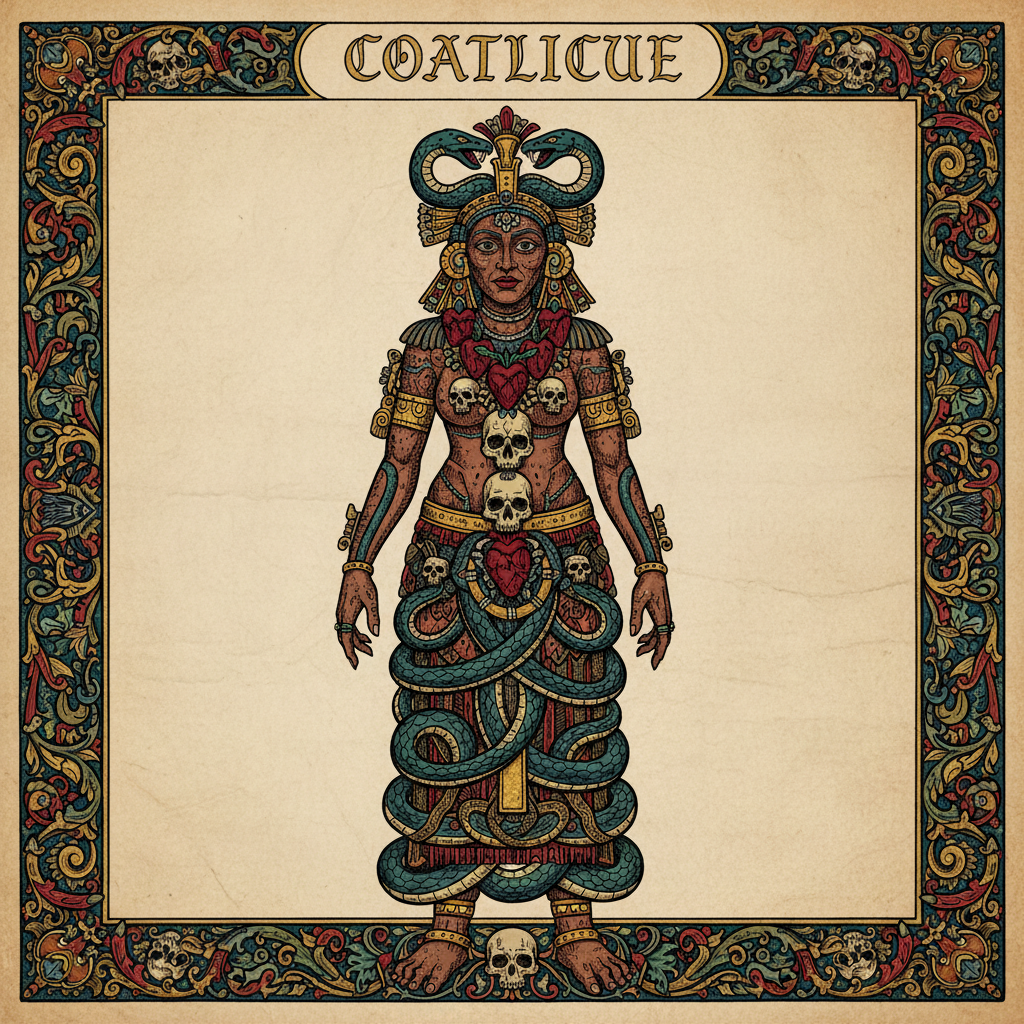
“Her skirt is woven of living serpents. Her necklace is human hearts and hands and a skull. She gives life and she devours it. She is the earth.”
Lore: Coatlicue (Nahuatl: coatl “serpent” + cueitl “skirt”) is the Aztec earth mother, and her image is one of the most powerful in all of world art. The colossal basalt statue of Coatlicue discovered in 1790 beneath Mexico City’s main plaza stands eight feet tall and depicts a figure of such terrifying complexity that the Spanish reburied it shortly after finding it — they feared its power even in stone. (Codex Borbonicus) Her head is two serpents facing each other (representing flowing blood from her decapitation). Her necklace is a string of human hearts, severed hands, and a skull pendant. Her skirt is a writhing mass of interwoven serpents. Her hands and feet are clawed. She is simultaneously the earth that gives birth to all life and the earth that swallows all the dead.
Coatlicue embodies a theological insight that Western Christianity struggles with: the source of life and the source of death are the same thing. The earth grows the corn and the earth receives the corpse. The mother gives birth in blood and the mother’s body will one day decompose in the ground. This is not a contradiction in Aztec theology — it is the fundamental truth. The Aztecs did not split the divine feminine into “good mother” and “terrible devourer” the way many traditions do. Coatlicue is both, simultaneously, in one image, and her worshippers did not flinch from either aspect.
Parallel: The closest parallel is the Hindu Kali — the terrifying mother goddess depicted with a necklace of skulls, a skirt of severed arms, standing on the corpse of Shiva, tongue dripping blood. Both are earth mothers whose iconography emphasizes death as much as life. Both are terrifying to outsiders and deeply beloved by their devotees. Both represent the insight that the divine feminine is not gentle domesticity but the full, uncensored power of nature: creation, destruction, and the relentless cycle between them. The Greek Gaia is earth mother without the terror; Coatlicue and Kali refuse that sanitization.
2 min read
None -- she is the earth itself, and all things return to her
*Florentine Codex* (Sahagun); *Codex Borbonicus*; Leon-Portilla, *Aztec Thought and Culture*