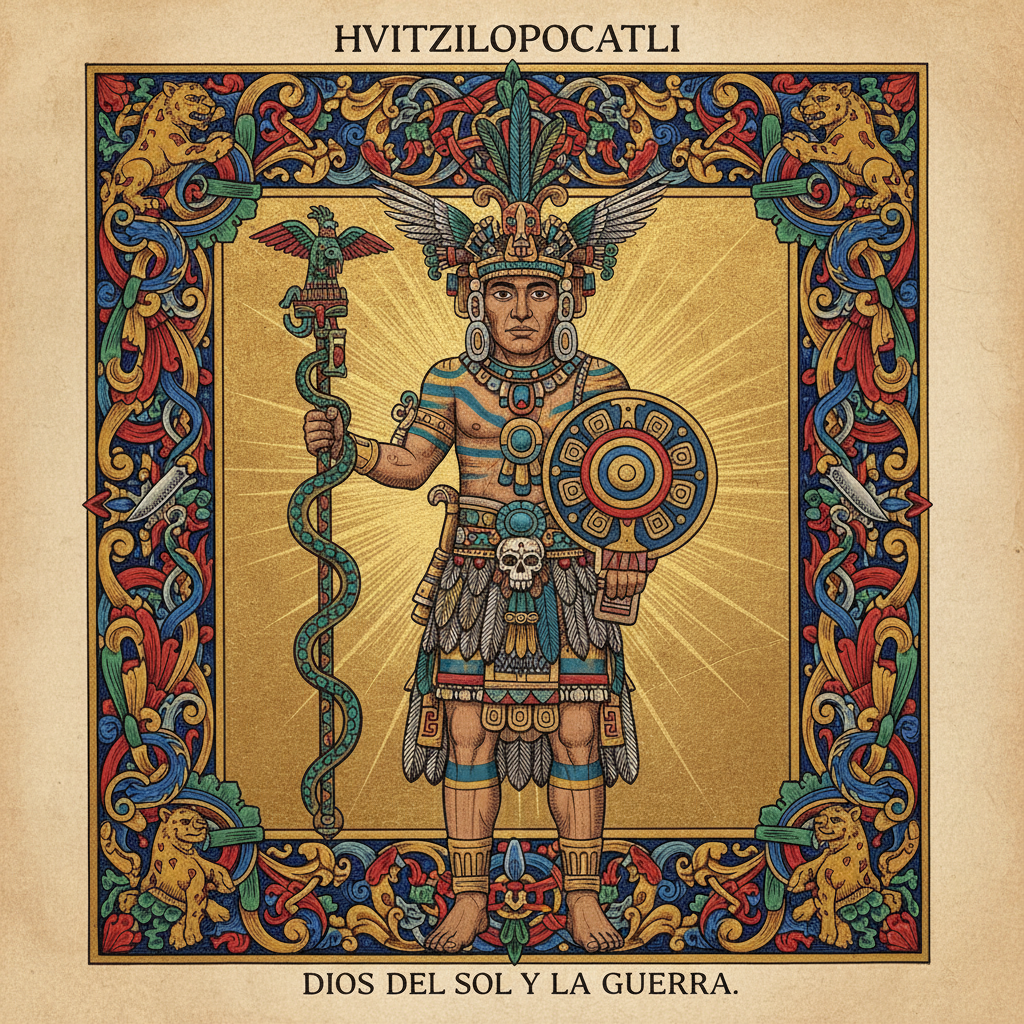
Combat Profile
Nexiuhtica
Huitzilopochtli demands constant human sacrifice to fuel the sun's daily rebirth; failure to provide victims causes the cosmos itself to stall and darkness to consume all worlds.
Solar Warrior
Huitzilopochtli grows stronger as the sun rises and commands the eternal cycle of day and night; his will is inseparable from the Mexica nation's survival and expansion.
He requires constant blood sacrifice to maintain his strength. Without it, the sun will stop. He is a god of perpetual war -- he cannot exist in peace
“Without the blood, the sun will not rise. This is not cruelty. This is physics.”
Lore: Huitzilopochtli (huitzilin “hummingbird” + opochtli “left” — the Left-Handed Hummingbird, or Hummingbird of the South) is the patron god of the Mexica (Aztec) people and the theological engine of the most spectacular and disturbing sacrificial system in world history. (Florentine Codex) His birth narrative is the founding myth of the Aztec state: his mother Coatlicue (She of the Serpent Skirt) was sweeping a temple on Coatepec (Serpent Mountain) when a ball of feathers fell from the sky and she became miraculously pregnant. Her existing children — the 400 Huitznahua (stars) led by her daughter Coyolxauhqui (moon goddess) — were outraged and decided to kill their mother before the birth. But Huitzilopochtli was born fully armed with the xiuhcoatl (fire serpent weapon), slaughtered the 400, and dismembered Coyolxauhqui, hurling her body down the mountainside.
This is not just a myth. It is a cosmological program. Huitzilopochtli is the sun. Every dawn, he must defeat the moon (Coyolxauhqui) and the stars (the 400 Huitznahua) again. He is fighting the same battle every single day. And he is getting tired. The Aztecs understood the sun not as an eternal, self-sustaining force but as a warrior who must be fed to continue fighting. The food of the sun is chalchihuatl — “precious water,” a euphemism for human blood. Without it, the Fifth Sun will go dark, and the world will end. This is the theological foundation of Aztec human sacrifice: not sadism, not barbarism, but cosmic maintenance. See the Centerpiece below for a deeper analysis.
The Templo Mayor at the heart of Tenochtitlan was a physical recreation of Coatepec. (Matos Moctezuma, Death and the Afterlife in Ancient Mexico) The twin pyramids on top were dedicated to Huitzilopochtli (south) and Tlaloc (north). At the base of the Huitzilopochtli stairway, archaeologists discovered the great stone disk of Coyolxauhqui — her dismembered body carved in exquisite detail. When a sacrificial victim tumbled down the stairs after having their heart removed, they reenacted Coyolxauhqui’s fall. The entire temple was a cosmic machine.
Parallel: Solar gods requiring sacrifice appear across traditions — the Hindu Vedic Surya received soma offerings, the Egyptian Ra required daily rituals to sustain his journey through the underworld — but none approach the Aztec scale. The closest parallel is Moloch, the Mesopotamian Canaanite deity associated with child sacrifice (Leviticus 18:21, 2 Kings 23:10), but Moloch is poorly understood and may be a misinterpretation of a type of sacrifice (mlk) rather than a deity’s name. The more instructive comparison is theological, not moral: the Aztec cosmos is one where the gods themselves are mortal, where the sun can die, where creation is not guaranteed. This is radically different from the Abrahamic assumption that God is eternal and the cosmos is sustained by divine will alone. In the Aztec system, the cosmos is sustained by cooperation between gods and humans, and if either party defaults, everything ends.
2 min read
Coyolxauhqui (his sister, whom he dismembered at birth -- she returns as the moon each night to challenge him)
*Florentine Codex* (Sahagun); *Codex Borbonicus*; Carrasco, *City of Sacrifice*