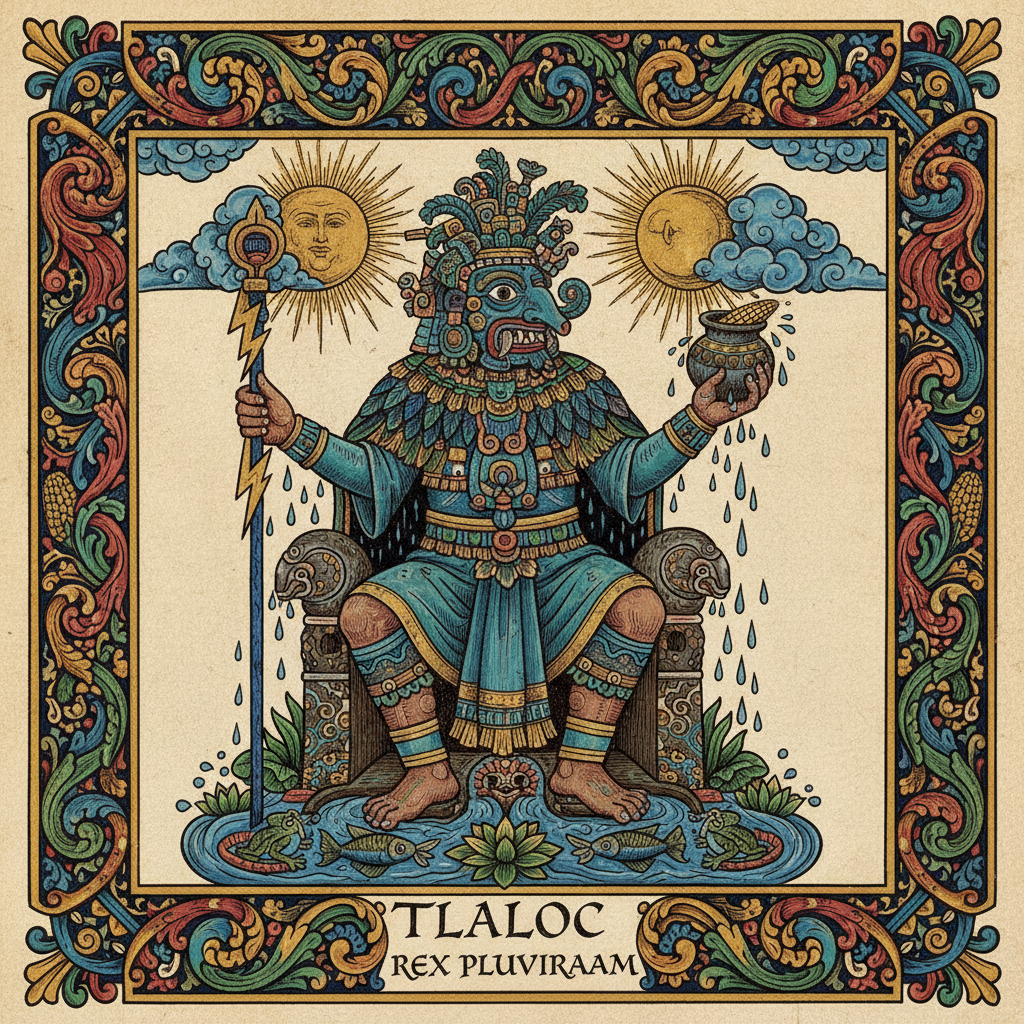
Combat Profile
Tlaloc's Deluge
Summons catastrophic rains and floods that devastate the land, demanding sacrifice to restore fertility.
Divine Moisture
Tlaloc's presence warps weather itself; crops flourish or wither at his whim, and lightning crackles at his command.
His paradise (Tlalocan) is reserved for those who die by water, lightning, or drowning -- he does not judge morally, only by manner of death
“The children must weep. Their tears call the rain.”
Lore: Tlaloc (possibly from tlalli “earth” + oc “surface” — “He who is made of earth”) is the rain god, recognizable by his distinctive goggle eyes and fanged mouth — one of the oldest continuous deity images in Mesoamerica, appearing in Teotihuacan murals (100-600 CE) over a thousand years before the Aztecs. His worship involved the sacrifice of children, specifically because their tears were believed to be sympathetic magic for rain. (Duran, Book of the Gods and Rites) The Spanish friar Diego Duran recorded that children were selected, adorned in paper streamers representing water, and carried in litters to mountaintop shrines while they wept. The priests wanted them to weep. If they did not weep enough, more painful measures were applied. The theological logic is brutal but internally consistent: tears are water; water from the eyes of the innocent calls water from the sky; the crops grow; the people live.
Tlaloc’s realm, Tlalocan, was a paradise of eternal green — a garden of abundance reserved not for the morally virtuous but for those who died in ways associated with water: drowning, lightning strike, certain diseases associated with moisture (dropsy, gout). This is a radically different afterlife theology from the Abrahamic model, where moral behavior determines destination. In the Aztec system, how you die matters more than how you live. Warriors who die in battle go to accompany the sun. Women who die in childbirth (considered a form of combat) go to the western sky. Those killed by water go to Tlalocan. Everyone else descends to Mictlan. The universe sorts the dead by their manner of death, not their ethical record.
Parallel: Rain gods demanding sacrifice appear across the ancient Near East: Baal (Canaanite) is the most direct parallel — a storm god whose worship involved practices the biblical authors condemned alongside Moloch worship. Hindu Indra is the warrior-storm god who slays Vritra to release the waters. But the child sacrifice dimension makes Tlaloc uniquely disturbing to modern sensibilities. The parallel is not to gentle rain gods but to the darkest corner of Leviticus: “Do not give any of your children to be sacrificed to Molek” (Leviticus 18:21). The Israelite prohibition exists precisely because the practice existed — the Hebrew prophets were not condemning something foreign but something their own neighbors (and possibly their own people) were doing.
2 min read
Drought -- without human propitiation, he withholds rain and the crops fail
*Florentine Codex* (Sahagun); *Codex Borgia*; Lopez Austin, *Tamoanchan, Tlalocan*