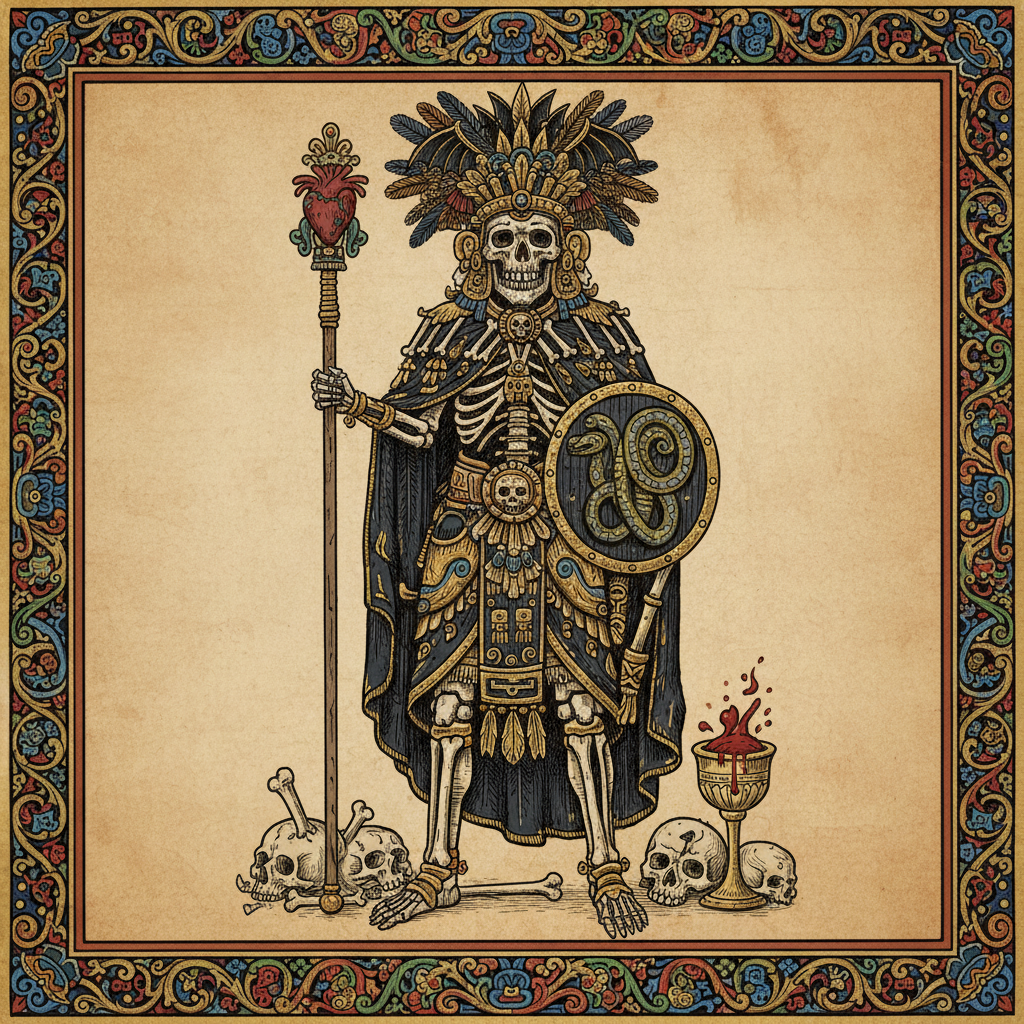
Combat Profile
Ossuary Ascension
summons skeletal warriors from the bones of the fallen and compels spirits to serve his underworld dominion
Lord of Mictlan
all death magic within his presence grows stronger and mortal souls cannot escape his inexorable pull toward the underworld
Not malevolent -- he simply *is*. He guards the dead but cannot prevent heroes from entering his realm and stealing from him
“We all go to Mictlan. Warriors, kings, slaves, children. In the end, the bones are all the same.”
Lore: Mictlantecuhtli is the lord of Mictlan, the land of the dead, depicted as a skeletal figure with a necklace of human eyeballs and a headdress of owl feathers, often shown with his jaw open and his liver exposed. (Florentine Codex) He rules alongside his wife Mictecacihuatl, the Lady of the Dead — who is the origin figure behind the modern Dia de los Muertos celebration and the iconic La Catrina skeleton image. Together they preside over the ninth and deepest layer of the underworld, which the ordinary dead must reach through a four-year journey of trials: crossing a river with a dog companion, passing between clashing mountains, navigating a field of obsidian knives, enduring freezing winds, and being stripped of flesh. Only after these ordeals does the soul reach Mictlan and find rest — not punishment, not reward, simply cessation.
The Aztec underworld is fundamentally different from both the Christian Hell and the Greek Hades. It is not a place of punishment for sin. Mictlantecuhtli does not judge. Almost everyone goes to Mictlan regardless of moral behavior — only those who die specific deaths (battle, childbirth, drowning, sacrifice) are diverted elsewhere. The journey through Mictlan’s nine levels is arduous but not punitive; it is simply the process of dying completely, of being stripped of everything earthly until only the essence remains. This is closer to the Buddhist concept of dissolution after death or the Egyptian Duat (underworld journey) than to the Abrahamic heaven/hell binary.
Parallel: Lords of the dead appear in virtually every tradition: Hades (Greek), Yama (Hindu/Buddhist), Hel (Norse), Osiris (Egyptian), Ereshkigal (Mesopotamian). Mictlantecuhtli is closest to Hades in function — a ruler of the underworld who is not evil, not a punisher, simply the custodian of the inevitable. But the Quetzalcoatl-in-Mictlan narrative resonates most powerfully with the Christian Harrowing of Hell: Christ descends to the realm of the dead between the Crucifixion and Resurrection, breaks open the gates, and liberates the righteous dead (1 Peter 3:19, the Apostles’ Creed: “He descended into hell”). Quetzalcoatl descends to Mictlan, outwits the Lord of the Dead, and retrieves the bones to create new life. Both are dying-and-rising gods who enter death’s domain and return with salvific cargo. The structure is identical.
2 min read
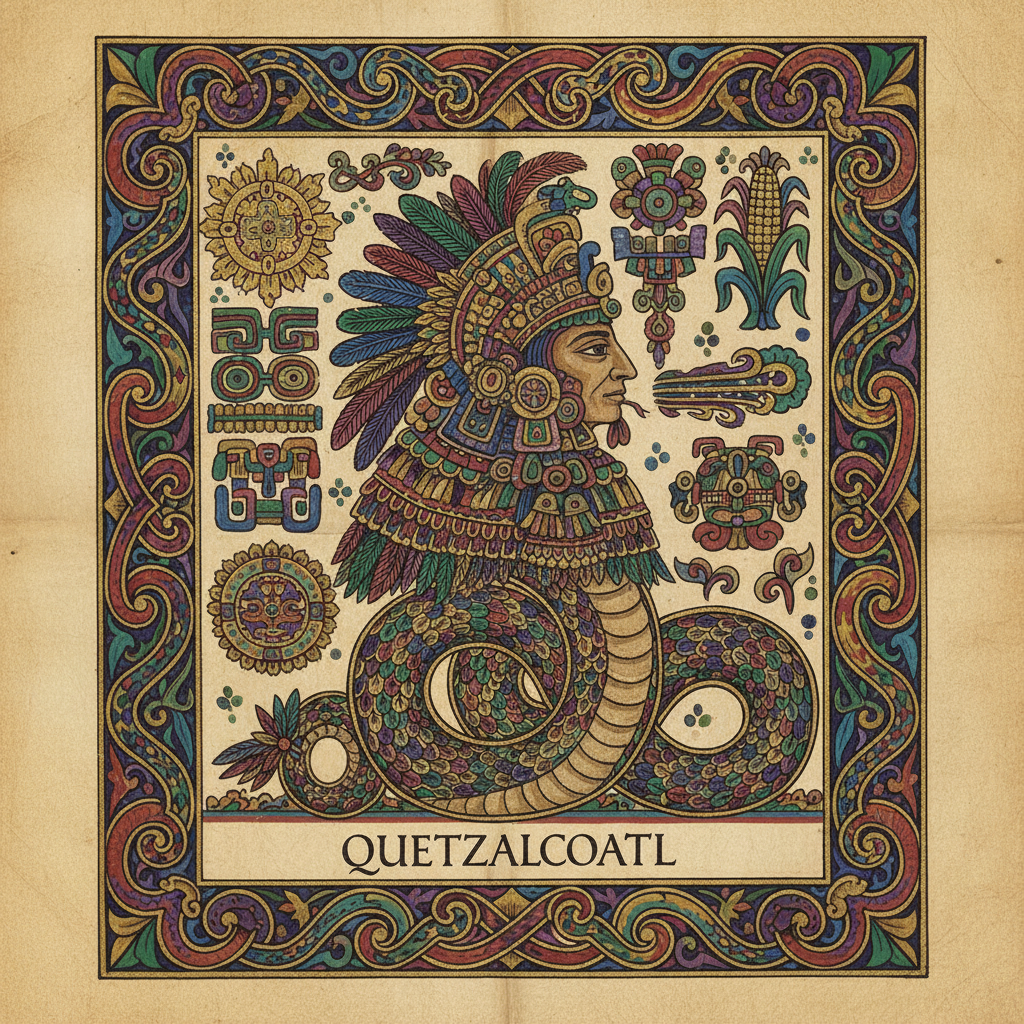
Quetzalcoatl (who descended to Mictlan, outwitted Mictlantecuhtli, and stole the bones of the dead to create new humanity)
*Florentine Codex* (Sahagun); *Legend of the Suns*; Matos Moctezuma, *Death and the Afterlife in Ancient Mexico*