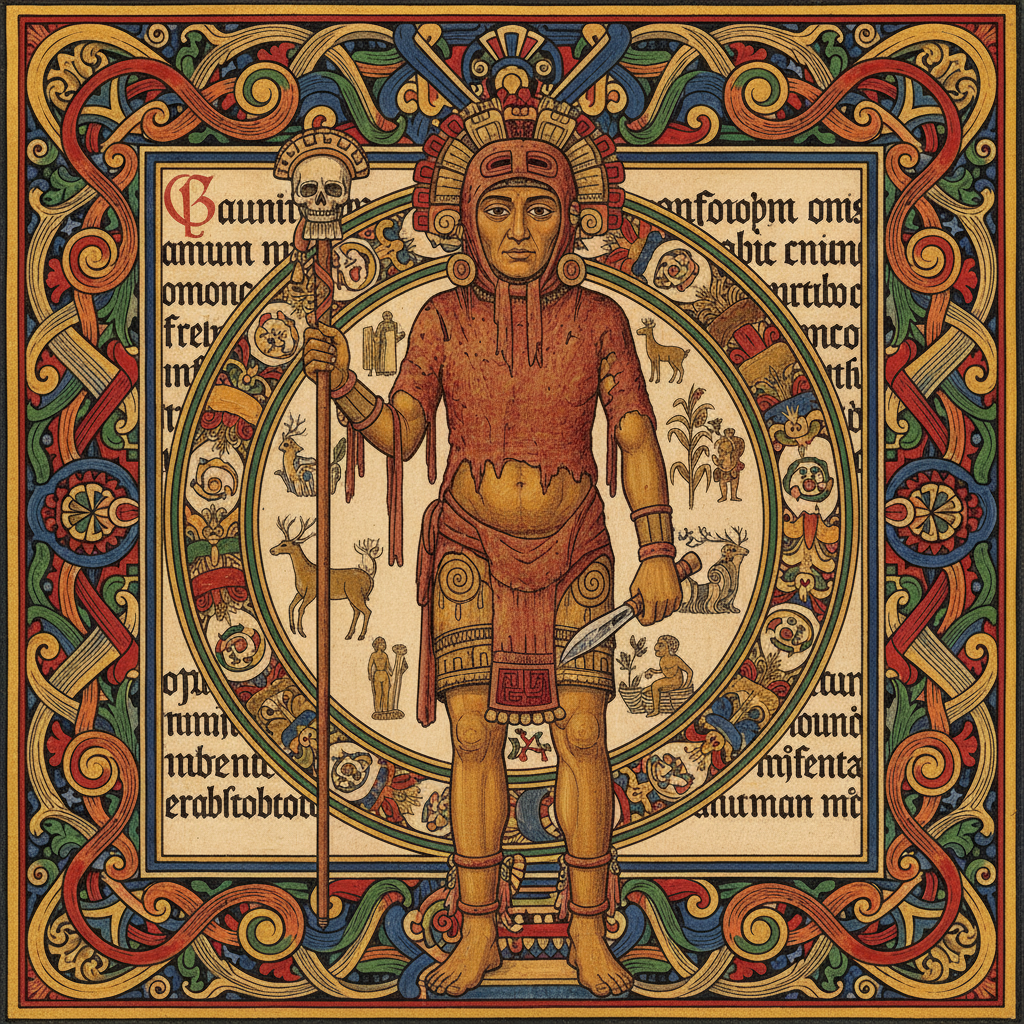
Combat Profile
Xipe's Flaying
Xipe strips away disease and decay from the land, causing a season of explosive agricultural renewal that heals all allies and purges corruption.
Golden Transformation
Xipe continuously cycles through states of renewal and sacrifice, gaining increased power during spring seasons and bestowing fertility upon those who honor him.
His renewal requires absolute destruction of the old form -- the skin must be torn away completely before new growth can emerge
“The seed cannot grow while the husk still covers it. The spring cannot come while the old skin clings. Something must be torn away.”
Lore: Xipe Totec (xipehua “to flay” + totec “our lord”) is perhaps the most viscerally disturbing deity in any world mythology — and simultaneously one of the most theologically profound. He is the god of spring, of agricultural renewal, of the moment when the dry husk splits and green life emerges. (Florentine Codex) His central ritual, the festival of Tlacaxipehualiztli (“The Flaying of Men”), involved sacrificing captive warriors and flaying their skins, which priests then wore for twenty days. As the skin slowly rotted and fell away from the priest’s body, it represented the earth shedding its dead winter surface to reveal the new growth of spring beneath.
The symbolism is layered and deliberate. Corn (maize) is the foundational crop of Mesoamerican civilization — the Popol Vuh literally says humanity was made from corn. Corn grows inside a husk that must be peeled away. Seeds germinate by splitting their outer casing. Snakes shed their skin and emerge renewed. Xipe Totec takes this agricultural observation and extends it to its logical theological extreme: all renewal requires the destruction of the old form. You cannot have spring without the death of winter. You cannot have new growth without the decomposition of the old. And so the god of spring is the god of flaying, because the two concepts are, in Aztec theology, identical.
Parallel: Dying-and-rising gods are among the most universal archetypes in world mythology: Osiris (Egyptian), Tammuz/Dumuzi (Mesopotamian), Adonis (Greek), Baldur (Norse), and of course Christ. What distinguishes Xipe Totec is the gruesome literalism of the “dying” phase. Where Osiris is murdered and reassembled, where Christ is crucified and resurrected, Xipe Totec is flayed — the most visceral possible metaphor for transformation through suffering. The Christian parallel is closer than it might appear: “Unless a grain of wheat falls to the ground and dies, it remains only a single seed. But if it dies, it produces many seeds” (John 12:24). Christ’s metaphor for his own death and resurrection is an agricultural metaphor — exactly the same logic that drives the worship of Xipe Totec. The difference is one of degree, not of kind.
2 min read
The passage of time itself -- the flayed skin eventually rots and falls away, revealing new growth beneath
*Florentine Codex* (Sahagun); *Codex Borgia*; Duran, *Book of the Gods and Rites*