The Ball Game at the Heart of Xibalba
Mythic time / K'iche' Maya oral tradition, written c. 1554-1558 CE · Xibalba — the K'iche' Maya underworld, and the ball court at its heart
Contents
Hunahpu and Xbalanque descend to Xibalba to play the ball game against the Lords of Death — using their father's skull as the ball. They survive six houses of torment, lose Hunahpu's head to a bat, replace it with a squash, and finally die into the river and rise again to unmake the gods of decay.
- When
- Mythic time / K'iche' Maya oral tradition, written c. 1554-1558 CE
- Where
- Xibalba — the K'iche' Maya underworld, and the ball court at its heart
The ball is their father.
Not a symbol of their father. Not a stand-in, a token, a ritual substitution. The rubber ball that the Lords of Xibalba have provided for this morning’s game is the skull of One Hunahpu, the Twins’ father, wrapped in black-stained rubber and smoothed to roundness over years of ceremonial use. The Lords had hung the skull in the fork of the calabash tree at the road-fork as a warning to travelers. It spat into the hand of a girl named Blood Moon, and she fled to the upper world with the Twins growing inside her. Now the Twins stand at the stone edge of the court in the heart of the underworld, and the Lords of Xibalba are rolling the skull toward them across the painted floor, and everything that follows is played with the instrument of their grief.
This is the game their father could not win. This is the game that killed him.
They bounce the ball once, says Hunahpu, and catches it on his knee.
The descent had been methodical. The Twins are not their father — their father was summoned and went down innocent, hopeful, still believing the Lords wanted a game and not a death. The Twins carry the knowledge of what happened in their bones. They send a mosquito ahead through the four-colored crossroads to bite every lord on the council bench in sequence, drawing from each one the cry that tells his name. When they walk into the council house they name every Lord of Xibalba on the first pass — One Death, Seven Death, Scab Stripper, Blood Gatherer, Demon of Pus, Demon of Jaundice, Bone Scepter, Skull Scepter, Trash Master, Stab Master, Wing, Packstrap — and the silence that falls over the long bench is the silence of a trap that has just found itself outrun.
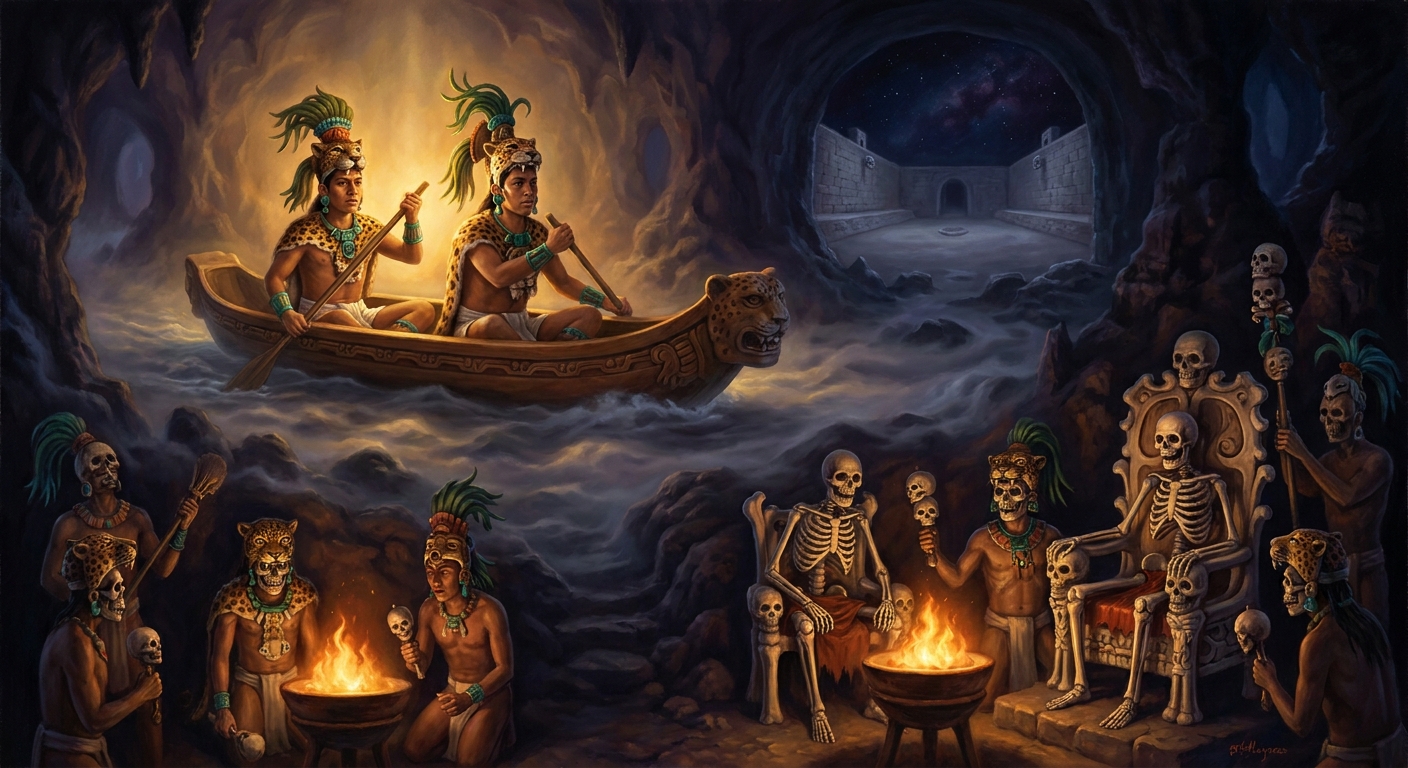
The six houses are the next instrument. Dark House, Razor House, Cold House, Jaguar House, Fire House, Bat House. In each one the Twins do the thing the house does not expect: they speak to the knives and the knives listen; they burn pine cones against the cold; they feed bones to the jaguars; they pass through fire without burning. The houses are built on the assumption that the body will panic and submit. The Twins treat each house as a negotiation.
Bat House is different. In Bat House, Camazotz rules — the great leather-winged lord, the decapitator bat of Xibalba, whose name means simply Death Bat because some names are just their function. The Twins sleep inside their blowguns, standing upright, safe behind the narrow tubes until the first gray light seeps under the door. Hunahpu turns to check whether dawn has come. His head comes out of the blowgun by a finger’s width. That is all Camazotz needs. He drops from the ceiling and takes the head in a single pass, clean as a knife through fruit.
The Lords carry the head to the court and hang it above the goal ring. Tomorrow’s ball.
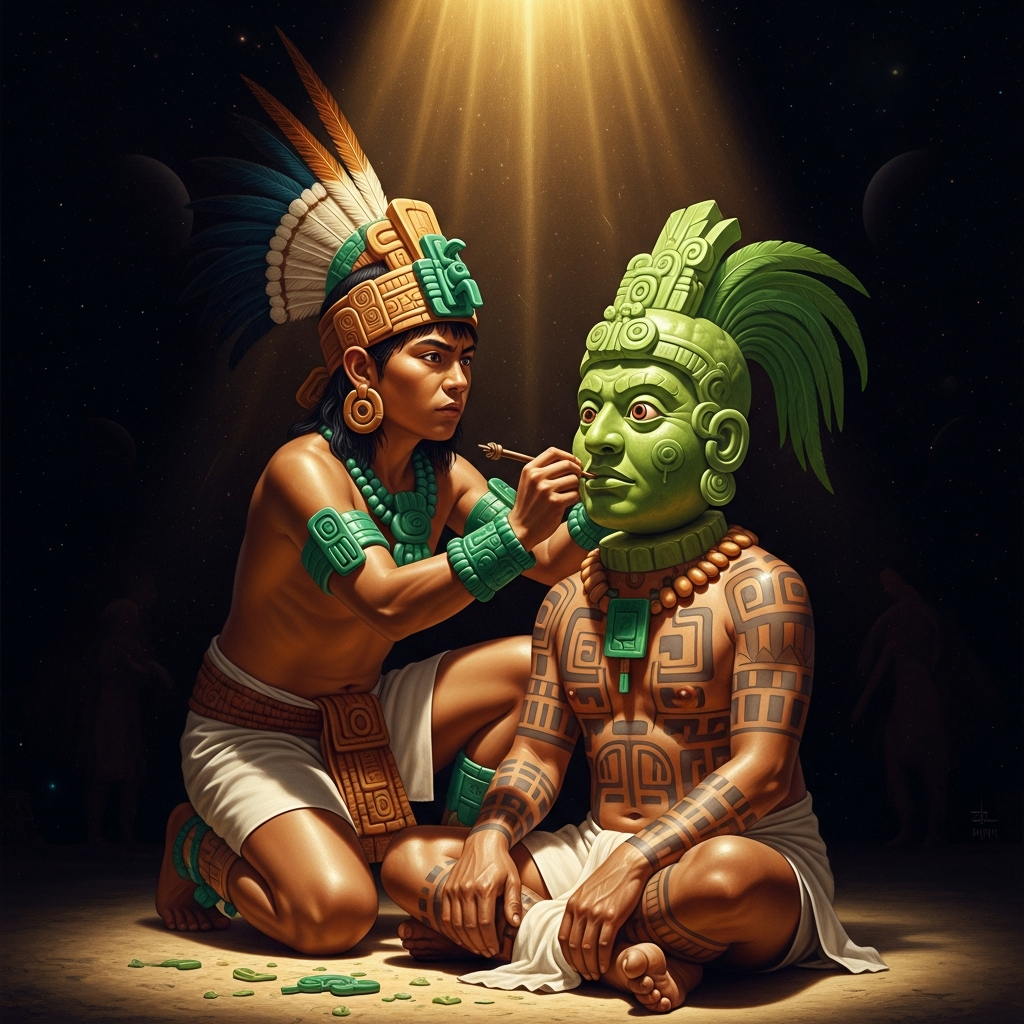
Xbalanque stands in Bat House with his brother’s body and does not mourn — or rather, mourning is a luxury that will come later, if there is a later. He thinks. The animals owe him favors; he calls in several. He carves a head from a chilacayote gourd, the big winter squash that cures in cold storage, and he shapes the curve of the cheekbones and the line of the brow. He places it on his brother’s neck and he speaks to it in a low voice, the words the Popol Vuh does not transcribe, and the gourd opens its eyes.
It is not a good head. The jaw is wrong. The nose is flatter than it should be. But in bad light, at game distance, it will pass.
The court opens in the morning. The Lords of Xibalba arrive with their ball — Hunahpu’s actual skull — and serve first, as is their right as hosts. Xbalanque lets it go two bounces off the stone wall before Hunahpu, in the gourd-head, positions himself. The Brothers play the ball true. They hit it back and forth across the stone floor, back and forth, normal game, normal game — and then Xbalanque strikes the rubber hard with his hip and drives it out of the court into the heavy brush at the court’s edge.
The rabbit is there. The rabbit has been there since before dawn, paid in roots and told exactly when to run. The moment the ball disappears into the brush, the rabbit bolts — low to the ground, impossibly fast, bouncing off rocks. Every Lord of Xibalba chases it. They cannot help themselves. The Lords of Death are still subject to certain instincts, and the instinct to chase a bouncing thing is older than their malice.
Xbalanque walks into the brush on the other side. He lifts his brother’s skull from where it lay. He pulls the gourd off Hunahpu’s neck and settles the real head back into place and holds it there until the eyes open and the jaw moves and Hunahpu says, low, I can see.
They walk back to the court together, carrying the gourd.
The Lords return from the brush exhausted and empty-handed. Xbalanque serves. The gourd bounces once, twice, and on the third bounce he drives it into the far wall with his full hip and the chilacayote splits. The seeds scatter across the painted stone floor. The Lords of Xibalba look at the seeds and look at each other and look at the Twins.
That, says Hunahpu, is the trick. Now you know what we are.
The Lords build an oven. This is the direct approach, the thing they should have done at the beginning: a stone-lined pit full of charcoal fire, and an invitation to leap over it four times as a sport. The Twins know the oven. They know they cannot refuse it and they know they cannot clear it. There is no trick that jumps the gap between being alive and being thrown into an oven. Some instruments only do one thing.
They look at the oven. They look at each other. A sport? says Xbalanque.
Very well, says Hunahpu.
They join hands and jump straight in.
The Lords of Xibalba cheer so loud the roof of the underworld shakes. They grind the bones of the Twins to flour with grinding stones — careful, thorough, the way you grind corn, because the Lords have been around long enough to know that bones left whole have a way of reconstituting. They pour the flour into the river that runs deep beneath Xibalba. The river carries it away in the dark.
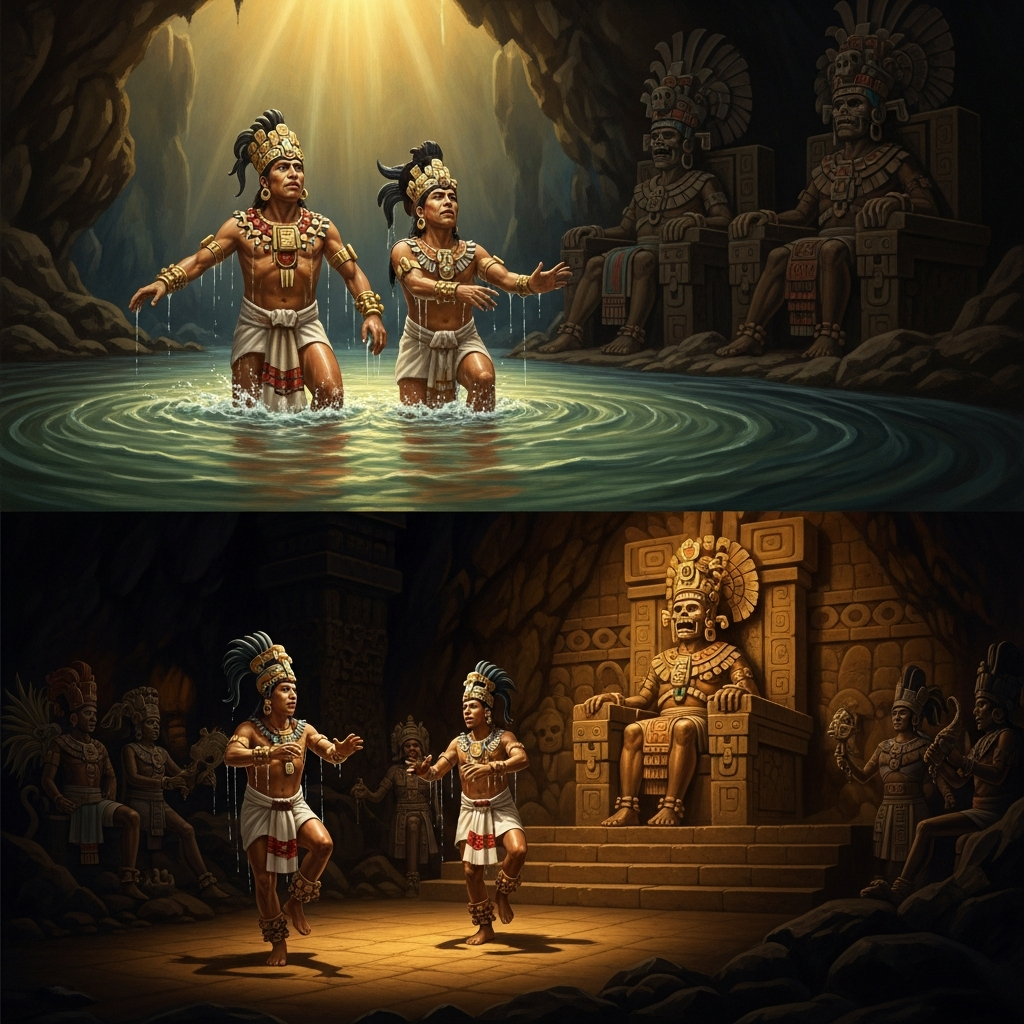
After five days, in a quiet bend in the river where no one watches, two shapes surface. Fish-tailed at first, then wading, then standing. The Twins walk out of the water and stretch their fingers wide and look at their hands.
They have come back from something worse than death. They have come back from flour.
They return to Xibalba in disguise — ragged, painted with soot, no more than wandering performers working the road. They sacrifice a dog and restore it. They burn a house and unburn it. Word reaches the council house: there are strange poor men on the road who do wonders.
The Lords send for them. The Twins arrive. They dance.
The dance begins as entertainment and becomes something else between one step and the next. Xbalanque raises his hands and cuts Hunahpu apart — arm, leg, chest, head, each piece set down on the court floor — and then claps once, and Hunahpu stands up whole. The Lords of Xibalba are screaming with delight. Do it to us, shouts One Death, pushing forward. Do us. We want to feel it.
The Twins oblige. They cut One Death to pieces with great ceremony and precision, every gesture perfect, the way a master performs his art. They set the pieces down.
They do not clap.
They cut Seven Death to pieces. They set the pieces down.
They do not clap.
The remaining Lords of Xibalba look at the floor. They understand, all at once, what the dance always was.
You will no longer receive the great offerings, the Twins announce into the silence. No more will the deer and the puma and the first fruits come to you. You will receive broken pots, dried resin, the things people throw away as they pass the road-fork. The high prayers are finished for you. You have been demoted.
The Lords of Xibalba kneel. There is nothing else to do. The game is over and the Twins have the score.
They go to the calabash tree at the road-fork and lift down their father’s skull. They speak to it a long time. The Popol Vuh is plain about what they cannot do: One Hunahpu’s debt was permanent. Some deaths are the price of a story rather than an accident, and his death is what made the story possible, and you cannot undo the premise while standing inside the conclusion. They bury his skull at the center of the maize field instead, where farmers will find it at planting and know what to say.
Then the Twins climb — up the smoke of the great fire they have burned at the edge of the court, up through the ceiling of the underworld, up into the sky. Hunahpu becomes the Sun. Xbalanque becomes the Moon. They take their stations and the world below gets its lights.
The four hundred boys murdered by Zipacna before the story began rise around them as the Pleiades, the Motz, the seed-cluster — the stars that tell farmers when to plant and when the rains are coming.
The Lords of Xibalba remain below, in their diminished jurisdiction, receiving broken pots.
The game is played every two hundred and sixty days in the Maya ritual calendar — the tzolk’in, the sacred round, the count of days that has no beginning and no end. The ball court is not a stadium. It is a calendar made of stone. Every game played on its floor is a re-enactment of this one: death summoning the living down, the living refusing to stay, the ball passing back and forth until someone stops clapping and the corn knows to grow.
Scenes
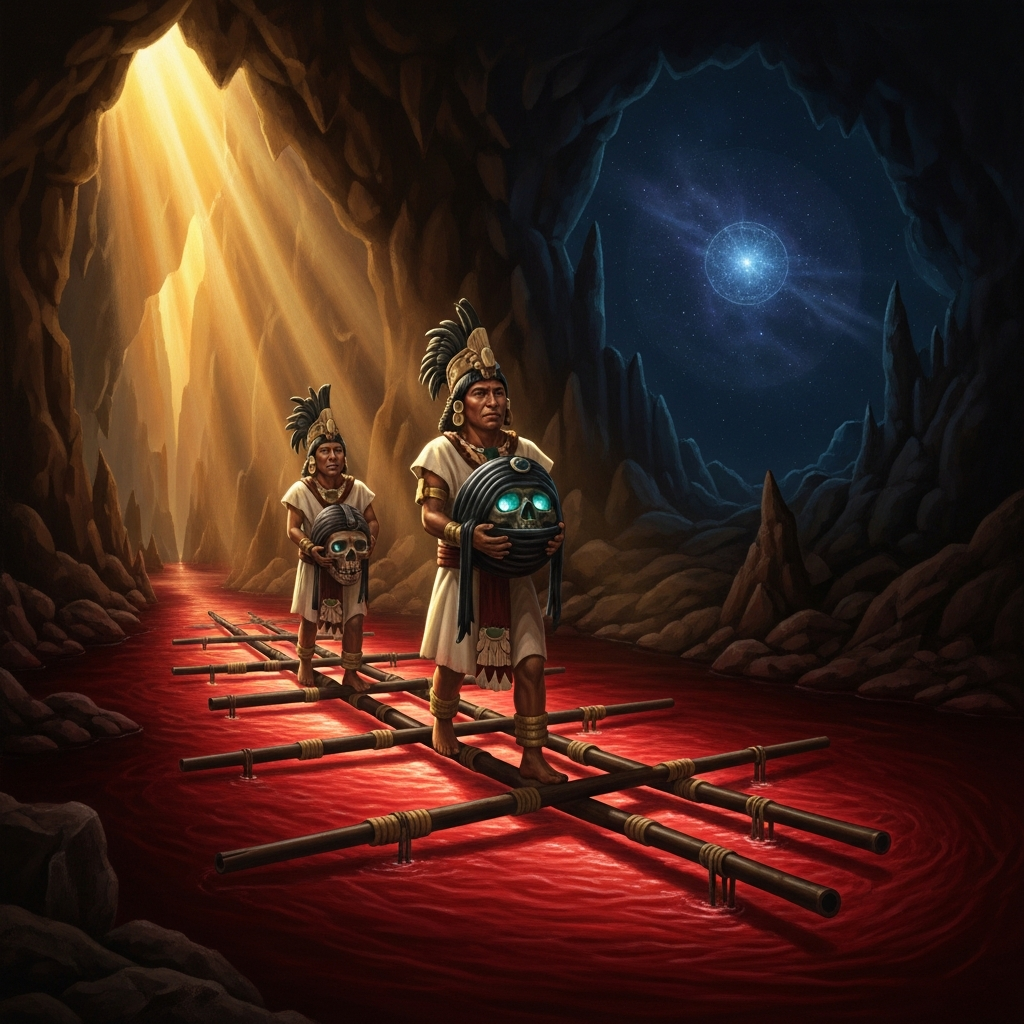
The Twins lay their blowguns end to end across the river of blood and walk into Xibalba carrying their rubber ball — the skull of their father, wrapped in black
 Generating art…
 Xbalanque carves a head from a chilacayote gourd and seats it on his brother's neck
 Generating art…
 The Twins rise from the river after five days and return to Xibalba in disguise
 Generating art…
 Echoes Across Traditions
Entities
- Hunahpu
- Xbalanque
- One Death
- Seven Death
- Camazotz
- One Hunahpu
Sources
- Dennis Tedlock (trans.), *Popol Vuh: The Definitive Edition of the Mayan Book of the Dawn of Life* (1985, rev. 1996)
- Allen J. Christenson (trans.), *Popol Vuh: The Sacred Book of the Maya* (2003)
- Michael D. Coe and Stephen Houston, *The Maya* (9th ed., 2015)
- Karl Taube, *The Major Gods of Ancient Yucatan* (1992)
- Mary Miller and Karl Taube, *An Illustrated Dictionary of the Gods and Symbols of Ancient Mexico and the Maya* (1993)