The Hero Twins Defeat the Lords of Death
Mythic Time · K'iche' Maya oral tradition, written down c. 1554–1558 CE · Xibalba — the K'iche' Maya underworld of decay, fever, and flint-bladed games
Contents
Hunahpu and Xbalanque are summoned to Xibalba by its lords of decay. They survive six houses of torture, lose and recover Hunahpu's severed head, trick the death gods into begging for their own dismemberment, and ascend as the sun and moon.
- When
- Mythic Time · K'iche' Maya oral tradition, written down c. 1554–1558 CE
- Where
- Xibalba — the K'iche' Maya underworld of decay, fever, and flint-bladed games
The summons comes by owl.
Four owls climb out of Xibalba — Shooting Owl, One-Legged Owl, Macaw Owl, Skull Owl — and fly up the cliff road that joins the upper world to the lower. They find the Twins in the ball court, mid-game, and perch on the rim. One Death and Seven Death send for you, the owls say. They have heard the noise of your ball through their ceiling. They want a game. The grandmother of the Twins begins to cry. She knows this story. Their father, One Hunahpu, played ball above Xibalba once, and the Lords called him down, and they killed him in the House of Knives, and they hung his head from a calabash tree at the road-fork as a warning, and the head spat into the hand of a maiden passing by, and that was how the Twins were conceived. The same story does not have to end the same way.
We will go, says Hunahpu.
The road into Xibalba is designed to break travelers before they arrive.
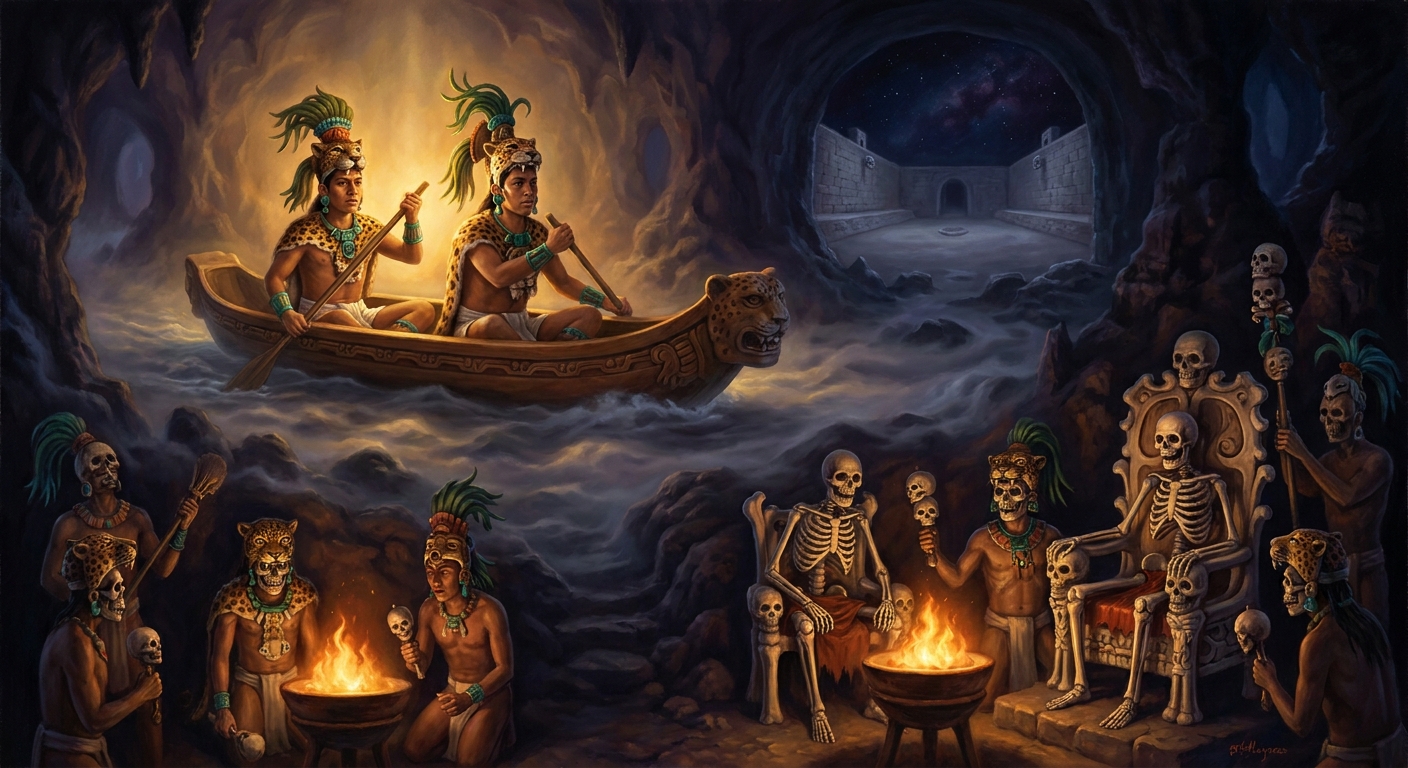
The Twins cross the river of blood walking on their blowguns laid end to end. They cross the river of pus the same way. At the crossroads of four colored roads — red, white, yellow, black — they send a mosquito ahead to bite the mannequins of carved wood seated on the first bench, the fake lords, and then to bite the real Lords of Xibalba in sequence, drawing from each a cry, learning every name. When they enter the council house and walk past the wooden decoys without greeting them, and then name every living lord on the first try, the silence that falls is the silence of a trap that has just failed. The Lords gesture to a stone bench glowing with heat. The Twins decline. That is the first night’s game: six tricks attempted, six tricks identified. The Lords of Xibalba retire to plan the trial-houses.
There are six houses, and the Twins survive them all.
In the Dark House they put fireflies on the tips of the cigars and red macaw feathers on the torches, and the lights burn steady all night, and in the morning the cigars are whole. In the Razor House they speak directly to the knives: We give you the flesh of every animal, if you stop cutting at us. The knives, which have always wanted that contract, agree. In the Cold House they burn pine cones and stay warm. In the Jaguar House they throw bones to the jaguars, who are satisfied. In the Fire House they breathe through the smoke and come out unburned. The Bat House is last, and the Bat House is the one that almost works. The killer bats of Xibalba — Camazotz, the great leather-winged lord — circle the ceiling all night. The Twins climb into their blowguns and sleep standing up. At dawn, Hunahpu looks out to see if the light is rising. Camazotz drops from the dark and shears off his head in a single pass.
The Lords of Xibalba hang the head above the ball court. Tomorrow’s ball.
Xbalanque stands in the Bat House with a headless brother and thinks for a long time.
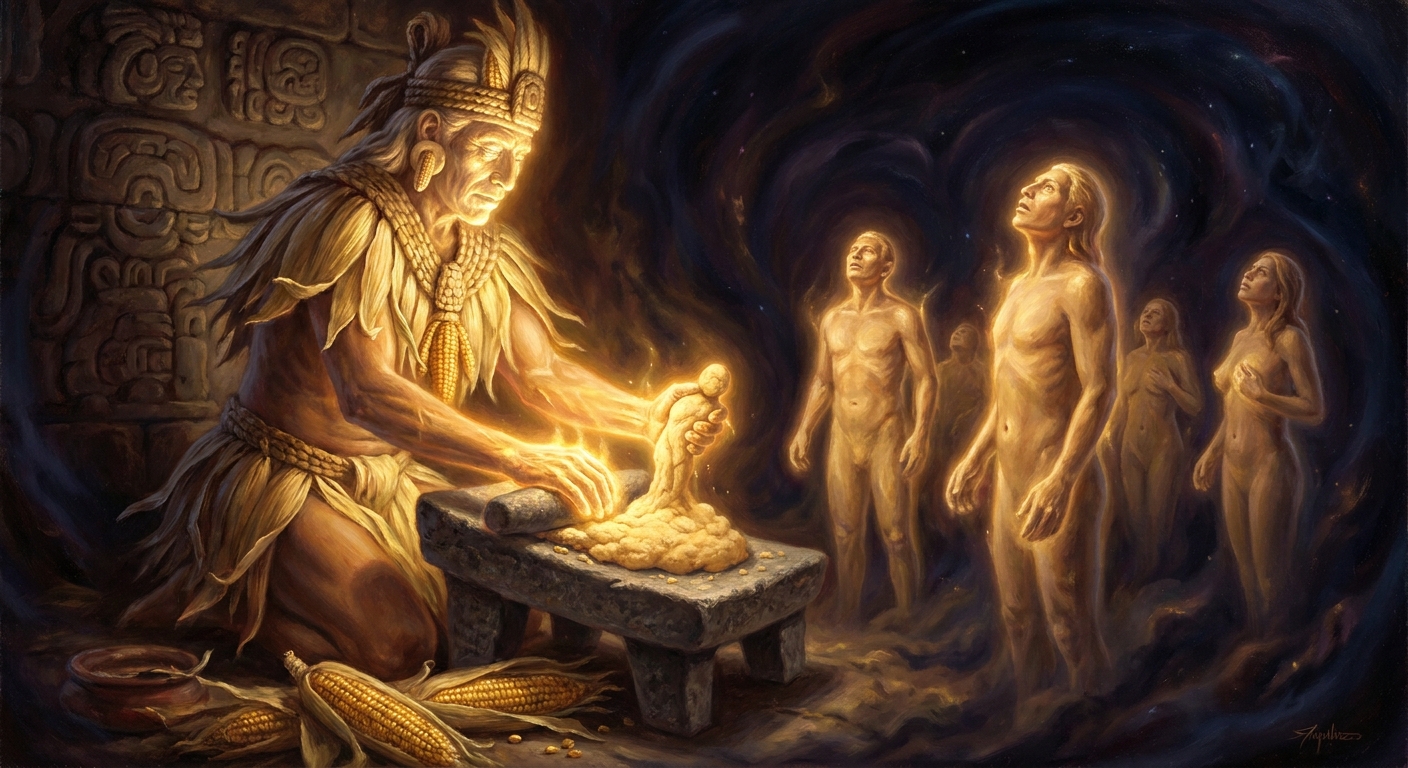
He calls to the animals — the rabbit, the coati, the forest creatures who owe no allegiance to the Lords of Death — and he tells them what to do. Then he carves a head from a chilacayote gourd, shapes it, paints it, places it on his brother’s neck, and speaks to it until the eyes open. It is not a perfect head. The jaw is wrong. But it holds. When the ball court opens for the morning game and the Lords arrive with Hunahpu’s real head under one arm, the painted gourd passes for him in the bad light. The game begins. Xbalanque strikes the ball so hard it flies into the brush at the court’s edge. The rabbit, waiting there, bolts from cover exactly like a bouncing ball. Every Lord of Xibalba runs after it — they cannot help themselves, the chase instinct is deeper than their dignity. In the chaos Xbalanque sprints to where the real head lies, pulls the squash off his brother’s neck, and puts the real head back. Hunahpu stands up whole. They walk back to the court carrying the gourd, and when the Lords return empty-handed and panting, Xbalanque serves. The gourd splits against the wall and seeds scatter across the stone floor.
That, says Hunahpu, is the trick. Now you know what we are.
The Lords decide to be done with them.
They build an enormous oven — stone-lined, fire-packed — and invite the Twins to leap over it four times as a sport. The Twins know. They look at the oven and they look at each other and Xbalanque says: A sport. Very well. They join hands and jump straight in. The Lords of Xibalba cheer so loudly the walls of the underworld shake. They grind the bones of the Twins to flour and pour the powder into the river that runs below Xibalba, the way you dispose of ash. The river carries it a long way into the dark. After five days, in a quiet bend where no one is watching, two figures rise from the water — fish-tailed, then legged, then fully human. They walk out onto the bank dripping and stretch their fingers wide. They are the Twins again. Death has not held.
They return to Xibalba in disguise, soot-painted and ragged, performing at the roadside — the dance of the weasel, the dance of the swallow. They sacrifice a dog and bring it back to life. They burn a house to ash and unburn it. Word reaches the Lords: There are wonderful poor performers on the road. The Lords send for them.
The Twins arrive at the council house and they dance.
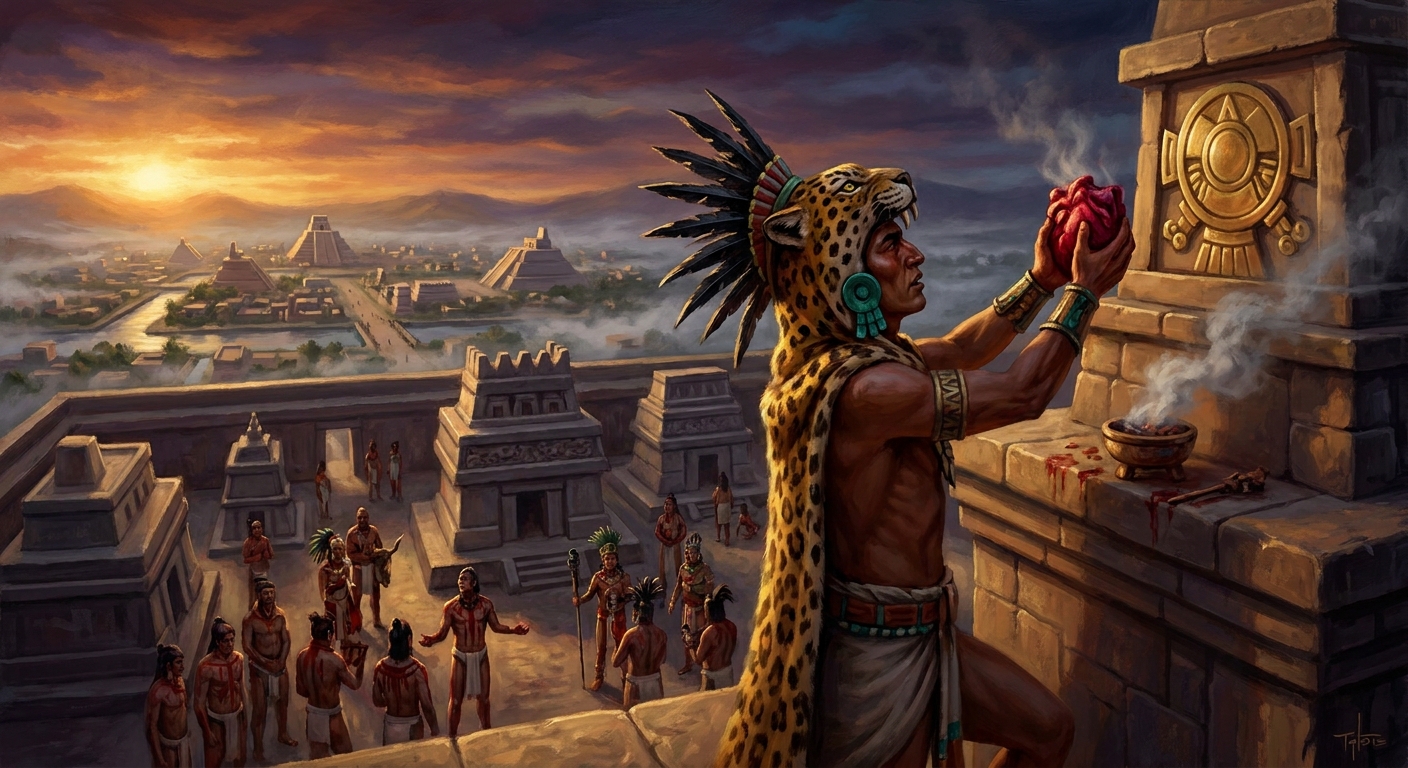
They dance the sacrifice dance — Xbalanque cuts Hunahpu to pieces and then claps once and Hunahpu stands up whole and laughing. The Lords of Xibalba are screaming with delight. Do us! Do it to us! We want to feel it! One Death pushes forward, then Seven Death, and the Twins cut One Death to pieces with ceremony and precision. They do not clap. They cut Seven Death to pieces. They do not clap. The remaining lords look at the floor and understand, all at once, that the dance was never a dance. From this day, the Twins announce into the silence, you receive only broken pots, the gum of the resin tree, the things people leave for the dead in passing. The great offerings will not come to you anymore. The Lords of Xibalba kneel. They accept the demotion. There is nothing else to accept.
The Twins go to the calabash tree at the road-fork and take down their father’s skull. They speak to it. They cannot bring him back — some deaths are permanent, and One Hunahpu’s debt is the one the whole story was built to pay — but they place the skull at the center of the maize field where farmers will speak to it at planting. Then they climb. They climb the smoke of a great fire, up through the roof of the underworld, up into the sky. Hunahpu becomes the Sun. Xbalanque becomes the Moon. The four hundred boys murdered before the story began become the stars around them — the Pleiades, called Motz in K’iche’, the seed-cluster of heaven.
The world below has its lights at last.
The manuscript was written in secret between 1554 and 1558 by an anonymous K’iche’ noble who knew the Inquisitors were burning every codex they could find; the original is lost, and all that survives is the single copy a Dominican friar named Francisco Ximénez discovered around 1701 and translated before anyone could destroy it again.
Scenes
The Twins descend the cliff road into Xibalba carrying their blowguns
Generating art… Xbalanque replaces his brother's severed head with a gourd carved to look like a face
 Generating art…
 The Twins perform their death-dance before the delighted Lords of Xibalba — cutting each other to pieces and reassembling
 Generating art…
 Echoes Across Traditions
Entities
- Hunahpu
- Xbalanque
- One Death
- Seven Death
- Camazotz
- One Hunahpu
Sources
- Dennis Tedlock (trans.), *Popol Vuh: The Definitive Edition of the Mayan Book of the Dawn of Life* (1985, rev. 1996)
- Allen J. Christenson (trans.), *Popol Vuh: The Sacred Book of the Maya* (2003)
- Adrián Recinos (trans.), *Popol Vuh: Las antiguas historias del Quiché* (1947)
- Michael D. Coe and Stephen Houston, *The Maya* (9th ed., 2015)
- Karl Taube, *The Major Gods of Ancient Yucatan* (1992)