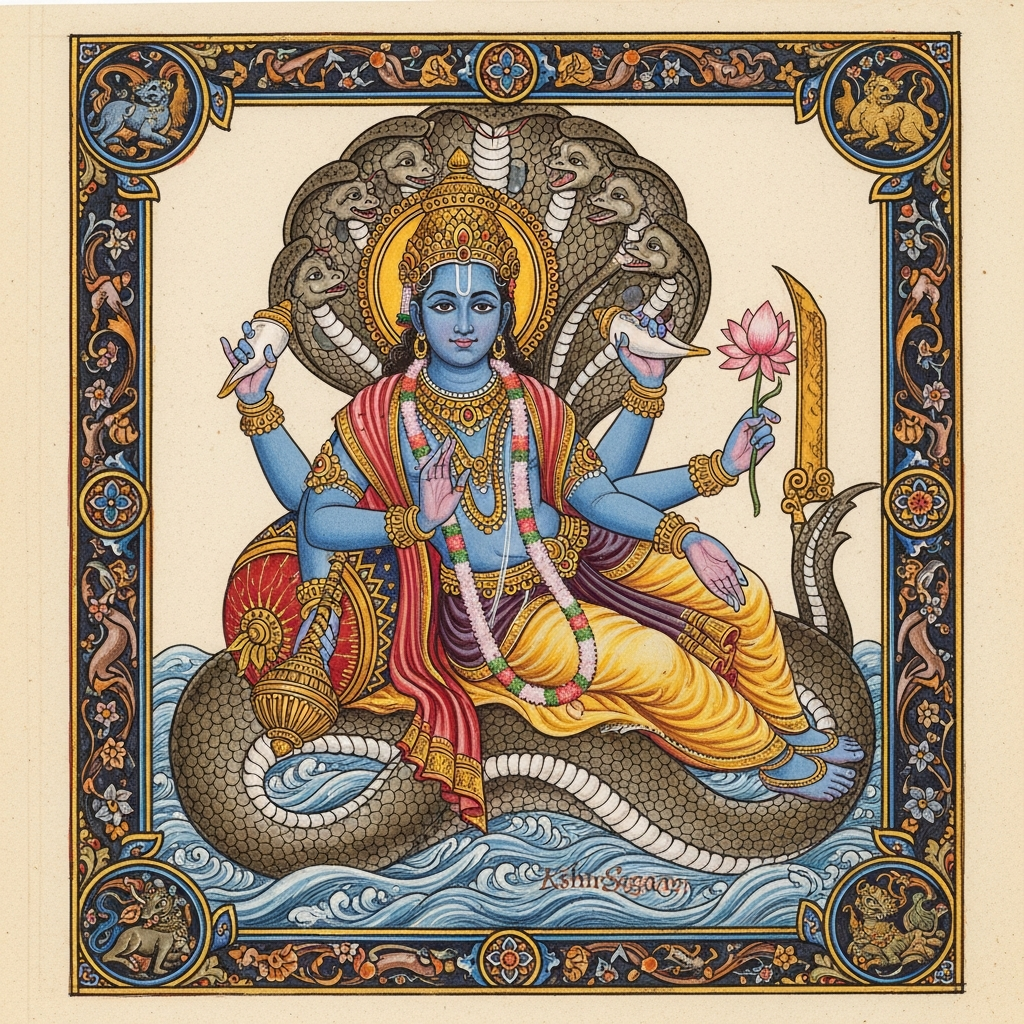
Prahlada and Narasimha: The Pillar Splits
Mythic Time — Dvaita Yuga · Bhagavata Purana Book 7, ~9th century CE composition · The demon kingdom of Hiranyakashipu — the palace courtyard, threshold of the great hall, at the hour of dusk
Contents
The demon king Hiranyakashipu has made himself inviolable by boon — unable to be killed by man or god, beast or weapon, by day or night, inside or outside. When every torture fails to break his own son's devotion to Vishnu, he strikes a pillar. From the pillar, Vishnu erupts as Narasimha — the man-lion — and disembowels the demon at the threshold, at dusk, on his own lap, defeating every loophole at once.
- When
- Mythic Time — Dvaita Yuga · Bhagavata Purana Book 7, ~9th century CE composition
- Where
- The demon kingdom of Hiranyakashipu — the palace courtyard, threshold of the great hall, at the hour of dusk
Hiranyakashipu has conquered everything and is still afraid.
This is the first truth of the story, though it takes the whole story to see it. He has the three worlds — the heavens, the earth, the underworld — arranged in obedience beneath his throne. He has the gods serving as his slaves. He has the boon from Brahma that makes him unkillable: not by day or night, not inside or outside, not on earth or in the sky, not by man or beast, not by any weapon created or held. The boon covers every axis of existence. He stood in austerity for an age to earn it, and Brahma granted it, and now there is nothing left to threaten him.
And yet he cannot sleep.
The reason is Vishnu. Vishnu, who killed his brother Hiranyaksha in the form of a boar, dragging him up from the cosmic deep. Vishnu, who pervades everything — who is, in the tradition’s logic, literally everywhere that consciousness exists. Hiranyakashipu cannot eliminate Vishnu because he cannot find an edge to Vishnu, a place where Vishnu ends and non-Vishnu begins. He has done the next-best thing: he has banned the name. In his kingdom, no one speaks it. No prayer rises toward the preserver. The air is clean of that sound.
Then his son is born.
Prahlada does not choose to be devoted.
This is the detail that every telling of the story emphasizes: it is not a conversion, not a crisis of faith, not a decision made after reasoning through the options. While still in the womb, Prahlada heard the sage Narada speaking of Vishnu to his mother, and the words entered him before he had a self to receive them with. He was born already knowing. His first words were Vishnu’s name. His first songs were Vishnu’s attributes. He does not understand why everyone around him does not feel what he feels — which is the characteristic confusion of a mystic in an administrative family.
Hiranyakashipu sends him to the palace school. The teachers are demons, loyal, efficient. They teach statecraft, military strategy, the philosophy of power. Prahlada listens and learns and between every lesson teaches his fellow students what the teachers will not: that the supreme being is everywhere, that devotion is the highest knowledge, that Vishnu is the ground on which all other ground rests.
Word reaches the king. He recalls his son. He asks, with extraordinary restraint, that Prahlada stop. He explains, as a father explains to a child who does not understand the stakes, that this is not acceptable. He offers the kingdom. He offers all the pleasures the three worlds can supply. He offers, in the end, his own love — and Hiranyakashipu does love his son, in the manner of a man who has forgotten that love is not ownership.
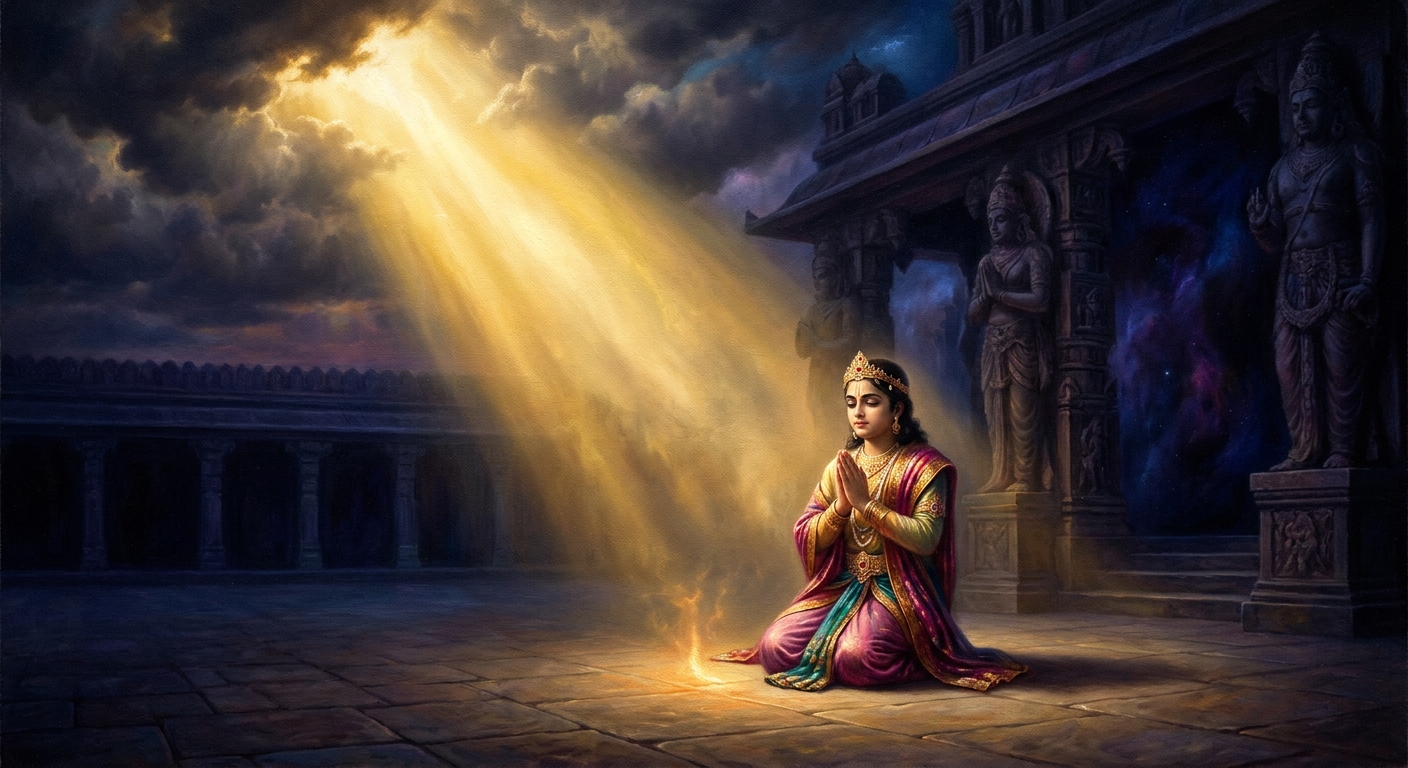
Prahlada smiles and chants the name.
The tortures begin methodically.
Hiranyakashipu applies them with the thoroughness of a king who believes every problem has a sufficient solution. He has Prahlada thrown into the sea with stones bound to his feet. The waves carry the boy back to shore, unharmed, still chanting. He orders venomous serpents to bite him. The serpents coil and will not strike. He commands the royal elephants to trample him. The elephants approach, halt, kneel. He has him thrown from a cliff; Prahlada lands in Vishnu’s arms, which are everywhere, and is set down gently. He has him sealed in a chamber of stone and the stone heated to the temperature of the sun; when the chamber cools and the door opens, Prahlada walks out.
Demons watch these failures accumulate and understand something the king does not yet accept: the boy cannot be broken because he is not holding anything together. Every torture assumes a self that can be made to suffer, an identity that can be unmade by sufficient pressure. Prahlada has dissolved that identity entirely into the name he chants. There is no separate Prahlada-self left that the tortures can find. They reach for him and find only Vishnu, and Vishnu cannot be tormented because Vishnu is not afraid.
Hiranyakashipu’s fear grows in direct proportion to his failure. He is no longer a king managing a rebellious son. He is a man watching the universe demonstrate, through the body of a child, that his entire system of power has no purchase on the real.
The final audience occurs in the great hall.
Hiranyakashipu sits on his throne, and Prahlada stands below, and the court of the demon kingdom watches. The king’s voice is controlled, now, in the way that voices go controlled when the person speaking is past anger and into something colder.
“You keep saying Vishnu is everywhere,” Hiranyakashipu says. “Is he in this pillar?”
He gestures at the column of stone beside him — one of the pillars that hold the roof of his palace, massive, ancient, carved with his own victories.
“Yes,” Prahlada says. “He is in the pillar. He is in the stone and in the space between stones and in you and in me and in every point in creation where consciousness touches matter. There is no place where he is not.”
Hiranyakashipu stands from his throne. He walks to the pillar. He raises his mace.
He strikes it.
The sound that comes from the pillar is not the sound of stone splitting.
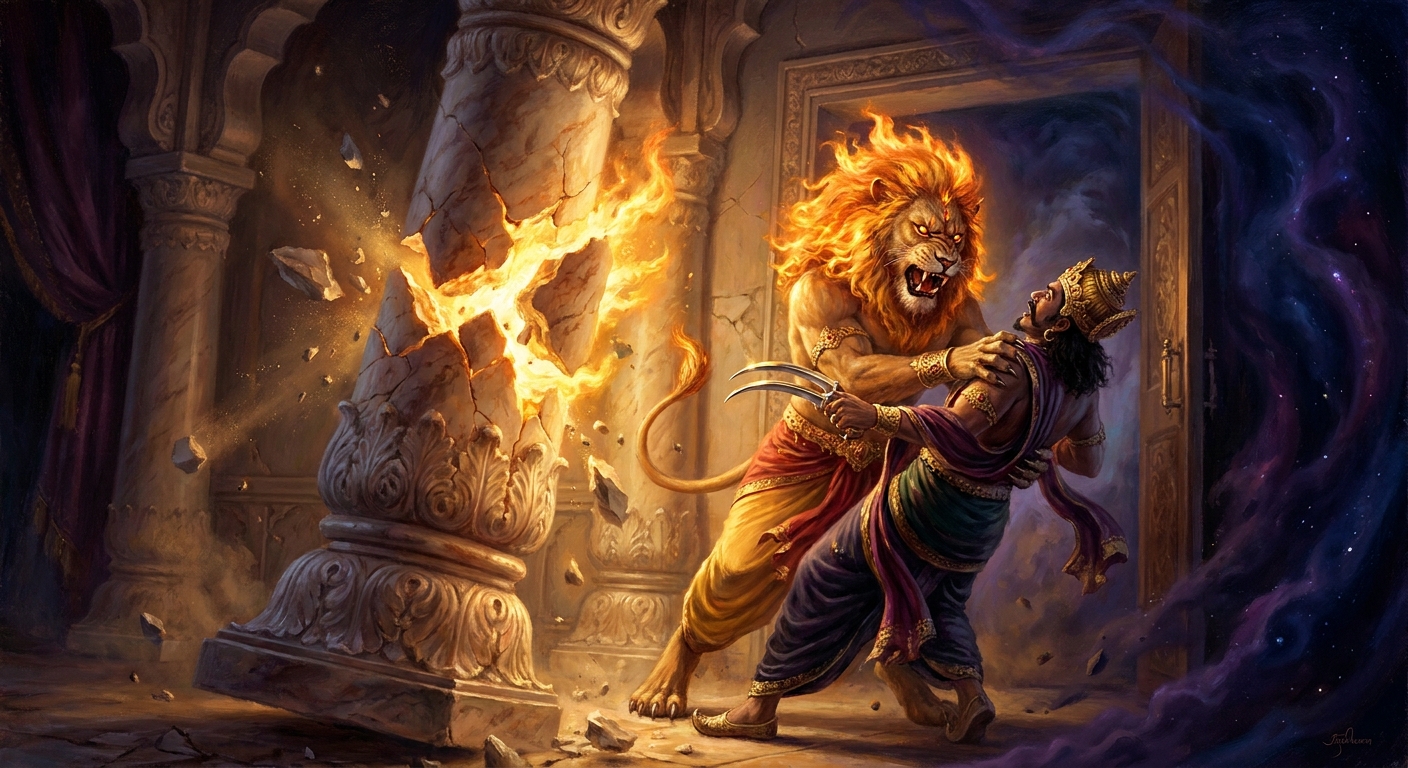
It is the sound of a dimension arriving — a note so deep it precedes the possibility of hearing. The floor of the palace shudders. Then the pillar cracks from ceiling to floor, and from the crack comes light, and from the light comes a roar that is neither human nor animal because what emerges is neither human nor animal.
Narasimha stands in the ruins of the pillar.
He is not as the scriptures have prepared the court to understand a divine avatar. He is not serene. He is not golden-lit and distant. He is enormous and present and terrifying, a being of lion’s head and man’s shoulders and claws that are weapons without being weapons — not forged metal, not a tool created by craft, but extensions of the living divine, which no category in the boon can cover. His eyes are not eyes that see you from outside. They are the eyes of something that has been inside the pillar all along, waiting — not for the right moment, but for the precise question that would demand this answer.
He seizes Hiranyakashipu.
The demon fights. He is, by boon, among the most powerful beings in creation, and he fights with everything — every weapon, every technique, every gram of strength the universe has permitted him. He lands blows. He would kill any other being. Narasimha does not stagger. He moves through Hiranyakashipu’s resistance the way the truth moves through an argument: not by overcoming it but by revealing that the argument was never the kind of thing that could stop it.
Narasimha carries him to the threshold.
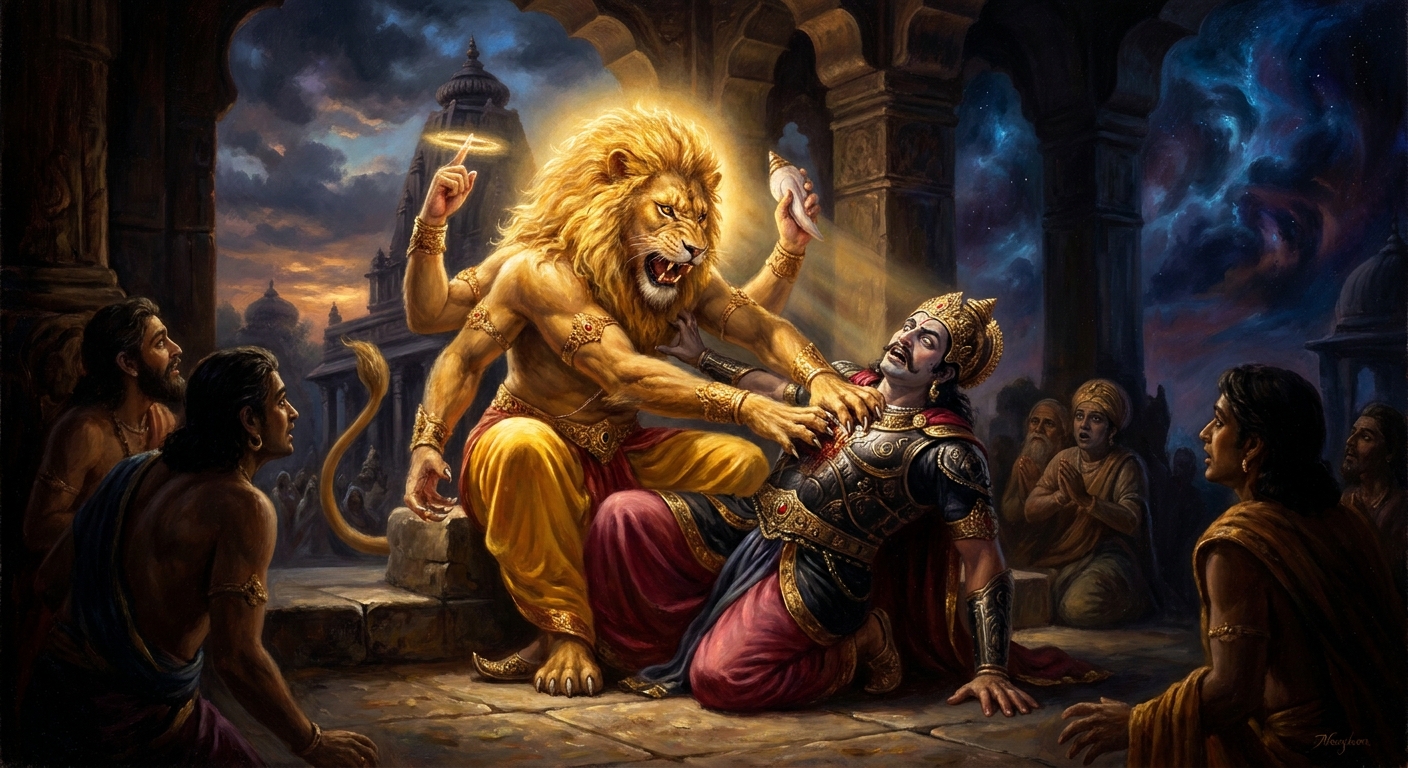
This is the geography of the satisfaction: not inside the palace, not outside it. The threshold is the edge, the liminal strip where inside and outside cease to be categories. He lays Hiranyakashipu across his lap — not earth, not sky, the lap of a man-lion that is neither the one nor the other. The hour is dusk: not day, not night, the one moment when both and neither are true simultaneously. The claws do their work. They are not weapons — they grew from living flesh, created by no maker. The boon is satisfied on every count.
The demon king dies at the exact center of every loophole he built.
Prahlada kneels beside the form of his father and weeps. This also is part of the story. He weeps and prays for his father’s liberation, and the tradition records that it is granted — that even Hiranyakashipu, who spent his existence fighting the divine, is released in the moment of dying at the hands of the divine, because death by the direct action of Vishnu is itself a form of grace.
The court is silent. The palace is still. The lion-headed god stands at the threshold in the dusk light, and his rage subsides as visibly as a tide receding, until what remains is the face that Prahlada has been seeing in his mind since before he was born: the face of the one who was in the pillar all along.
The boon that made Hiranyakashipu inviolable was also the map that led Vishnu to invent Narasimha — which means that the demon king’s attempt to become unkillable was the precise instrument of the death that found him.
Scenes
Narasimha erupts from the split pillar — half-man, half-lion, neither god nor animal, claws extended — seizing Hiranyakashipu at the threshold of the hall as the last light of dusk streams through the broken stone
 Generating art…
 Prahlada sits in serene devotion, eyes closed and lips moving with Vishnu's name, while his father's torturers stand uncertain behind him — their every instrument failing against a child who does not resist
 Generating art…
 Narasimha holds Hiranyakashipu across his lap — neither earth nor sky, neither inside nor outside — and the demon's inviolability boon is satisfied on every count as the man-lion's claws complete their work
 Generating art…
 Echoes Across Traditions
Entities
- Vishnu
- Narasimha
- Prahlada
- Hiranyakashipu


Sources
- *Bhagavata Purana* 7.2-10
- *Vishnu Purana* 1.17-20
- Cornelia Dimmitt and J.A.B. van Buitenen, *Classical Hindu Mythology*
- Georg Feuerstein, *The Yoga Tradition* (chapter on bhakti)