Quetzalcoatl in the Bone-Pit
After the emergence of the Fifth Sun at Teotihuacan · recorded ~16th century CE · Mictlan, the nine-layered underworld beneath the earth — and the courtyard of Tamoanchan above
Contents
The feathered serpent descends to Mictlan, tricks the lord of the dead, drops the bones of humanity, and bleeds his own body onto the broken pieces to make the Fifth Race.
- When
- After the emergence of the Fifth Sun at Teotihuacan · recorded ~16th century CE
- Where
- Mictlan, the nine-layered underworld beneath the earth — and the courtyard of Tamoanchan above
The Fifth Sun has just been lit.
In the great courtyard of Teotihuacan, the gods have thrown themselves into a fire and the small pockmarked god Nanahuatzin has emerged as the new sun, and the proud god Tecciztecatl as the moon, and a rabbit has been thrown at the moon’s face to dim it, and the world has begun. But the world is empty. The four previous suns have ended in flood and wind and fire and jaguars, and each ending took its humanity with it. The new sun rises over a planet with no one to see it.
The gods convene in council. Someone has to go down to Mictlan and bring back the bones of the previous humans, so that a Fifth Race can be made from them.
They look at Quetzalcoatl. Quetzalcoatl looks at the floor.
“I will go,” he says.
He takes Xolotl with him — his twin, his shadow, the dog-headed double who is the underworld-version of his own face. Xolotl knows the road. Xolotl, in fact, is the road; it is his job to lead the dead down through the nine layers, and he can lead the living down too, if they are foolish enough to ask.
They descend.
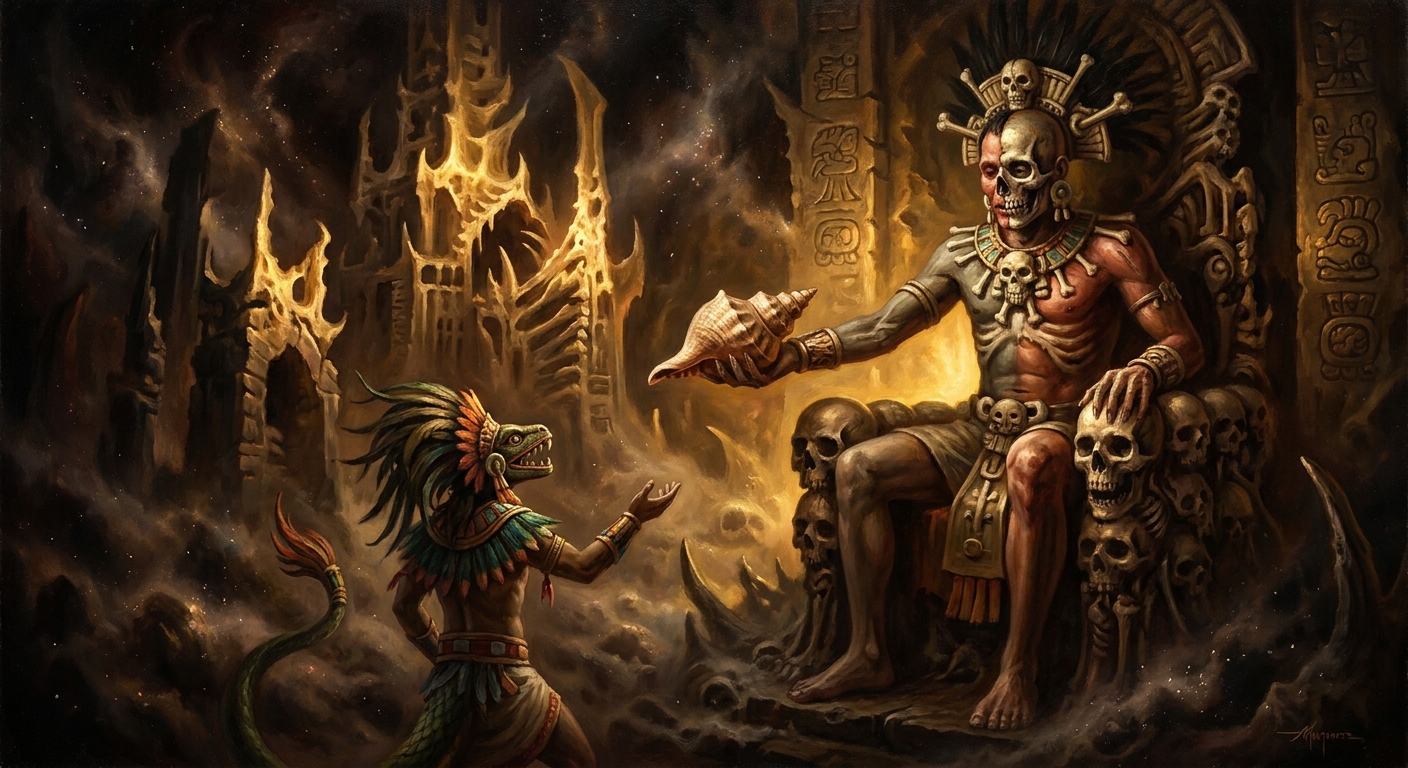
The first layer is the river that no one swims. Xolotl carries Quetzalcoatl across on his back. The second layer is the place where two mountains grind together, opening and closing like a jaw, and they slip through in the half-second the jaw is open. The third is the obsidian mountain. The fourth, the wind of knives. The fifth, the place where banners blow without wind. The sixth, the place where arrows fly without archers. The seventh, the place where the heart is eaten. The eighth, the narrow passage of stone. And the ninth — the courtyard of Mictlantecuhtli, lord of the dead, and his consort Mictecacihuatl, lady of the dead, sitting on thrones made of skulls in a hall lit by no fire.
Mictlantecuhtli looks up.
He has a face that is half flesh and half skull, and the half that is skull is the half that is smiling.
“Feathered one,” he says. “You came a long way for a small request. Speak it.”
“I have come for the bones,” Quetzalcoatl says. “The bones of the previous humanities. The gods above intend to make a new race. We need the raw material.”
Mictlantecuhtli lets a silence fall, the way a fisherman lets a line fall — slowly, with the certainty that something will eventually take it.
“You may have them,” he says, finally. “On one condition. You must blow my conch trumpet four times around my kingdom. If you can do that, the bones are yours.”
He hands Quetzalcoatl a great spiral conch.
The conch has no holes. There is no mouthpiece. There is no way to blow it.
Quetzalcoatl turns it over in his hands. He has been tricked, and the trickery is the kind that, if he protests, will let Mictlantecuhtli refuse him on a technicality. He says nothing. He walks out of the throne room with the conch under his arm.
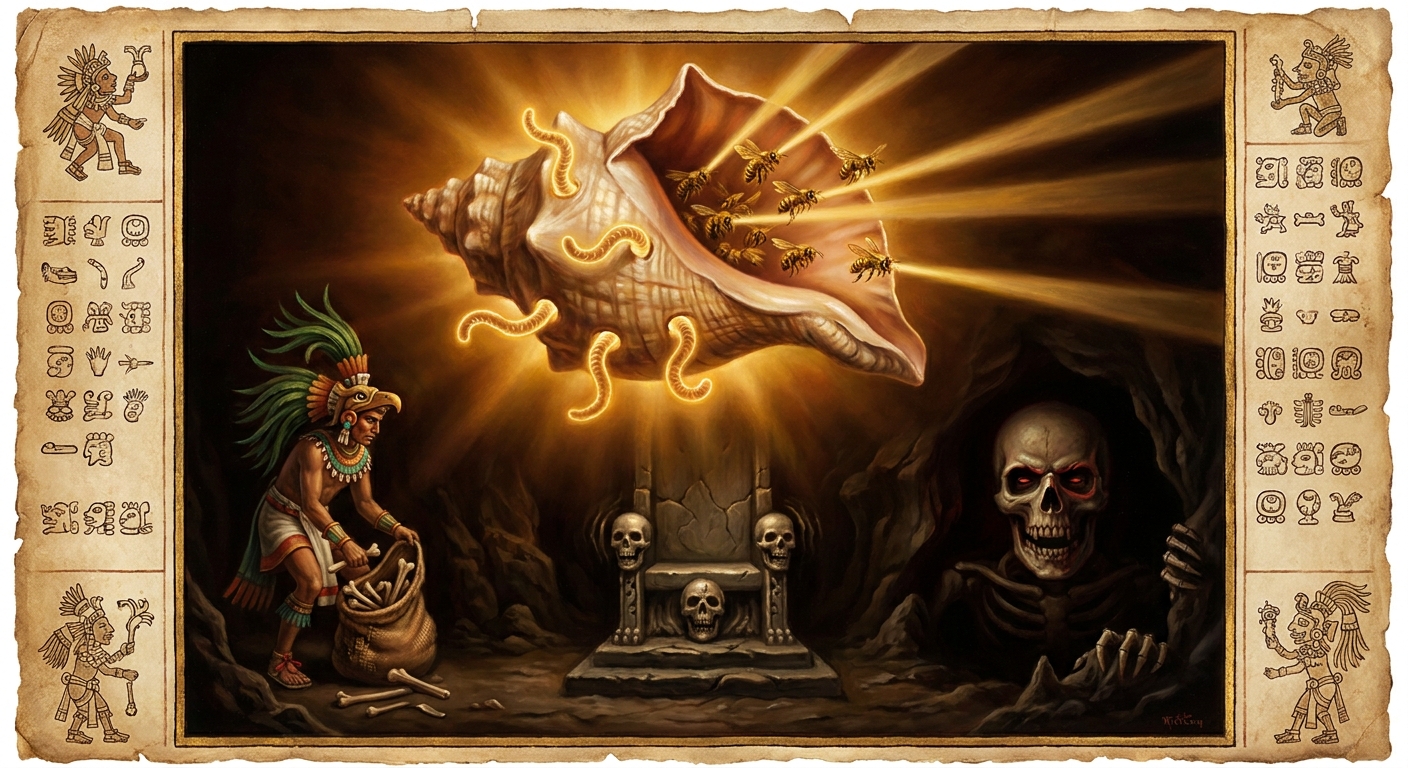
He calls the worms.
He calls the bees.
The worms come up out of the floor of the underworld and bore four small holes through the spiral of the conch — clean holes, evenly spaced, the way only worms can drill. The bees crawl into the conch one at a time and fill it with their bodies and begin to hum, and the hum comes out the worm-holes as four notes, four trumpetings, four blasts that ring across the obsidian halls of Mictlan and shake the skull-thrones in the courtyard.
Mictlantecuhtli hears the conch sound and understands he has been outflanked.
He gives Quetzalcoatl the bones — a great heap of them, the broken skeletons of four previous humanities, men’s bones and women’s bones jumbled together because the dead do not sort themselves. Quetzalcoatl gathers them into a bundle. He turns to leave.
But Mictlantecuhtli is the lord of the dead, and the dead do not give up their dead easily. He whispers to his servants, and his servants dig a pit in the path Quetzalcoatl must walk on the way out, and they cover the pit with cloth, and they wait.
Quetzalcoatl walks out of the throne room. He is tired. He is carrying a heavy bundle of bones. He is thinking about the worm-holes and the bees and the slow patience the underworld requires of anyone who wants to leave it.
He does not see the pit.
He steps onto the cloth. The cloth gives. He falls. The bones fall with him — a great clattering shower of femurs and ribs and skulls into the pit-bottom, and as they fall they break. They break against each other. They break against the stone floor. They break into pieces that no longer match the shapes they had been.
A quail, sent by Mictlantecuhtli, flies down into the pit and pecks at them as they break, scattering them further.
Quetzalcoatl lies in the bone-pit for a long time and does not move. He is the god who agreed to bring back humanity whole, and he has dropped humanity, and humanity is now in pieces. He could climb out empty-handed. He could go back up to Tamoanchan and tell the council the descent failed, and they would have to choose another way. He thinks about it.
He decides, instead, to gather what is left.
He picks up the broken bones one by one.
He picks up femurs that no longer match other femurs. He picks up ribs cracked across their length. He picks up skull fragments and finger bones and the small bones of a child’s foot. He puts them all into his bundle, and the bundle is heavier now than when it was whole, because broken things weigh more than the things they used to be.
He climbs out of the pit. Xolotl is waiting at the rim, ears low, dog-eyes patient.
They climb back up through the nine layers. The stone narrows; the arrows fly; the banners blow; the wind of knives screams; the obsidian gleams; the mountains grind; the river flows. By the time they reach Tamoanchan, Quetzalcoatl is bloody from the climb, and the bundle on his back is stained with the blood of his climbing.
He lays the bones on the floor of the courtyard.
He stares at them.
They are pieces. They will not become people on their own.
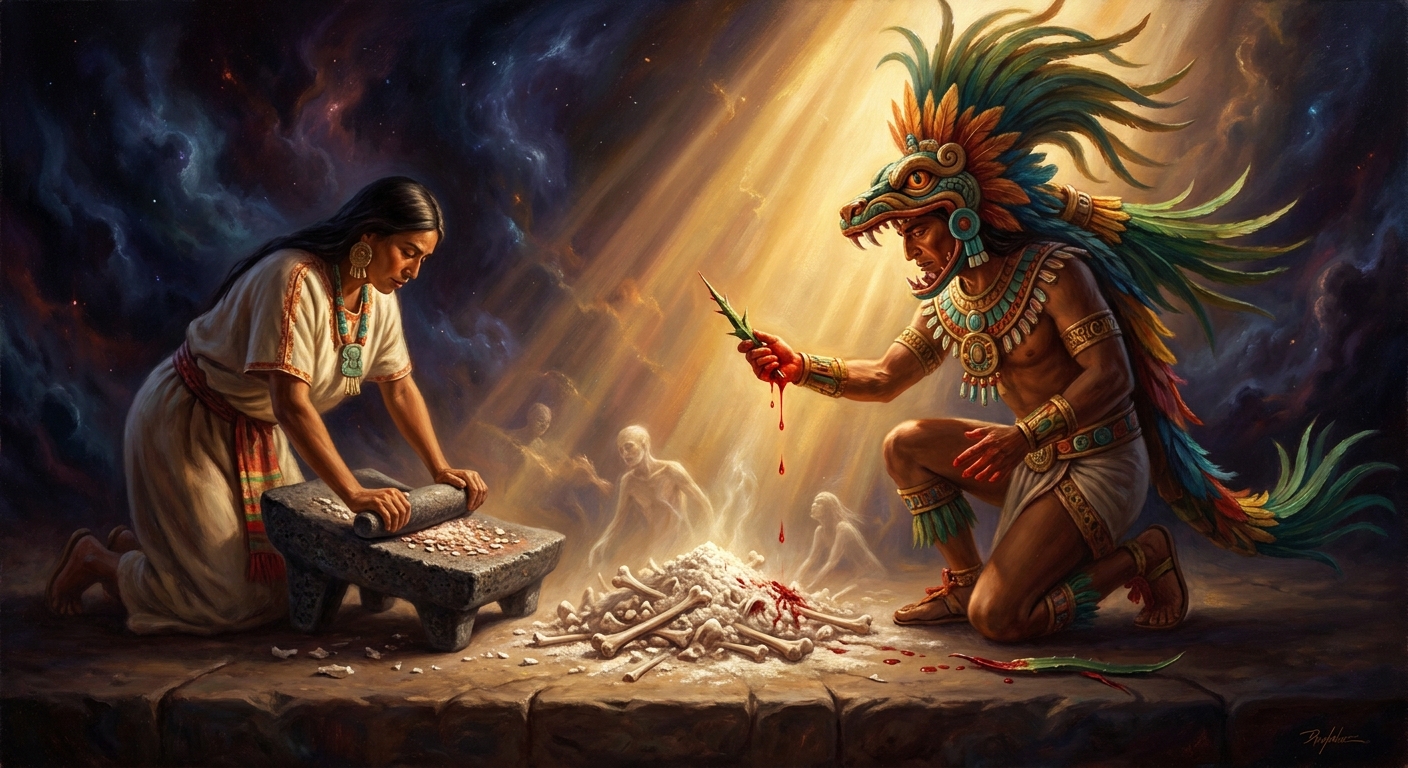
He cuts himself.
The Florentine Codex is matter-of-fact about where: he drew blood from his member. He bleeds onto the broken bones — not a ritual sprinkle, not a symbolic touch, but a pouring, his own blood running down over the heap until every fragment is wet with it. The blood soaks into the bone-meal. The bone-meal absorbs. The fragments begin to knit — not back into their original shapes, but into new shapes, the shapes a god decides on while bleeding.
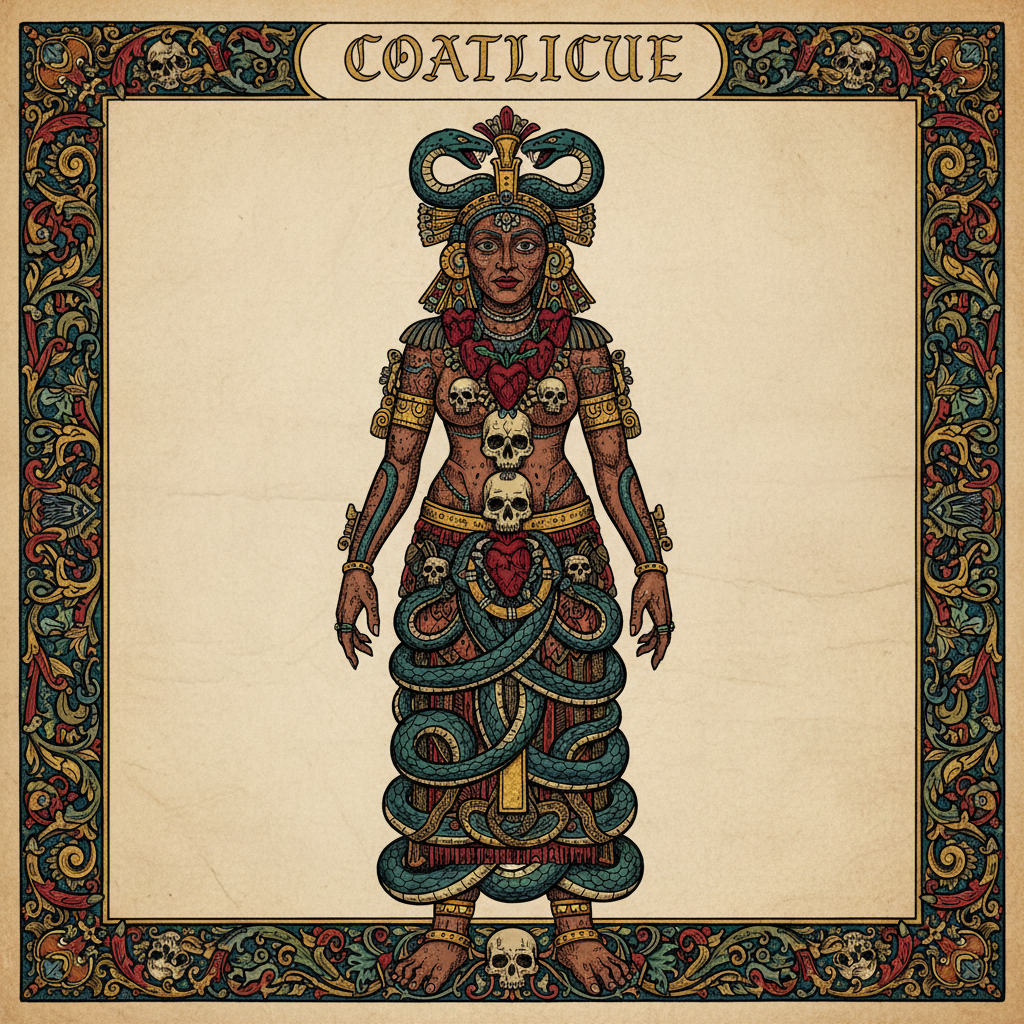
Cihuacoatl, the snake-woman goddess, helps him. She grinds the bones finer where they need grinding. She mixes the meal. She is the midwife of the Fifth Race the way she is the midwife of every birth, and she does not flinch at the blood.
When the work is done, the first humans of the Fifth Sun stand up on the courtyard floor. They are smaller than the previous humanities. They are made of mismatched bones. They have, inside their bodies, the blood of the god who descended for them — and that blood is the reason, the Aztecs will say for the rest of their civilization, that humans owe blood back. Not because the gods are cruel. Because the gods went into Mictlan for us, and dropped us, and bled themselves to put us back together, and the blood-debt runs in our veins.
The Florentine Codex is restrained. The Codex Chimalpopoca is more graphic. Both agree on the structure: descent, trick, fall, broken bones, divine blood.
Western readers tend to recoil from Aztec sacrifice. Reading the creation story changes the recoil into something more uncomfortable: a recognition that the sacrificial economy was not arbitrary cruelty but a theological accounting. If a god bled to make you, you bleed back. The Mexica state turned this into industrial-scale violence at Tenochtitlán’s altars, and that violence is its own indictment. But the underlying claim — that humans are mended bones held together by divine blood, and that the mending is the whole story — is one of the strangest and most honest creation myths in any tradition.
Quetzalcoatl himself, in later legend, will refuse the sacrificial economy his own descent founded. He will exile himself rather than accept human hearts. The contradiction is not resolved. It is the engine of the religion.
Scenes
The ninth layer of Mictlan
 Generating art…
 The worms drill four clean holes in the spiral
 Generating art…
 Tamoanchan, after the descent
Generating art… Echoes Across Traditions
Entities
- Quetzalcoatl
- Mictlantecuhtli
- Mictecacihuatl
- Xolotl


Sources
- Bernardino de Sahagún, *Historia general de las cosas de Nueva España* (Florentine Codex), Book 7 (~1577)
- *Leyenda de los Soles* (Codex Chimalpopoca, ~1558)
- Miguel León-Portilla, *Aztec Thought and Culture* (1963)
- David Carrasco, *Quetzalcoatl and the Irony of Empire* (1982; rev. 2000)
- Karl Taube, *Aztec and Maya Myths* (1993)