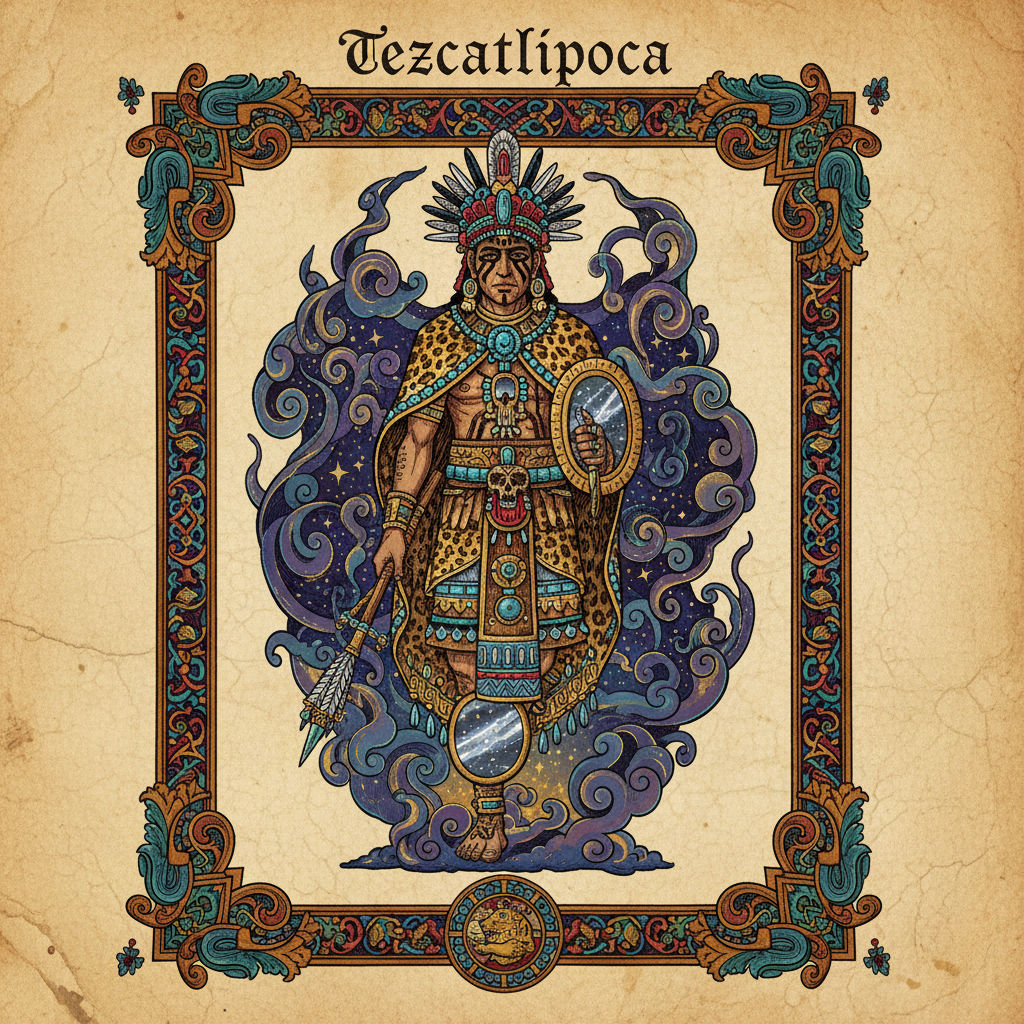
Tezcatlipoca and the Mirror That Shows Everything
Mythological time; Toltec historical period c. 900–1150 CE · Tula (Tollan), Hidalgo, Mexico; the Night Sky
Contents
The god of the night sky and sorcery who carries a smoking obsidian mirror in which he can see all things. His rivalry with Quetzalcoatl. The night he showed Quetzalcoatl his reflection and broke him.
- When
- Mythological time; Toltec historical period c. 900–1150 CE
- Where
- Tula (Tollan), Hidalgo, Mexico; the Night Sky
Tezcatlipoca arrives at Tula before he is recognized.
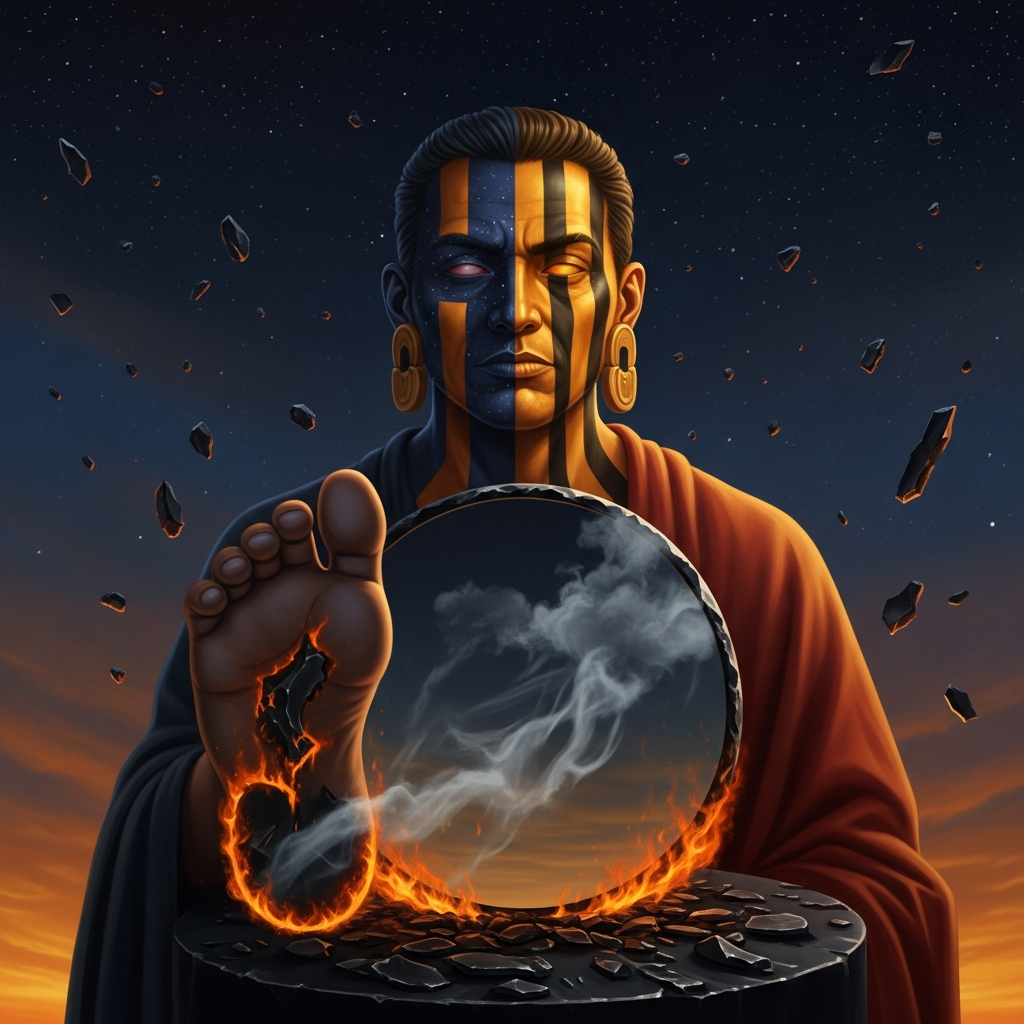
This is how it always works with him. He is the god of the night sky, the jaguar that paces the darkness while the sun is gone, the keeper of the obsidian mirror that smokes without fire and shows what is real rather than what is wished. He has no fixed shape. His foot is the mirror itself — in the early sky battles, when he fought with Quetzalcoatl over the creation of successive worlds, the earth-monster bit his foot off, and what grew back in its place was the polished volcanic glass that sees everything. He walks on it. Every step leaves a smoky reflection.
He comes to Tula in the form of an old merchant selling green chiles, or in the form of a young warrior with a magnificent headdress, or in the form of a doctor. The sources do not agree on the disguise. What they agree on is the purpose. Tezcatlipoca has come to Tula because Tula is too good. Quetzalcoatl — Ce Acatl Topiltzin Quetzalcoatl, the feathered-serpent priest-king who has built in Tula the greatest city the Toltec people have made — has instituted a reign of such rigorous virtue that it is becoming a problem.
The problem is this: Quetzalcoatl opposes blood sacrifice.
In Tula under Quetzalcoatl, the offerings are butterflies and snakes and flowers. The corn cobs are the size of a man’s arm. The cotton grows in colors — red, yellow, green — without being dyed. The birds called trogons and roseate spoonbills live in the courtyards because Quetzalcoatl has planted the trees they need. The artisans produce featherwork so fine that the feathers seem to grow from the fabric directly. The theology of Quetzalcoatl is the theology of beauty and order, the earth as it would be if the gods were fully appeased and human conduct were perfectly calibrated.
Tezcatlipoca sees this and understands what it means. A theology of beauty and order without blood is a theology that has forgotten something. It has forgotten that the sun requires feeding. It has forgotten that the earth is not naturally given to generosity. Quetzalcoatl’s Tula is an argument that the cosmic debt can be discharged through beauty alone, and Tezcatlipoca knows — in the way that darkness knows what light obscures — that this argument is false. More specifically, he knows it is false about Quetzalcoatl himself.
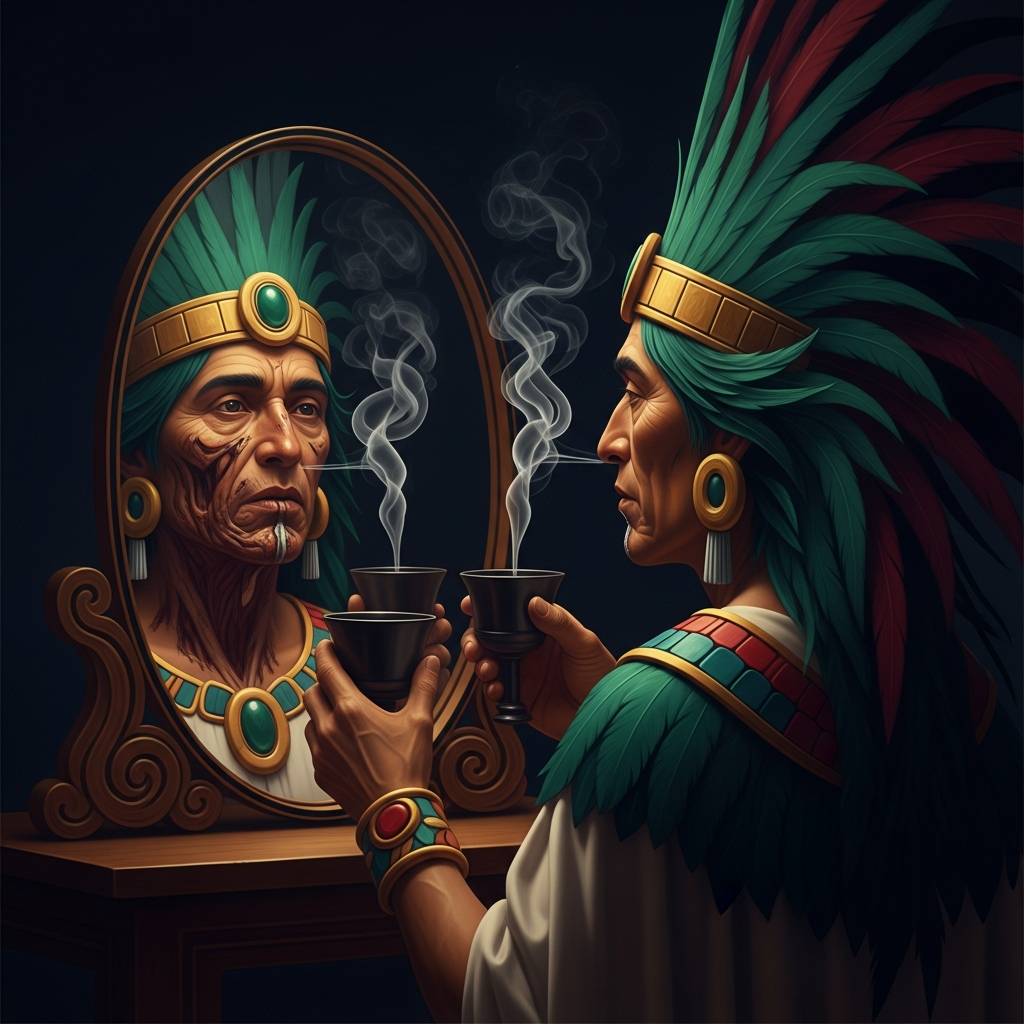
He goes to the palace and asks to see the king. He says he has a gift. He unwraps the smoking mirror.
No one who looks into the obsidian mirror sees what they want to see.
The mirror shows exactly what is there. It is the anti-wish. Every powerful person who looks into it sees their own face, which is the face of a mortal, which is lined and aging and ultimately the face of a corpse that has not yet stopped moving. Quetzalcoatl is a king who has been performing divinity for so long that he has partly forgotten the performance. He has not looked at his own face in years, or he has looked but not seen. He is the feathered serpent. He has the calendar name Ce Acatl, One Reed, and his birth and death dates are both predicted to fall on days named One Reed, which means the mythology has already scripted his departure.
He looks into the mirror.
What he sees there — an old man’s face, a body beginning its slow withdrawal from itself — the sources describe with some variation. Some say it broke his peace. Some say it induced in him a specific kind of shame, the shame of having maintained so rigorous a purity that the sight of his own ordinariness was unbearable. Tezcatlipoca, watching him look, offers the solution immediately. There is pulque, the fermented maguey drink that Quetzalcoatl has renounced as part of his discipline. It will ease the distress. It will make the reflection bearable.
He drinks. He drinks more. He calls for his sister, and what happens between them that night is the desolation the myth has been preparing: not a single transgression but the collapse of the entire architecture of virtue that required constant vigilance to maintain, all of it, the butterflies and the dyed cotton and the prohibition on blood, undone in one night by the thing the mirror showed.
He leaves the city before dawn.
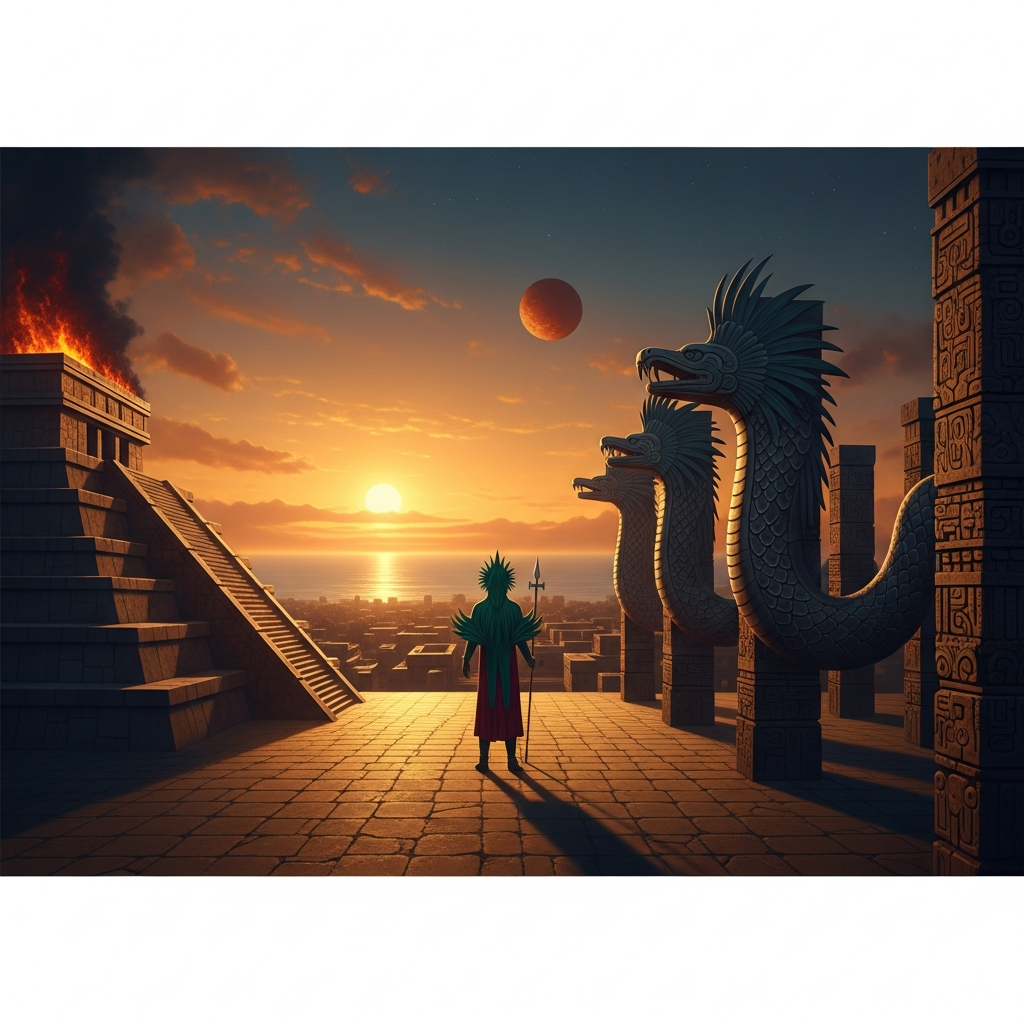
There is a version in which he buries his treasures first — the turquoise masks, the featherwork, the seeds of the colored cotton — and all of it rots or vanishes before anyone can find it, because these things were his and belonged only to the dispensation he embodied. There is a version in which he burns Tula himself, torching the temples and the ball court and the great colonnaded halls, not in rage but in some combination of grief and intentionality, closing the record before someone else writes over it. The bird-carvings and serpent-columns remain standing in either version, the carved stone bodies without the priest who gave them meaning.
He walks east. He walks toward the sea, toward the horizon where Venus rises in its role as morning star — and Quetzalcoatl in his calendrical identity is identified with Venus, the star that precedes the sun and disappears into the underworld and returns. At the coast, different versions of the story diverge: he builds a raft of serpents and sails east across the sea; he immolates himself on a funeral pyre and his heart becomes Venus directly; he promises to return on a day One Reed. Cortés arrived in Mexico in a One Reed year. Moctezuma knew.
Tezcatlipoca does not follow him to the coast. He does not need to. The mirror has already done its work.
The theological argument between Tezcatlipoca and Quetzalcoatl is one of the deepest arguments in Mexica religion.
Quetzalcoatl represents the aspiration toward a cosmos governed by beauty and mind — feathers rather than blood, understanding rather than force. Tezcatlipoca represents the counter-argument: that this aspiration is itself a kind of lie, a failure to see the cosmos as it is, a refusal of the darkness that is half of what exists. The smoking mirror is not a weapon of malice. It is an epistemological instrument. It shows what is true. What is true about Quetzalcoatl — that he is an old man, a mortal, a person capable of the failures his discipline had been straining to prevent — is not something Tezcatlipoca fabricated. It was already there. The mirror only made it visible.
David Carrasco reads this myth as a story about the irony of empire: that the very virtues that create civilization contain within them the seeds of its undoing, that the king who refuses blood will eventually perform a different and worse version of it in private. The sacrifice that Quetzalcoatl withheld from the gods he spent on himself.
Tula falls. It always falls. The mirror is always right.
What Tezcatlipoca offers, in every encounter, is the same thing: an accurate reflection. The question the myth poses is whether a civilization — whether a person — can bear to be seen truly, and what they drink to make the seeing stop.
Scenes
Tezcatlipoca in the night sky, the obsidian mirror where his foot should be, stars behind him like scattered obsidian chips
 Generating art…
 Quetzalcoatl, the plumed serpent-priest-king of Tula, looking into the smoking mirror for the first time
 Generating art…
 The city of Tula burning in the distance at dawn
 Generating art…
 Echoes Across Traditions
Entities
- Tezcatlipoca
- Quetzalcoatl
- Smoking Mirror
- Tula


Sources
- Bernardino de Sahagún, *Florentine Codex: General History of the Things of New Spain*, Book III (trans. Anderson and Dibble, 1952)
- Inga Clendinnen, *Aztecs: An Interpretation* (Cambridge University Press, 1991)
- David Carrasco, *Quetzalcoatl and the Irony of Empire: Myths and Prophecies in the Aztec Tradition* (University of Chicago Press, 1982)
- Cecelia Klein, 'The Devil and the Skirt: An Iconographic Inquiry into the Pre-Hispanic Nature of the Tzitzimime,' *Ancient Mesoamerica* 11 (2000)
- Miguel León-Portilla, *Aztec Thought and Culture* (University of Oklahoma Press, 1963)