The Gods Who Threw Themselves into the Fire
Mythological time — the creation of the fifth sun, before history begins · Teotihuacan, Valley of Mexico
Contents
The creation of the fifth sun at Teotihuacan: the two gods who volunteered to become the sun and moon by leaping into the fire. Nanahuatzin, humble and syphilitic, leaped without hesitation. Tecuciztecatl, proud and beautiful, hesitated four times before jumping. The order of their leaping explains why the moon is dimmer than the sun.
- When
- Mythological time — the creation of the fifth sun, before history begins
- Where
- Teotihuacan, Valley of Mexico
The gods have already destroyed four worlds.
Each one was made and unmade in sequence — the first sun, the second sun, the third, the fourth — each destroyed by the conflict between cosmic forces that cannot be reconciled by any arrangement of the previous world. The jaguar ate the first. Wind destroyed the second. Rain of fire ended the third. Flood drowned the fourth. Each destruction was also a kind of failure of design, an experiment in cosmological architecture that collapsed because the materials were wrong or the proportions were off or the gods who powered it could not be sustained.
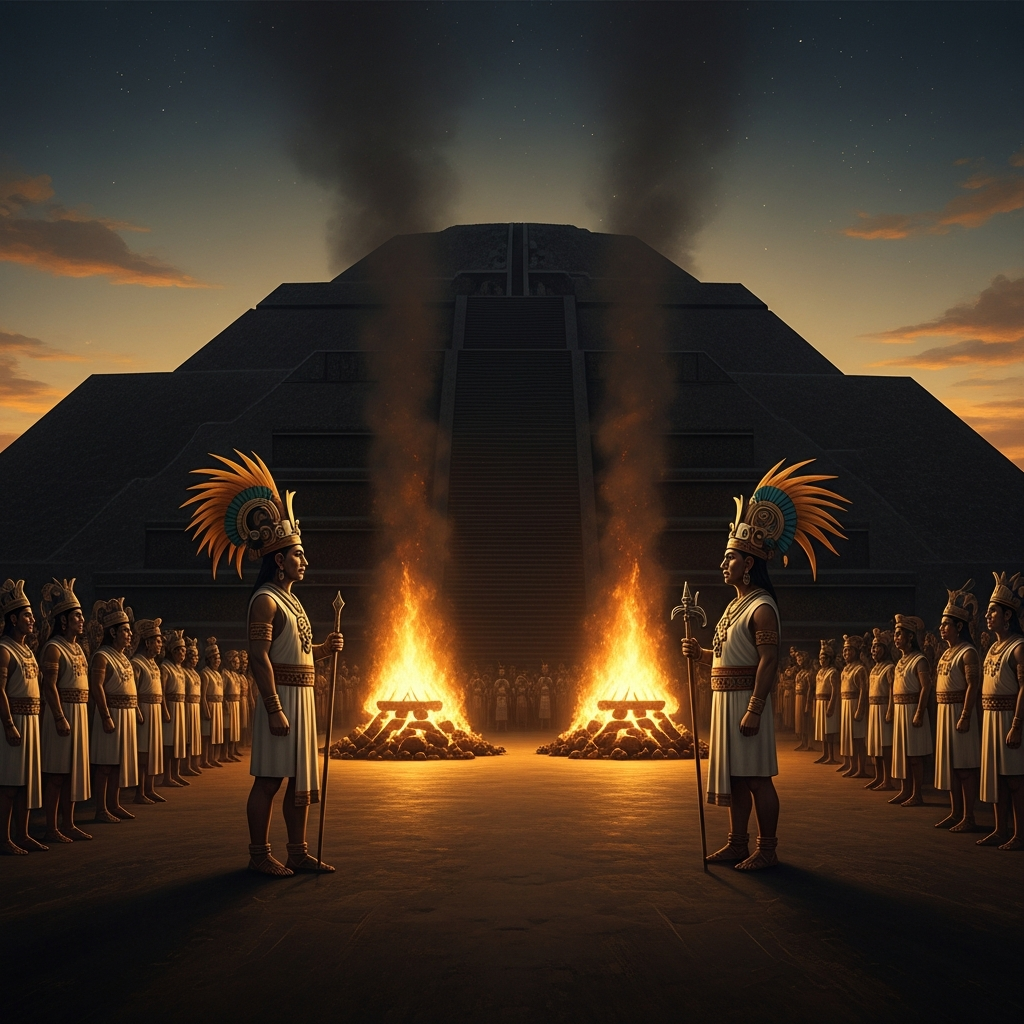
Now the gods have gathered at Teotihuacan, the Place Where Men Become Gods, in the darkness before any sun exists. They have lit a great fire, and the fire has been burning for four days, and the question before the assembly is: who will leap into it? Someone has to. The fire is the transformation mechanism. It will receive a god and return a sun. But the god who leaps will be consumed, and what returns will not be a god in any ordinary sense — it will be a ball of burning stone crossing the sky every day until the fifth world ends, as the others ended, in whatever catastrophe the calendars predict.
Two gods have volunteered.
They could not be more different.
Tecuciztecatl is beautiful. He is wealthy, in the way that gods can be wealthy — his offerings to the fire, which the assembled gods observe being prepared, are exquisite. Where other gods bring bundles of grass and cactus spines stained with their own blood, Tecuciztecatl’s penance gifts are coral and quetzal feathers and red-stained spines made of precious stone rather than actual thorns. He performs his ritual bloodletting with spines made of coral. His performance of sacrifice is magnificent. He is visibly, conspicuously the more impressive candidate.
Nanahuatzin is not beautiful. His name means something like the Pimpled One or the Syphilitic One, and the sources are not using these as metaphors — his body is covered with scabs and sores, his pennants are made of paper rather than feathers, his grass bundle is scrubby, his bloodletting spines are actual grass stalks sharp enough to wound but nothing like the coral of Tecuciztecatl. He has nothing impressive to offer except his blood, and his blood is already compromised. He is the least god at the assembly.
Both of them have fasted and done penance for four days before the leap. The fire has built itself into the kind of heat that the sources describe carefully: a fire so hot that standing near it is already an act of courage. The gods arrange themselves in two rows facing the fire, a corridor of divine observers, and the moment comes.
Tecuciztecatl is called to leap first.
He runs at the fire four times.
The Florentine Codex is exact about this. Each time he runs toward the heat, he stops. He flinches back. He cannot — the fire is too hot, the light too blinding, the reality of what he is being asked to do too present. He runs again. He stops again. The gods watch. The count is four: four approaches, four retreats, and in the Mexica ritual-numeric system four is the number of cardinal directions and completed cycles, which means four failed approaches is a specific kind of failure, a spatial and temporal completeness of cowardice that the myth records with precision.
After the fourth failure, the gods turn to Nanahuatzin.
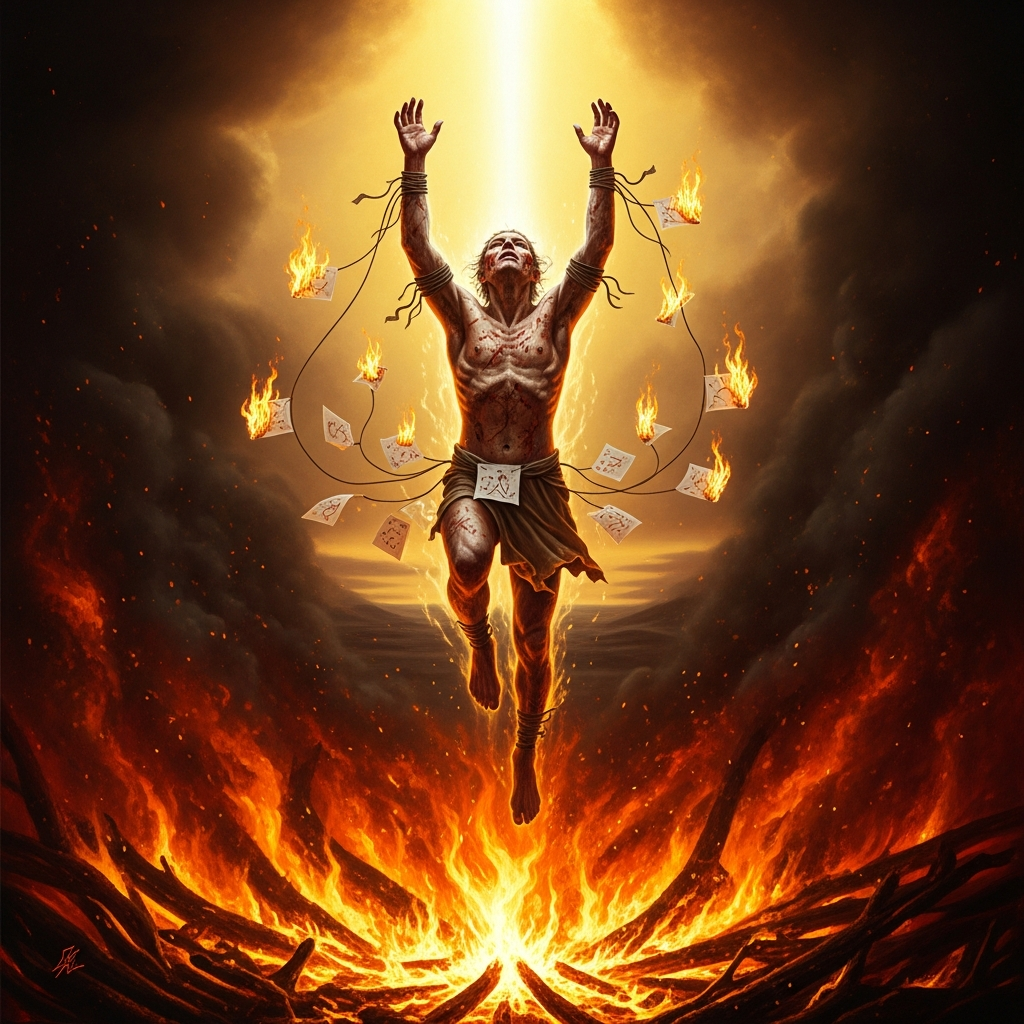
He does not run. He gathers himself — the sources use the word for preparation, for the kind of internal collecting that happens before action — and then he leaps directly into the heart of the fire. There is no hesitation. No approach and retreat. No display. He goes in.
The Florentine Codex says the earth shook.
Tecuciztecatl, watching Nanahuatzin enter the fire without pausing, is shamed into his own leap. He goes in after him. He burns. The gods watch from their two rows as both figures become incandescent.
Then nothing happens.
The horizon is dark. The assembled gods do not know from which direction the sun will rise — east is not yet east, because east is defined as the direction from which the sun comes, and no sun has come yet. They watch all four quadrants. The Florentine Codex describes them turning in every direction, uncertain.
Then the east brightens.
Nanahuatzin rises first — brilliant, almost unbearably bright, the light of the new sun filling the entire horizon before the disk itself appears. Then Tecuciztecatl rises, and he is nearly as bright, and the assembled gods realize that they have two suns. The world as they intend it cannot function with two suns of equal brilliance; the night cannot exist, the darkness in which life rests and regenerates cannot exist, if both hemispheres are blazing continuously. A god takes a rabbit and strikes Tecuciztecatl’s face with it — this is the rabbit that can still be seen in the moon’s surface, the mark of the blow that reduced the second sun to the level of a moon — and Tecuciztecatl dims.
There is now one sun and one moon.
But the sun will not move.
It hangs on the horizon, brilliant and still, and the gods argue about what they must do. The sun does not move because it is waiting. Nanahuatzin leaped into the fire and gave everything he had — his scabbed body, his paper pennants, his inadequate bloodletting implements — and was transformed into the sun. But the sun requires continuous feeding to move. What it consumed in the transformation is not enough for the ongoing motion of crossing the sky every day for the duration of the fifth world. The sun is waiting for what the gods owe it.
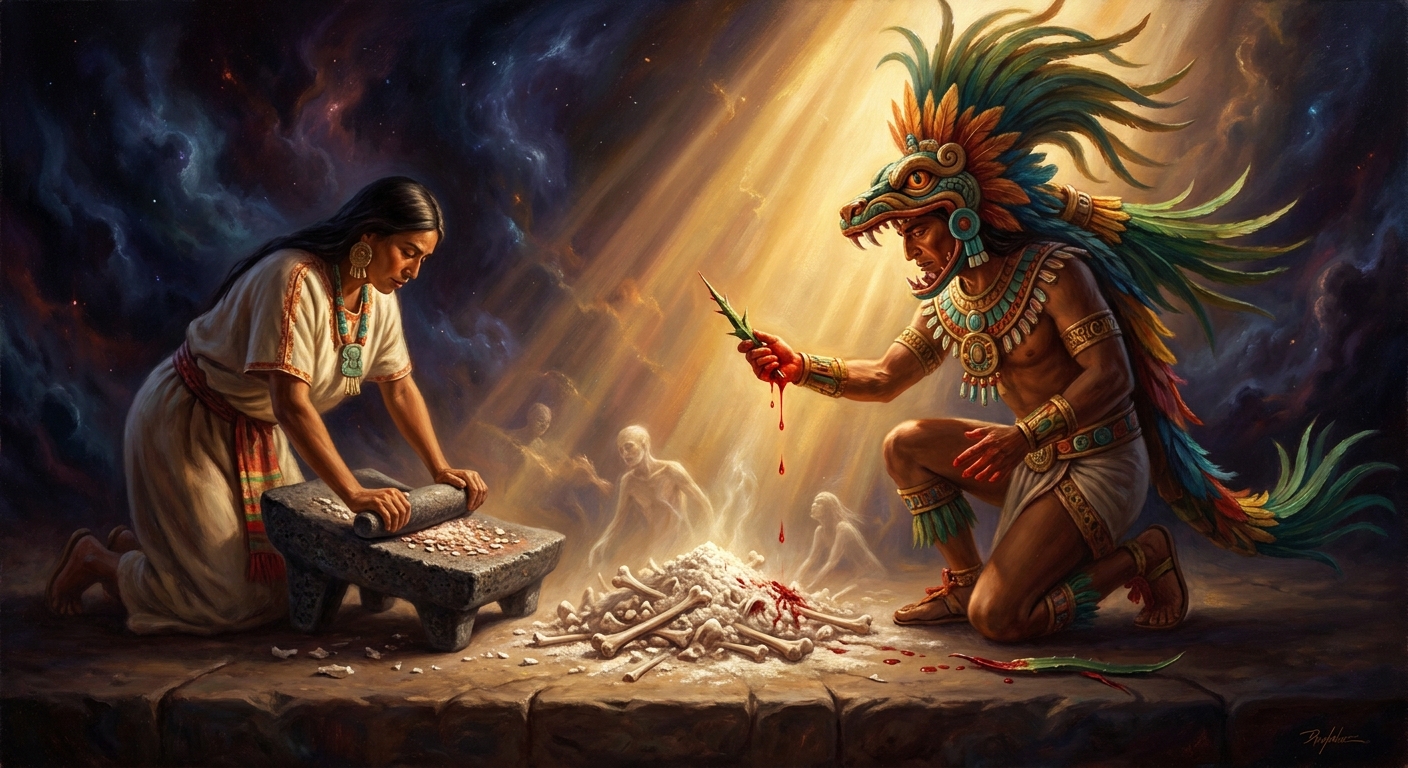
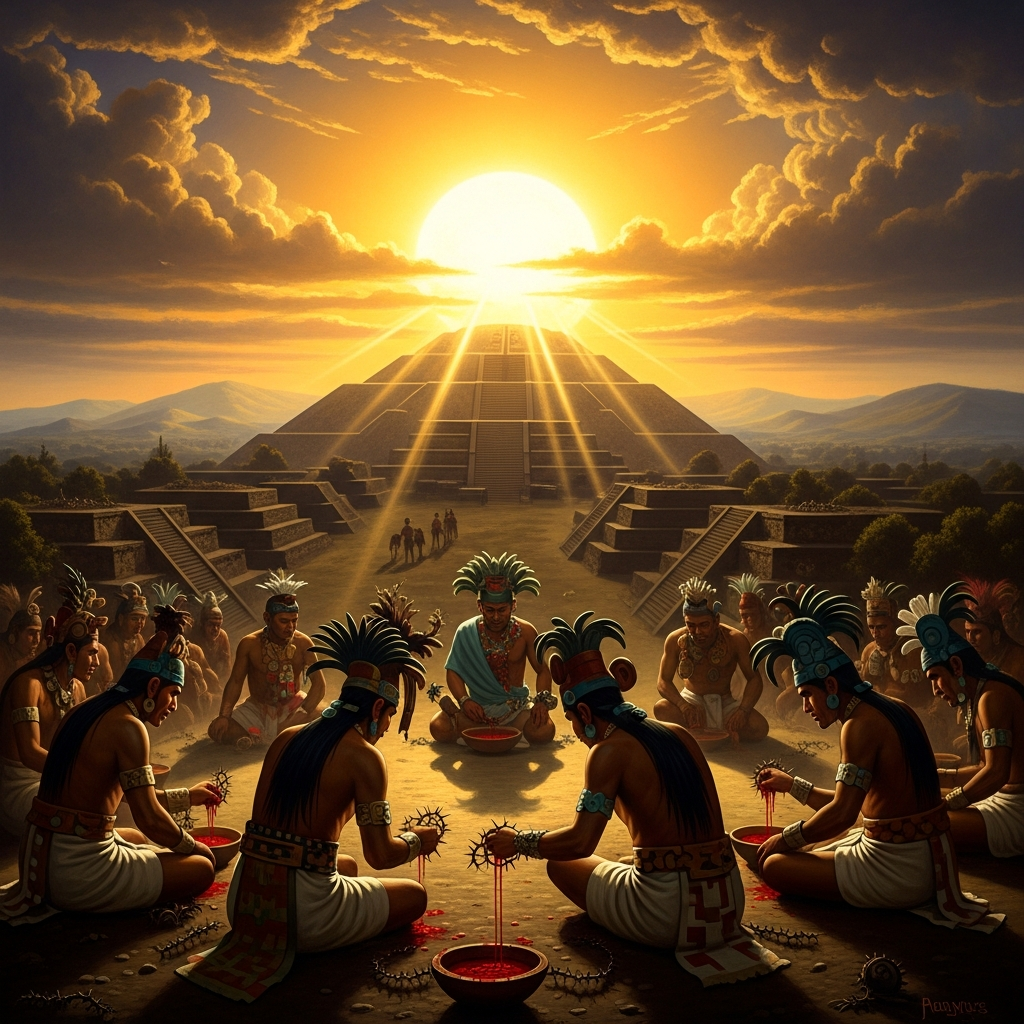
The gods bleed themselves. All of them. They puncture their ears and genitals and tongues with obsidian blades and offer the blood, and the sun begins to move, and the sky tilts, and east becomes east, and the first day of the fifth world begins.
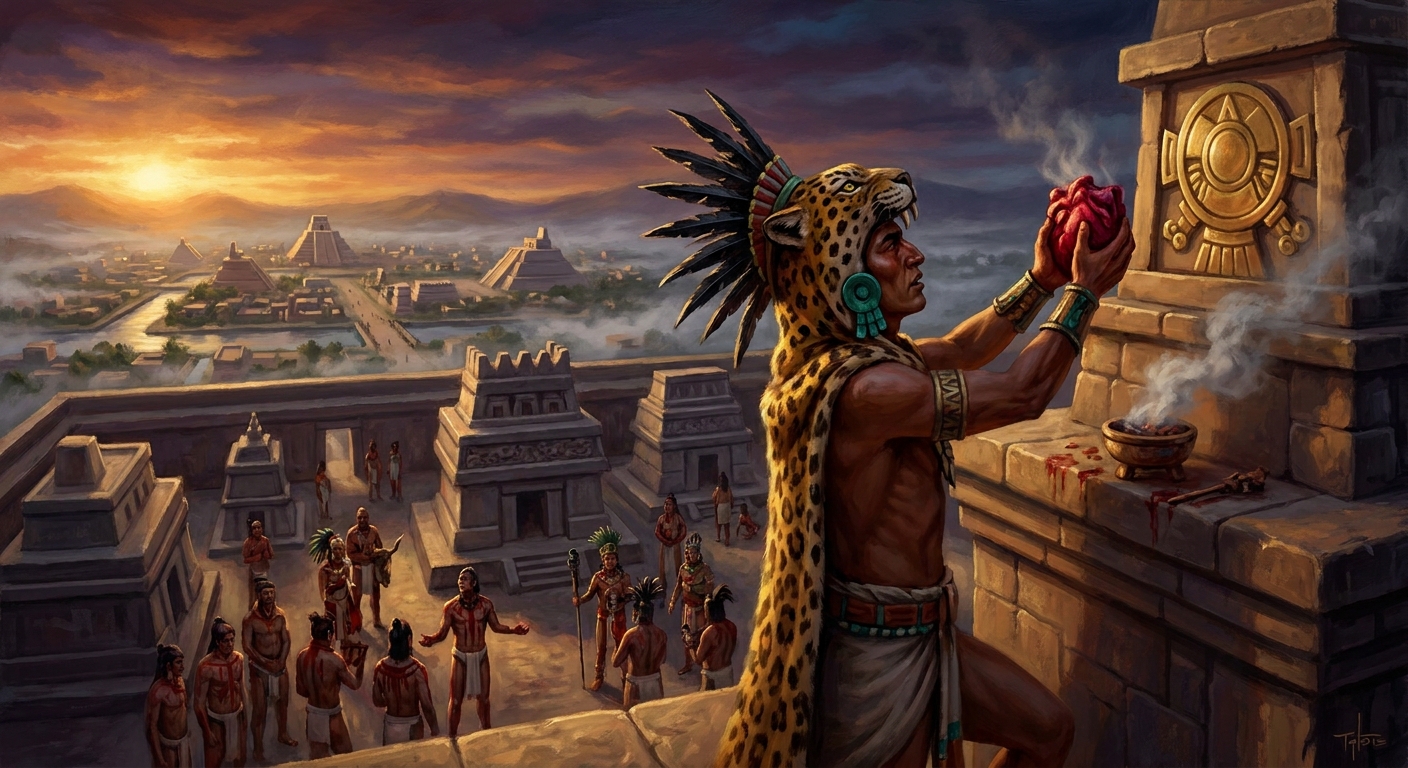
This is what human sacrifice maintains in the Mexica theological system: not the creation of the sun, which required a god, but the sun’s motion. The blood debt incurred at Teotihuacan is what every sacrifice is paying forward. The body on the altar at the top of the Templo Mayor is Nanahuatzin, offered again, the humble one, the sufficient one, the one whose willingness to enter the fire without hesitation made the world possible.
What the myth asks you to notice is which god made the world. Not Tecuciztecatl with his coral and his quetzal feathers and his four magnificent approaches to the fire. The world was made by the syphilitic one, the paper-pennant one, the one whose bloodletting grass was barely sharp enough to count. Courage and beauty, in the Mexica cosmogony, are not the same thing. The gods who watch most carefully are the ones who notice the difference.
Scenes
The gods assembled at Teotihuacan before the great fire, the pyramid mounds dark in the pre-dawn dark
 Generating art…
 Nanahuatzin, scabbed and unbeautiful, his paper pennants already burning at the edges, leaping without a pause into the heart of the fire
 Generating art…
 The fifth sun rising over Teotihuacan for the first time, blinding and still, refusing to move until the gods offer their own blood
 Generating art…
 Echoes Across Traditions
Entities
- Nanahuatzin
- Tecuciztecatl
- Tonatiuh
- Tecuciztecatl as Moon
Sources
- Bernardino de Sahagún, *Florentine Codex: General History of the Things of New Spain*, Book VII (trans. Anderson and Dibble, 1953)
- Inga Clendinnen, *Aztecs: An Interpretation* (Cambridge University Press, 1991)
- David Carrasco, *City of Sacrifice: The Aztec Empire and the Role of Violence* (Beacon Press, 1999)
- Karl Taube, *Aztec and Maya Myths* (British Museum Press, 1993)
- Cecelia Klein, 'Rethinking Cihuacoatl: Aztec Political Imagery of the Conquered Woman,' in *Smoke and Mist: Mesoamerican Studies in Memory of Thelma D. Sullivan* (1988)