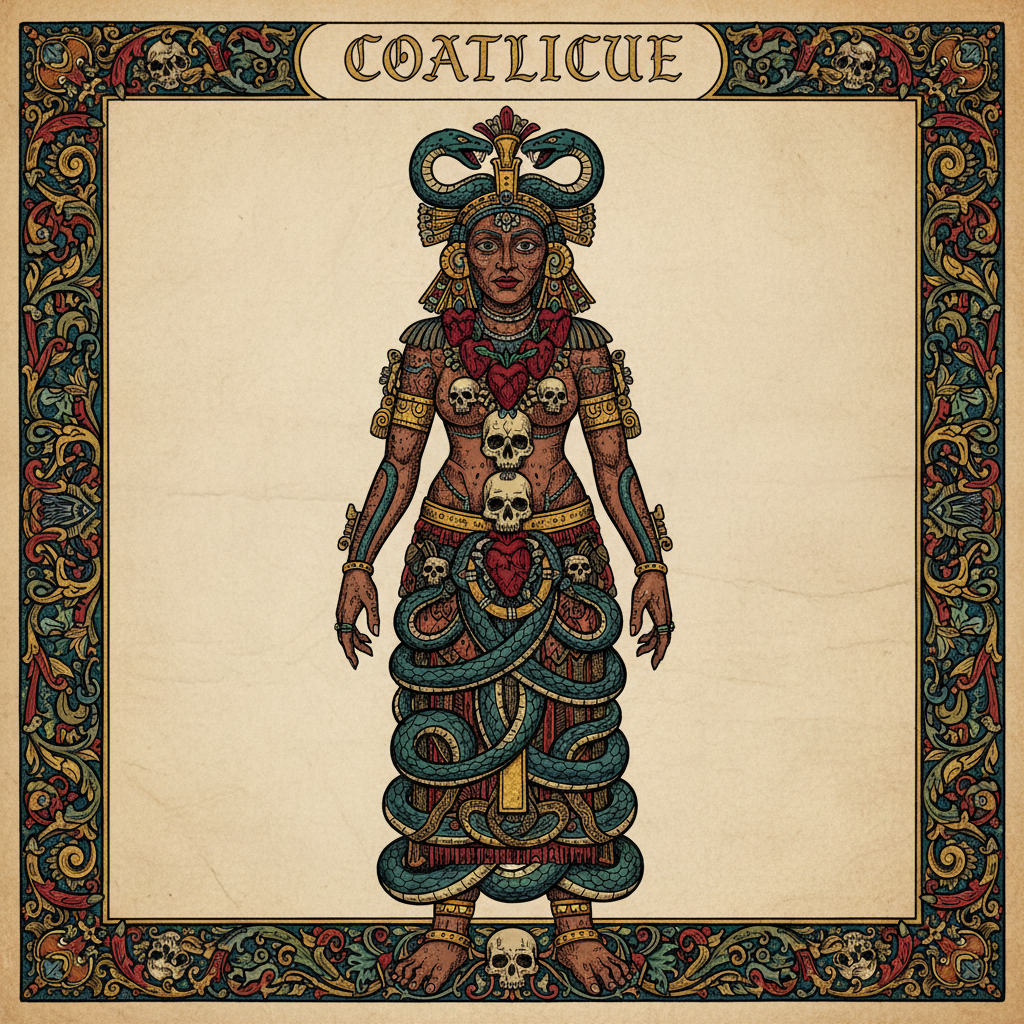
Coatlicue at Coatepec
Mythic Time — Aztec cosmogony · *Florentine Codex* Book 3, Sahagún ~1580 CE · Coatepec — Serpent Mountain, near Tula
Contents
The earth goddess Coatlicue becomes pregnant from a ball of feathers while sweeping her temple on Serpent Mountain. Her four hundred star-children, led by her daughter Coyolxauhqui the moon, march to kill her for the dishonor. From her womb, before he is born, the unborn Huitzilopochtli already knows what he is going to do about it.
- When
- Mythic Time — Aztec cosmogony · *Florentine Codex* Book 3, Sahagún ~1580 CE
- Where
- Coatepec — Serpent Mountain, near Tula
The ball of feathers descends from a clear sky.
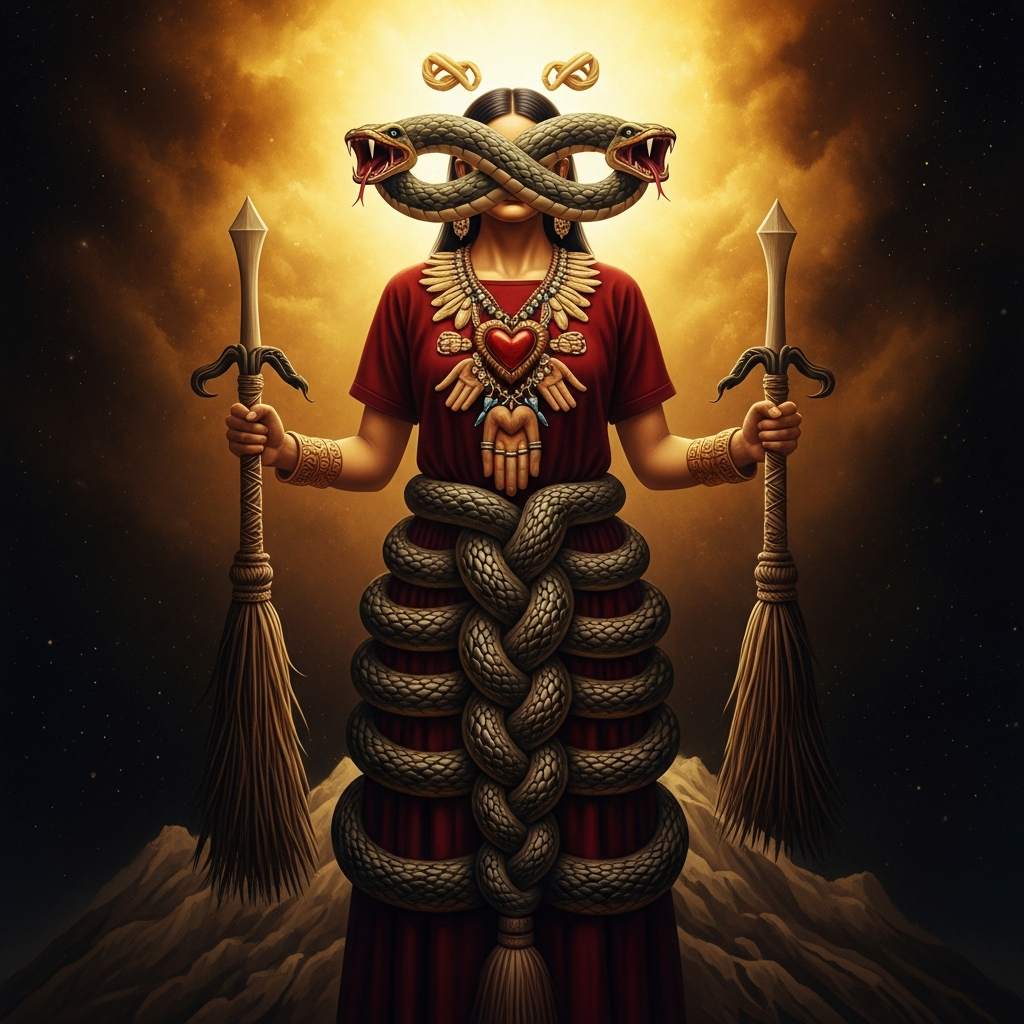
Coatlicue is sweeping the temple at the top of Coatepec when it happens — the temple that is her duty, the summit of Serpent Mountain where the gods maintain their presence in the Valley of Mexico. She is the earth goddess: her skirt is made of living serpents braided together at the waist, her necklace is strung with human hearts and severed hands and a skull pendant at the center, her face is two serpent heads meeting across the space where a human face would be, two mouths and four eyes looking in opposite directions simultaneously. She is not beautiful in any way that the human categories of beauty organize themselves. She is accurate. She is what the earth actually is — the place where the dead go and the food comes from, fecundity and consumption in one body, the soil that gives and takes simultaneously.
She sweeps. The ball of feathers falls from the sky and lodges against her chest. She tucks it into her breast, thinking she will set it aside later. She continues sweeping.
When she realizes she is pregnant, the feathers are gone — absorbed. Whatever descended from the sky has taken hold.
Her daughter notices before anyone else.
Coyolxauhqui is the moon — Golden Bells on Her Cheeks, the warrior daughter who leads the four hundred Centzon Huitznahua, the stars of the southern sky, the army of the night. She is ancient and powerful and she loves her mother, and she sees the pregnancy and immediately constructs the logic of it: there is no father, no god who has come to Coatepec and departed with permission, no sanctioned union that the family has been told about. The old earth goddess is pregnant by something the family does not know.
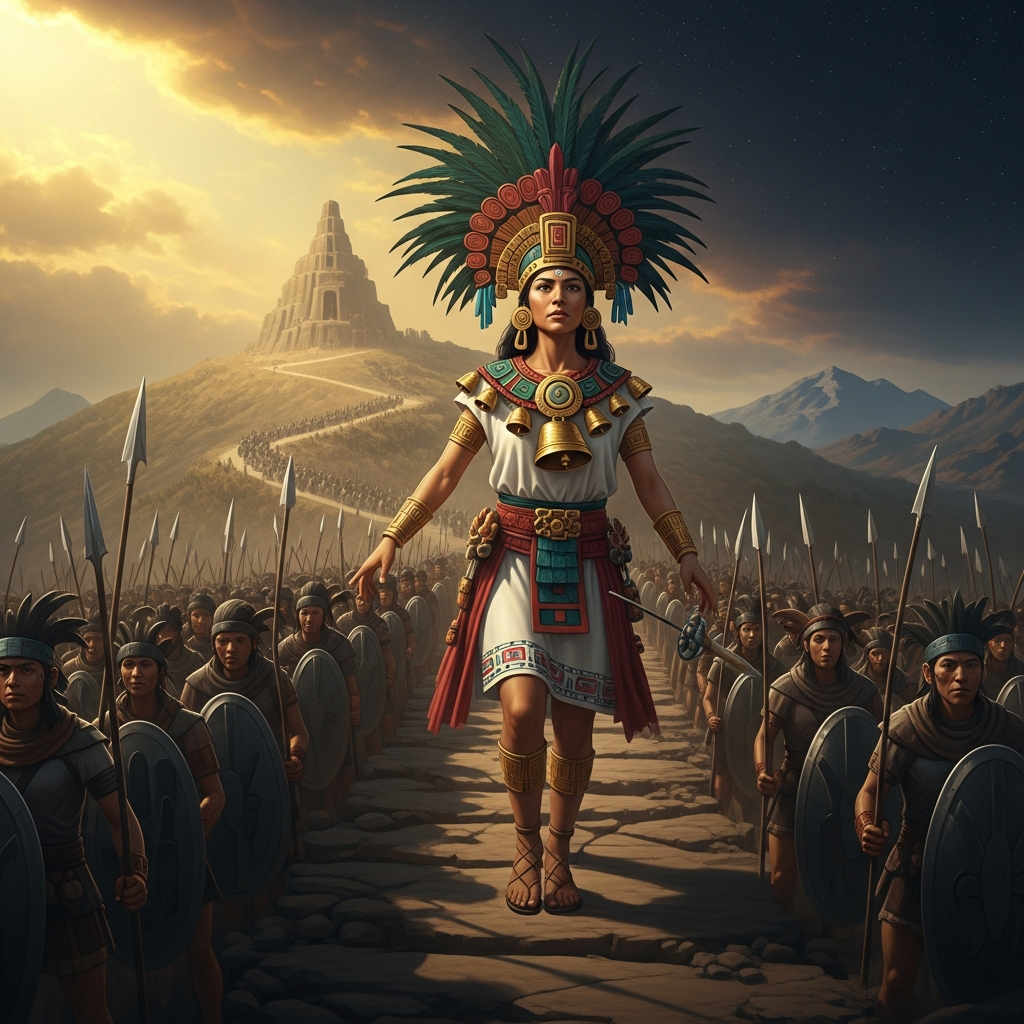
This cannot stand. Coyolxauhqui is certain of this. She calls the four hundred brothers together on the slopes below the temple summit and she speaks, and the Florentine Codex gives her the clear, clean words of someone who has already decided: they will go up the mountain. They will handle it. Their mother’s dishonor requires action.
The four hundred arm themselves — obsidian-tipped spears, atlatl darts, war shields — and they begin the climb.
One brother breaks ranks and runs ahead.
Quauitlicac, whose name means He of the Eagle Place, does not march with the formation. He finds a crack in the rock face of Coatepec and puts his face to it and calls through the stone to the child inside Coatlicue: they are coming. They are armed. They are almost at the upper switchback.
The voice that comes back through the stone is not the voice of an unborn child. It is a general’s voice, a tactician’s voice, the voice of something that has been preparing for exactly this situation: I hear you. I know. Do not be afraid. I know what I am doing.
Quauitlicac runs back down to the formation, shaken, and the four hundred continue their climb.
Coyolxauhqui reaches the summit.
She is magnificent at this moment — the Florentine Codex and the archaeology both insist on this. She is armed and armored and her gold bells catch the light of the stars she commands, and she has four hundred warriors behind her, and the target is an old earth goddess who sweeps a temple and does not fight. This should not be complicated. Coyolxauhqui raises the weapon.
Coatlicue falls.
And in the instant of the fall — the sources stack these events so tightly they cannot be separated, cannot be read as sequential, can only be understood as simultaneous — Huitzilopochtli erupts from his mother’s womb.
He is fully formed. Fully armed. Blue-painted, wearing the hummingbird helmet of the left-sided sun, the south side, the heat side. In his right hand the Xiuhcoatl — the Fire Serpent, the turquoise serpent — which is simultaneously lightning and spear and the trajectory of the sun itself across the sky. He does not need to stand. He does not need to orient himself. He was born knowing where his sister is and what she came here to do.
He turns.
The Xiuhcoatl finds her.
The blow is final and total. Coyolxauhqui’s body comes apart at the joints — the Florentine Codex is anatomically specific — her head separating from her torso, her arms from her shoulders, her legs from her hips, her hands scattering. The pieces roll and tumble down the slopes of Coatepec: head coming to rest at the base of the mountain, limbs distributed across the rocks, torso rolling through the pine trees. The gold bells at her cheeks ring as she falls, or maybe the ringing is the sound the myth makes when the moon is struck and diminished and sent to the sky in fragments.
The four hundred Huitznahua scatter. Huitzilopochtli drives them in all directions with the fire serpent and they flee across the sky, which is why the stars are where they are — positioned by their rout, scattered to the edges of the vault by a sun that was born fighting and cannot stop. He does not pursue them past the horizon. He has accomplished the dawn. The battle is won until tomorrow night, when it must be won again.
He rises. He begins to travel west.
The Aztec architects know what they are building.
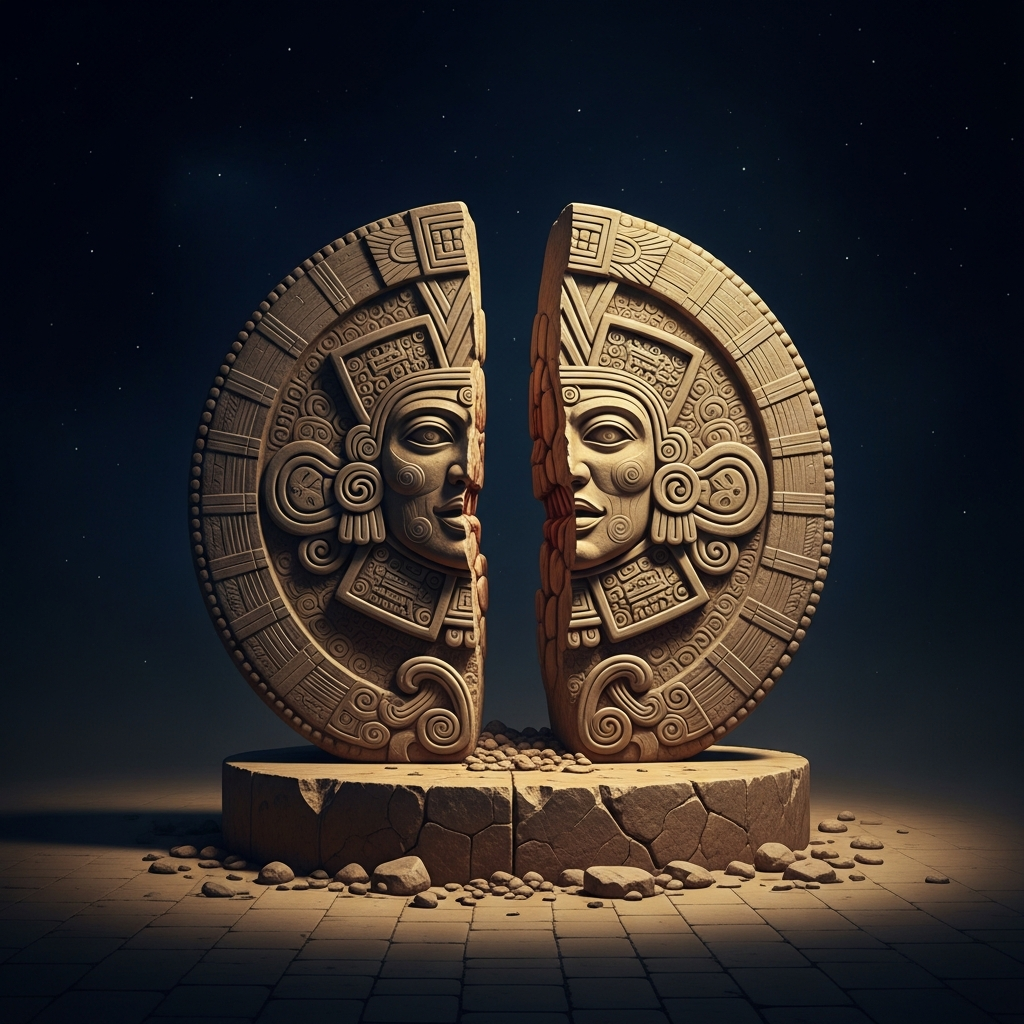
When they construct the Templo Mayor at the center of Tenochtitlan — the great double pyramid that marks the center of the known world, the axis mundi of the Aztec empire, the place where Huitzilopochtli and Tlaloc receive their sacrifices side by side — they build it as Coatepec. They are explicit about this. The pyramid is the Serpent Mountain. The north staircase is Tlaloc’s; the south staircase is Huitzilopochtli’s. At the base of the south face, where Coyolxauhqui’s body landed when Huitzilopochtli struck her down, they place a carved stone disc: the goddess in pieces, her body arranged in the dismemberment pattern, her gold bells still visible on her fractured cheeks, her face still wearing the expression of someone who arrived at the summit certain of what was going to happen and encountered something else entirely.
Every captive sacrificed at the summit of the Templo Mayor falls down the south staircase and lands at the base of the pyramid where Coyolxauhqui waits in stone. Every sacrifice reenacts the birth. Every dawn is Coatepec. Every day the sun wins and the moon retreats and the stars scatter, and the empire that has built its central monument as an architectural retelling of this myth continues to maintain, by sacrifice and calendar and architectural precision, the cosmic mechanics that keep the fifth sun moving.
When the electrical workers cut through a cable conduit beneath the streets of Mexico City in February 1978 and their shovels struck stone carved in relief, they had found her — the Coyolxauhqui stone, three meters below the surface, buried under the colonial city that the Spanish built on top of the Aztec capital they destroyed, the moon goddess waiting in the dark beneath downtown traffic for four and a half centuries, her gold bells intact in the carved stone, still falling, still at the base of the mountain, still where Huitzilopochtli put her.
Scenes
Coatlicue on Serpent Mountain: her skirt of braided snakes, her necklace of hearts and hands, her face of two serpent heads facing each other across the space where a human face would be
 Generating art…
 Coyolxauhqui leads the four hundred Huitznahua up the switchbacks of Coatepec in war formation
 Generating art…
 The Coyolxauhqui stone: the great carved disc of the dismembered moon goddess, found in 1978 beneath a street in Mexico City, placed by the Aztecs at the base of the Templo Mayor so that every sacrifice at the summit would fall to land at her feet
 Generating art…
 Echoes Across Traditions
Entities
- Coatlicue
- Coyolxauhqui
- Huitzilopochtli
- the Centzon Huitznahua
- Quauitlicac


Sources
- *Florentine Codex*, Book 3 — Bernardino de Sahagún (~1580)
- *Crónica Mexicayotl* — Fernando Alvarado Tezozomoc (c. 1609)
- *Historia de los Mexicanos por sus pinturas* (c. 1535)
- Eduardo Matos Moctezuma, *The Great Temple of the Aztecs* (1988)
- Cecelia Klein, 'The Ideology of Autosacrifice at the Templo Mayor,' in *The Aztec Templo Mayor* (1987)
- Inga Clendinnen, *Aztecs: An Interpretation* (1991)