Brigid: The Keeper of the Perpetual Flame
Mythic / historical · Saint Brigid c. 451–525 CE; the goddess much older; the Imbolc festival prehistoric · Kildare (Cell Dara — the Church of the Oak) and the landscape of Leinster
Contents
There are two Brigids — the goddess of poetry, healing, and smithcraft; and the abbess of Kildare, the woman who founded the greatest monastery in early medieval Ireland. They share a feast day. They share a fire. They share a cell of oak. The church does not abolish the goddess; it baptizes her, and the flame at Kildare keeps burning.
- When
- Mythic / historical · Saint Brigid c. 451–525 CE; the goddess much older; the Imbolc festival prehistoric
- Where
- Kildare (Cell Dara — the Church of the Oak) and the landscape of Leinster
The fire at Kildare is older than the church.
That is the first thing the visitor learns. The round hedge of thorn that surrounds the precinct is older than the round wall of stone that replaces it. The precinct itself — the circle of ground around the flame, the small structure of oak that gives the place its name (Cell Dara, the Church of the Oak) — is older than Christianity in Ireland. The flame has been tended by women in unbroken rotation since before anyone in Leinster could write down what the rotation was for.
When the church comes, it does not put the fire out.
It builds an abbey around it.
The goddess Brigid is the daughter of the Dagda, the great god of the Tuatha Dé Danann. She is one of three sisters who all bear the same name: Brigid the poet, Brigid the healer, Brigid the smith. The Irish tradition is comfortable with this. It is the same goddess in three offices. Poetry and medicine and forge-craft are versions of one another in the Celtic imagination — they are the disciplines of making, the threefold work of giving form to formless matter, and the goddess who governs them is the goddess of the workshop of the world.
She is also the goddess of fire.
Imbolc — the feast at the beginning of February, the moment when the ewes begin to give milk again, the first stirring of spring out of the dead winter — is her festival. The fires are lit. The hearths are cleaned. The midwives go from house to house with rush dolls and herb bundles and prayers for the women whose children will be born in the next quarter. The priestesses at Kildare tend the flame that has been tended since the last people remembered to tend it, and the flame keeps burning, and the year turns again.
The Romans do not reach Ireland. The Empire’s wave breaks at the Irish Sea and falls back. Ireland is the only province of Europe that converts to Christianity without first being conquered by Rome.
It converts anyway.
Saint Brigid is born in the middle of the fifth century. The hagiography is layered — Cogitosus writes his Life around 650 CE, two centuries after she dies, and behind his account there are clearly older texts and older oral traditions still. She is the daughter of a chieftain and a slave-woman. Her mother is sold off while she is still in the womb. She is raised in the household of the chieftain who is her father, and she gives away his food, his cattle, his cloak, his butter — anything she can lift, she gives to the poor. The chieftain takes her to the king to be sold for the embarrassment of having such a daughter. While he is inside speaking to the king, Brigid sits in the cart outside and gives away his sword to a leper.
The king refuses to buy her. He says she is too holy to be a slave. The chieftain takes her back, defeated, and gives her permission to do what she wants with her life.
She wants to found a monastery.
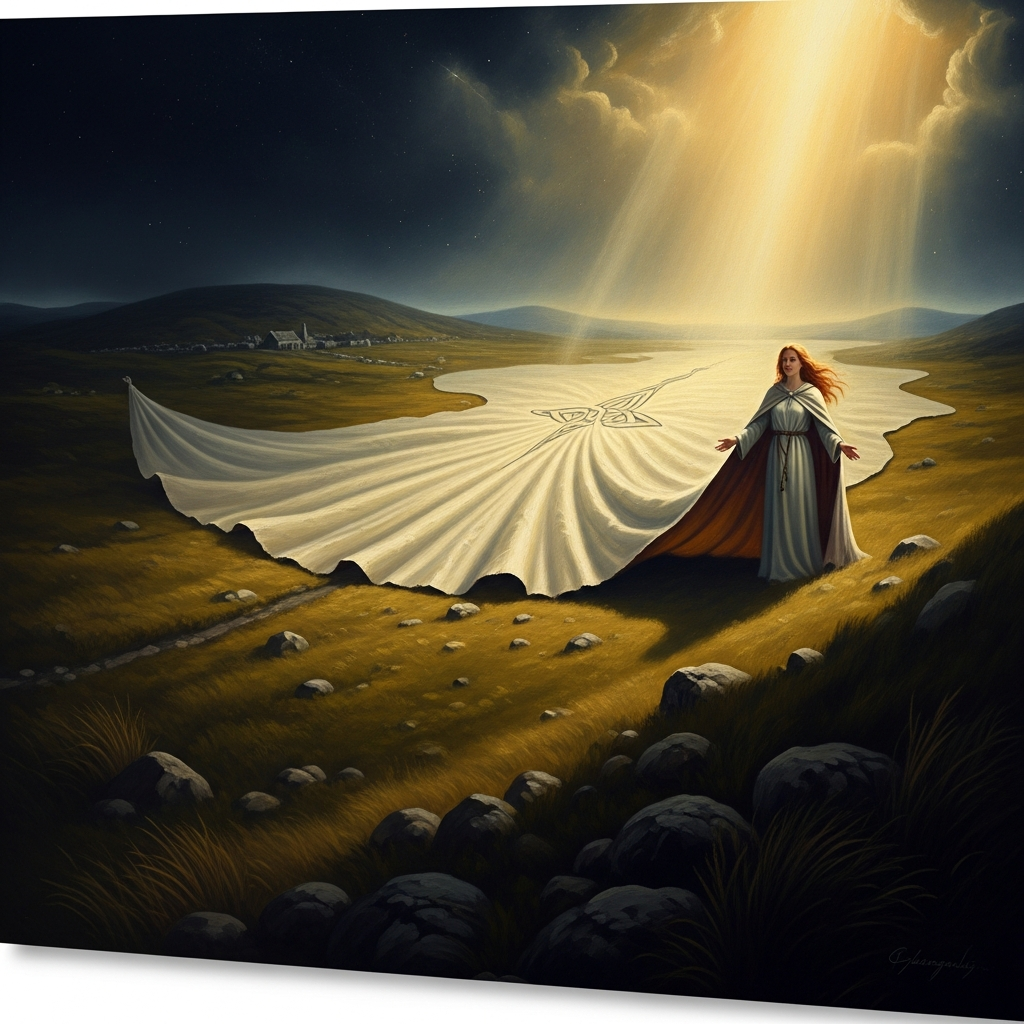
She comes to the king of Leinster and asks for land for her foundation. The king is amused. He says he will give her as much land as her cloak will cover.
She lays the cloak on the ground.
It begins to spread.
Four of her companions take the four corners and walk in four directions, and the cloak unfolds with them, covering more ground the further they walk, until it has covered the whole plain of the Curragh. The king sees what is happening. He stops them before the cloak swallows the kingdom. He gives her the Curragh — a great level plain that becomes the heart of her monastery, a ground that is still pasture today, a place horses run on in the morning when the mist is low.
She founds Kildare on it.
She is, by some traditions, ordained as a bishop — by accident, the texts say, the bishop reading the wrong prayer over her, but the ordination valid once spoken. She rules the monastery as bishop. The monastery is a double monastery — men and women under one rule, with her as abbess over both. This is not unusual in early medieval Ireland. It will become unusual later.
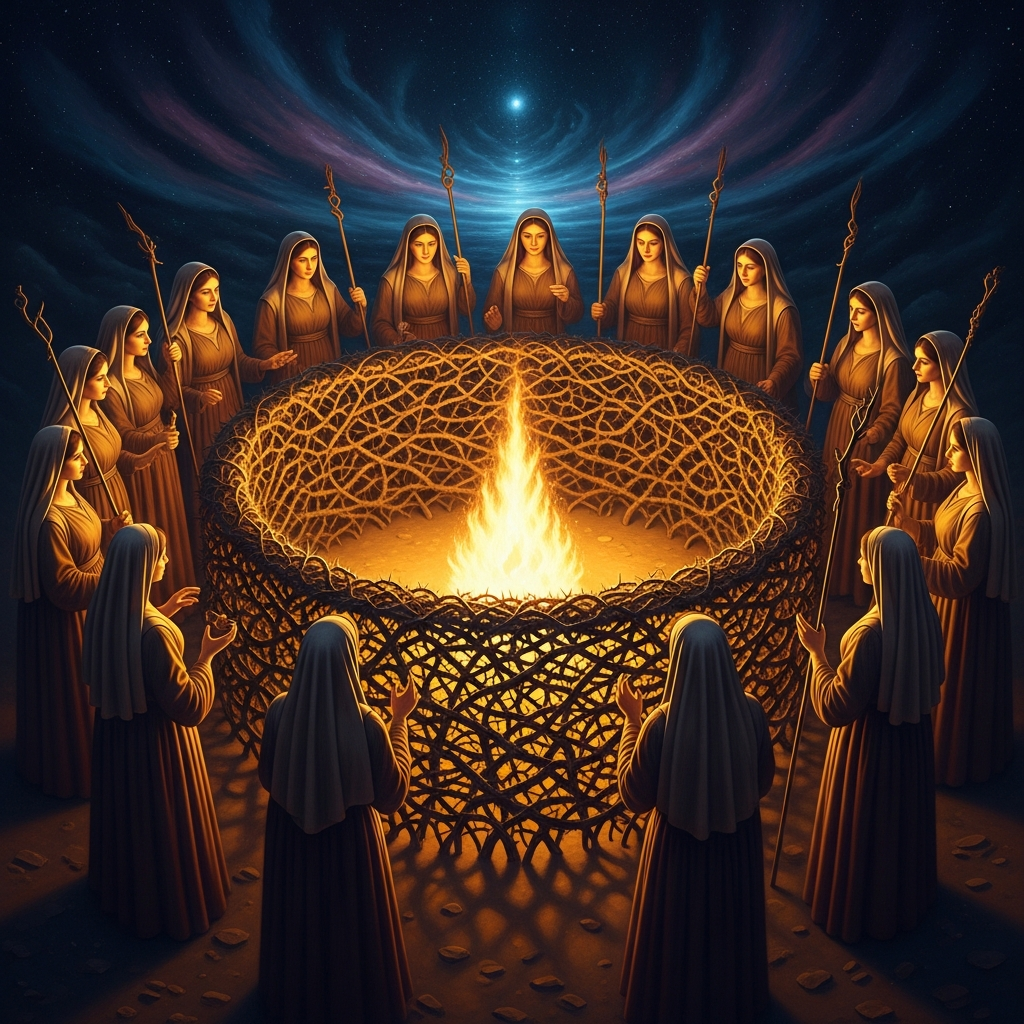
The flame burns in the precinct. Nineteen women tend it in rotation. Each woman keeps the flame for one night. On the twentieth night, no woman tends it — Brigid herself keeps the flame on that night, alone, invisible, the goddess in her saintly form returning to the duty she has had since before the saintly form existed. The hedge of thorn around the precinct admits no man.
This continues for seven hundred years.
The chieftain of Leinster is dying.
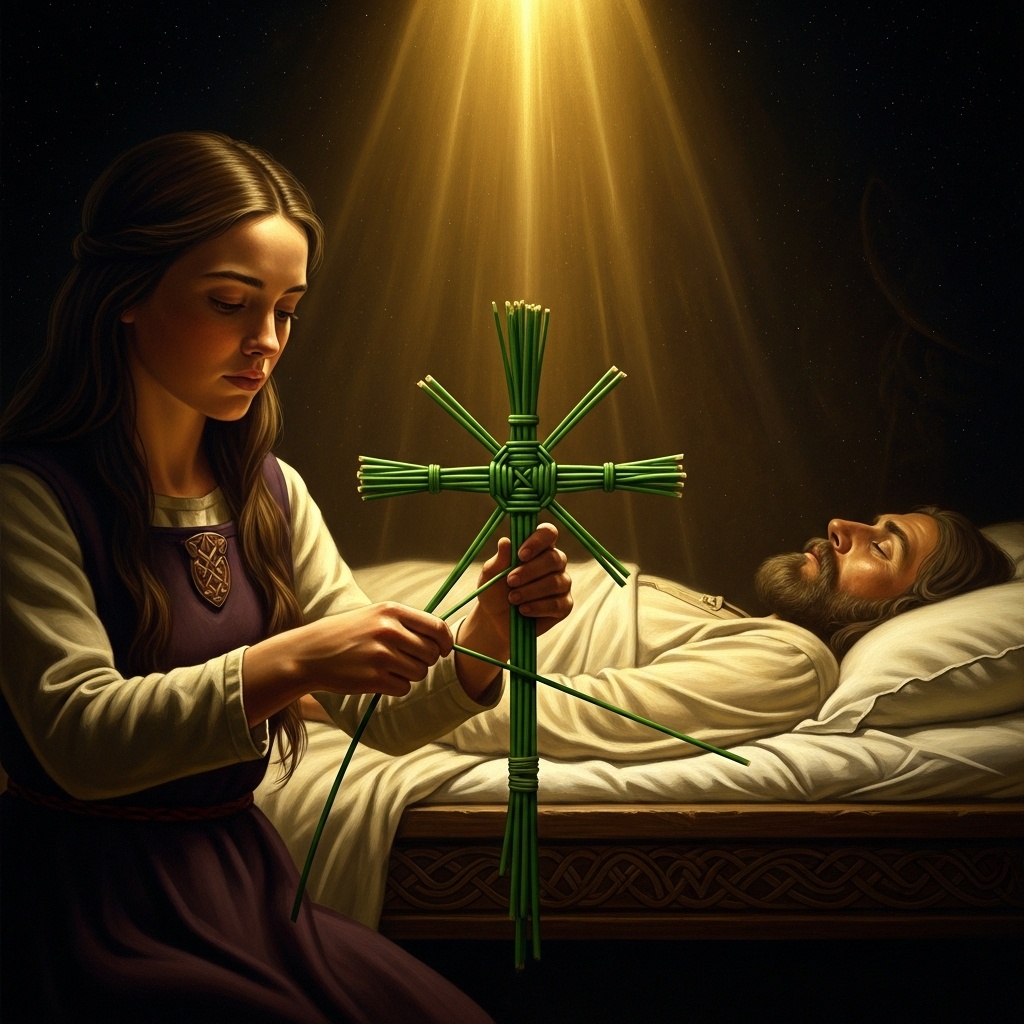
He is a pagan. He has resisted Christianity politely, the way a man resists a sales pitch from someone he genuinely likes. Brigid comes to him at the end. She sits on the floor beside his bed. The rushes are scattered on the floor — the long green stalks of the bog that Irish houses use as floor-covering. She picks up some of them as they sit there. She begins, idly, while she talks to him, to weave them into a shape.
He asks her what she is making.
She tells him: a cross.
She holds it up. It is the four-armed cross that any child can make from rushes — four bundles bent at right angles around a central square, the geometry simple, the result almost trivial. She tells him about the man who died on a cross like this. She tells him that the death of one man can take away the death that everybody else has earned. She tells him about the resurrection. She tells him about the flame she keeps at Kildare and about the fire of Pentecost and about the burning bush. The chieftain has been listening to druids his whole life. He recognizes the structure. He understands that the goddess he has worshipped is being told to him in a new dialect.
He asks for baptism.
She baptizes him there, in the bed, with water from the pitcher beside him. He dies a Christian within the hour.
The rush cross becomes the symbol of Saint Brigid’s Day. Every February 1, in farms across Ireland, families weave the rush cross from green stalks and hang it over the door for the year. The cross is also Brigid’s spinning-wheel, the Celtic four-armed solar emblem, the wheel-of-the-year in miniature. The Christian cross and the pagan wheel and the woven thing on the lintel are the same object. The hand that weaves it does not need to choose.
In 1185, Gerald of Wales visits Kildare.
He writes about it in the Topographia Hibernica. He is a Norman, a clergyman, an outsider, and he is fascinated by the perpetual fire. He notes that it has burned since the time of the saint without interruption. He notes that no man may enter the precinct. He notes that nineteen nuns tend it in rotation and that the twentieth night is Brigid’s. He notes that the wood used is fed in only by women’s hands.
He does not say it is pagan.
But the structure he describes is not Christian — not in any other Christian house in twelfth-century Europe is there a perpetual flame tended by women in a precinct that no man may enter. Vesta is recognizable in the description. The goddess of the threefold workshop is recognizable. The bridge between the two religions stands open in Kildare in 1185, four hundred years after the conversion of Ireland was supposedly complete, and the flame is still burning, and the women are still rotating, and the priest who comes to say Mass at the abbey does not enter the precinct that holds the fire.
In 1220, the Archbishop of Dublin orders the flame extinguished. He says it is a relic of pagan superstition.
It is relit. It is extinguished again. It is relit again. It burns through the medieval period in defiance of multiple orders to put it out.
In 1540, the dissolution of the monasteries under Henry VIII closes Kildare. The flame goes out for what looks like the last time.
In 1993, the Brigidine Sisters — a Catholic order of nuns founded in 1807 — relight the flame in Kildare. They keep it burning now in a glass enclosure in the town square. It is open to the public. The women take turns tending it, as the women of Kildare have always taken turns tending it, in unbroken rotation when the rotation is unbroken and in resumed rotation when it has been broken.
The two Brigids are the same Brigid.
The goddess of the threefold workshop and the saint of the rush cross are the same figure operating in two registers of Irish religion. The flame at Kildare is the same flame in both registers. The cloak that covers the Curragh is the cloak of the goddess of generosity and the cloak of the saint of charity, and the church at Kildare did not have to choose between these because Ireland did not require that the church choose. The conversion was not a replacement. It was a translation.
What burns in the glass enclosure today, in the square at Kildare, is a flame that has been tended by women in this place since before the Romans came to Britain. It has gone out and been relit. It has been forbidden and been resumed. It does not belong to either religion exclusively. It belongs to the place. The women belong to the flame and the flame belongs to the women and the saint and the goddess take turns at the hearth on the nineteenth and twentieth nights.
The first stirring of spring comes around again. The ewes begin to give milk. The midwives walk from house to house with bundles of rushes in their arms. The flame burns.
It is February 1. It always has been. It always will be.
Scenes
The flame at Kildare burns inside the round hedge of thorn — the precinct that no man may enter, tended by nineteen women in unbroken rotation since the time before time
Generating art… Brigid's cloak unfolds across the field of Curragh — the small garment that covers as much land as she asks of the king, the geometry of generosity made literal
 Generating art…
 She weaves the rush cross at the deathbed of the chieftain — green stalks bent in four directions, the old religion folded into the new shape with no seam visible
 Generating art…
 Echoes Across Traditions
Entities
- Saint Brigid of Kildare
- Brigid the goddess
- the Dagda
- the Brigidine Sisters
- the chieftain of Leinster

Sources
- Cogitosus, *Vita Sanctae Brigidae* (Life of Saint Brigid), c. 650 CE — the earliest hagiography
- *Bethu Brigte* (Old Irish Life of Brigit, c. 800 CE)
- Kim McCone, *Pagan Past and Christian Present in Early Irish Literature* (Maynooth, 1990)
- Mary Condren, *The Serpent and the Goddess: Women, Religion and Power in Celtic Ireland* (Harper & Row, 1989)
- Noel Dermot O'Donoghue, *The Mountain Behind the Mountain* (T&T Clark, 1993)
- Gerald of Wales, *Topographia Hibernica* (c. 1188), on the perpetual flame