Barong and Rangda: The Battle That Never Ends
Eternal mythic time; ceremony performed in village temple cycles across Bali · Bali, Indonesia
Contents
In Bali, the eternal battle between Barong the protective lion-deity and Rangda the demon queen of witches is not a battle that ends. Neither wins. They are locked in perpetual struggle that is the world's balance. The human dancers who enact this battle enter genuine trance states. Some stab themselves with their own kris daggers and do not bleed.
- When
- Eternal mythic time; ceremony performed in village temple cycles across Bali
- Where
- Bali, Indonesia
The performance begins at dusk and ends when it ends.
This is the first important distinction from Western theatrical convention. The Calonarang ceremony — the ritual enactment of the battle between Barong and Rangda — does not have a set duration. It runs until the ritual state has been achieved and the balance has been restored. This sometimes takes three hours. It has taken all night. The ceremony is not over when the narrative is over, because the narrative is not the point. The point is the balance.
The village gathers in the pura — the temple courtyard — and the gamelan begins. The gamelan orchestra is the sonic environment in which everything else happens: the gongs marking time, the metallophones moving faster and faster as the ceremony deepens, the drums driving the dancers from movement into something other than movement. Balinese gamelan is organized around the concept of kotekan — interlocking melodic patterns played by pairs of instruments, one tuned slightly sharp of the other, producing a shimmering beat frequency that Westerners sometimes describe as hypnotic and Balinese practitioners describe as the sound of the spirit world becoming audible.
Barong arrives first.
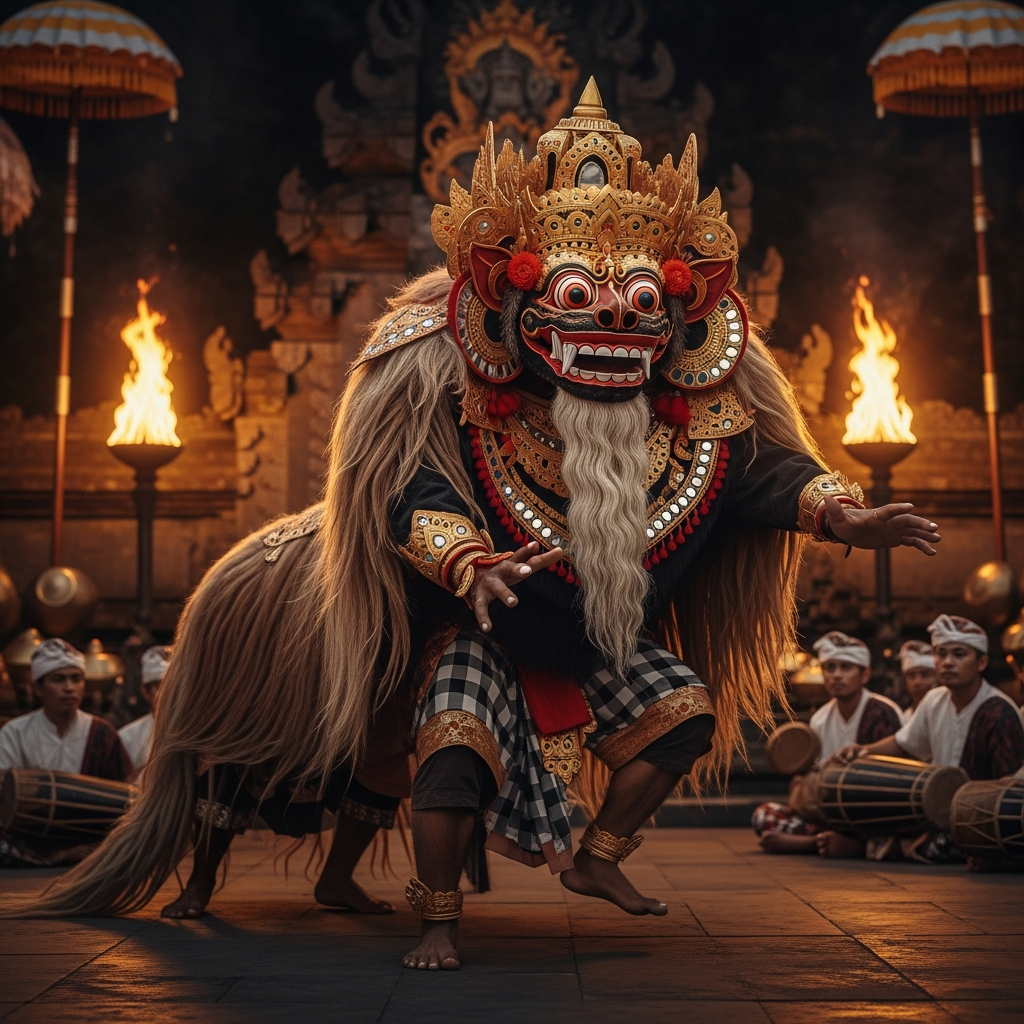
He is the protective deity of the village — Barong Ket, the great lion, guardian of the human world against the forces that would destabilize it. His mask is gilded and massive, fitted with mirrors and bells, with a great shaggy beard of silver fibers and eyes that are painted wide open because he is always watching. He requires two men to wear him: one for the mask and the front legs, one for the back legs, the two moving in such close coordination that the body appears to have a single will.
Barong’s movements are elaborate and specific. He shakes his head. The bells on his mask ring. He turns. He turns again. He inspects the four corners of the courtyard in the manner of a guardian inspecting his territory. He moves with a dignity that is also playfulness — he is protective but not solemn, and this is theologically important. The world he guards is worth enjoying. He is a guardian who is also a friend.
The crowd relaxes in his presence. This is not a metaphor. There is a measurable physical relaxation in a Balinese temple crowd when Barong enters, a settling that the anthropologists who studied these ceremonies in the mid-twentieth century noted consistently. He is felt as protective. The feeling is real.
Rangda arrives from the other direction.
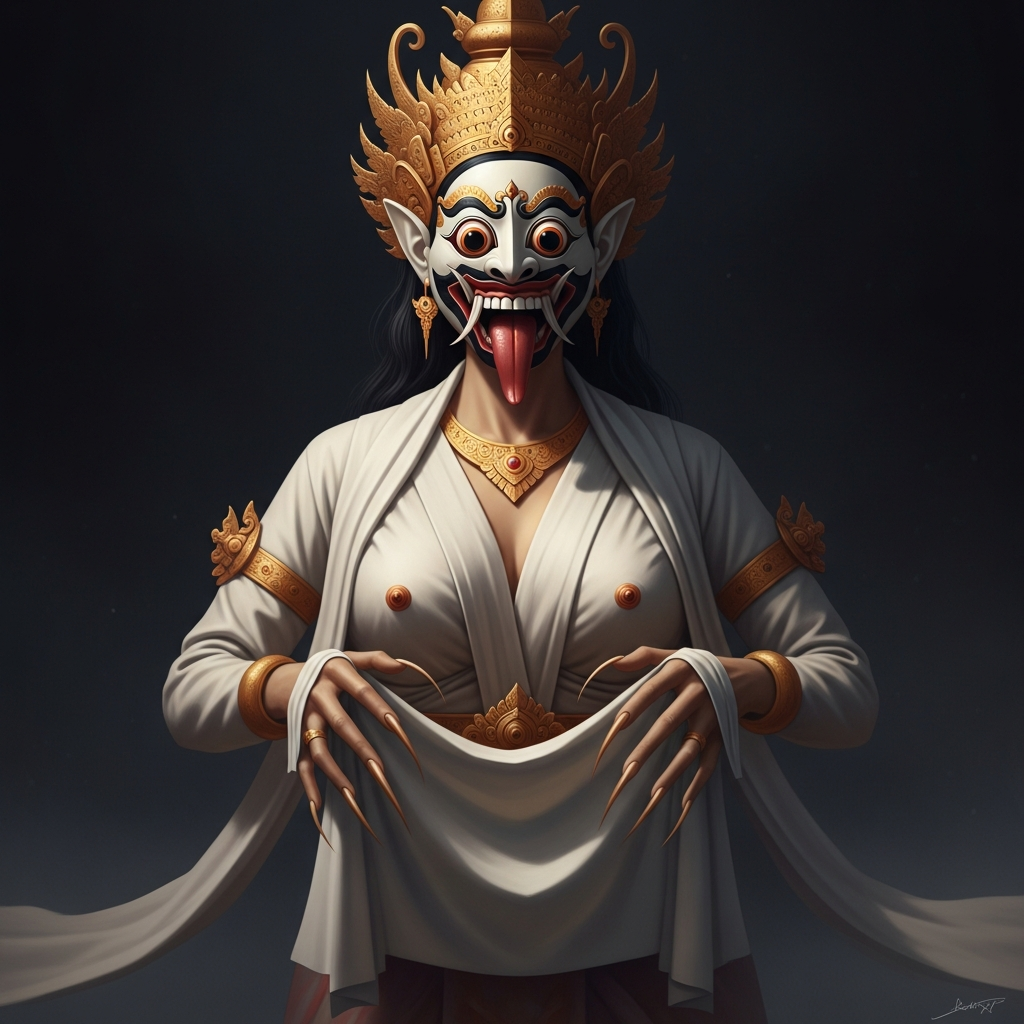
Her mask is white — the color of death and magic in Balinese cosmology — with enormous fangs and a protruding tongue and eyes that are round and terrible. Her hair is wild. Her robes are white. Her fingernails are painted gold and they are very long. She carries a white cloth that she holds in front of her, and the cloth itself is charged — it is her weapon, the vehicle of her power, the thing she points at the young men when she wants them to fall.
Rangda is the demon queen of witches, the leyak, the widow-witch who brings plague and miscarriage and the madness that arrives in the night. She is modeled on a historical queen — Calonarang, who lived in eleventh-century East Java, a practitioner of the death arts who caused a plague in the kingdom of Airlangga. But she is older than the historical model. She is the ancient principle of destructive power, the force that opposes everything Barong represents, and she is not simply evil.
This is the central theological claim of the ceremony: Rangda is not simply evil. She is necessary.
The fight is not a fight.
In the Western narrative expectation, a battle between a protective deity and a demon queen should resolve into one of them winning. The protector defeats the monster. The monster is driven back. The world is safe.
This is not what the Calonarang ceremony enacts.
Barong and Rangda battle. The battle goes back and forth. Rangda points her cloth at Barong’s allies — the young men of the village who have come to Barong’s aid — and they fall under her power. Barong rallies. He recovers some of them. Rangda advances again. The battle oscillates.
It does not end.
Rangda is not defeated. Barong does not prevail. The battle reaches a point where the priests judge that the balance has been achieved — that the forces have been engaged fully enough, that the ceremony has done its work — and the ceremony concludes not with a victor but with a restoration. Both forces withdraw. The world continues.
This is not a narrative failure. It is the cosmological statement the ceremony is designed to make: the world continues because the forces that oppose each other are both real, both necessary, and neither eliminable. A world in which Barong had permanently defeated Rangda would be a world without the destructive principle, which is a world without the power of death to clear the old, without the chaos that makes new growth possible, without the dark that gives the light its contrast. The ceremony enacts balance, not victory.
The kris dancers.
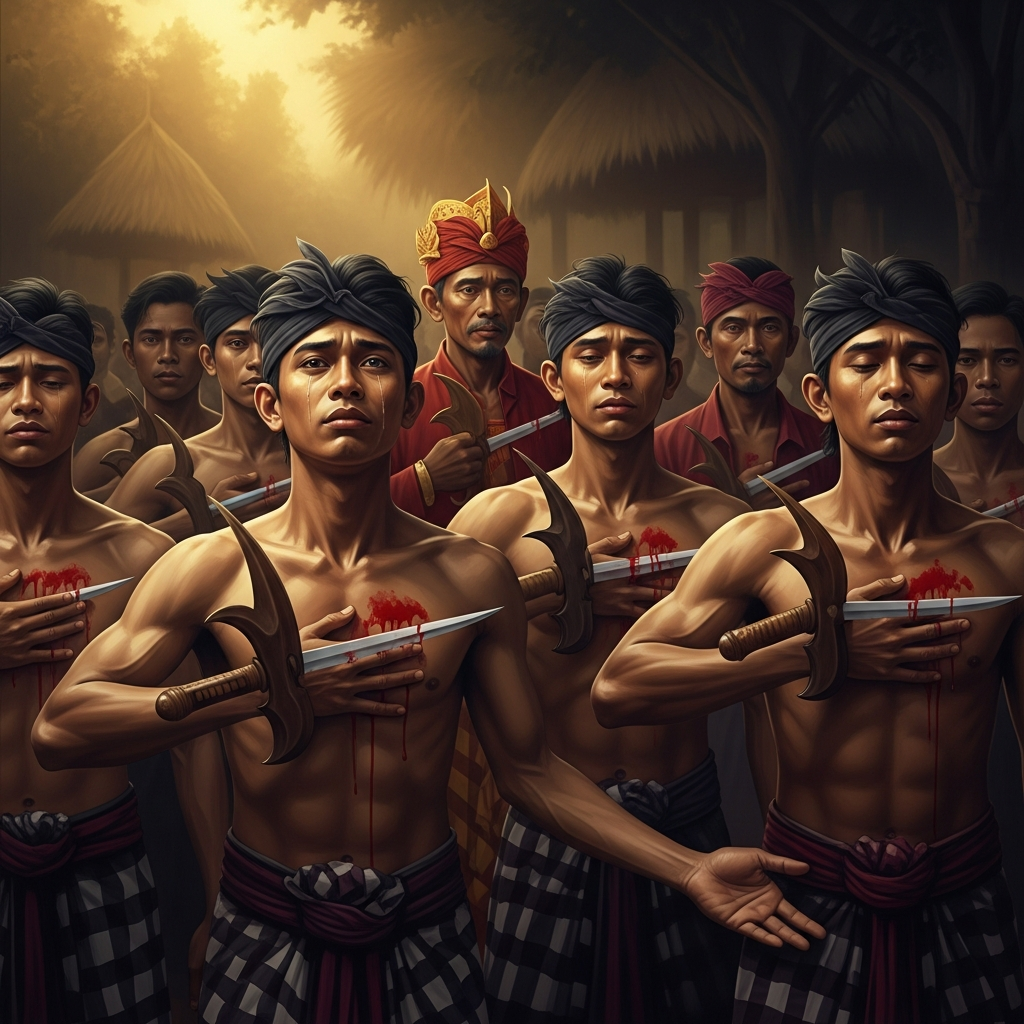
After Rangda has advanced and the young men have been struck by her power, a group of male dancers enter the courtyard in trance state. They carry their kris daggers — the wavy-bladed ceremonial weapon of Indonesia, charged with ancestral power. In the ordinary Balinese understanding, a kris is not simply a knife. It has a spiritual identity, a taksu, a living force that it has accumulated from its history. A properly made and properly consecrated kris from an important family can be centuries old and still active.
The young men in trance press the blades against their own chests.
The gamelan is at its most intense. The crowd watches in a silence that is not quite silence. The pemangku — the temple priest — moves between the dancers, monitoring them. Some of the dancers are pressing hard enough that in ordinary circumstances they would be drawing blood. They are not drawing blood. The blades press into the skin and stop. The men are weeping or smiling or elsewhere, their faces showing the specific expression of someone whose attention is very far from the ordinary world.
The priest brings them back. He sprinkles holy water. He makes the gestures that call the attention back from wherever it has been. Each dancer, as he returns to ordinary consciousness, looks around with the bewilderment of someone who has just traveled and cannot quite place where.
The anthropological literature from the mid-twentieth century — Jane Belo’s observations, the studies commissioned by the Rockefeller Foundation, Miguel Covarrubias’s field reports from the 1930s — is consistent on the point of the kris and the lack of bleeding. The observation has been replicated. The explanations vary. The Balinese explanation is straightforward: Barong protects the dancer during the trance state. The dancer is not subject to ordinary physical harm because the dancer is not, during the trance, fully in the ordinary physical world. The kris cannot harm what it cannot fully reach.
Whether one accepts this explanation or substitutes another, the phenomenon itself is not contested. The dancers press the blades. They do not bleed. The ceremony ends. They go home.
The Calonarang ceremony is not performed on a schedule.
Or rather, its schedule is determined by the ritual calendar, which is layered and complex and produces a rhythm of ceremonies that the village tracks collectively. The ceremony is performed when the balance requires it — when there has been too much illness, too many difficult births, too much of the malign. It is a corrective ceremony. It restores the balance by enacting it.
The balance is not a philosophical concept in this tradition. It is a physical condition of the world that requires maintenance. The world can go out of balance. When it does, people get sick, harvests fail, strange things happen at night. The ceremony is the technology for restoring it. Barong and Rangda must be engaged so that neither gets the upper hand. The engagement is the work. The performance is the intervention.
This is the thing that Western aesthetic categories cannot fully accommodate: a performance that is not a representation of something but the thing itself.
Barong and Rangda are not symbols of order and chaos. They are order and chaos. When the masks are brought out of the temple, the forces inhabit them. When the gamelan plays at full intensity, the trance is not a psychological state that resembles divine possession — it is divine possession. When the kris presses into the chest and does not draw blood, the protection is real protection.
The battle never ends because the world never stops needing the balance. Barong and Rangda will be brought out again at the next ceremony. They will battle again. Neither will win. The world will continue.
This is what the ceremony says: the world continues because the forces that oppose each other are sustained in perpetual balance by the people who keep enacting that balance. The world does not maintain itself. Humans maintain it. Every ceremony is the world choosing to continue.
Scenes
Barong in full ceremony regalia — the massive gilded lion mask with its mirror-studded beard, the long shaggy body borne by two men moving in perfect synchrony
 Generating art…
 Rangda the demon queen: the white mask with its great fangs and protruding tongue, her white robes trailing behind her, her long fingernails catching the firelight, her pendulous breasts a feature of her ancient power
 Generating art…
 The young men of the village in trance state, their kris daggers turned against their own chests — pressing the blades into themselves while the gamelan reaches its highest intensity
 Generating art…
 Echoes Across Traditions
Entities
- Barong
- Rangda
- Kris
Sources
- Clifford Geertz, *The Interpretation of Cultures* (Basic Books, 1973)
- I Wayan Dibia and Rucina Ballinger, *Balinese Dance, Drama and Music* (Periplus, 2004)
- Miguel Covarrubias, *Island of Bali* (Alfred A. Knopf, 1937)
- Jane Belo, *Trance in Bali* (Columbia University Press, 1960)
- Angela Hobart, *Dancing Shadows of Bali: Theatre and Myth* (KPI, 1987)