Baridegi, the First Shaman
Mythic time, origin of the mudang tradition · The Korean peninsula and the Western Paradise, the land of the dead
Contents
The seventh daughter of a king is abandoned at birth because she is not a son. Decades later, when her parents are dying of an illness only the Water of Life can cure, every other child refuses the quest. The abandoned one volunteers. She descends alone into the underworld, serves a spirit lord for nine years, and comes back with the medicine — to find her parents already dead. What she becomes is not a healer. It is something older.
- When
- Mythic time, origin of the mudang tradition
- Where
- The Korean peninsula and the Western Paradise, the land of the dead
The king counts his children at the birth of each one.
Six daughters. No sons. He has wives and consorts enough to exhaust this possibility, and still: daughters. The kingdom needs an heir. The kingdom, as the king understands the kingdom, requires a male body on the throne. When the seventh child is born and it is another daughter, he does not look at her.
He orders her abandoned.
This is how Korean shamanism begins: with a king who cannot see the value of what he has made.
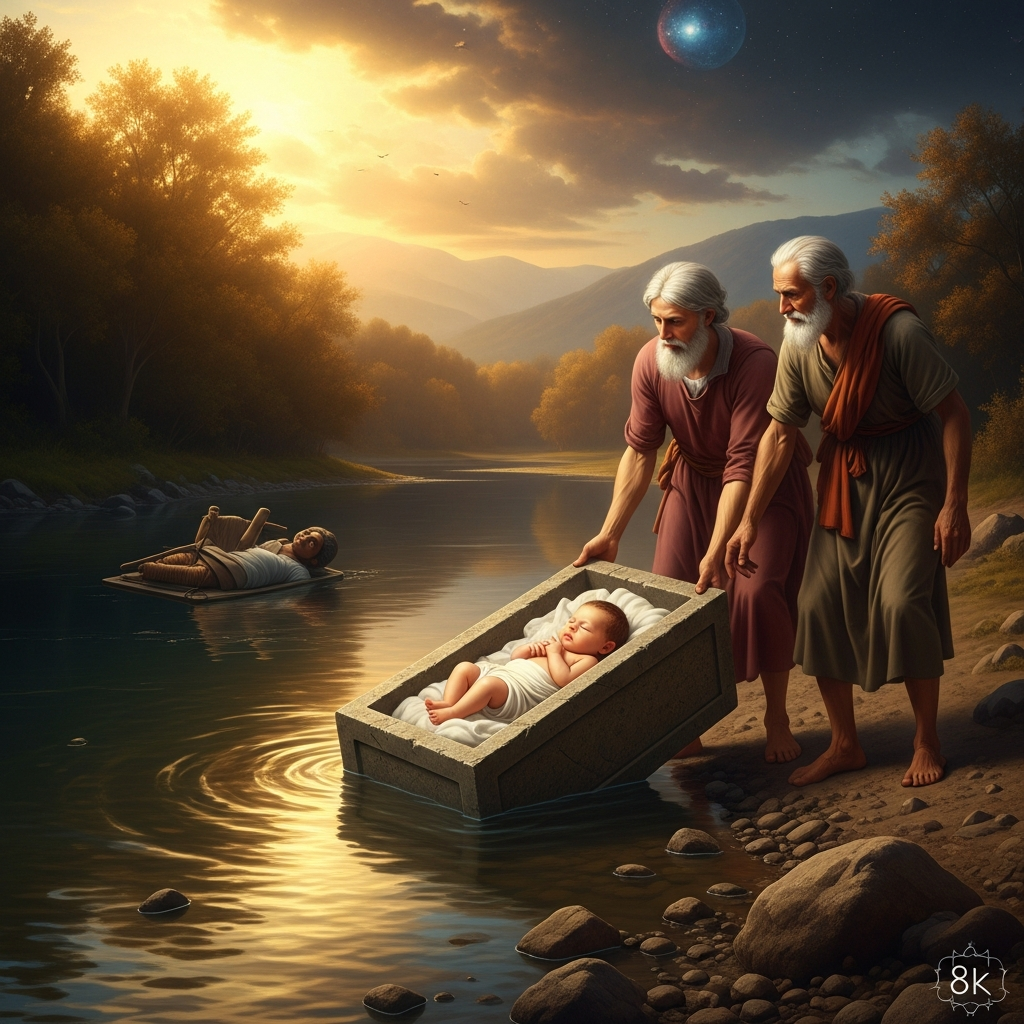
She is placed in a stone box — the Samguk Yusa tradition says a golden box, other versions say stone, the difference matters less than the image — and the box is set afloat on a river. She does not die. An old couple living at the river’s edge hears something in the current that is not current-sound and pulls the box from the water. Inside is a girl who has already survived the first attempt to undo her.
They name her Baridegi. In Korean: the abandoned one. The name is a wound kept visible, a scar worn as identification.
She grows up at the river with the old couple. She does not know who her parents are, and then she does, and then she carries that knowledge the way you carry something heavy — not dramatically, but continuously, in every movement.
The king and queen fall sick.
The illness is the kind that shamans recognize and physicians cannot touch — it comes from the spirit world, which means it can only be remedied by spirit-world medicine. The specific cure is the Water of Life, which exists in the Western Paradise, the land beyond the land of the dead. Someone has to go and get it.
The six daughters are asked.
They say no. The Western Paradise is not a place you go to. It is a place you arrive at by dying, and even dying is not sufficient — you have to walk there with intention, which is a different kind of dying, and the road is long, and the place is ruled by a spirit lord whose terms of service are not negotiable, and no one who has gone has come back in time to say whether going was worth it.
The six daughters love their parents. They simply do not love them that much.
The seventh daughter is not asked. She is the abandoned one. She is not in the count of daughters the king makes when he looks at his family. She volunteers.
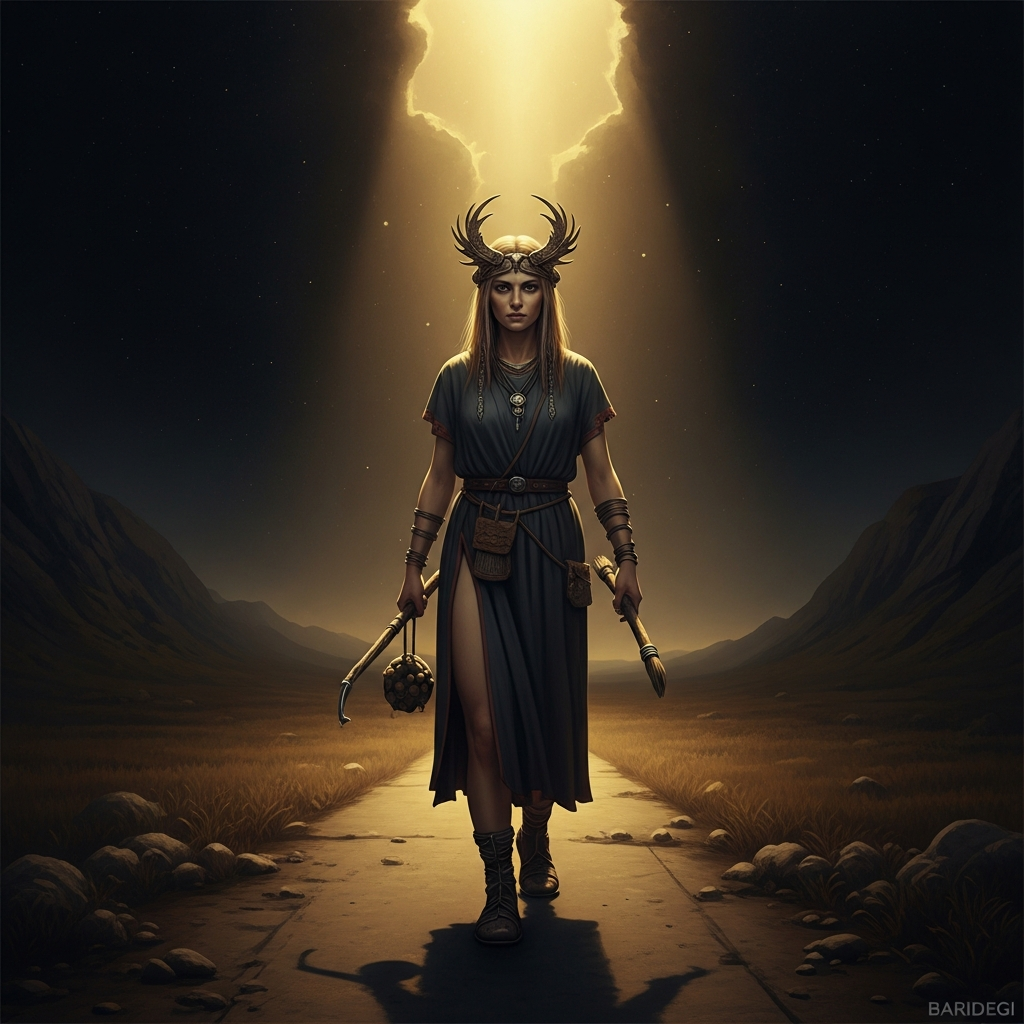
She walks to the Western Paradise in iron shoes.
The shamanic tradition specifies the shoes. Iron, not leather, not cloth. Iron because the road is long enough to wear metal down, and when the iron is worn through she will be at the threshold. She carries wormwood and garlic for the road — the same provisions Hwanung gave to the bear, which is not coincidence — and she walks alone on the road that goes west until the west runs out.
The road runs through mountains that have no names and rivers with no fords and a darkness that is not the absence of light but a presence of its own — thick, attentive, the dark that knows you are walking through it and watches to see if you slow down.
She does not slow down.
She reaches the Western Paradise. The spirit lord Mujangshin meets her at the gate.
He has a proposal. Nine years of labor in exchange for the Water of Life. She can serve him, keep his household, do the work of the spirit world — and after nine years, he will give her what she came for.
She agrees. This is the part of the myth that is hardest to sit with: she agrees without hesitation, without bargaining, without asking for a shorter term. Nine years is nine years. She has been walking toward this for weeks on iron shoes that are now worn thin. Nine years is a number she has already decided she can carry.
She serves him. She works. And somewhere in the nine years — the myth is not precise about when — she and Mujangshin have seven sons. This is the part of the story that the scholarly interpretations argue most about. Is it coercion? Is it genuine relationship? The myth does not say. It says seven sons, who become her seven spirit helpers, the assistants who will guide the dead when she begins doing what she came to be.
At the end of nine years, Mujangshin gives her the Water of Life.
She turns back toward the world of the living.
The road home is shorter than the road there — this is also shamanic tradition, because the return from the spirit world always moves faster, the way you always walk home faster than you walk away. She crosses the rainbow bridge between the realms, the bridge that shamans see in trance and sometimes describe as a ribbon of color stretched across a darkness no color can fully illuminate.
On the bridge, she already knows.
She knows the way you know things in dreams, where knowledge arrives before its occasion — she knows that she is too late. The Water of Life is in her hands. Her parents are already on the other side of the bridge she is crossing. She is going the wrong direction.
She arrives home and finds their bodies cold.
She pours the water on their bodies anyway.
This is the grace note the myth cannot leave out: the Water of Life works even post-mortem, even when the timing is wrong, even when the quest was completed one breath too late. They rise. The king and queen open their eyes and see the daughter they could not see when she was born, the one they set on the river in a box.
The myth does not say what the king says. It does not give the reunion a happy ending. What it gives instead is transformation: Baridegi does not return to her life at the river. She becomes the first mudang.
She is made the first shaman not because she succeeded, not because she failed, but because she made the road. She walked the path between the living and the dead in iron shoes, served nine years in the house of the spirit lord, gave birth to seven sons who now live in the spirit world and know its geography. She knows how to get there. She knows how to find the dead. She knows how to guide them.
The dead, in Korean shamanic practice, are never addressed without invoking Baridegi first. She is the one who made the road. Every mudang who climbs inside a trance and goes looking for a lost spirit is walking in her footsteps, in the iron-shoe prints she left on the road to the Western Paradise.
The authority of Korean shamanship is not conferred. It is not learned in school or passed through a lineage of masters. It is earned by undergoing what Baridegi underwent: the descent, the years of service, the return.
What makes her the first shaman is not that she went. It is that she came back.
The dead need someone who has already walked the road. She is that someone. She will always be that someone. Her seven sons are waiting at every threshold. The rainbow bridge is still there. When the mudang enters trance, she is not performing a ritual. She is finding the road Baridegi laid down and following it in.
Scenes
The newborn seventh daughter is placed in a stone box and floated down the river by royal command
 Generating art…
 Baridegi walks toward the Western Paradise in iron shoes on a road that wears metal down to nothing
 Generating art…
 After nine years of labor and seven sons, Baridegi receives the Water of Life from the spirit lord
 Generating art…
 Echoes Across Traditions
Entities
- Baridegi
- Mujangshin
- Okwhang Sangje
Sources
- Kim Tae-kon, *Korean Shamanism — Muism* (Jimoondang, 1998)
- Laurel Kendall, *Shamans, Housewives, and Other Restless Spirits* (University of Hawaii Press, 1985)
- Hyun-key Kim Hogarth, *Syncretism of Buddhism and Shamanism in Korea* (Jimoondang, 2002)
- Boudewijn Walraven, *Songs of the Shaman: The Ritual Chants of the Korean Mudang* (Kegan Paul International, 1994)
- Daniel Kister, *Korean Shamanist Ritual: Symbols and Dramas of Transformation* (Akademiai Kiado, 1997)