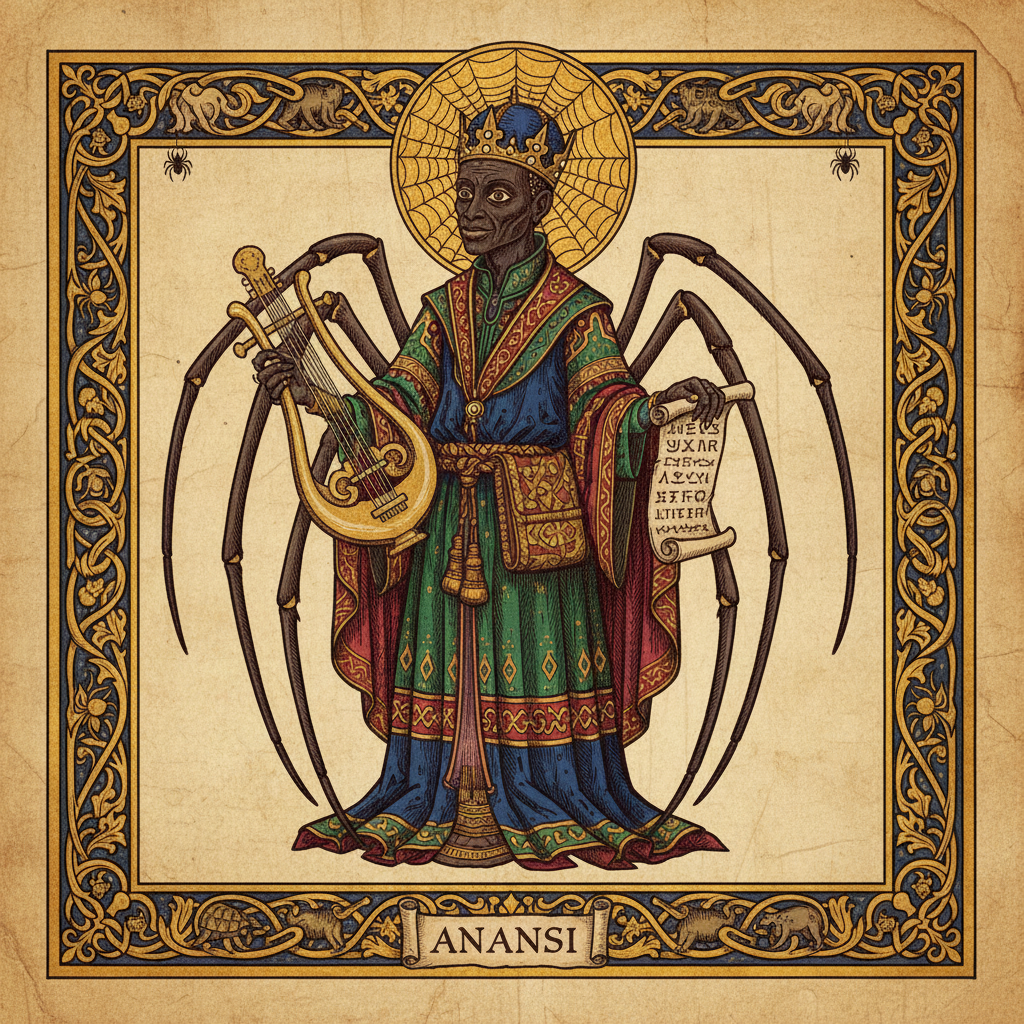
Anansi Pays the Impossible Price
In the beginning — Akan oral tradition, West Africa · West Africa — Ghana, Akan peoples, and the sky kingdom of Nyame above
Contents
The spider goes to the sky god with nothing but cleverness and an audacious request: to buy every story in the world. Nyame names a price no king has ever paid. Anansi pays it before morning.
- When
- In the beginning — Akan oral tradition, West Africa
- Where
- West Africa — Ghana, Akan peoples, and the sky kingdom of Nyame above
The storyteller begins like this: before I tell you any story, know that it belongs to the spider.
This is not a figure of speech. It is a theological statement. Every Anansesem — every spider-story, every tale told in the Akan world from the forests of Ghana to the plantations of the Caribbean to the parlors of Harlem — belongs to Anansi by right of purchase, not birthright. He bought them. He paid in full. He paid a price that every chief and king and warrior on earth had refused to pay, because they all looked at the price and laughed.
But that is the end of the story. Start at the beginning.
In the beginning, all the stories belong to Nyame.
Not some of them. Not the important ones or the old ones or the ones about gods. All of them — the cautionary ones and the funny ones, the love stories and the battle stories, the ones about why the python moves the way it moves and why the hornets hold their nest so fiercely and why the forest is dark. Every story ever told already exists somewhere. It lives in Nyame’s great store-chest, up in the sky where the god lives in his immensity, attended by everything that belongs to him. The sky is well-organized. The sky has a place for everything.
On earth, there are no stories. When something happens — a death, a marriage, a drought, a child born with an extra finger — it simply happens. There is no way to make meaning of it. There is no way to pass it forward. Events occur and are forgotten, and each generation inherits nothing from the one before it except the bare fact of being alive. This strikes Anansi as an emergency.
He is small. His body is the size of a fist. His eight legs give him purchase on any surface, and he uses this to climb into everything — into the rafters above the elder’s compound, into the cracked bark of the silk-cotton tree, into the conversations of the powerful. He has been listening to those conversations for as long as the powerful have been having them, and he has noticed something: the powerful have no idea what to do with what they know. They hoard it. They mistake ownership for understanding.
He climbs to the sky.
Nyame receives him without surprise.
Gods who have been sitting above the world long enough stop being surprised by anything. He looks at Anansi — the eight legs, the small body, the bright eyes that are always calculating two moves ahead — and he waits to hear what the spider has come for.
“I want to buy your stories,” Anansi says.
Nyame’s court goes quiet in the way that courts go quiet when someone has said something simultaneously absurd and serious. The chiefs and the court functionaries exchange looks. The spider wants to buy the stories. The spider has come to the sky with no army, no tribute, no letter from any king of earth, and asked to purchase the entire contents of the most valuable chest in the cosmos.
Nyame smiles.
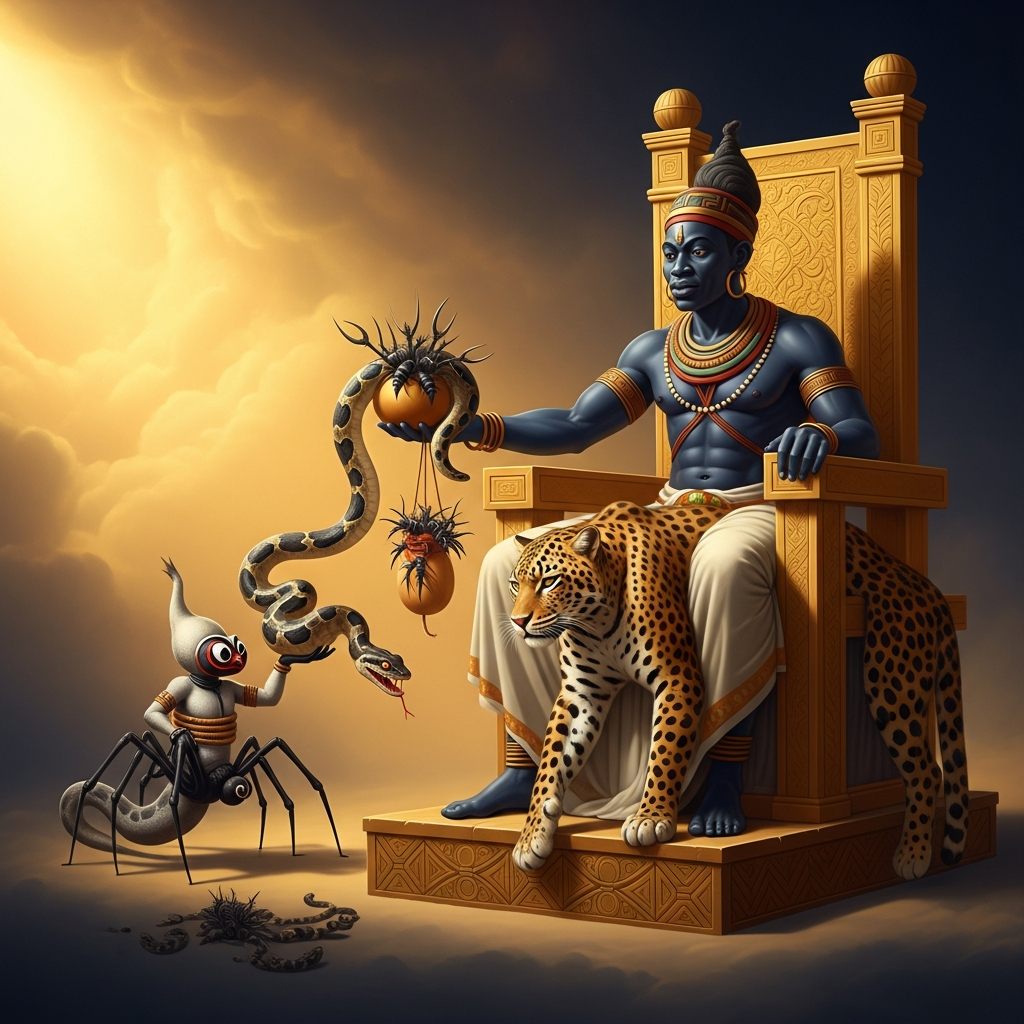
He names his price: Onini the great python, whose length no man has ever measured because no man has gotten the head and tail in view at the same time. Osebo the leopard, who has never been caught and who has killed every trapper who has tried. The Mmoboro hornets, whose nests hang in the trees and whose sting, delivered by the whole colony at once, has dropped men where they stood. And Mmoatia, the forest fairy, who has never been seen because she moves between the visible and the invisible the way light moves through water — present, refracted, essentially impossible to pin.
Every king who has ever heard this price has walked away laughing. They go home and tell the story of how Nyame set an impossible price for his stories, and they do not notice, Anansi notices, that they are already trading in stories that do not belong to them.
He says: “I will bring them all by morning.”
He climbs back down his thread to the earth.
He captures Onini first, because Onini is proud.
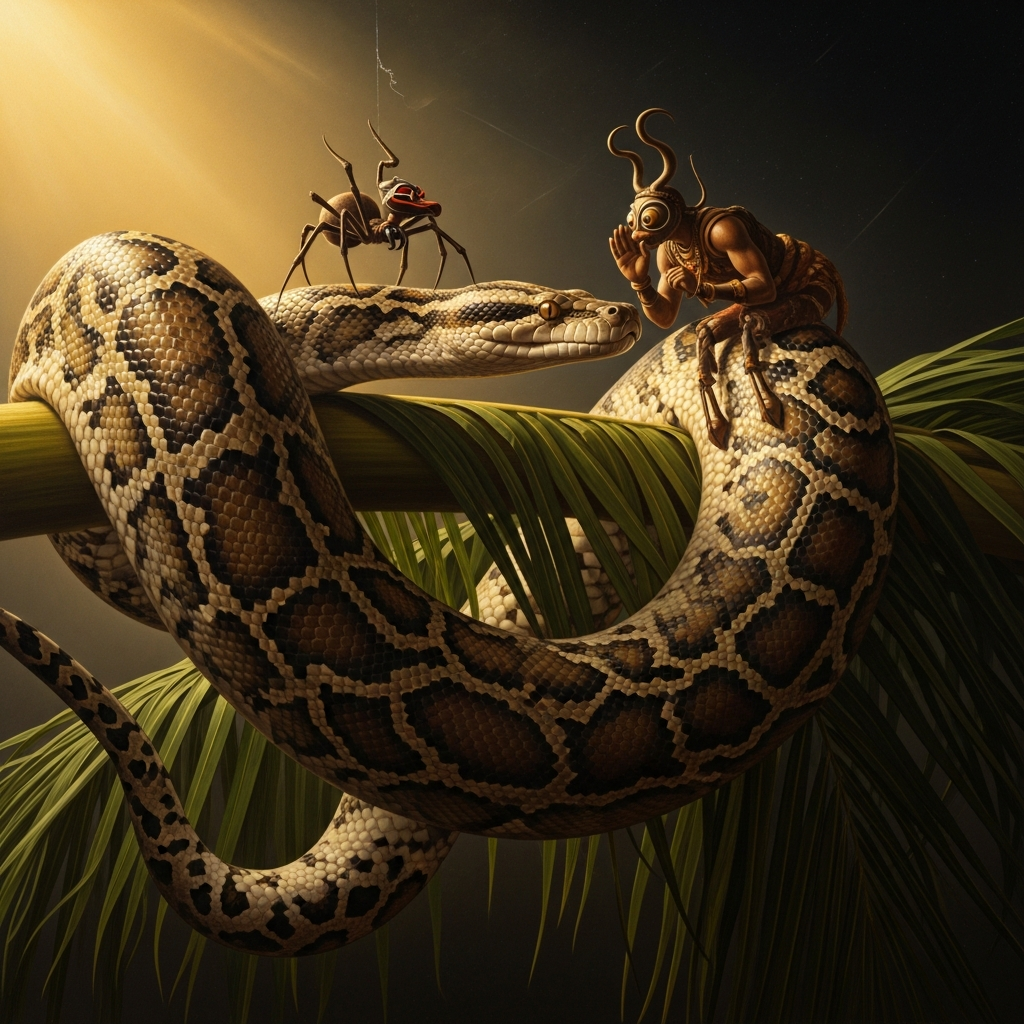
He goes to the river where the python lives and begins arguing with himself, loudly and specifically, about whether the palm tree growing at the bank is longer or shorter than Onini. He runs the argument with technical precision — if you measure from the base of the tree to the first major branch, and you assume the snake is as long as its body at full extension, which he himself has never measured, then it is possible that the palm tree is longer, but also possible that the snake is longer by one or two lengths of a man’s forearm. He argues this back and forth for as long as it takes.
Onini glides out of the river.
There is a principle at stake. He is exactly as long as the palm tree. He can prove it. Anansi says: the only honest proof is to lie beside the tree and let me mark both ends. Onini considers this. He considers it for exactly as long as it takes a vain animal to decide that accurate measurement of its own greatness is a reasonable request. He stretches himself along the palm branch that Anansi has cut, from tail to jaw, full extension. Anansi begins to measure — and the measuring is done with vine, and each loop of vine is placed carefully around the python before the next measurement is announced, and by the time Anansi reaches the neck the tail is already bound too firmly to strike.
Onini understands what has happened the moment before the last loop is placed. He understands it in the particular way of a creature who has been entirely honest about its own length and has been defeated by that honesty. He does not struggle. There is no point. He is perfectly, helplessly accurate.
Anansi carries him to the sky.
Osebo goes into a pit.
The leopard does not hide his tracks because the leopard has never needed to. Anansi follows them to the place where Osebo walks each morning and digs a deep pit in the path and covers it with sticks and leaves and goes home. He sleeps. In the morning the pit holds a leopard.
Osebo is furious and then, when he has finished being furious, he is trapped. Anansi appears at the rim. He says: you have caught yourself, which is undignified — allow me to help you out. He bends a young tree down into the pit and invites Osebo to grab it. When the leopard grabs the sapling and the arc carries him upward, Anansi ties all four legs before the leopard’s paws have cleared the rim. The whole process takes three seconds. Osebo stares up at the spider from his binding and cannot produce a single thought that accounts for how this occurred.
Anansi carries him to the sky.
The Mmoboro require theater.
He arrives at their nest with a banana leaf held over his head and a calabash gourd in his other hand. He pours water from the gourd over the leaf, onto the ground, and shouts: the rain has started! He holds the gourd open below the nest and calls out: take shelter, take shelter, get inside, get inside! The Mmoboro are a community mind. The community mind agrees: there is water, there is shelter, get in. They pour into the gourd in thousands. Anansi stoppers it before the last one notices what has happened.
Inside the gourd, the colony reconsiders. The colony is furious. The colony makes the high, thin, boiling sound of an entire species reconsidering a decision. Anansi walks away with the gourd, carrying several thousand furious hornets in a container the size of his torso, and he does not hurry because hurrying would communicate nervousness and he is not nervous.
He carries them to the sky.
Mmoatia is the hardest, because she cannot be seen.
She is the forest fairy — she exists, she moves through the forest, she interacts with things. But she is not visible in the way that snakes and leopards and hornets are visible. She can be heard, occasionally. She can be inferred. But Anansi cannot trap what he cannot locate.
He carves a figure from black gum tree wood and coats it in sticky latex — the gummy sap that hardens on contact and holds whatever presses against it. He props the figure at the base of the odum tree where Mmoatia likes to dance, and he puts a bowl of mashed yams in the figure’s lap, because Mmoatia has a powerful preference for mashed yams. He ties a string to the doll’s head, runs it through the undergrowth to where he is hiding, and waits.
He cannot see the yams disappear. He can hear them being eaten — the particular soft sound of food that is being enjoyed by someone who has forgotten to be cautious. He hears Mmoatia thank the figure. Silence. She thanks it again. Silence from the doll, because the doll has no interior, no chi, no self to be grateful to. Mmoatia hits it. Her hand sticks to the latex. She hits it with the other hand. That hand sticks. She kicks it with one foot and then the other. Both feet stick.
By the time Anansi walks out of the undergrowth she is completely attached to the figure, visible now because the body that is caught can be seen — being held is its own kind of making-visible. He wraps her gently in cloth and carries her to the sky.
Nyame opens the chest.
He does it slowly. He does it with ceremony, because Nyame is a god who respects ceremony even — especially — when the ceremony is acknowledging that he has lost. The chest is large. The stories inside it are not physical objects; they are something else, something with weight and light and the particular texture of truth that has been given form in language. He opens the chest and they come out like breath from a sleeping body — slow, enormous, present.
He says: from this day, when men speak of these stories, they will call them spider stories.
He says: you have done what my strongest kings could not do.
He says: here are all the stories in the world.
Anansi takes them.
He stands in the sky with all the stories in his hands — every story, the ones about gods and the ones about ordinary people, the ones about the first things and the ones about what happens at the end, the ones that explain why the sky is far and the ones that explain why the earth is close and the ones that do not explain anything but simply show what it is like to be alive — and then he opens his hands and lets them go.
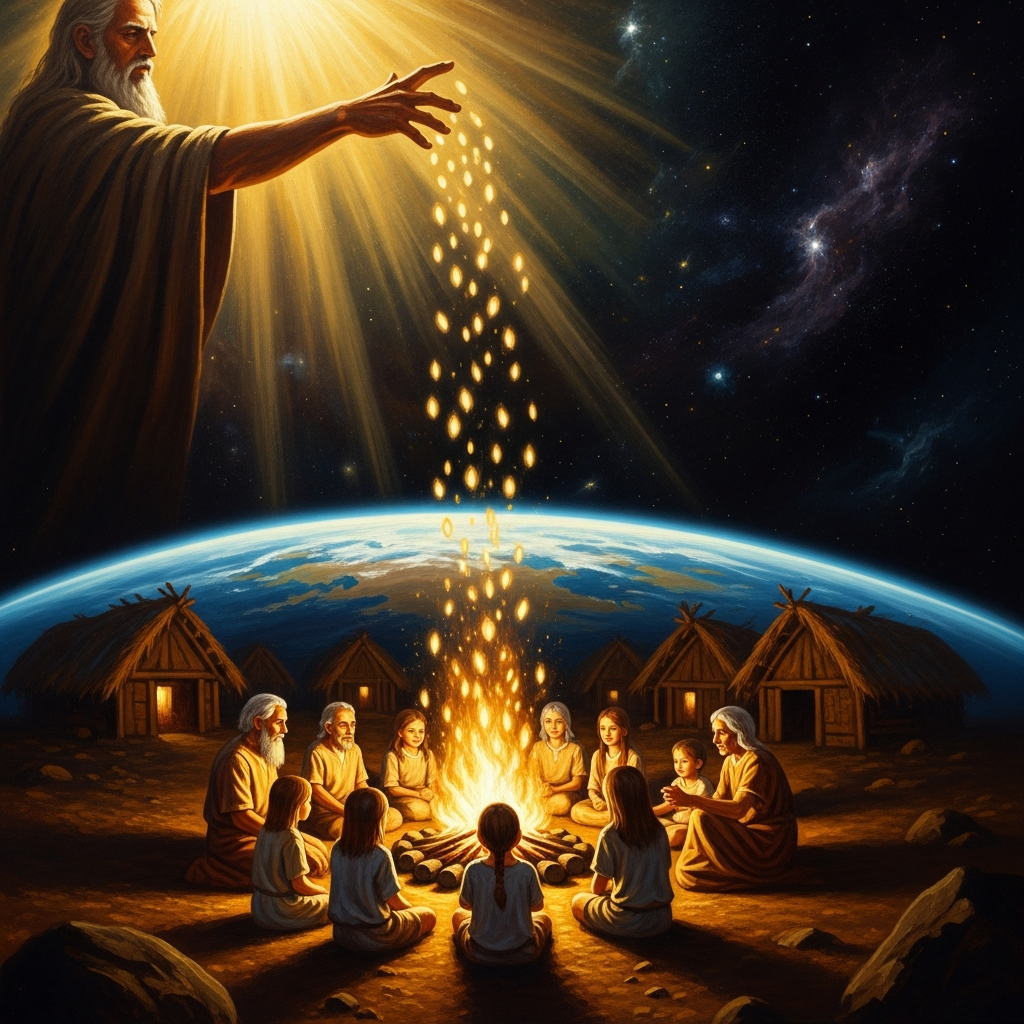
They fall. They scatter in the descent like seeds from a opened pod, drifting and spinning, and they land in every place a fire is burning, every place a child is listening, every place an elder is trying to explain something that language almost cannot hold. They land in the dark of the forest and the noise of the market and the silence between two people who have just seen something they have no other way to keep.
The stories belong to everyone now.
They still belong to Anansi. That is the paradox the Akan live with. Anansesem — it is a spider-thing, it belongs to the spider — but the spider is the one who made it common. Ownership, in the hands of the right person, is the mechanism of distribution. Anansi bought the stories from the sky so he could give them to the earth, and he did not give them by carrying them door to door. He gave them by opening his hands and letting them fall into the mouths of everyone who was hungry.
You are hungry. You have always been hungry. That is why you are listening.
The sky god had every reason to believe the price was impossible. He was right about the difficulty and wrong about who was standing in front of him — and that, Anansi would tell you, is precisely the kind of mistake that costs you everything. Every story told anywhere in the world tonight is told by the spider’s permission. The spider, meanwhile, is already somewhere else, watching, and he is already thinking two moves ahead of you, which is exactly where he was when this started.
Scenes
Anansi the spider, small and clever, presenting a bound python, a gourd of angry hornets, and a dead leopard to Nyame the sky god on his golden throne — the impossible price paid, the stories of the world changing hands
 Generating art…
 Onini the great python stretched alongside the palm branch, wholly convinced by Anansi's argument about measurement that lying still and being lashed with vine is a reasonable act of self-documentation
 Generating art…
 The stories scatter across the earth like seeds from an open hand — into every village, every fire, every mouth of every elder who will speak tonight to a child who is listening
 Generating art…
 Echoes Across Traditions
Entities


Sources
- R.S. Rattray, *Akan-Ashanti Folk Tales* (Clarendon Press, 1930)
- Harold Courlander, *A Treasury of African Folklore* (Crown Publishers, 1975)
- Peggy Appiah, *Ananse the Spider: Tales from an Ashanti Village* (Pantheon, 1966)
- Kwame Gyekye, *An Essay on African Philosophical Thought: The Akan Conceptual Scheme* (Cambridge University Press, 1987)