Amaterasu Emerges
Mythic Time · Kojiki ~712 CE; oral tradition centuries earlier · The cave of Ama-no-Iwato
Contents
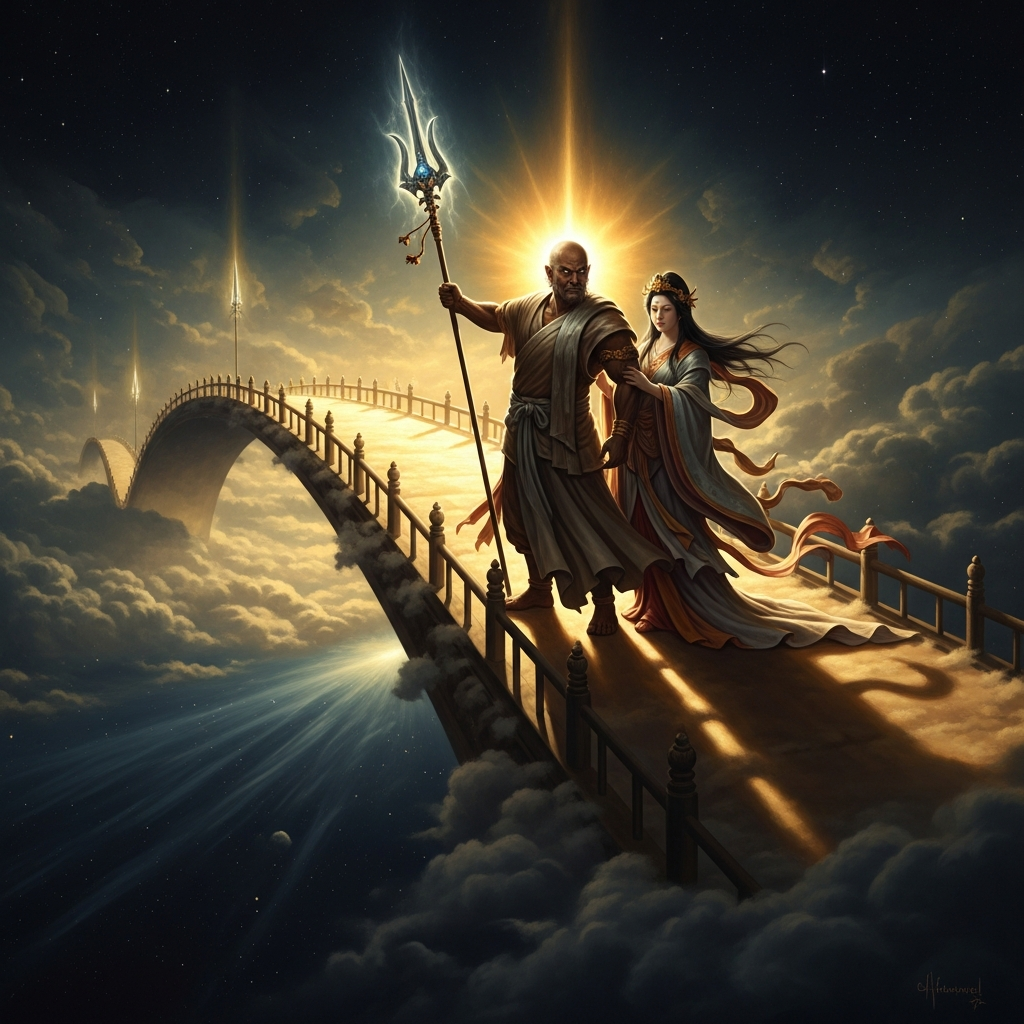
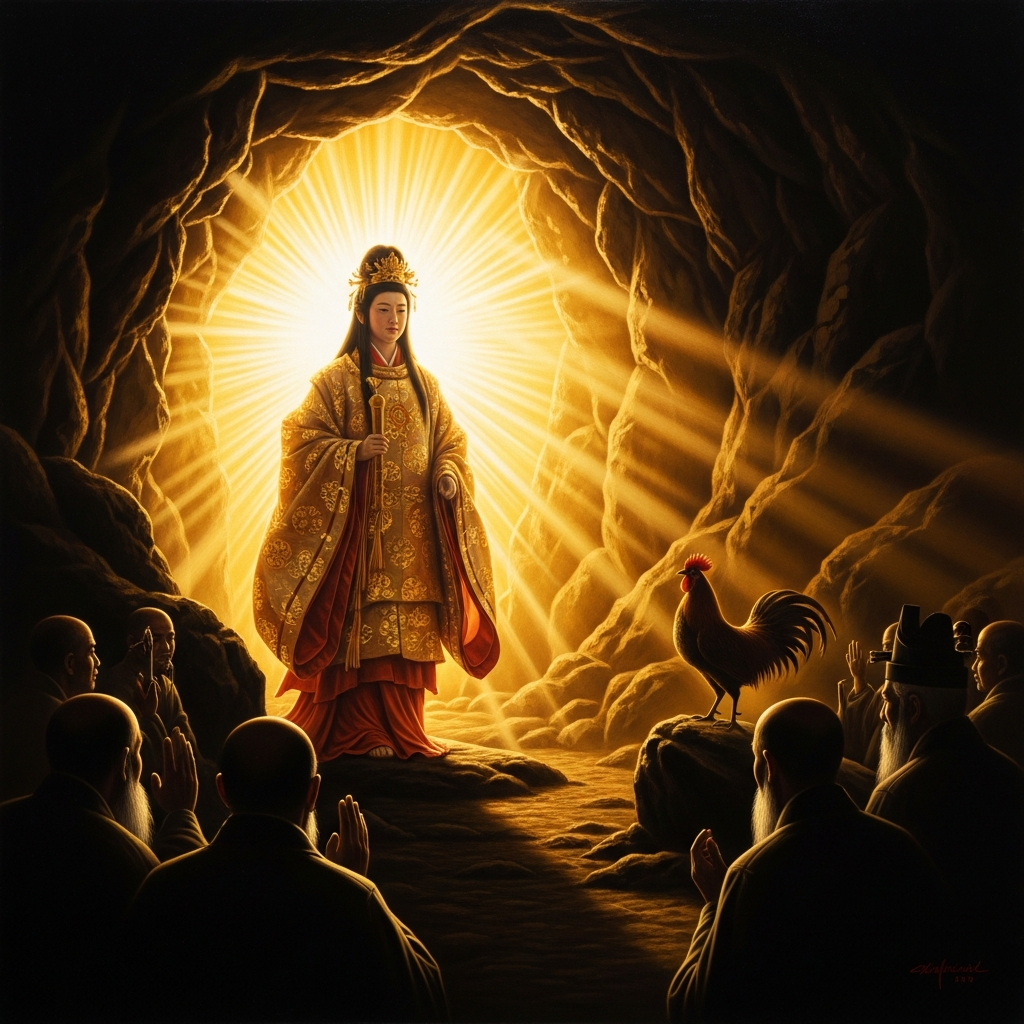
The sun goddess seals herself inside a cave after her brother Susanoo's rampage darkens the world. Eight million kami gather, Uzume dances, the gods laugh — and Amaterasu, drawn by the noise and a mirror's deceptive light, steps out to restore the sun.
- When
- Mythic Time · Kojiki ~712 CE; oral tradition centuries earlier
- Where
- The cave of Ama-no-Iwato
The stone rolls into place at dawn.
Not a small stone. The door of Ama-no-Iwato is a boulder that seals the cave the way a coffin lid seals a body — final, absolute, indifferent to regret. Amaterasu, goddess of the sun, pulls the dark around herself and sits. Outside, the world goes black.
It is not a gradual dark. One moment there are paddy fields, herons, the particular gold of morning light on water. The next there is nothing. Stars appear at noon. Rice stalks stop growing mid-reach. Foxes begin to howl because they cannot tell day from night. Evil spirits, who had been skulking in the margins, walk openly now. The world had always needed the sun the way a body needs its blood — quietly, completely, without knowing how much until it is gone.
Amaterasu is not sorry.
Her brother Susanoo has spent months making it impossible to be her. He wept so long and loudly for their dead mother that the mountains shook and the rivers ran dry. When banished from heaven, he came to say goodbye and tore up the paddies she had planted, filled in the irrigation ditches, defiled the sacred weaving hall. One of her weaving maidens died in the chaos — a shuttle driven through flesh by Susanoo’s careless violence, or so the Kojiki records it, careful not to say exactly whose fault it was. Amaterasu has pulled the boulder shut and sat down in the black and decided she is finished.
Outside, eight million kami gather.
Yaoyorozu no Kami — eight million gods, or something like that number; the Japanese do not mean it literally, the way a person does not mean literally forever when they say they will love you forever. Eight million means all the gods there are, every spirit in every river and mountain and doorpost, crowding the plain of heaven outside a boulder, arguing about what to do.
Thought-Includer devises the plan. He is not a god of great power; he is a god of great cleverness, which in a crisis is worth more. He lists what they will need: a mirror, long-singing birds to crow at the right moment, a jewel, specific grasses, a bonfire, and Uzume.
Uzume arrives.
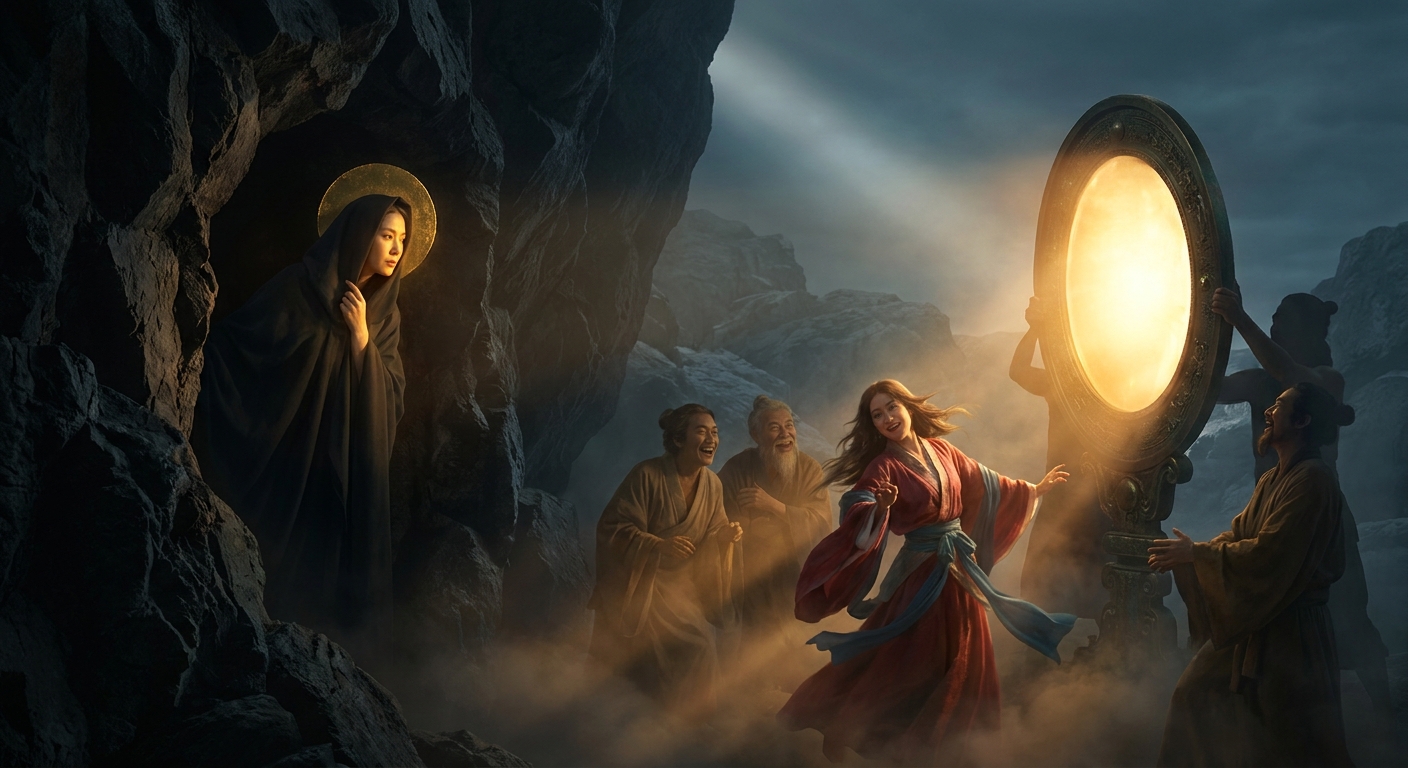
She is the goddess of dawn and festivity and the particular joy that breaks through grief when nothing else can. She overturns a wooden tub, climbs atop it, and begins to dance.
This is not a formal dance. There is nothing ceremonial about what Uzume does. She stomps on the tub until it thunders. She pulls at her own robes. She improvises. She makes faces. She does the kinds of things that polite mythology, written down centuries later by court scholars, describes in euphemism — her clothing became disordered, the Nihon Shoki says, with the particular delicacy of a text that knows what it saw and chooses not to say it plainly. She makes the gods laugh.
That is the important thing. Not the dancing, not the disrobing, not the spectacle — the laughter. Eight million gods erupt in it. The plain of heaven shakes. The sound rolls outward in all directions like a wave from a stone dropped in still water, and it crashes against the boulder that seals the cave.
Inside the cave, Amaterasu hears it.
She has been sitting in the dark for what might be hours or centuries — time is not consistent in the age of the gods. She has been listening to the world fall apart, and she has felt, beneath her grief and her anger, the thin guilt of knowing that her grief and her anger are killing the rice. She has been refusing to care about that.
But the gods are not weeping. They are not holding a funeral. They are laughing — eight million of them at once, the kind of laughter that shakes mountains, and she cannot fathom what there is to laugh about. She has sealed herself in the dark. The world is dying. Why is everyone laughing?
She does what any person does when they hear a party happening without them.
She gets up and moves toward the noise.
The boulder shifts. A crack of light appears — her own light, leaking out around the edges of the stone. The long-singing birds, arranged in rows by Thought-Includer, begin to crow all at once. The bonfires outside roar up.
In the crack of light, something gleams.
The kami have hung a mirror from a sacred sakaki tree directly in Amaterasu’s line of sight. The Yata no Kagami — a great octagonal mirror, cast and polished to a sharpness that can hold light the way water holds the moon. She sees it through the crack and stops.
There is another sun.
She did not know this was possible. She thought she was the sun — the one, the only, the thing that light meant. But there it is, blazing in the mirror: a second radiance, as bright as she is, looking back at her with the same expression she must be wearing right now, which is the expression of someone who has just had a very specific kind of surprise.
She pushes the boulder further. She leans out to look.
The strong god Ame-no-Tajikarao has been crouching beside the boulder this whole time, waiting. The moment Amaterasu leans out far enough, he takes her hand and pulls. The boulder rolls away. The jeweled rope of Futodama is drawn across the entrance behind her — you cannot go back, the rope says, you have already come out, the rope says, and the gods are very sorry about the rope but it is necessary.
The sun floods back into the world.
It is not gradual. One moment dark, the next: paddies, herons, the particular gold of morning light on water. The evil spirits scatter. The rice continues its reach. Foxes sit down and clean their ears, embarrassed by their own howling. Susanoo is eventually found, punished, and expelled from heaven for good — but that is another story and a longer one.
Amaterasu does not fully understand yet what the mirror showed her. She looked at her own light and saw something outside herself, something in the world worth stepping toward. Maybe that is what curiosity always is: your own brightness reflected back in a shape you do not recognize, pulling you out of the dark you chose.
The mirror goes to Ise.
Not a copy, not a symbol — the actual Yata no Kagami, the one that caught the sun, is enshrined today at the Ise Grand Shrine in Mie Prefecture, where it has been kept for more than two thousand years in a wooden sanctuary that is ritually rebuilt every twenty years so it is always ancient and always new. It is one of the three sacred treasures of the Japanese Imperial House. No one looks at it. It is wrapped in layers of cloth and kept in perpetual darkness.
This is not accident. The mirror does not need to be seen to do its work. It only needed to be seen once — at the right moment, from the right angle, by the right goddess, who was sitting in a cave deciding whether the world was worth the trouble.
She decided it was.
The sun came out.
Echoes Across Traditions
Entities


Sources
- *Kojiki* (712 CE), trans. Donald L. Philippi
- *Nihon Shoki* (720 CE)
- Lafcadio Hearn, *The Complete Works of Lafcadio Hearn* — 'In a Japanese Garden' and mythological essays