The Boat of Heaven: Nanna-Sin's Monthly Journey
c. 2100 BCE · Ur and Nippur, southern Mesopotamia (modern Iraq)
Contents
Every month, Nanna-Sin, the Sumerian moon god, makes the sacred boat journey from his temple at Ur to receive the decrees of Enlil at Nippur. The city processes along the canal banks in torchlight. The god decides who will die before the next new moon. The moon is the cosmic accountant who measures time by disappearing.
- When
- c. 2100 BCE
- Where
- Ur and Nippur, southern Mesopotamia (modern Iraq)
The canal keepers have been working since before dawn.
They walk the bank of the canal with long poles, clearing the water hyacinth that has grown across the channel in the three weeks since the last journey. They do not speak to each other. The work is devotional — each cleared stem a preparation, each pushed-aside root a small act of making the path clean. By the time the sky turns orange above the flat horizon, the canal from Ur to the junction at Larsa is navigable, and the junction at Larsa to the branch that runs north toward Nippur has been checked twice.
The moon god’s barge cannot be impeded. This is not a theological statement. It is a logistical requirement understood by every canal keeper employed by the Third Dynasty of Ur.
Inside the great temenos, the boat itself is being prepared. Not a working boat — not the flat-bottomed reed boats that carry grain and date-wine down the Euphrates. This boat is cedar and silver fittings, its prow carved in the likeness of a crescent moon curved over a bull’s head, because the moon has always been associated with the bull, with the horns that echo its shape, with the fertility the full moon governs. The statue of Nanna-Sin has been carried to the boat by priests whose hands have been ritually purified for thirty days. The statue sits at the prow, facing forward toward Nippur, the holy city where Enlil waits with the decrees.
The theology of the journey requires understanding what Nanna-Sin actually is.
He is the moon — but this means, in Sumerian thought, something more specific than a light in the sky. He is the measurer. He is the god who makes time legible to human beings by changing shape on a predictable schedule. The waxing crescent becomes the full disc becomes the waning crescent becomes the three days of darkness when the moon is absent from the sky — and then the sickle rises again, thin and sharp and silver, and another month has been allocated.
Every month, during those three days of darkness, Nanna-Sin is understood to be in the underworld. Not trapped there. Traveling there deliberately, as a judge goes to consult with the great judges, to learn what fates have been prepared for the coming month. He descends. He takes the decrees. He ascends. He begins to be visible again.
This is why the journey to Nippur matters. It is not merely ceremonial. In the Sumerian understanding, it is the mechanism by which the decrees of Enlil — the orderer, the assigner, the god whose breath became law — are transmitted into the world. Nanna carries them from Nippur back to Ur. He carries them in the dark when he is invisible. He distributes them as he brightens. By the time he is full and round above the city, the fate of the month has been set.
The procession begins at the moment the boat is launched.
The priests go first. Then the temple singers — the male and female kalum singers who perform the lament songs, the ones that acknowledge the moon god’s passage through the underworld, the ones that were composed to accompany what might otherwise be experienced as pure loss. In Mesopotamian religion, the three dark days are always acknowledged as a kind of death. The lament songs exist to say: we know you are gone, we are grieving your absence, we are waiting for your return.
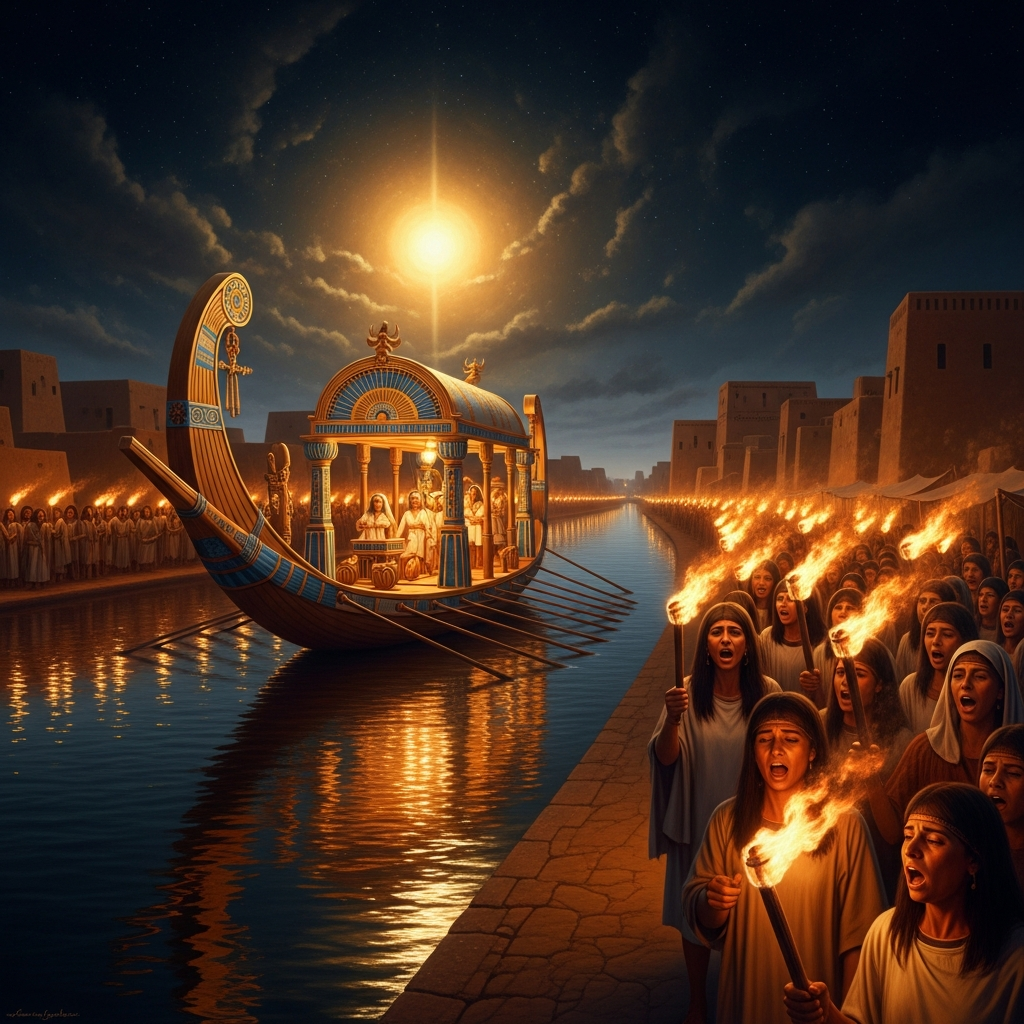
They process along the canal bank. Torchlight. The torches are not decorative — the canal is narrow in places and the boat must be guided through the dark sections where the walls of the city throw shadow on the water. The torch-bearers on the bank and the torch-bearers on the boat make the channel visible from above. If you stood on the walls of Ur and looked down, you would see a line of fire moving slowly northeast in the dark.
The women sing. The specific text that survives is called the Lament for the Destruction of Ur in its more extended form, but the monthly processional hymns draw on the same vocabulary: the lord has gone away, the moon has set, who will speak for us in the high temple? They are not sad exactly — they are doing what the liturgy requires of them, which is to hold the emotional weight of absence so that the return, when it comes, is recognized for what it is.
Nanna-Sin is deciding.
Inside the boat — or in the consciousness of the divine figure the statue represents, or in the astronomical reality of the moon moving through its cycle in ways that the Ur III astronomers have already begun to calculate and predict — the god is working through the month’s allocation. Every civilization that watches the night sky discovers that the moon is a counter. Its regularity is a shock — that something in the chaos of the cosmos repeats itself with such precision, waxes to fullness and wanes to nothing and returns, that you can predict it, that thirty tablets of astronomical observations allow you to say: on the fourteenth day of the third month, the moon will be full.
What the Sumerians add to this observation is personality. The moon counts because the moon is a person, and persons have intentions. The regularity is not mechanical — it is the regularity of a god whose nature tends toward order, whose journeys follow a pattern because the god chooses to honor the pattern, because Enlil’s decrees are worth traveling to Nippur to receive.
What is decided in the boat on the canal, in the theology of the Third Dynasty priests, is this: who in the city of Ur will not see the next new moon. The sick woman in the third district. The old man whose cough has lasted since the harvest. The soldier recently returned from a border skirmish with a wound that the temple physicians have cleaned and bandaged twice. Their fates were settled at Nippur. The moon carries them south in the cedar boat.
The women on the bank do not know the names. They sing the lament songs anyway, because the lament songs are for everyone who will need them, and someone always needs them.
Nippur appears at dawn.
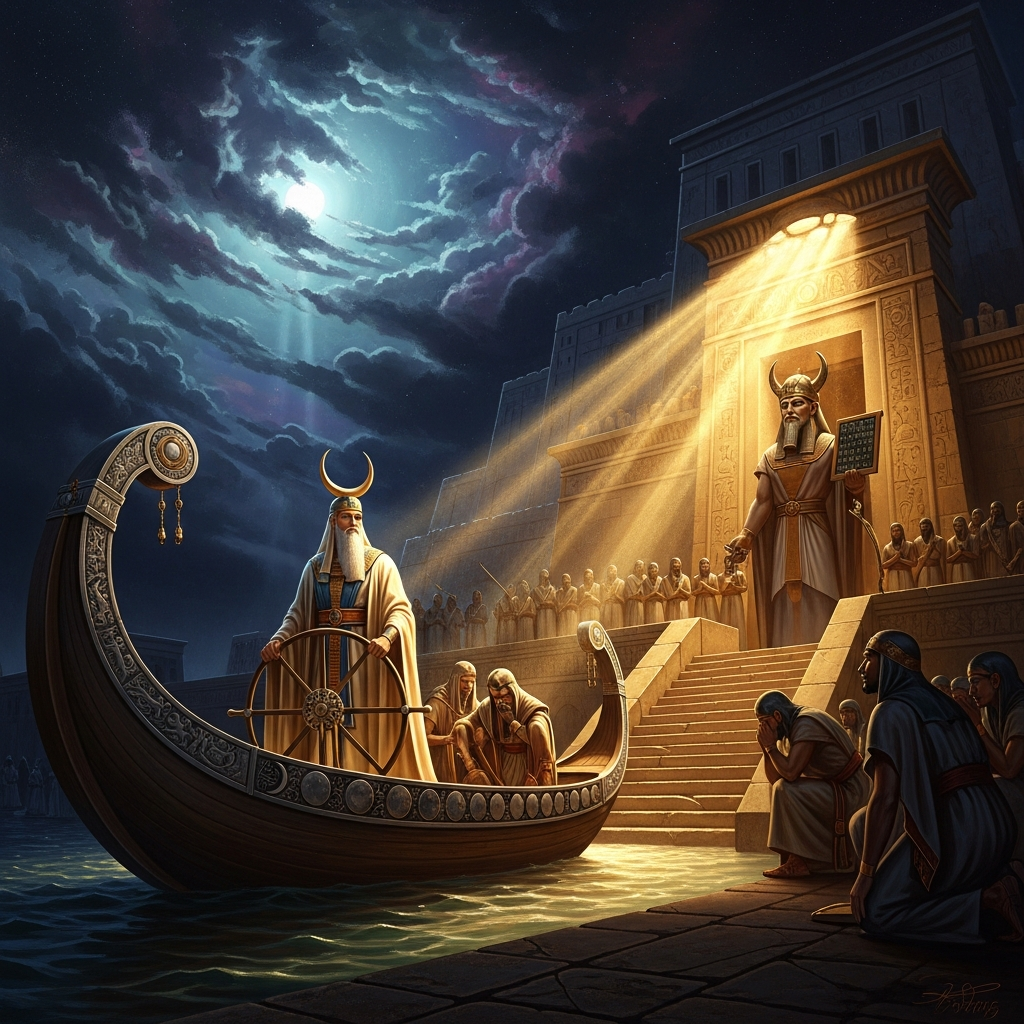
The city’s sacred quay is dressed with cedar branches and fresh-caught fish and offerings of date-wine. Enlil’s temple, the Ekur, rises from the flat plain ahead, its ziggurat already visible in the early light, the smoke of the morning sacrifices rising straight up in the still air. This is the center of the world in the Sumerian theological geography — not Ur, which is the moon god’s home, not Eridu, which is the oldest city — but Nippur, which belongs to Enlil, in whose house the fate of everything is decided.
The boat docks. The statue of Nanna-Sin is carried to the temple precinct. The rituals of greeting are performed: the exchange of gifts, the formal acknowledgment that the moon god has made his journey and arrived with honor, that the journey was unimpeded, that the canals were clear.
The decrees are transmitted in a ceremony the texts describe elliptically — the clay tablet recording the ritual breaks at the crucial moment, the way the most important things always seem to break in the historical record. What survives is the list of what Enlil provides: abundance, fertility, long life for the righteous, the fates of the cities for the coming month. Not only death. The moon god returns with both kinds of decrees, the quickening and the ending, because a month contains both.
The boat turns south toward Ur.
Three days after the boat journey completes, the new moon rises.
It appears on the western horizon at sunset — thin, precisely curved, unmistakably intentional. The women on the rooftops of Ur who have been watching for it call out when they see it. A shout that crosses the city from the western edge inward, a wave of recognition that moves faster than a man can run. The god has returned. The darkness is over. The month has its decrees and can begin.
The canal keepers will rest for another three weeks. The torch-bearers will oil the torches and put them back in the storeroom. The lament singers will sing different songs — the ones about fullness, about the bull-horned god whose light makes the night safe for travel, whose light the fishermen use to work the river past dark, whose light the mothers of newborns count when they cannot sleep.
Nanna-Sin brightens slowly over the next two weeks, carrying the month’s fate from the crescent sickle to the full disc, distributing what Enlil decreed, measuring out the days with the same precision the astronomers can calculate from their clay tablets. The sick woman in the third district does not know that her fate was settled in a boat on the canal. She knows only that she is not well and that the new moon is beautiful above the rooftops.
She is gone before it is full again.
The Nanna-Sin journey ritual lasted in some form for two thousand years — from the earliest Sumerian texts through the Akkadian period and into the Ur III empire that built the great ziggurats whose ruins survive at Ur today. The ziggurat of Ur was Nanna’s house. The boat in the canal was his vehicle. The women on the bank were his witnesses.
The moon as a person — as a traveler who judges, who counts, who disappears into the underworld and returns — is one of the oldest theological formulations on record. It answers the question that the night sky poses every month: where does it go? It goes to receive decrees. It comes back knowing things you do not know.
Every tradition that looks at the moon sees something different: a rabbit, a face, a mirror, a calendar, a dead satellite. The Sumerians saw a god who made the journey monthly because the journey was the work, because the measuring of time is sacred work, because someone has to know when things end.
The canal keepers are still clearing hyacinth from the waterway in the dark before dawn. Not in Ur — Ur is desert and archaeology now — but in the part of the human project that keeps making a path for something it cannot see.
Scenes
The moon god's sacred barge moves through the canal system at night, the whole city of Ur processing along the bank with torches and lament songs
 Generating art…
 Nanna-Sin's boat arrives at Nippur's sacred quay, where Enlil waits in the great temple to deliver the decrees of the coming month
 Generating art…
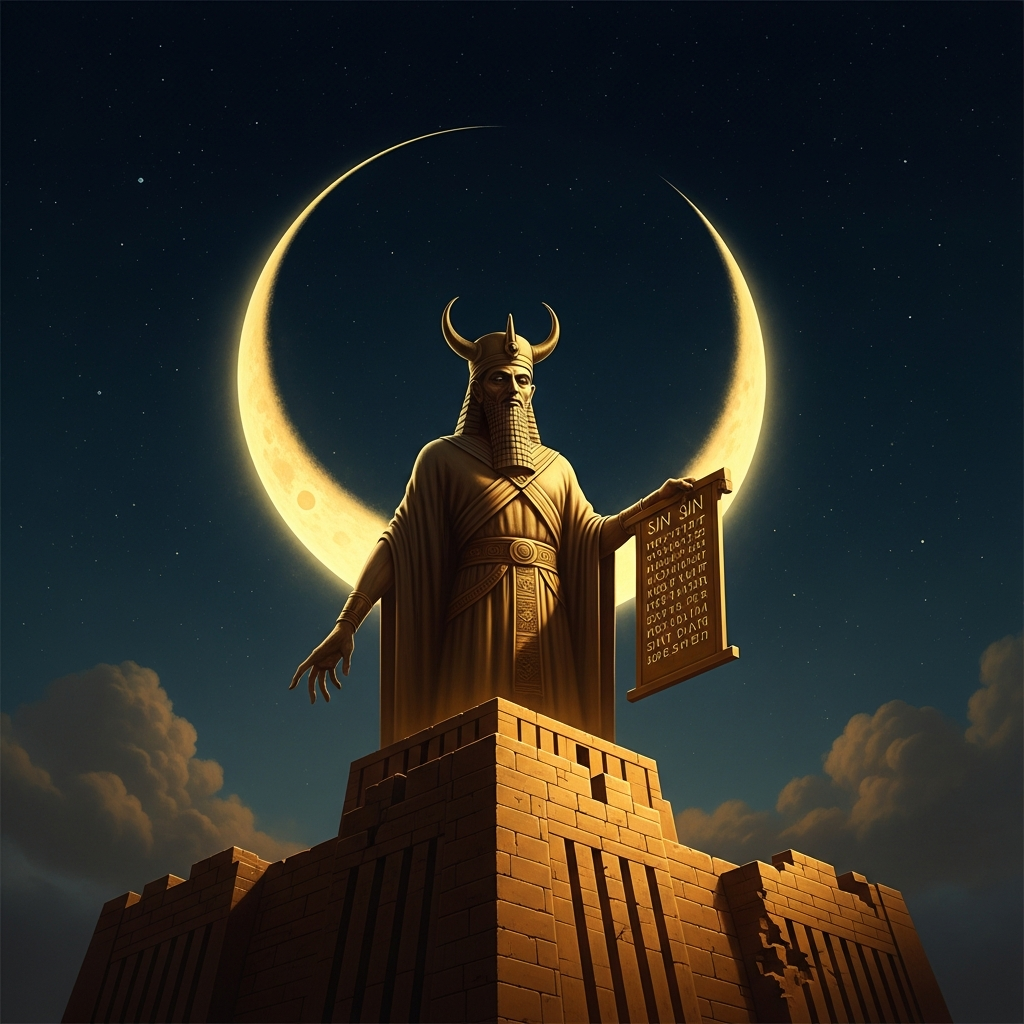
 The new moon rises over Ur three days after disappearance — the god returning from the underworld, thin as a sickle, carrying the fate of the next thirty days
 Generating art…
 Echoes Across Traditions
Entities
- Nanna-Sin
- Enlil
- Ningal
- Enki

Sources
- Thorkild Jacobsen, *The Harps that Once...: Sumerian Poetry in Translation* (Yale University Press, 1987)
- Samuel Noah Kramer, *Sumerian Mythology* (University of Pennsylvania Press, 1944)
- Åke Sjöberg, *Der Mondgott Nanna-Suen in der sumerischen Überlieferung* (Stockholm, 1960)
- Piotr Steinkeller, 'The Administrative and Economic Organization of the Ur III State,' in *The Organization of Power* (Oriental Institute, 1987)