Gilgamesh and Enkidu Slay Humbaba
~2100 BCE Sumerian; Standard Babylonian Epic ~1300 BCE · The Cedar Forest of Lebanon
Contents
The king of Uruk and his wild brother march into the Cedar Forest to kill its divine guardian. They succeed. The forest falls. And everything that follows is grief.
- When
- ~2100 BCE Sumerian; Standard Babylonian Epic ~1300 BCE
- Where
- The Cedar Forest of Lebanon
They march for twenty days and rest for thirty. They dig wells in dry ground where no wells have been. They make camp at the edge of the known world, and each night before sleep Gilgamesh holds the cedar door they have carved and carried as a talisman, presses his face against it, and asks Shamash the sun-god for a dream.
The dreams come wrong. Mountains crumble. Uruk floods. The stars fall.
Enkidu translates each nightmare into victory. The mountain is Humbaba. Its fall is his death. The flood is the guardian’s power breaking before you. He is not lying exactly. He is doing what companions do in the dark before battle: he is holding the shape of courage until morning can fill it.
Gilgamesh is two-thirds divine and one-third human. He is the strongest man alive. He has never been afraid before and does not have a word for what he is feeling now.
The Cedar Forest does not look like a place of death. That is the first surprise.
The cedars run to the horizon in every direction, older than any city, older than writing, their roots laced into the bones of the earth. The air is wet and green and smells of resin. Birds move through the branches. Light comes down in long shafts the way it comes down in a temple, and the floor of the forest is soft underfoot with generations of fallen needles. It is, in the oldest sense of the word, a paradise. A place set apart. Sacred.
Enlil, lord of storm and command, has appointed Humbaba to keep it that way.
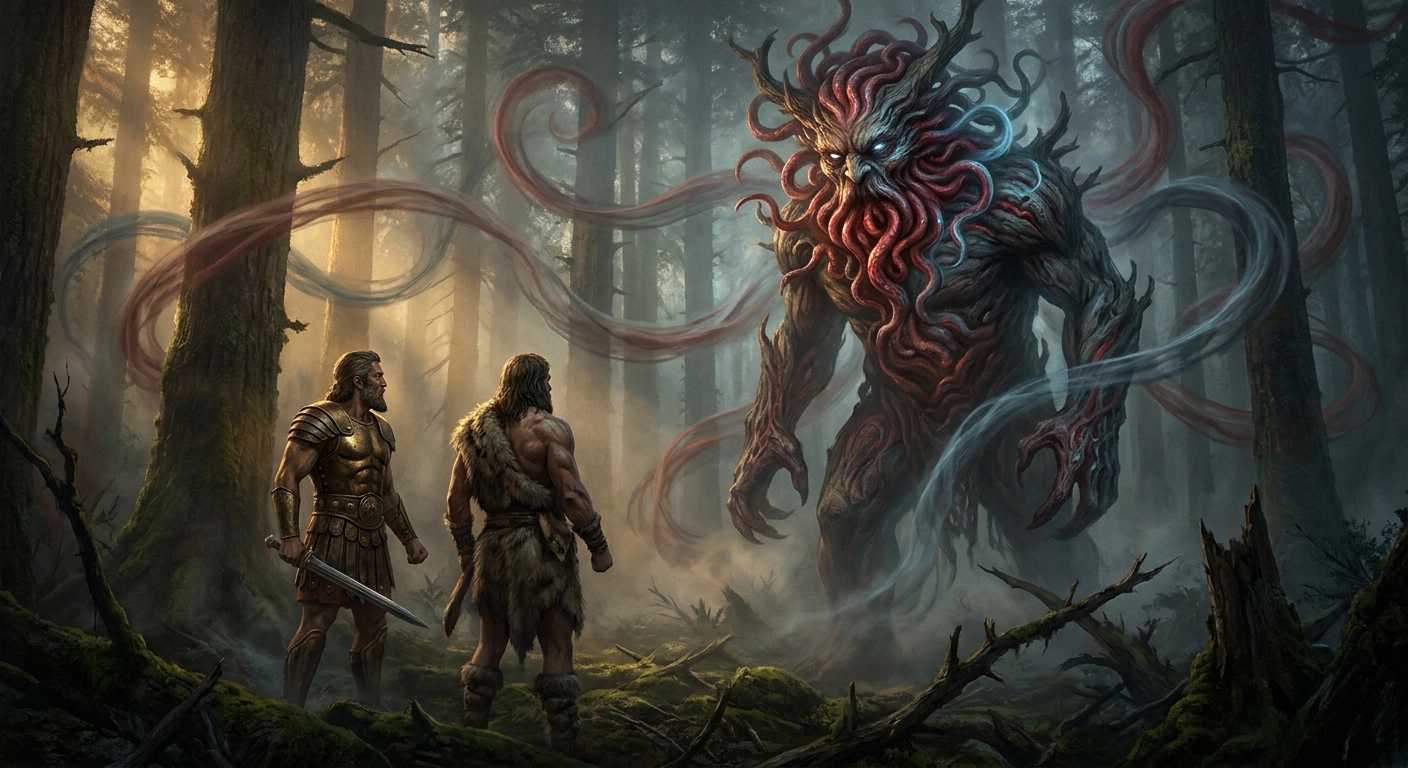
They hear him before they see him. The roar travels through the cedars like a flood travels through reeds: it bends everything in its path. Humbaba’s mouth is fire. His breath is death. He can hear a leaf fall sixty leagues away, and he has been listening to these two men crash through his forest for three days.
He comes.
He is enormous in the way that the word enormous fails. He is the forest given a face: old, vast, rooted in something that precedes the gods who appointed him. His face is layered — the ancient scribes drew it in coils and convolutions, intestines turned outward, the look of something that was never meant to be looked at directly.
He is terrifying.
He is also alone.
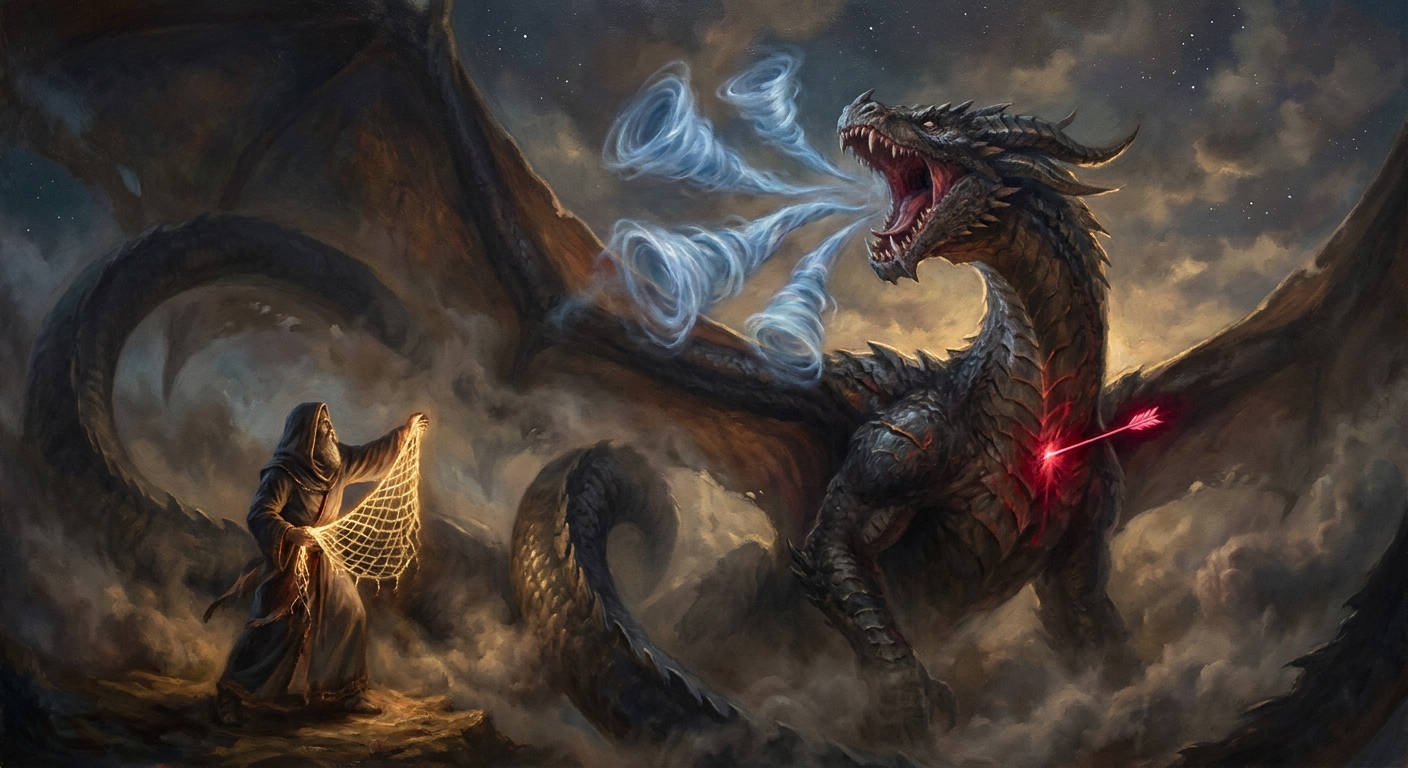
Shamash sends the thirteen winds. North wind, south wind, whirlwind, simoom, the tempest and the blizzard — they come down from the sky like a fist and pin Humbaba where he stands. He cannot advance. He cannot retreat. The divine machinery of the world has been arranged against him, and he knows it.
Gilgamesh raises his axe. Enkidu stands at his shoulder.
And Humbaba speaks.
“Gilgamesh. You are young. Your mother bore you. She is the wild cow Ninsun, who loves you. Your father is Lugalbanda. Enkidu has no mother and no father — he was made from clay, from wilderness, from nothing. He does not know what it is to have been made by someone who will grieve you.
“I am guilty of nothing. Enlil set me here. The cedar is my dwelling, my charge, my life. Let me go. I will give you the forest. I will give you cedar enough to build whatever you want. I will be your servant.”
He weeps. The guardian of the Cedar Forest, older than Uruk, appointed by the lord of the sky — he weeps, and asks to live.
Enkidu leans close to Gilgamesh and says: Kill him now. Before Enlil finds out and stops you. Kill him now.
This is the moment the epic never forgets, and neither should we.
Gilgamesh kills him.
The axe falls. Three times. The cedars shake. Birds explode from the canopy. The forest goes silent in the way that forests go silent after something very old has ended, which is not quite the same as quiet.
They cut down the cedars. They take the tallest, the one Humbaba slept beneath, and they drag it to the Euphrates and float it downriver to Nippur, a gift for the god who will not want it. They take cedar enough to build a gate for Enlil’s temple at Nippur. An offering. An apology. A monument to what they have done.
Enkidu pushes Humbaba’s head into the river with his foot.
They have killed a god. The first mortals to do it. They stand in the silence of the fallen forest and they have everything they came for, and the moment they have it they begin, without being able to stop it, to understand what it cost.
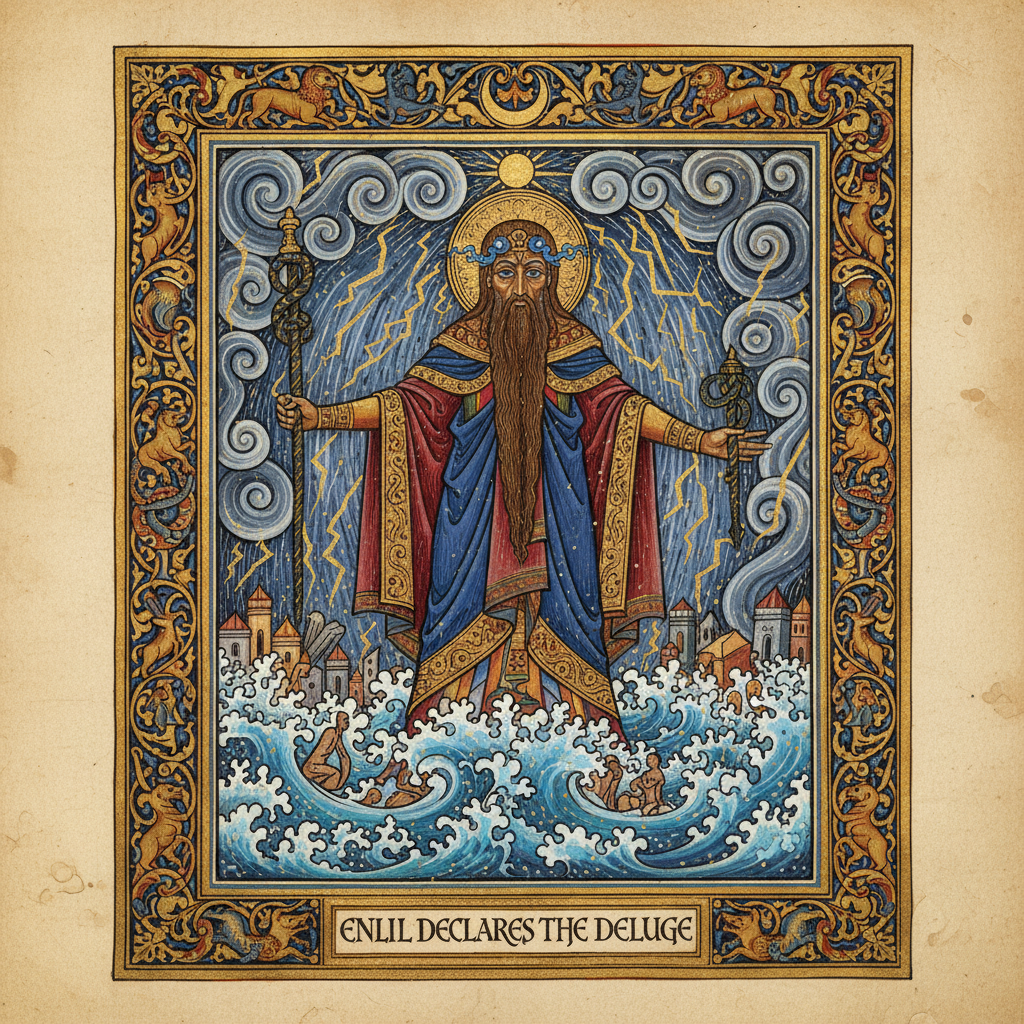
Enlil, when he hears, is not grateful. He does not send praise. He says only: You should not have done it. You should have let him live. He could have built you a temple. He could have ground your grain. Instead you killed him, and now the balance is wrong.
The words settle on Enkidu like a pronouncement. He has no mother. He has no father. He was made from clay by a god’s hands, given civilization by a woman’s body, and bound to this king by something the language of Uruk does not have a word for. He has been the instrument of Gilgamesh’s courage for the whole of their friendship, translating fear into action, holding the shape of bravery when the king could not.
He goes home to Uruk with cedar in his hands and something else that has no name.
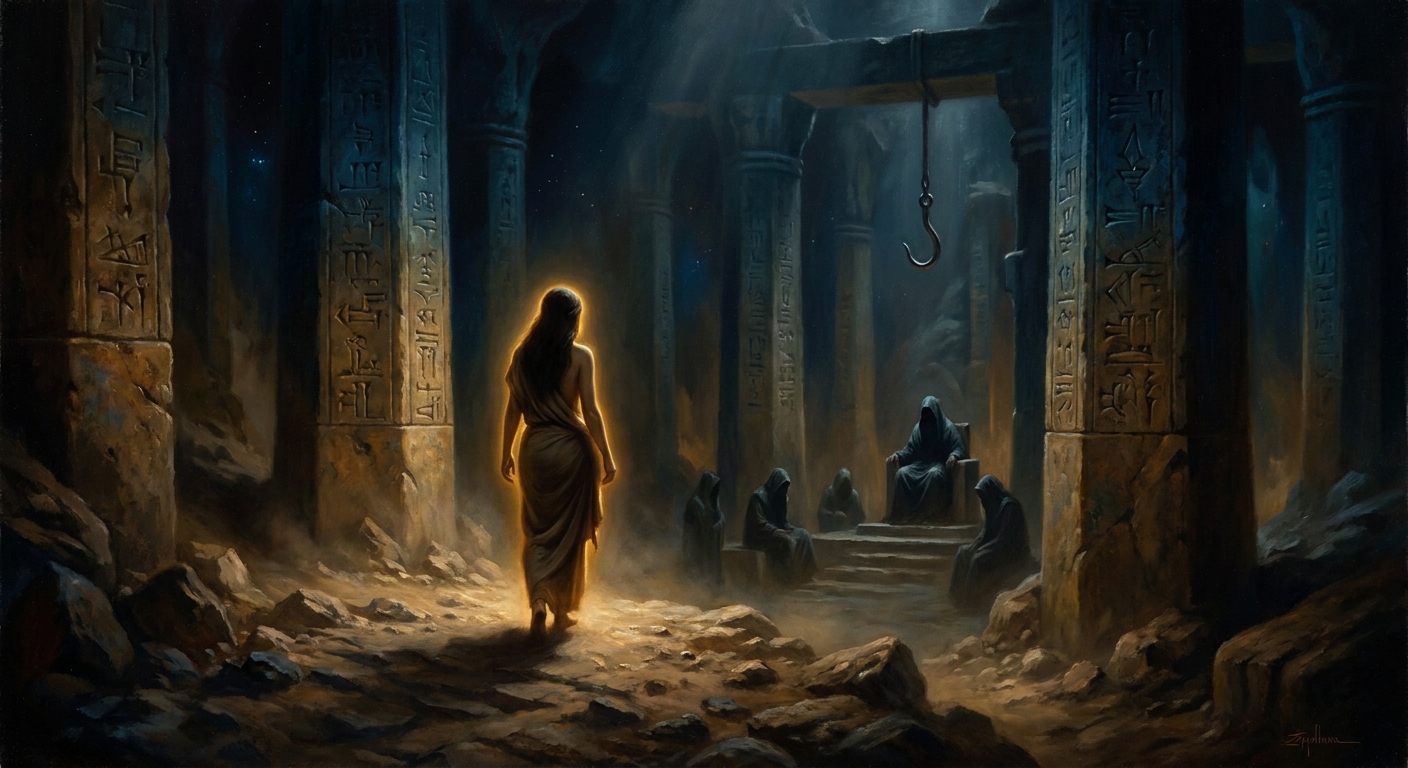
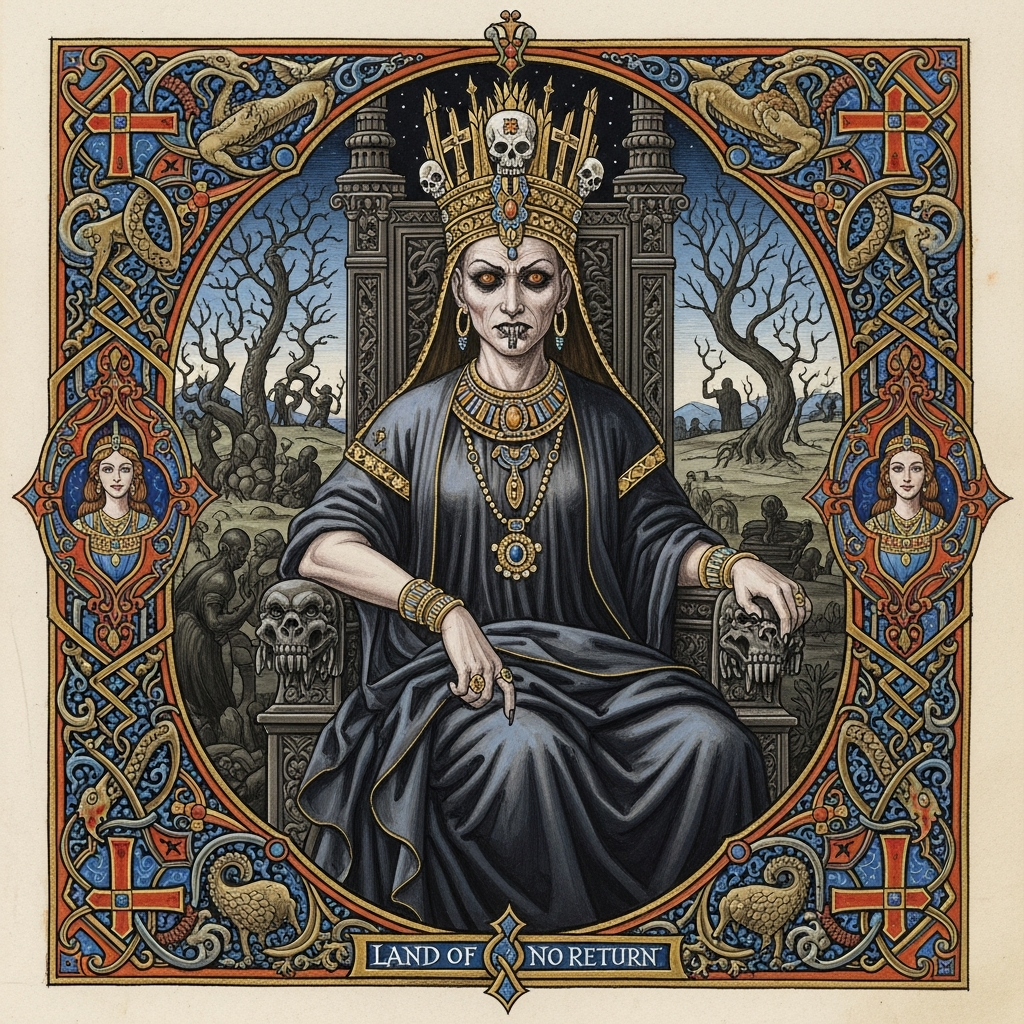
He dreams of the House of Dust, where the dead dwell in darkness, wearing feathers like birds, eating clay, never seeing light. He dreams it seven nights running. He dreams it with the precision of prophecy.
He wakes. He is sick.
He is sick for twelve days, and on the thirteenth day he does not wake.
Gilgamesh does not know what to do with grief. He has never practiced it. He sits beside Enkidu’s body and he waits for it to move the way a man waits for a sleeping friend to wake, and when it does not move he keeps waiting. He covers it with a linen veil. He calls the craftsmen of Uruk to make a statue: lapis lazuli for the chest, gold for the face, stone for the body, a statue so beautiful it will outlast every city. He calls the herdsmen and the farmers. He calls the men who press the oil and the men who pour the wine. He says: Weep for Enkidu. I will weep for him.
He weeps for six days and seven nights.
On the seventh night, a worm falls from Enkidu’s nose.
Gilgamesh stands up. He puts on a lion-skin. He goes out into the wilderness alone, toward the edge of the world, looking for the one thing the gods kept for themselves and the one thing the serpent will eventually take from him too.
He does not find it.
He comes back to Uruk with empty hands, and he climbs the walls of the city he built and runs his hands along the baked brick, and he says: Look at the walls. Look at the foundation. Is it not the equal of heaven? Was it not built by the seven sages? Look inside the bronze chest — there is a tablet of lapis lazuli. Read it. Read what Gilgamesh suffered and accomplished. Read it.
He means: I was here. We were here. We slew the monster together. The forest fell. He died. I could not stop it.
That is what the oldest story ever written is about.
Humbaba had done nothing wrong. He was appointed. He guarded what he was given. He wept and offered everything he had. Enkidu said: kill him now.
We have been Enkidu ever since.
The Cedar Forest of Lebanon, which the ancient Phoenicians and Assyrians stripped for ships and temples and palaces, is now a protected remnant of a few thousand trees. The Epic of Gilgamesh was buried in the Library of Ashurbanipal and stayed buried for two thousand years, until archaeologists dug it up from the rubble of Nineveh and a scholar named George Smith recognized what he was reading and wept at his desk in the British Museum in 1872.
Even the story came back from the dead.
Even the story could not save the forest.
Echoes Across Traditions
Entities


Sources
- Standard Babylonian *Epic of Gilgamesh*, tablets IV-V
- Andrew George (trans.), *The Babylonian Gilgamesh Epic* (Oxford University Press, 2003)
- *The Tablet of Sin-leqi-unninni*
- Stephanie Dalley (trans.), *Myths from Mesopotamia* (Oxford World's Classics, 1989)