Inanna Descends and the World Goes Still
Mythic Time · recorded on clay tablets c. 1900-1600 BCE, Sumer · the Great Below — the Sumerian underworld — and the earth above it
Contents
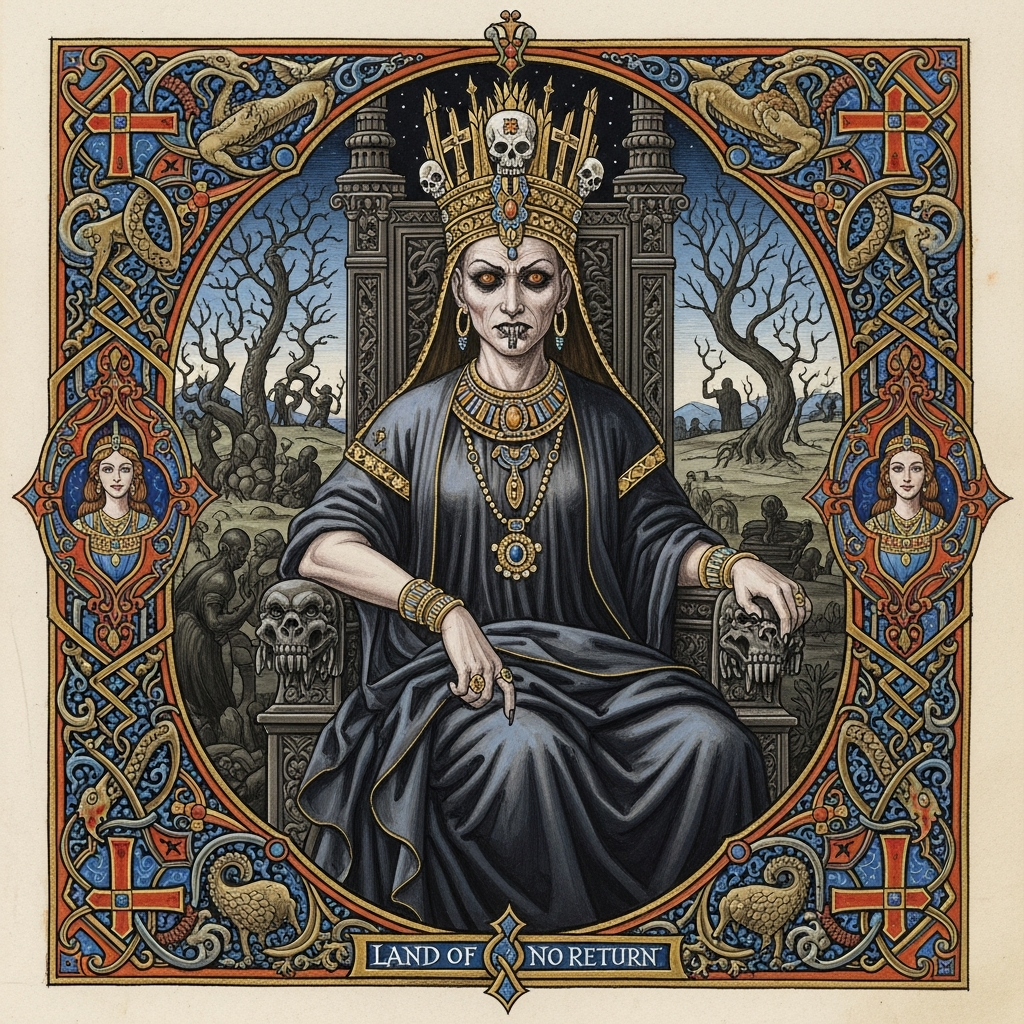
Inanna, Queen of Heaven and Morning Star, descends to the Great Below to attend her sister Ereshkigal's husband's funeral — or to seize the underworld's power for herself. At each of seven gates she surrenders a garment. She arrives naked before Ereshkigal, is killed, and hung on a hook. For three days nothing grows, nothing gives birth, nothing in the world above moves toward life.
- When
- Mythic Time · recorded on clay tablets c. 1900-1600 BCE, Sumer
- Where
- the Great Below — the Sumerian underworld — and the earth above it
She makes the decision in the way she makes all decisions: absolutely, without consultation, at the precise moment the desire becomes fully formed.
She is going down.
She does not tell her husband Dumuzi. She does not tell the great gods of the assembly. She tells one person: Ninshubur, her vizier, her faithful companion, the woman who has served her since before time had a name for service. She tells Ninshubur what she is going to do and she tells her what to do if she does not come back.
Wait three days, she says. If I have not returned in three days, go to the Father Enlil and weep. Go to the Moon-god Nanna and weep. Go to Enki, the god of wisdom, and weep — and Enki will find a way, because Enki always finds a way. Do not stop weeping until someone acts.
Ninshubur asks her why she is going.
Inanna does not answer, or the text does not preserve the answer, which may be the same thing. The scholars have argued about this for generations. She is going to attend the funeral of Gugalanna, Ereshkigal’s husband. She is going to expand her power into the third and final realm, having already mastered the earth and the heavens. She is going because something in the cosmos is pulling her downward and she has decided to go toward it rather than wait to be taken. She is going because the story requires her to go.
She fastens the crown of the steppe on her head. She arranges the wig of her station. She takes the lapis lazuli rod and line. She hangs the small lapis lazuli beads around her neck. She puts on the gold rings on her hands. She arranges the breastplate called Come, man, come. She takes the golden hip-girdle. She wraps the royal robe around her body. She applies the pala-garment, the garment of ladyship, to her torso.
She has seven things. She is going to need all of them.
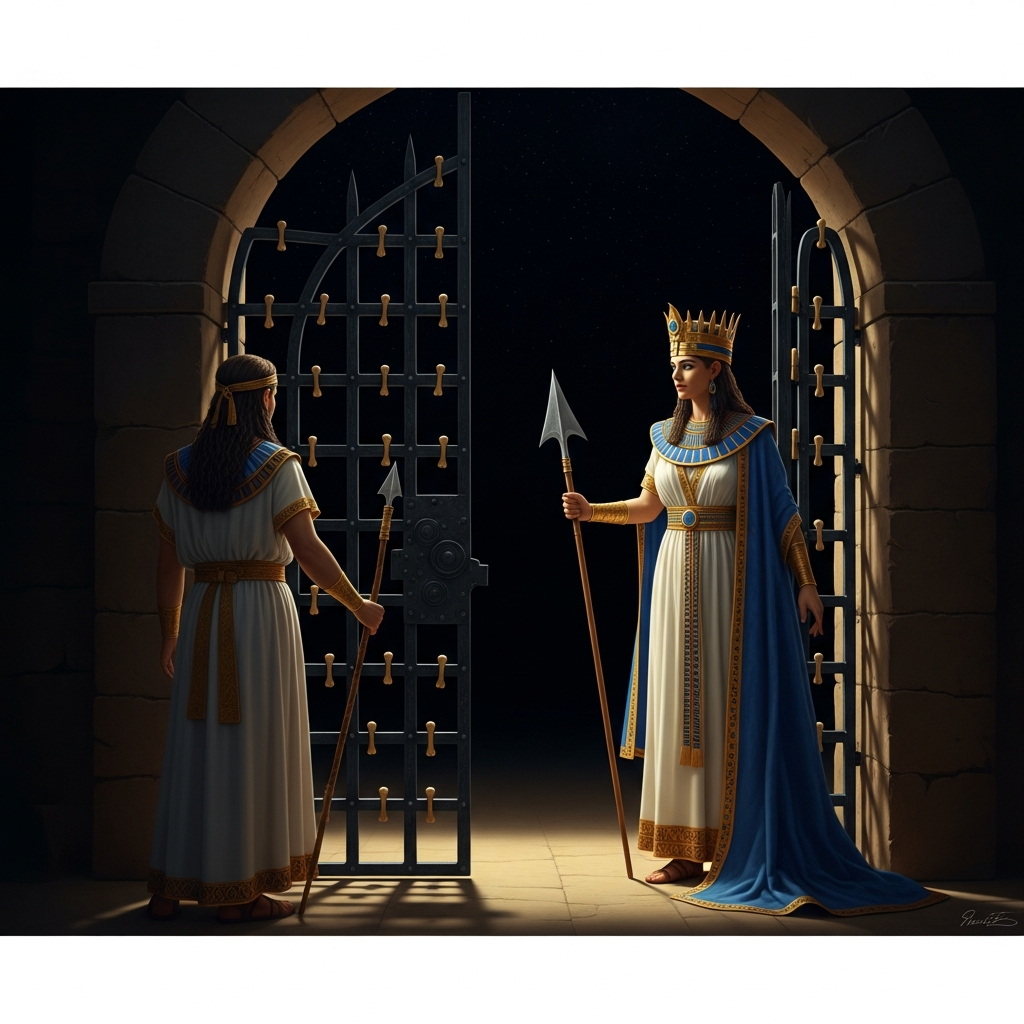
The first gate is iron, ancient, studded at the hinges with bone.
The gate-keeper is Neti, who serves Ereshkigal. He does not bow when Inanna approaches — no one bows in the underworld, which is the first thing she learns. She is still the Queen of Heaven, still wearing everything, still in possession of all the divine authority that makes worlds organize themselves around her preferences. She is also standing at a door she cannot open from this side.
She knocks.
Neti opens the wicket and looks at her. She is wearing the crown of the steppe. Her eyes are outlined with kohl. She is, by any standard available to the living, remarkable. Neti is not impressed. Who are you? he asks, and the question has a different quality down here than it would above. Above, the question would be rhetorical — everyone knows who Inanna is. Down here, it is genuine. The underworld does not recognize the credentials of the world above.
She tells him. He closes the wicket. He goes to Ereshkigal.
Ereshkigal listens. The text says she slaps her thigh, which is a Sumerian gesture of distress or grief — the great Queen of the Dead is troubled that her sister has come, and the trouble is not the ordinary trouble of an unexpected guest. It is the trouble of knowing what the law requires and knowing she cannot change it. The law applies to everyone. It has always applied to everyone. It applies to her own sister.
Let her in, she tells Neti. But treat her according to the ancient rites.
The ancient rites are: at each gate, she gives up something.
At the first gate, the crown of the steppe.
At the second gate, the small lapis lazuli beads.
At the third gate, the gold rings.
At the fourth gate, the breastplate.
At the fifth gate, the golden hip-girdle.
At the sixth gate, the pala-garment.
At the seventh gate, all remaining garments.
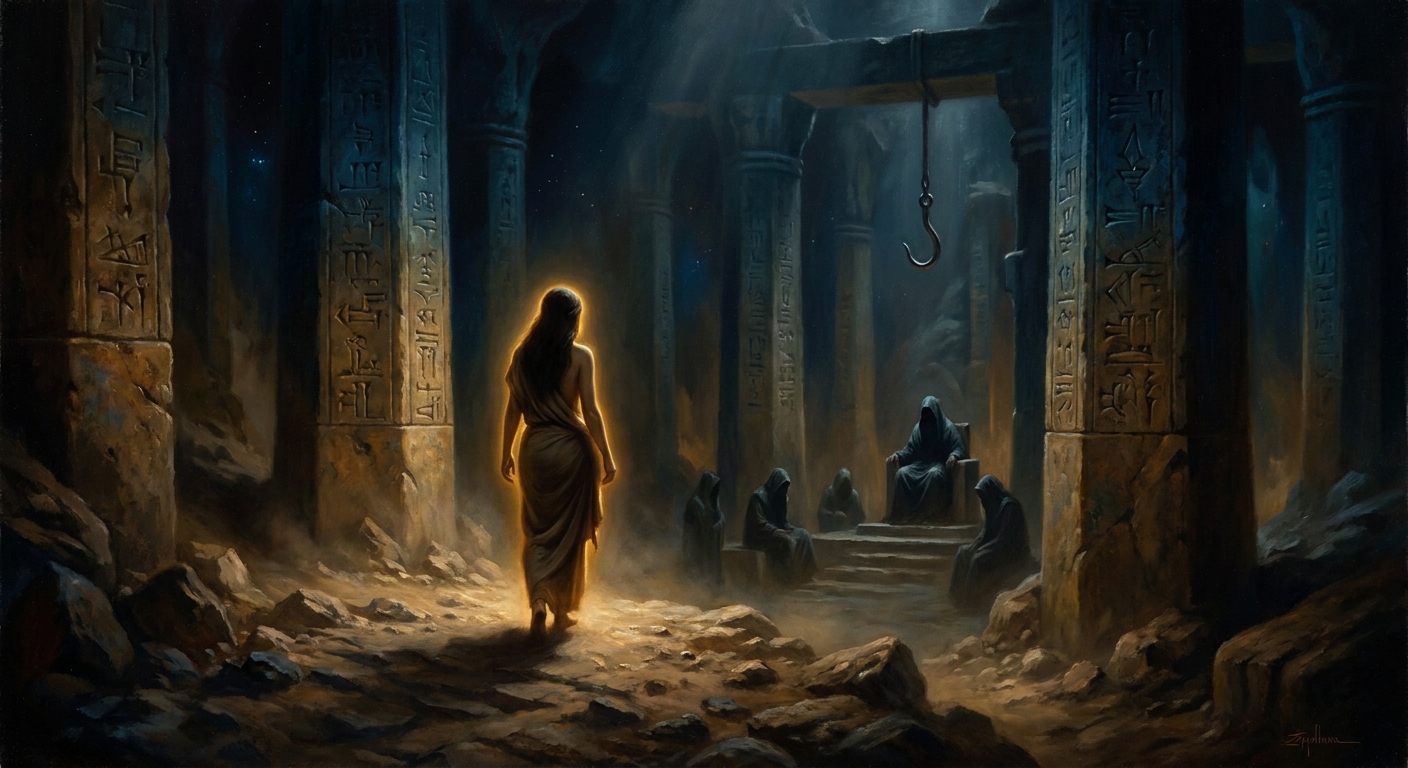
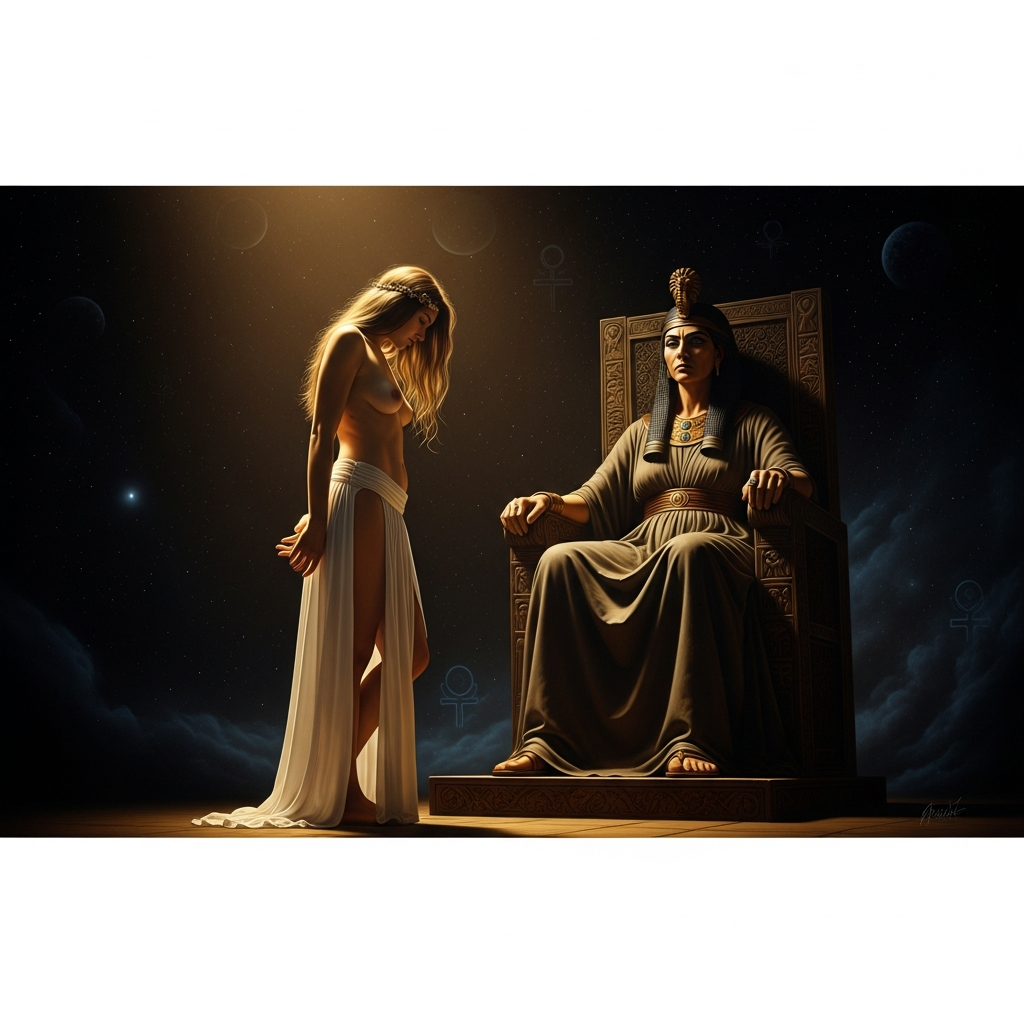
She arrives before Ereshkigal’s throne naked.
This is not nakedness in the sense the surface world understands it — the vulnerability of skin in cold air, the social exposure of a body unclothed. This is ontological nakedness: the stripping of everything that makes Inanna Inanna. The crown was the authority of the upper realm. The beads were the measurement of heaven and earth. The rings were the contracts she had made with the living. The breastplate was her war-power. The hip-girdle was her sexuality, her power of attraction. The pala-garment was her ladyship, her divine status. Stripped of all of these, she is still herself — but herself as the Sumerian scholars say she is at this moment: bowed low.
What she stands before is everything she is not.
Ereshkigal does not embrace her.
The two sisters face each other in the cold light of the underworld — there is light in the underworld, cold and directionless, not the warm gold of the sun but the gray of stone in deep places. Inanna is naked. Ereshkigal is robed in shadow. They share a mother. They share nothing else.
The Annunaki, the seven judges of the underworld, take their places around the throne. They look at Inanna. They look, in the text, with the look of death, which means the look that constitutes judgment, the look that is itself the verdict. They do not speak the sentence. They do not need to.
Ereshkigal fastens the eye of death upon Inanna.
She speaks the word of wrath.
She utters the cry of guilt.
Inanna is struck.
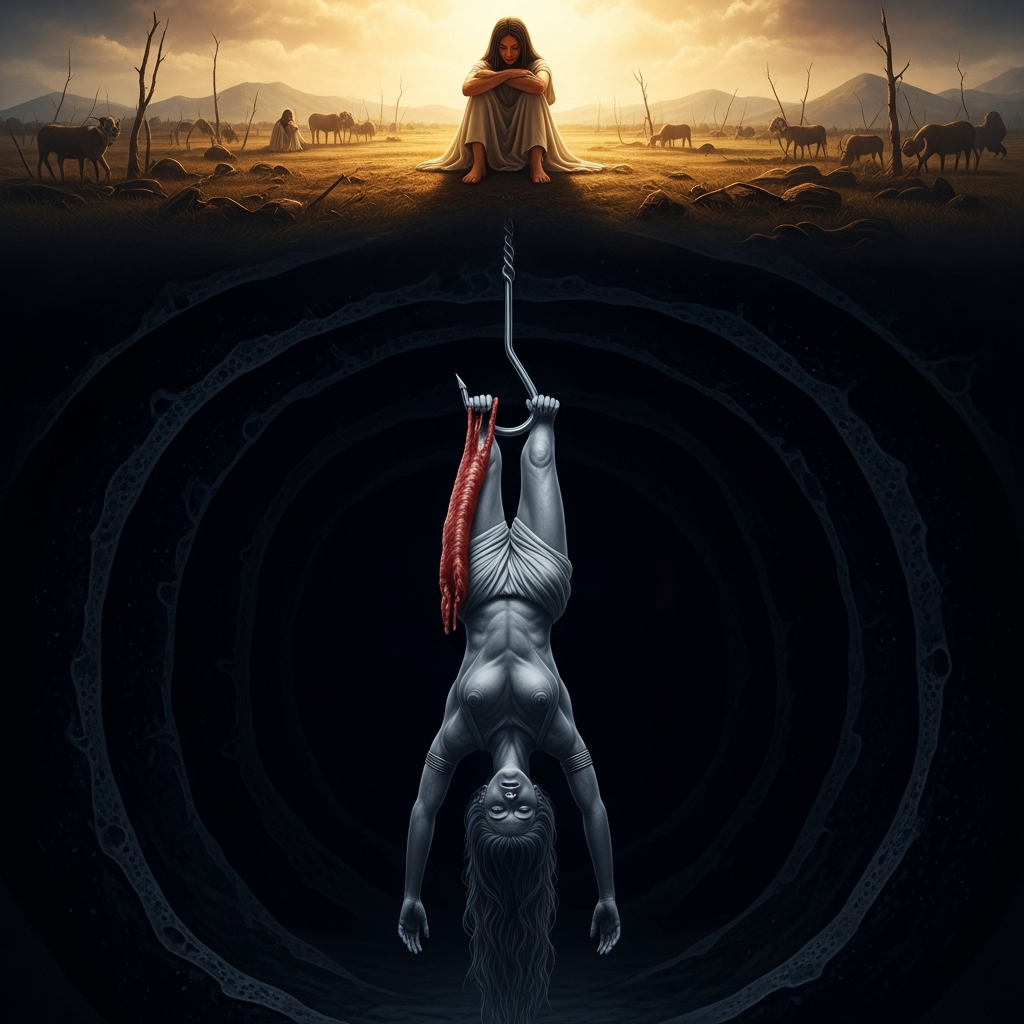
She becomes a corpse. She is turned to a piece of rotting meat. And then she is hung — on a hook, from a peg, in the wall of the underworld, the way a butcher hangs meat from a hook. The word the text uses is the word for meat hanging to drain.
The world above stops.
This is the part of the story the scholars say must be told because it is the reason for the story: the reason we tell the descent narrative is not the descent but the silence that follows the descent. No cow mounts the bull. No ewe bows to the ram. No woman conceives. No one gives birth to anything. The fields stand unplanted, or planted but not growing. The orchards flower but the flowers do not set fruit. The rivers run but the fish do not spawn.
The world above stops because Inanna is the principle of fertility in the world above — not merely a goddess who supervises fertility, but the living force of it, the locus of the drive toward life and multiplication and renewal. When she is hung on the hook, the drive is hung on the hook. The world continues existing but stops becoming.
Three days and three nights pass.
Ninshubur is sitting on the earth with torn clothes and broken drums, doing exactly what she was told to do.
She goes to Enlil. He refuses. No one goes down and comes back. That is the nature of the underworld.
She goes to Nanna. He refuses. Same reason.
She goes to Enki.
Enki listens. Enki puts his finger to his side and picks dirt from beneath his fingernail and from the dirt fashions the kurgarra, a small being, neither male nor female, that can pass through any gate without triggering the law of substitution — it is not alive in the way the law recognizes aliveness. From the other side of his fingernail he fashions the kalatura, the same kind of being. He gives each of them the food of life and the water of life.
Go to the Great Below, he tells them. Find Ereshkigal. When she cries out in her labor pains — for she is always in labor in the underworld, always giving birth to the dead — say to her: we grieve with you. Whatever she offers you as a reward, ask for the corpse on the hook.
The small beings descend.
They find Ereshkigal on her throne, groaning. The text says she is in agony — Oh, oh, her inside! the ancient words record, and it is the cry of someone in physical pain, specific and real: the pain of the queen who rules death, who is herself always in labor, who is never done with it, who can never rest from the work of receiving the dead that the world above keeps producing.
The kurgarra and the kalatura grieve with her. They say her words back to her: Oh, oh, her inside. They mirror her pain. They do not perform sympathy. They do not offer consolation. They simply repeat what she is saying, moment by moment, pain by pain, and this — the acknowledgment, the witness, the being-with-in-grief — is what Ereshkigal cannot refuse.
She offers them gifts. They ask for the corpse on the hook.
She gives it.
They sprinkle the food of life on it. They sprinkle the water of life on it.
Inanna rises.
She walks toward the seven gates.
The Annunaki are waiting. The law is the law. If Inanna rises from the underworld, the law says, let her provide a substitute. The Galla — the underworld’s enforcers, beings who know no food, who know no drink, who accept no offerings, who have never in their existence known what it is to want to be somewhere else — attach themselves to Inanna and rise with her. They will not release her until the substitute is named.
She rises through each gate. At each one, her garments are returned. The pala-garment. The hip-girdle. The breastplate. The rings. The beads. The crown. By the time she reaches the surface world she is herself again — queen, warrior, morning star, the one who makes the world fertile by virtue of her presence in it.
She is also surrounded by demons waiting for the name of the substitute.
She walks through the cities and the Galla follow, and she sees the men and women who wept for her during her three days hung on the hook — Ninshubur in torn clothes, the priests with ashes on their heads — and she will not give them to the Galla. They grieved. They earned their lives.
But Dumuzi did not grieve.
Dumuzi was sitting on his throne, dressed in fine clothes, enjoying himself, while his wife hung dead in the darkness. And Inanna looks at him and the texts record one of the oldest instances in literature of a love that has been permanently altered by what it witnessed: she looks at him, and her eyes are the eyes of death, and she gives him to the Galla.
They drag him below.
The tablet breaks here.
The full story continues in fragments: Dumuzi’s sister Geshtinanna negotiating to share his fate, so that half the year he is below and half the year she descends in his place, and the world above is fertile when Dumuzi is on the surface and going still again when he descends. The seasonal explanation, as old as agriculture.
But the part that the myth carries forward, across every subsequent dying-and-rising deity narrative, is the three days. The three days of divine absence. The three days when nothing grows, nothing is born, nothing is becoming. The world continuing to exist without the principle that makes existence worth anything.
Inanna comes back. The world starts again. But it does not come back unchanged. The goddess who descended as the Morning Star returns as something that has worn its own death like a garment and then removed it, and the removal leaves a difference. You can see it in the full versions of the myth, in the moment she names Dumuzi: she has been in the place where the law applies to everyone, and she has survived it, and surviving it has cost her the innocence of never having been there.
She rises, crowned, armed, fierce.
Below, the hook is empty.
Outside, the fields are already beginning.
Scenes
Inanna at the first gate of the Great Below, still crowned and robed in all her divine authority, the gate attendant Neti before her in the dark — Inanna in gold and lapis, the underworld gate black iron studded with bone, the darkness absolute beyond it
 Generating art…
 Inanna stripped of every garment, standing naked and defenseless before Ereshkigal's throne in the cold light of the underworld — the Queen of the Dead looking down at her sister with neither mercy nor malice, only the absolute law of that place
 Generating art…
 Inanna hung on a meat hook in the underworld, her body gray as clay, the darkness of the Great Below pressing in from all sides — while above, in a world gone still, Ninshubur sits on the earth and weeps, the fields empty, the animals silent
 Generating art…
 Echoes Across Traditions
Entities
- Inanna
- Ereshkigal
- Ninshubar
- Dumuzi
- Enki
- the Galla (underworld demons)

Sources
- Samuel Noah Kramer and Diane Wolkstein, *Inanna, Queen of Heaven and Earth* (Harper and Row, 1983)
- Stephanie Dalley (trans.), *Myths from Mesopotamia* (Oxford University Press, 1989)
- Thorkild Jacobsen, *The Treasures of Darkness: A History of Mesopotamian Religion* (Yale University Press, 1976)
- Betty De Shong Meador, *Inanna, Lady of Largest Heart* (University of Texas Press, 2009)
- Jeremy Black and Anthony Green, *Gods, Demons and Symbols of Ancient Mesopotamia* (University of Texas Press, 1992)