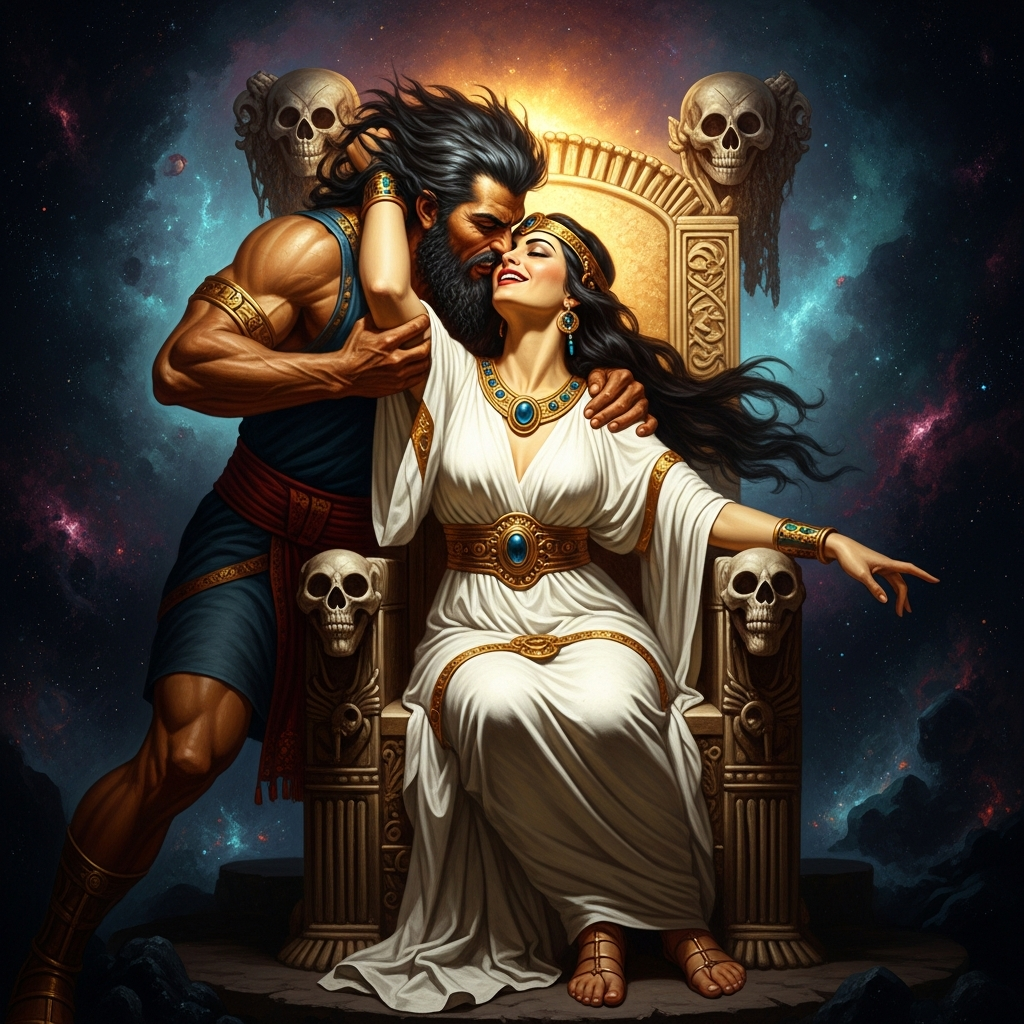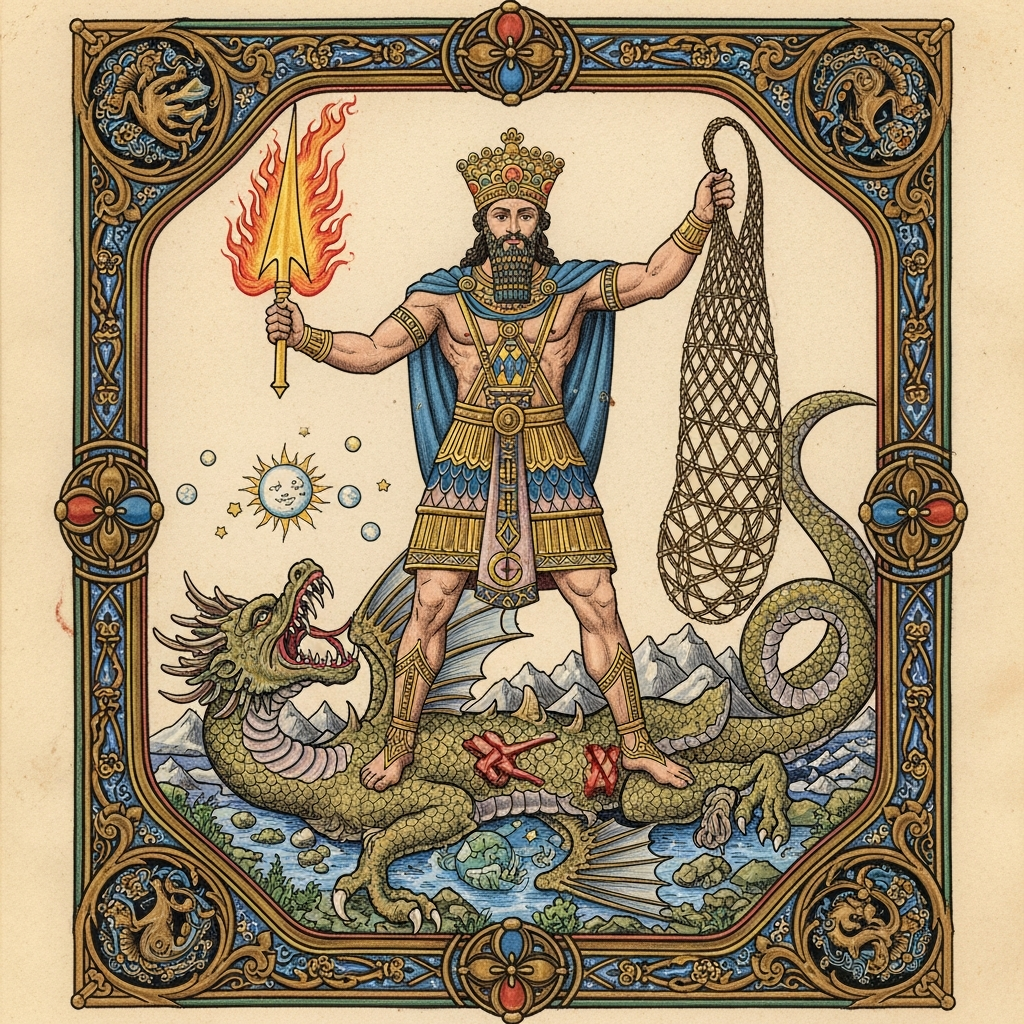
Marduk Splits Tiamat in Half
Composed c. 1800 BCE, Akkadian period; recited annually at the Babylonian New Year · Before the beginning — the primordial waters before sky and earth existed
Contents
From the Enuma Elish: the primordial salt-water ocean Tiamat assembles her army of monsters to destroy the younger gods. Marduk offers to fight her alone in exchange for supreme authority. He drives wind into her open mouth and splits her in half. He makes the sky from one half and the earth from the other. Creation as cosmic violence.
- When
- Composed c. 1800 BCE, Akkadian period; recited annually at the Babylonian New Year
- Where
- Before the beginning — the primordial waters before sky and earth existed
Before the beginning, there are only waters.
Not a single water. Two. Apsu is the freshwater, the underground aquifer, the sweet water that wells up through stone and feeds the rivers. Tiamat is the salt sea, the horizon water, the deep that has no bottom and no shore. They were there before the sky existed. They were there before the gods existed. They are the precondition, the substrate, the fact of the universe before the universe has any facts in it. In the beginning, the text says, when skies above were not yet named, nor earth below pronounced by name, these two waters mingled, and from their mingling the gods began to form the way sediment forms at the meeting of currents.
The gods are born inside Tiamat and Apsu. They do not ask permission.
They make noise. They play. They disturb the sleep of their parents in the way children disturb sleep — not maliciously but continuously, with the particular energy of things that have never experienced the quiet from which they came. Apsu summons Tiamat and says: their behavior is intolerable. I cannot rest. Let us destroy them.
Tiamat refuses. Shall we destroy what we have made? Their behavior is indeed very troublesome, but let us take it good-naturedly. She is the mother, still. She is not ready.
Apsu does not wait for her.
He plans the destruction alone. Ea, who is among the younger gods and whose knowledge runs deeper than any of them, hears the plan before it can be executed. He puts Apsu to sleep with a spell, steals the crown from Apsu’s head, kills him, and builds his own throne room over the body of the freshwater ocean. He names it Apsu, because everything in Mesopotamian theology is named after the thing that was there before it. He and his consort Damkina live in the Apsu, above the dead body of the original freshwater, and there they conceive a son.
Marduk is born with four eyes and four ears, and when he opens his mouth fire comes out. His father gives him winds to play with — the whirlwind, the dust storm, the four-way wind, the seven-fold wind — and Marduk carries them the way children carry toys, which means he carries them everywhere and disturbs everything with them. The winds stir Tiamat’s waters. Tiamat’s sleep is broken.
She is patient once. She is not patient twice.
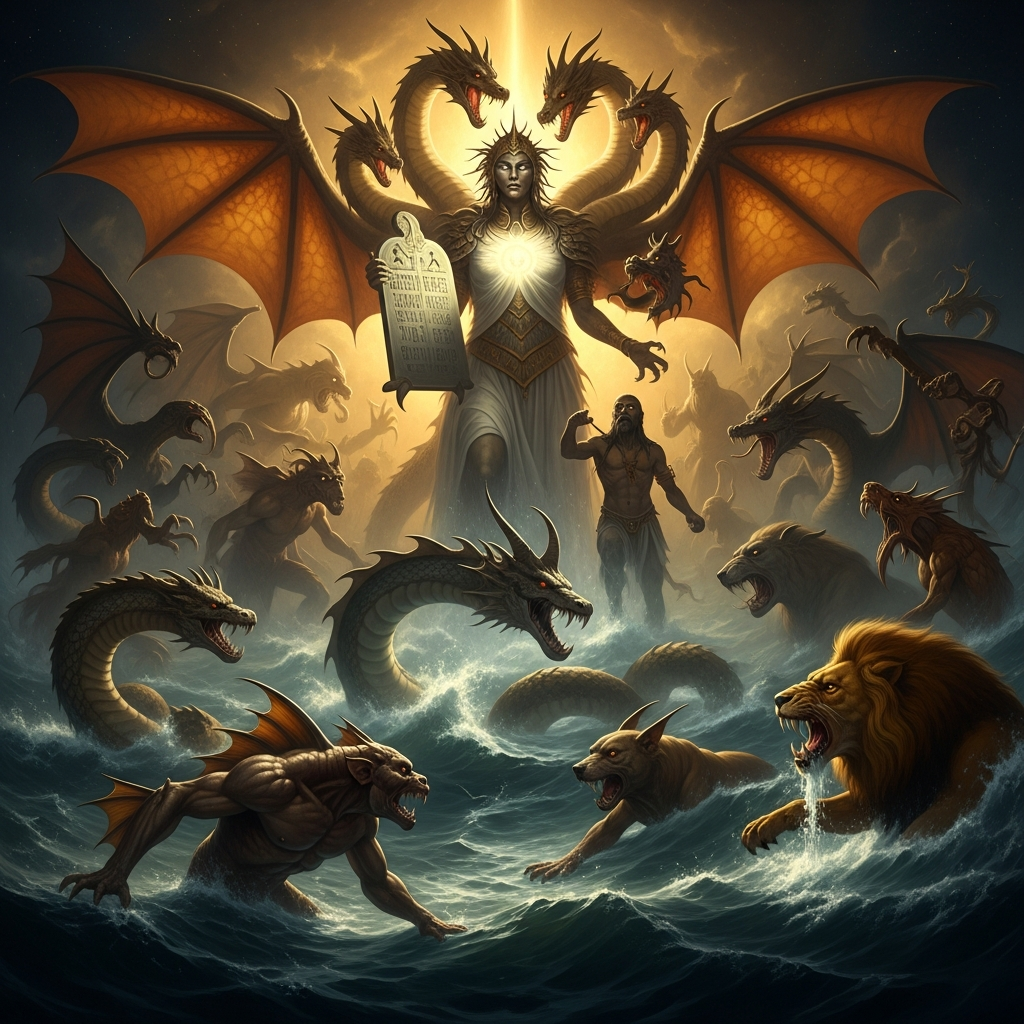
Her first husband is dead. Her children are noisy. Her waters are being churned by a child’s toys. She convenes her senior forces. The text lists her general: Kingu, who will carry the Tablet of Destiny on his chest like a breastplate. The text lists her army: serpents sharp of tooth and merciless of fang; the great lion, the rabid dog, the scorpion-man, mighty demons, fish-men, the bull-man. Eleven monster-forms, none of them conceived in tenderness. She fills them with venom instead of blood. She is making weapons that look like living things.
The younger gods hear the news and fall silent.
Anu goes to meet her. He comes back without having spoken. The oldest of the sky gods, father of the divine assembly, turns around at the edge of her presence and says nothing. Ea goes to meet her. He too returns. The gods have nothing to say to each other. They pass the problem around and no one lifts it.
Then Anshar, the horizon god, speaks a name. Marduk. The boy with four eyes. The boy who plays with storms.
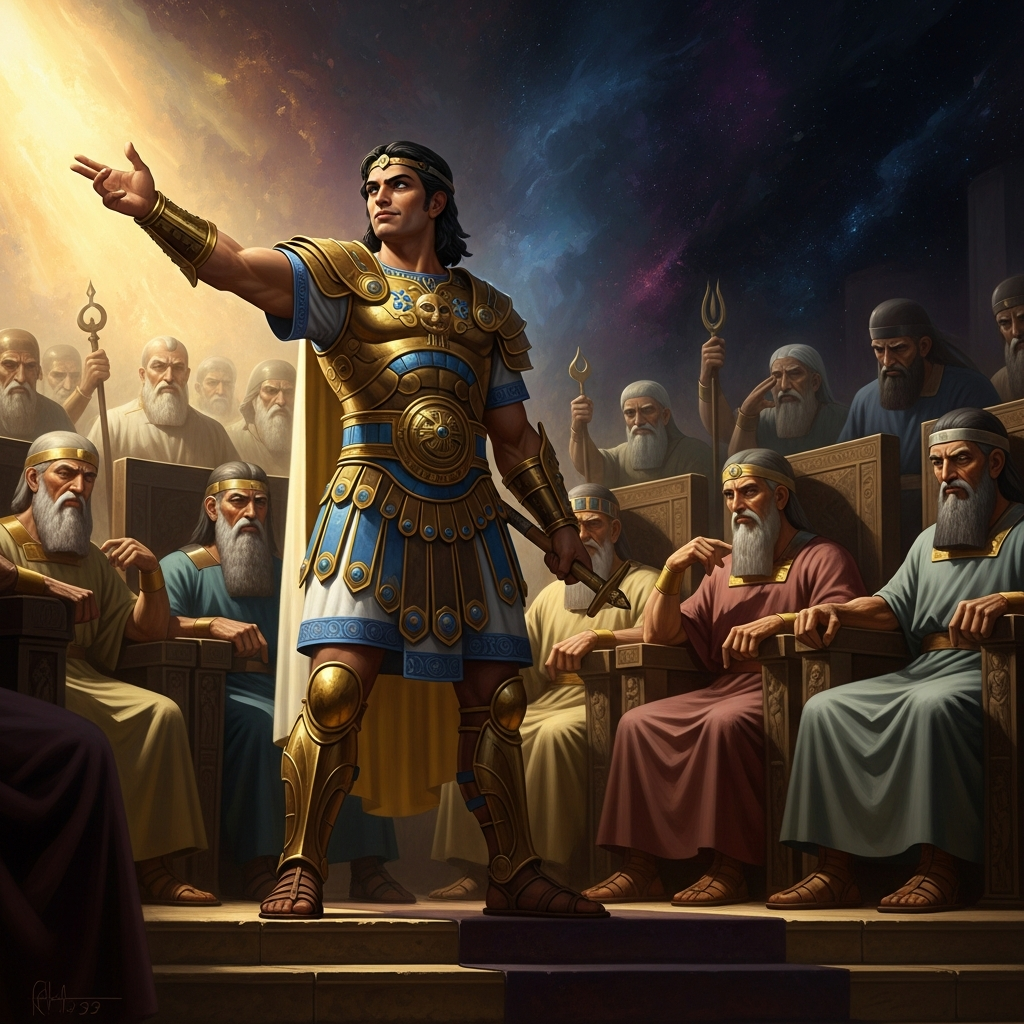
Marduk stands before the divine assembly and makes his offer.
If I am indeed to be your champion, to subdue Tiamat and keep you alive, then convene the assembly, make my destiny preeminent and supreme. When in the assembly hall you sit down joyfully, my word shall fix fate instead of you. Whatever I create shall be unalterable; the word of my lips shall never be changed or reversed.
The terms are extravagant. He is asking the older gods to cede the mechanism of reality itself — the power of naming, which in Mesopotamian theology is the power of making. They put a constellation in the center of the hall and tell him to demonstrate. He says: Disappear. The constellation vanishes. He says: Return. It comes back. The gods roar and say: Marduk is king. They pour wine. They make a throne for him. They give him a scepter.
Then they give him weapons.
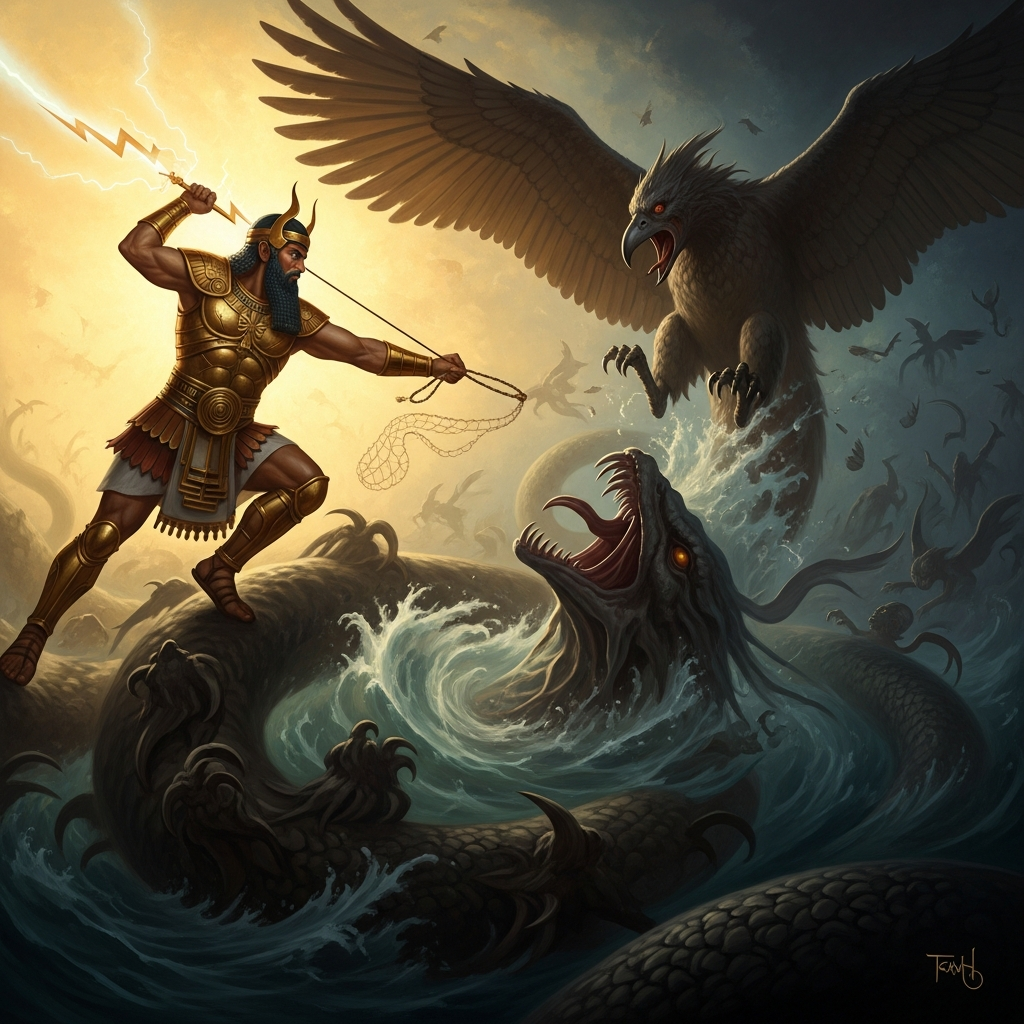
The net of the four winds, held open at its corners by the north and south and east and west so that nothing inside it can escape in any direction. The evil wind. The whirlwind. The hurricane. The fourfold wind, the sevenfold wind, the cyclone, the matchless wind. A spear, a mace, a lightning bolt. A flame-cloak that fills him with fire. He harnesses the four horses whose names are Killer, Relentless, Trampler, and Swift. He holds a herb that prevents poison from entering his heart. He holds a red paste and a white paste for vision. He holds the scepter.
He goes to find Tiamat.
She is larger than the darkness between worlds.
Her army flanks her on both sides, Kingu at her head with the Tablet of Destiny bound to his chest, and the eleven monster-forms spread out behind. Marduk sings a spell as he approaches, because Ea taught him that words of power precede the spear. Tiamat hears the spell and does not flinch. She says: how many gods have come to me with words? She says: your father Ea killed Apsu but here I stand. She says: you are a child and I am the sea.
She opens her mouth to speak a final curse.
Marduk throws the net. The four winds hold it open at its corners, north, south, east, west, and it is over her before she can close her jaws, and Marduk drives the evil wind into the open mouth — the whirlwind and the hurricane and the sevenfold wind, all of them at once, into the throat of the primordial salt ocean. She cannot close her jaws. She cannot swallow. She is vast and she is distended with his winds and she is held.
He raises his spear. He drives it into the distended belly of Tiamat. He splits her down the center.
He stands over two halves of the primordial sea. He breathes.
Then he begins to work.
He lifts one half of her body overhead and stretches it into a vault: the sky. He posts guards at the vault’s edges so that her water does not run back down. He pins Kingu, captures the Tablet of Destiny, and hands it to Ea. He draws his ax across Tiamat’s skull and heaps the bone into mountains. He pulls back her eyelids and lets the Tigris and Euphrates run from the sockets, because a river that runs from a goddess’s eyes is a river that can be prayed to, and Marduk understands from the beginning that he is building a theology, not only a world. He raises the other half of her body beneath his feet and names it earth.
He marks the stations of the great gods as constellations. He makes the moon and assigns it its monthly duties. He marks the positions of the year. He appoints Anu, Enlil, and Ea to their cosmic stations. Then he turns to the problem of who will carry the labor of the gods — who will dig the canals and maintain the temples and grind the grain — so that the gods themselves can rest.
He makes humanity from Kingu’s blood. Kingu, whose blood is thick with the rebellion that animated Tiamat’s army, whose charge was to destroy the younger gods. Humanity is made from that material, on that explicit theological basis: we are the labor force, assembled from the blood of the insurrection, assigned the corvée that the gods no longer want to carry. Marduk makes this decision in a single sentence and does not ask the humans.
The Enuma Elish ends in a ceremony at Esagila, the great temple at Babylon that mirrors the structure of heaven, where the gods gather in the throne room Marduk builds for himself at the summit of creation, eat a feast, and recite his fifty names. The fifty names are the names of what he has become: not just king of the gods but the principle by which the cosmos coheres, the force by which chaos was not destroyed but divided.
The priests recited these tablets aloud at the Akitu festival, the Babylonian New Year, every year. Creation was not, in this theology, a one-time event. It was a ceremony. Each year the world renewed its shape by hearing how it was made. If you stop performing it, the world forgets.
The salt sea is still out there, past the eastern edge of the sky. Tiamat is still out there. She is the sky above and the earth below and the deep below the earth, and you live between the divided halves of the thing that would have eaten you and you call it home.
Every dragon-slaying creation myth that follows the Enuma Elish follows the same logic: the world is made from the monster’s body. Apollo builds Delphi on top of Python’s grave. YHWH divides the tehom and calls it the firmament. Odin makes the sky from Ymir’s skull.
What changes between the versions is the theology layered on top. What stays the same is the wound.
Creation, in all of these traditions, is not a gift. It is a defeat that has been made livable. The chaos does not go away; it becomes the walls and the floor. You are inside the dragon. You always have been.
Scenes
Marduk stands before the divine assembly and makes his offer: I will fight Tiamat alone if you make my word supreme
 Generating art…
 Tiamat rises from the salt-water deeps with her army of eleven monster-forms — serpents, dragons, the horned serpent, the fish-man, the great lion, the rabid dog — wearing the Tablet of Destiny around Kingu's neck like a collar
 Generating art…
 Marduk drives the evil wind into Tiamat's open mouth as she roars
 Generating art…
 Echoes Across Traditions
Entities


Sources
- Stephanie Dalley (trans.), *Myths from Mesopotamia* (Oxford University Press, 1989)
- Thorkild Jacobsen, *The Treasures of Darkness: A History of Mesopotamian Religion* (Yale University Press, 1976)
- Alexander Heidel, *The Babylonian Genesis: The Story of Creation* (University of Chicago Press, 1951)
- Benjamin R. Foster (trans.), *Before the Muses: An Anthology of Akkadian Literature* (CDL Press, 2005)
- Mark S. Smith, *The Origins of Biblical Monotheism: Israel's Polytheistic Background and the Ugaritic Texts* (Oxford University Press, 2001)