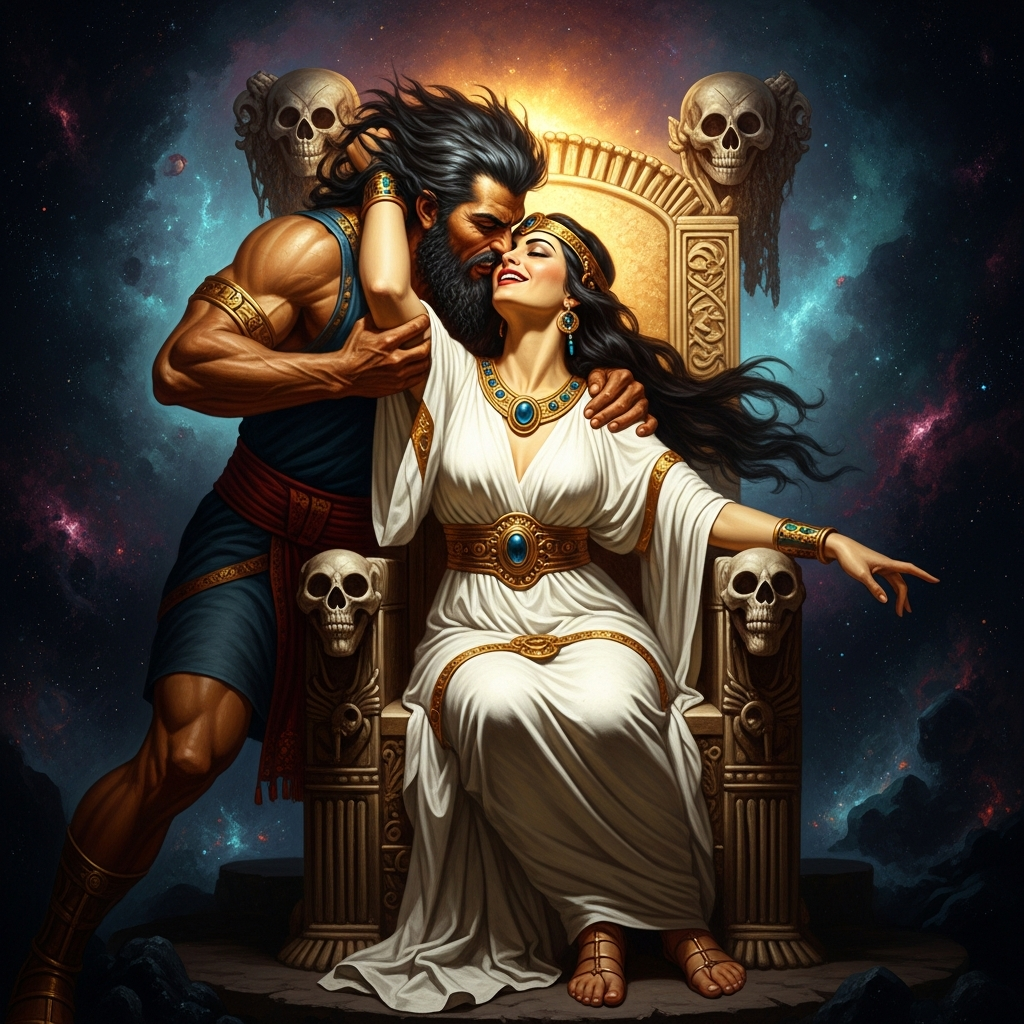
Ishtar's Descent into the Underworld
Mythic Time · Akkadian text ~1500–1000 BCE · Babylonia — the Land of No Return, beneath the seven gates
Contents
The goddess of love and war strips off one garment of power at each of the seven gates and arrives before her sister Ereshkigal naked, is killed, and is restored — but only if someone takes her place.
- When
- Mythic Time · Akkadian text ~1500–1000 BCE
- Where
- Babylonia — the Land of No Return, beneath the seven gates
She descends to the Land of No Return.
Ishtar, Lady of the Greatest Heaven, reaches the first gate and announces herself in the old way: she is the daughter of the moon, queen of desire and war, and she has come to see what no god has come to see and returned from. The gate attendant Neti carries the message to Ereshkigal, who sits below in silence. Ereshkigal’s face goes white at the name — not with fear, but with a knowledge so old it does not have a word. Bolt the seven gates, she commands. Let her in, one gate at a time. And at each gate, remove one of her garments.
At the first gate, the great crown of her head.
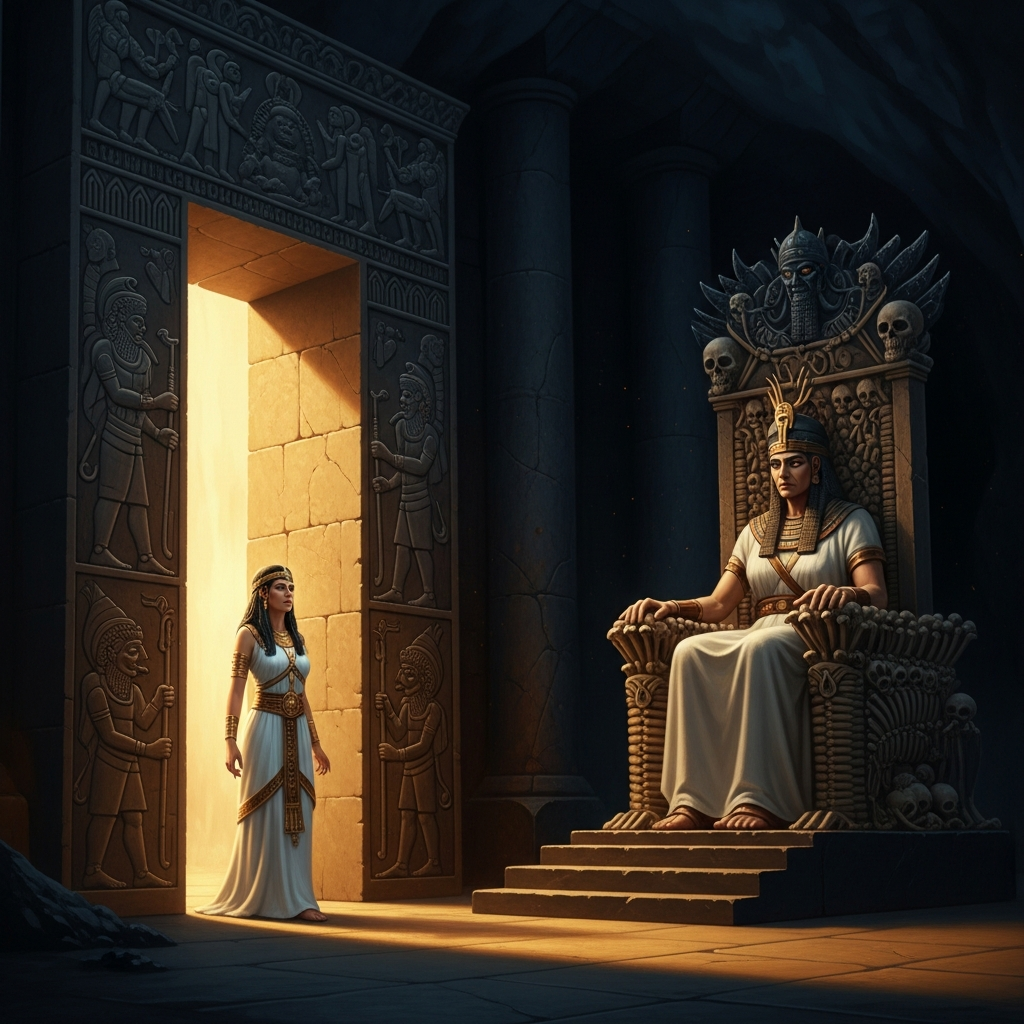
At the second gate, the earrings of her ears. At the third, the beads at her throat — those stones worn in battle, worn in bed, worn when she walked into the council of gods and every god turned to look. At the fourth gate, the ornaments of her breast. At the fifth, the girdle of birthstones at her waist, each stone a city she has blessed with increase. At the sixth gate, the bracelets of her wrists and ankles. At the seventh, the garment of her body — the last cloth between her divinity and the dark air of the underworld. She stands before her sister Ereshkigal as a body and nothing more. The goddess of heaven is naked and cold, and her power is piled in seven heaps behind her at seven gates she cannot now pass back through.
Ereshkigal does not embrace her.
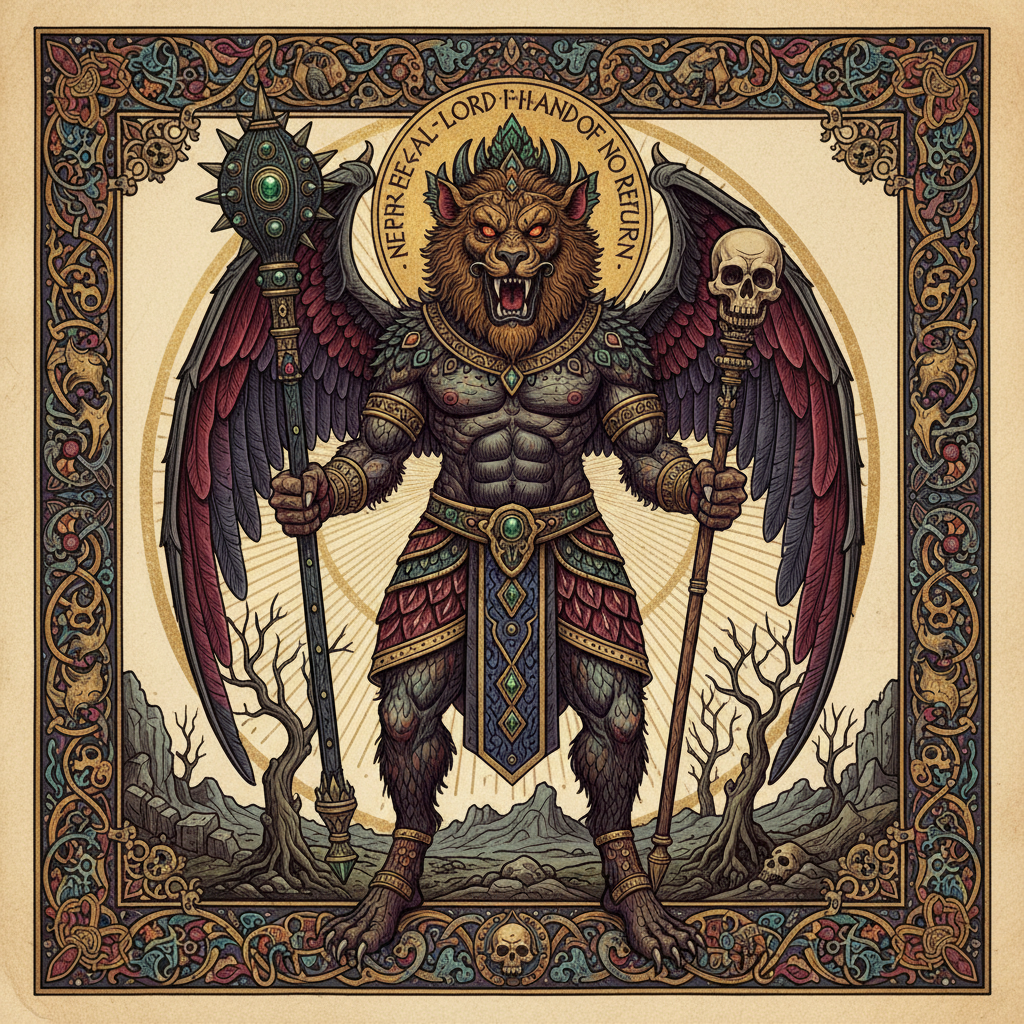
Ereshkigal lifts her eyes and fixes Ishtar with the Look of Death — that gaze that is not cruelty but law, older than either of them, carved into the substance of existence before the gods had names. Ishtar’s body takes the look and becomes a corpse. The text does not describe how it happens. It says only: she was struck, and she hung on the stake. A corpse on a hook in the Great Below, the goddess of love and war, who filled the world with coupling and desire, now still and cold in her sister’s keeping.
Above the seven gates, above the earth, every living thing stops. Animals will not mount. Humans will not touch. Bull ignores cow. Ram ignores ewe. The young men stand at the corners of the city and do not reach for the young women they have been reaching for since they were old enough to want. The world does not end. It simply pauses at the generative moment, holds its breath, and will not breathe again until the goddess returns.
Ea, the god of deep water and cunning, hears the silence.
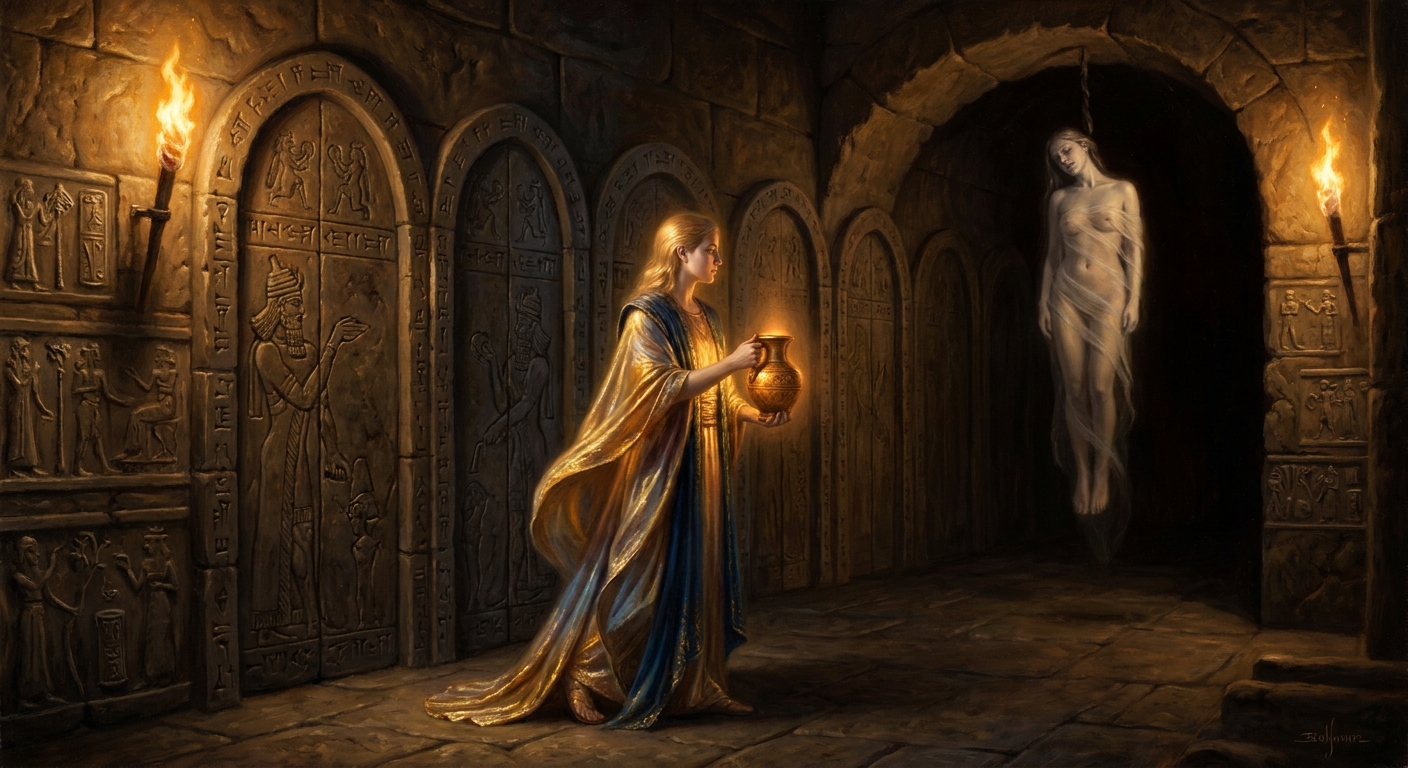
He does not petition the other gods. He does not mourn. He fashions a creature — the text calls it Asushunamir, its face is brilliant — a being of no gender, neither male nor female, neither living nor dead, a made thing that can pass through the gates without losing anything at the gates, because it carries nothing the law demands. He gives it one instruction: go to Ereshkigal, sit beside her as a supplicant, and when she offers you whatever you want, ask only for the waterskin that holds the water of life. Then he sends it into the dark.
Asushunamir descends through all seven gates. It stands before Ereshkigal, who knows exactly what Ea has done and who has sent this creature and why. She curses it with a great and terrible curse — it will live in doorways, it will eat the scraps cities throw away, it will sleep in the shadow of walls — but she gives it the water of life, because the law is the law, and she set the law herself, and even the queen of the dead cannot break what she has decreed.
The water of life falls on Ishtar’s corpse sixty times.
Nothing happens for the first fifty-nine. And then the sixtieth. Color seeps back into the gray flesh. The eyes open. The breath returns. Ishtar rises from the hook in the Great Below the way the sun rises in the east — not gratefully, not weakly, but with the complete authority of something that was always going to rise and was only delayed. Ereshkigal releases her. The gates open in reverse. At each gate the garments are returned: the cloth of the body, the bracelets, the birthstone girdle, the breast ornaments, the throat beads, the earrings, the crown. She walks out through the seventh gate into the world wearing everything she descended in, and the world begins again. Animals couple. Humans touch. The young men at the corners of the city turn toward the young women as if they had only paused in the middle of a sentence.
But the law will not be denied. A life for a life.
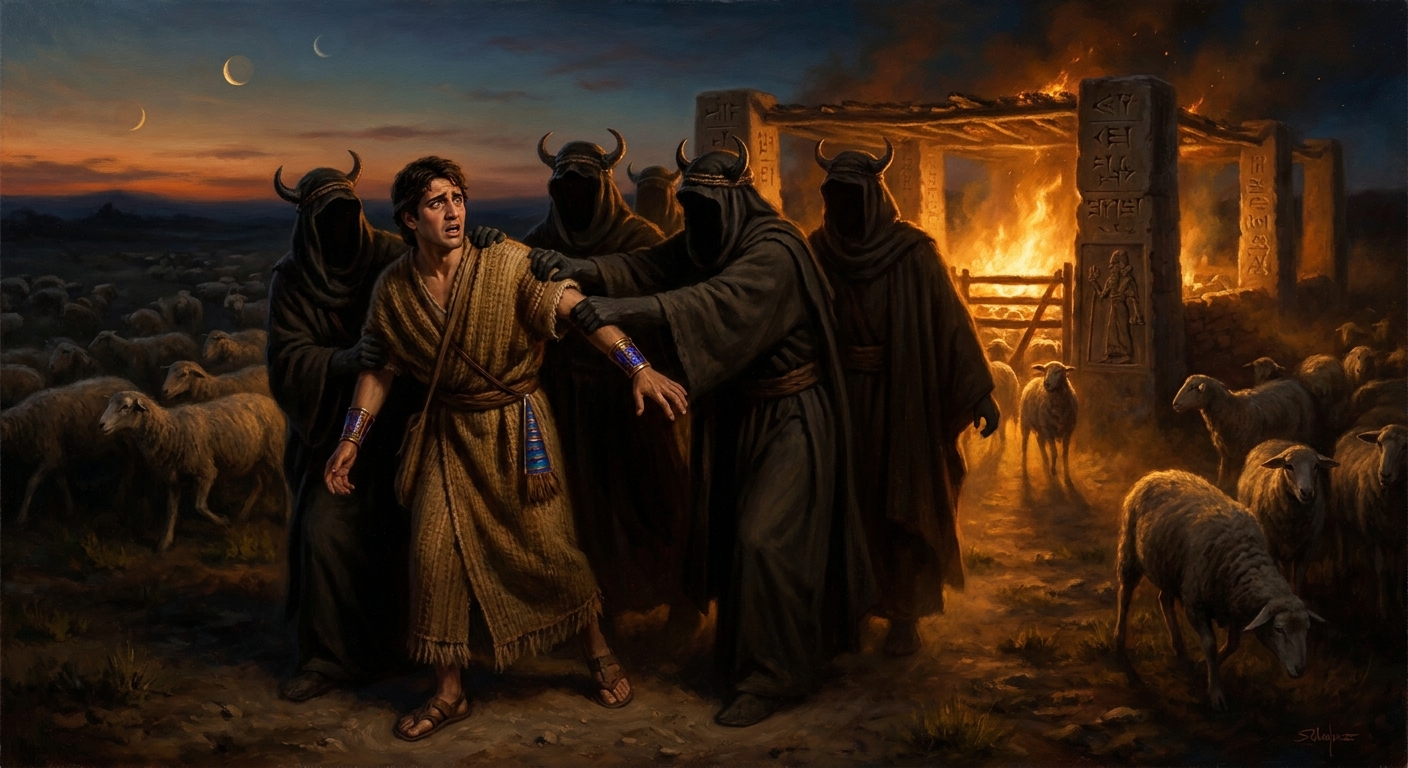
The demons of the underworld, the Galla, who eat no food and drink no water and understand no offering, march up from the gates behind Ishtar and wait. They need someone to take her place in the Great Below. They will not go back empty. Ishtar looks at Dumuzi, the shepherd who was her beloved, who sat on his throne in her absence not weeping but playing music as if he were already a king, and she fixes him with Ereshkigal’s look — the one she learned below, the Look of Death — and she says: Take him. The Galla seize the shepherd by his feet. He begs. He transforms himself — a gazelle, a snake — but the demons track every shape and drag him down through the gates one by one, and the last gate closes on his cries, and Ishtar ascends into her own sky, alone, and the world resumes its turning, and desire fills every breathing body again, and somewhere below Dumuzi wears feathers in the dark.
Love is the force that moves the world — not because it is gentle, but because without it the world stops entirely; Ishtar teaches that resurrection is not the miracle, it is the necessity, and the price of a god’s return is always paid by whoever was closest to her when she came back.
Scenes
Ishtar passes the seventh gate, stripped of all divine power, and enters Ereshkigal's throne room as a mortal body
Generating art… Asushunamir, the creature fashioned by Ea from clay and wind, carries the water of life down through the seven gates
 Generating art…
 The Galla demons seize Dumuzi the shepherd in Ishtar's name and drag him below to take her place
 Generating art…
 Echoes Across Traditions
Entities
- Ishtar
- Ereshkigal
- Asushunamir
- Dumuzi
- Ea

Sources
- *Descent of Ishtar to the Underworld* (Akkadian myth, cuneiform, ~1000 BCE)
- Stephanie Dalley (trans.), *Myths from Mesopotamia* (Oxford University Press, 1989)
- Samuel Noah Kramer and John Maier, *Myths of Enki, the Crafty God* (Oxford University Press, 1989)
- Benjamin Foster (trans.), *Before the Muses: An Anthology of Akkadian Literature* (CDL Press, 2005)