Manco Cápac and the Golden Staff
Mythic Time — origin of the Inca Empire · recorded in Pedro Sarmiento de Gamboa, *Historia de los Incas*, 1572 · Lake Titicaca — Pacaritambo — the Valley of Cuzco
Contents
Viracocha sends eight children of the sun — four Ayar brothers and their sister-wives — from the Island of the Sun in Lake Titicaca. They carry a golden staff. Where it sinks into the earth in one thrust, there the empire begins. Three brothers are lost to stone, earth, and sky. Manco Cápac alone drives the staff into the Valley of Cuzco. The city rises. The world changes.
- When
- Mythic Time — origin of the Inca Empire · recorded in Pedro Sarmiento de Gamboa, *Historia de los Incas*, 1572
- Where
- Lake Titicaca — Pacaritambo — the Valley of Cuzco
They emerge from three windows in the mountain and they carry the sun with them.
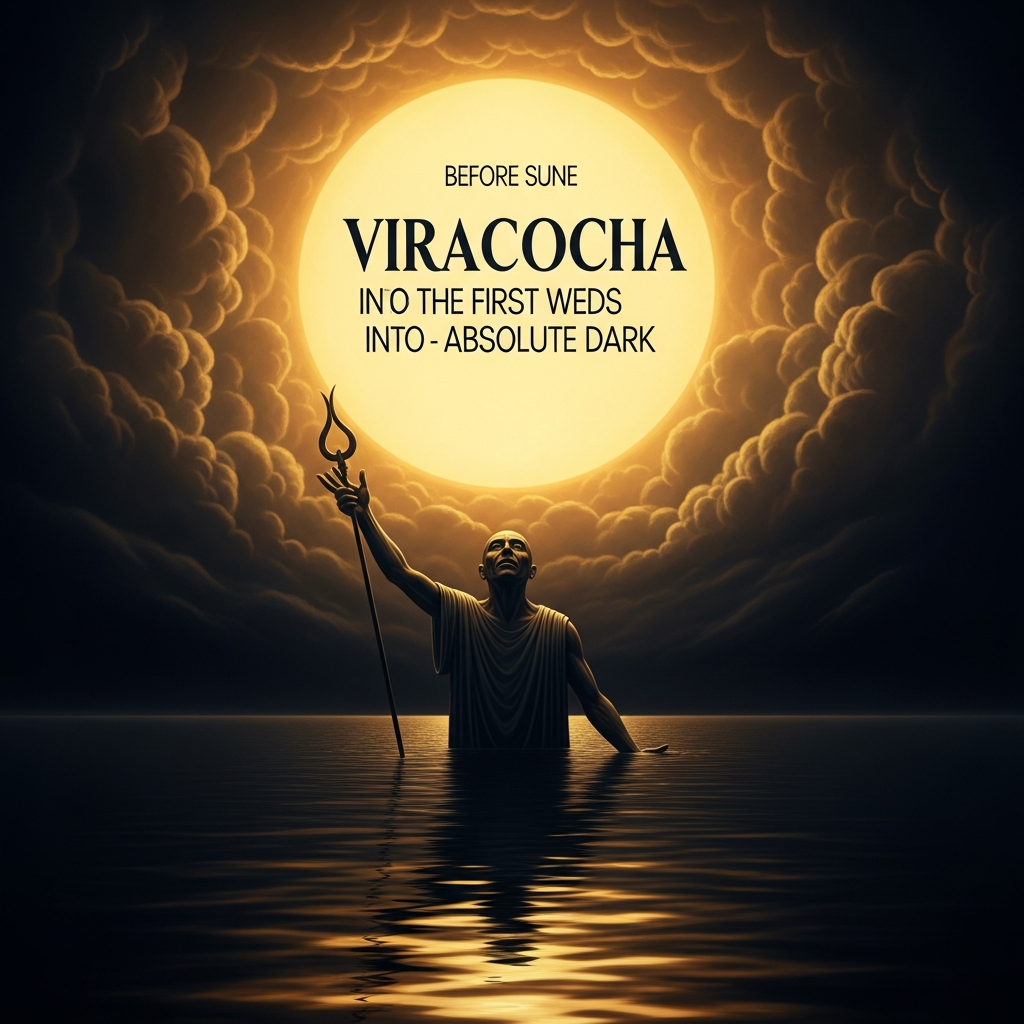
Viracocha — the primordial, the foam of the lake, the one who was before the sun — has prepared this day with precision. He does not send warriors or kings or architects. He sends children. Eight of them: four brothers and their sister-wives, paired as the Andean cosmos is always paired, one thing and its complement, the upper half of the world and the lower half, hanan and hurin. The brothers are named for what they will become: Ayar Cachi, Ayar Uchu, Ayar Auca, and Manco Cápac — four aspects of a single mandate, four attempts at a civilization that must be reduced to one. Viracocha has given them a tool: the golden staff, the tupayauri, a rod of hammered sun-metal as long as a man’s arm. The instruction is simple and ruthless. Walk. Test the earth. Drive the staff into the ground. If it sinks to its full depth in a single thrust, stop. That is the place.
They begin at Pacaritambo — the House of Dawn, the mountain with three windows, the exact location where Viracocha arranged for the world to open. They walk north.
Ayar Cachi is the first to be lost, and it is his own siblings who lose him.
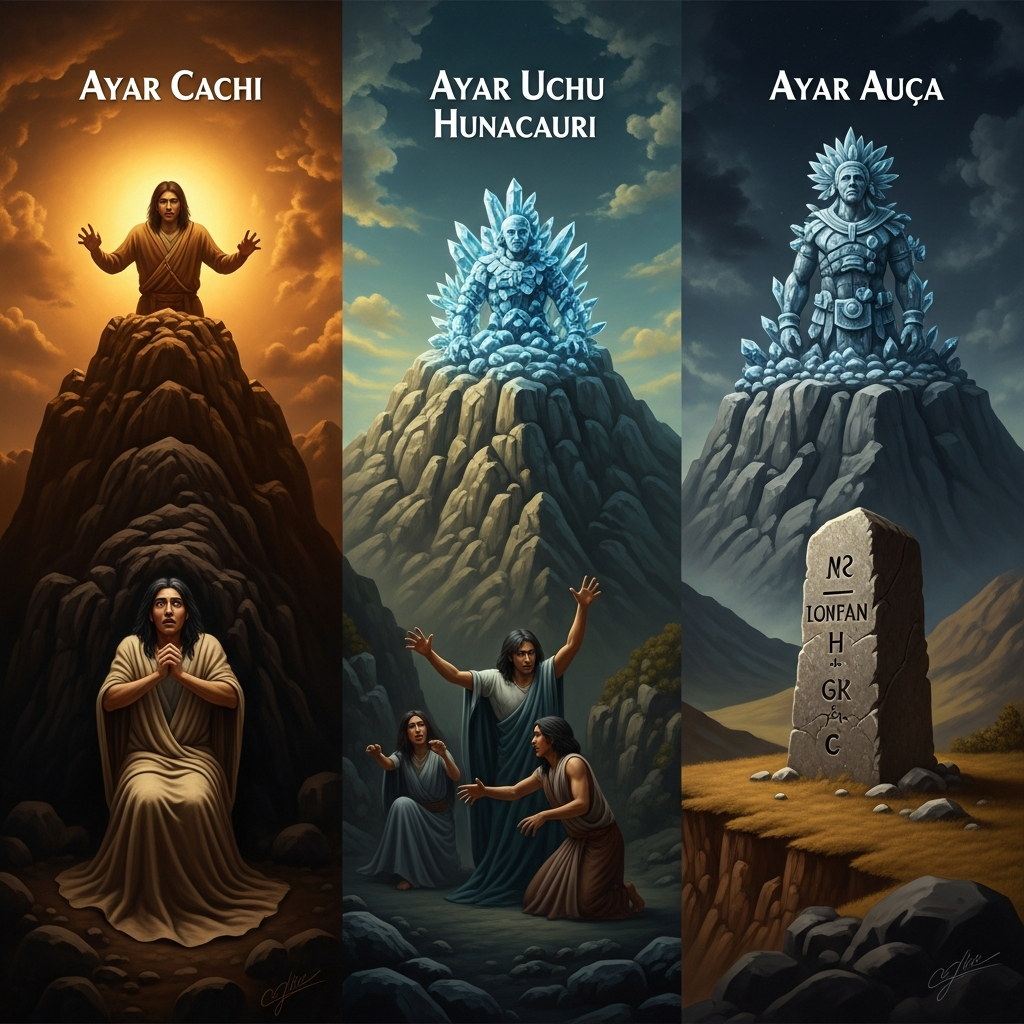
He is too strong. The sources agree on this with unusual precision: Ayar Cachi’s sling can shear off mountains. When he swings his stone and releases it, the rock he strikes cracks and the rubble rolls into the valleys and fills them. He is not cruel — he is simply operating at the wrong scale. A god meant to find a homeland cannot have a brother who rearranges the terrain on a whim. The others trick him. They send him back into the mountain to retrieve something they claim they forgot — sacred seeds, a golden cup, the particular account varies — and while he is inside they seal the door with stone. The mountain swallows Ayar Cachi.
Inside the mountain, sealed, the most powerful of the brothers becomes the first huaca — the first sacred site, the first ancestor who is in the earth and of the earth and can be spoken to. His voice is the sound mountains make when they settle. His power, which was too large for a wandering people, becomes exactly the right size for a fixed one: the power of the ground itself, which holds everything.
They continue north. The staff has not yet found its place.
Ayar Uchu does not disappear — he is transformed, and he transforms himself.
On the hill of Huanacauri, above what will eventually become the valley they are walking toward, he stops. He opens his arms. He says he will fly to the sun and speak to their divine father directly. He spreads his arms and he rises — and then he does not reach the sun, or perhaps he reaches it and cannot hold it, and he descends not as a man but as a stone. A great stone in the shape of a man with his arms spread, on the hill of Huanacauri, overlooking the valley below.
The sources treat this not as tragedy but as perfection. Ayar Uchu had said he would speak to the sun. In becoming stone at Huanacauri, he does something better: he becomes the visible sign of the sun’s approval, the monument the Inca will climb for generations to receive blessing before the great ceremonies, the huaca that overlooks the city and confirms, by its presence on the hill, that the sky knows about this valley and has marked it. He is the divine witness, petrified into permanence.
Two brothers remain. The staff still moves through the air above the earth without sinking.
Ayar Auca is the last to be lost before the finding.
His name means something like “the Warlike One” or perhaps “the Adversary” — the sources hedge — and at the valley’s northern edge he does what stone markers do: he fixes the location. He transforms himself into a boundary stone at the corner of the territory, the visible marker that says here and not further, here and not other. He becomes the post. He is placed exactly where a city wall will one day rise.
Now there is only Manco Cápac.
And Mama Ocllo beside him — the sister-wife who has walked the entire distance, who is not lost, who is not transformed, who is the feminine complement to the one who will plant the staff, because the founding of the Inca requires both principles, not one. She is the earth that receives. He is the force that drives. The myth knows that no city comes from a single act; it comes from a pair.
They stand at the northern end of the Valley of Cuzco. The valley is broad and green and watered by two rivers, the Huatanay and the Tullumayo, which join to form a triangle of arable land. The light of the altiplano is clear and cold. The staff catches it.
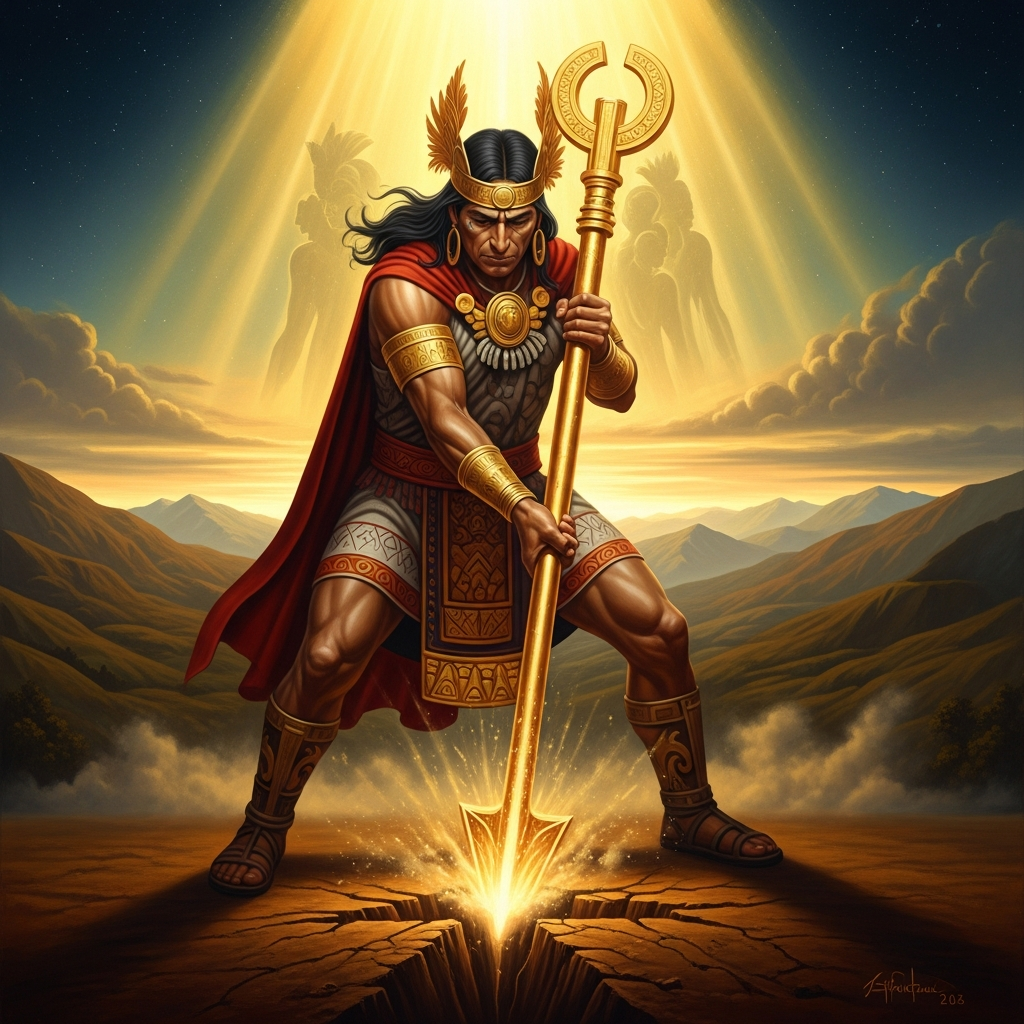
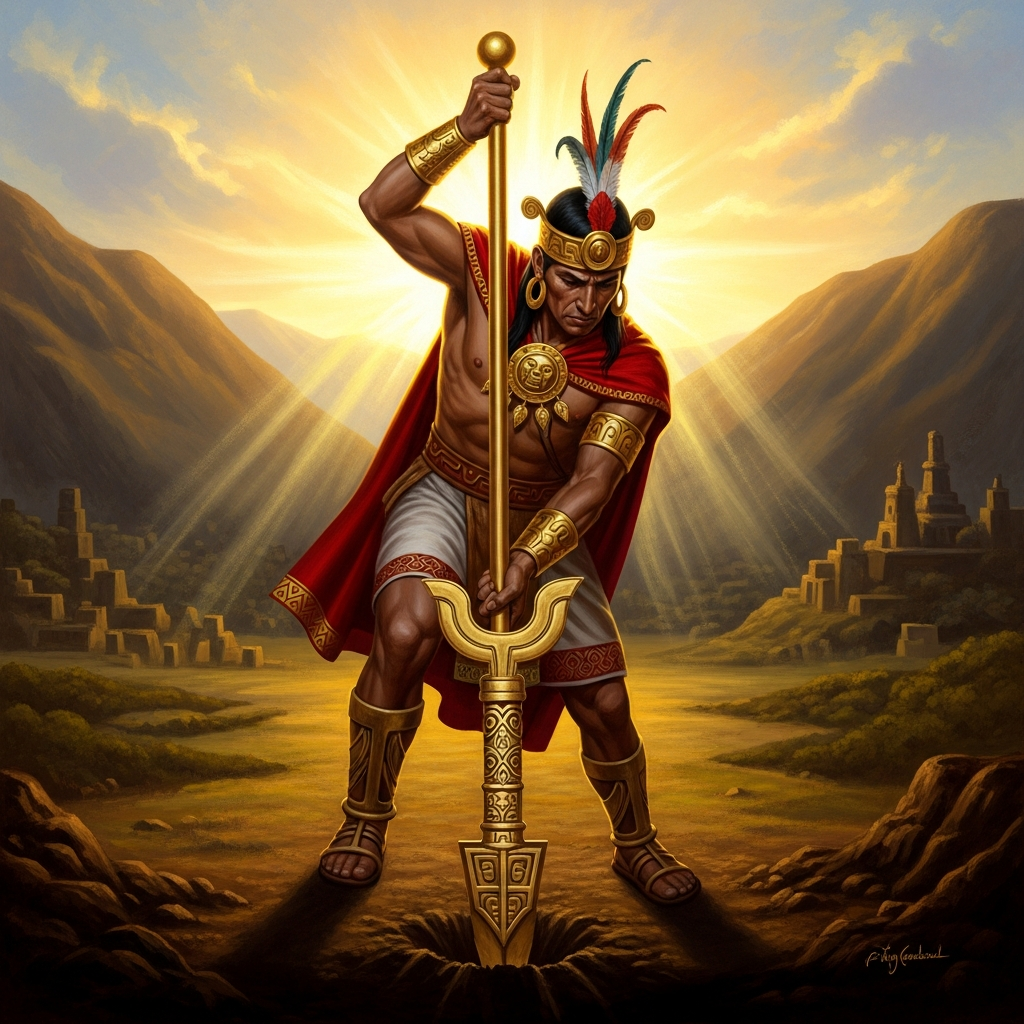
Manco Cápac drives the golden staff into the earth.
He lifts it, point down. He brings it down with the full authority of Viracocha’s mandate, the accumulated weight of three lost brothers who became stones and markers and mountains, the authority of the Sun their father who burns above the valley and watches. The tupayauri enters the soil.
And sinks.
The accounts agree on this with the quiet certainty of something that happened and was remembered because it was the most important thing that had ever happened: the staff goes in to its full depth on the first thrust. Not halfway. Not almost. All the way in, the gold disappearing into the valley floor, the hand that held it suddenly empty, the instrument delivered to the earth as if the earth had been waiting for it and seized it.
The wandering ends here.
Cuzco — Qosqo in Quechua, the Navel — is not chosen by the Inca. It is found. Found by a test that the earth set and the earth graded. The Inca claim is not that they were strong enough to take the valley but that the valley was the valley that matched the staff, the only valley in the Andes where the golden rod of Viracocha fit exactly. They did not conquer the navel of the world. They were assigned it.
They begin to build.
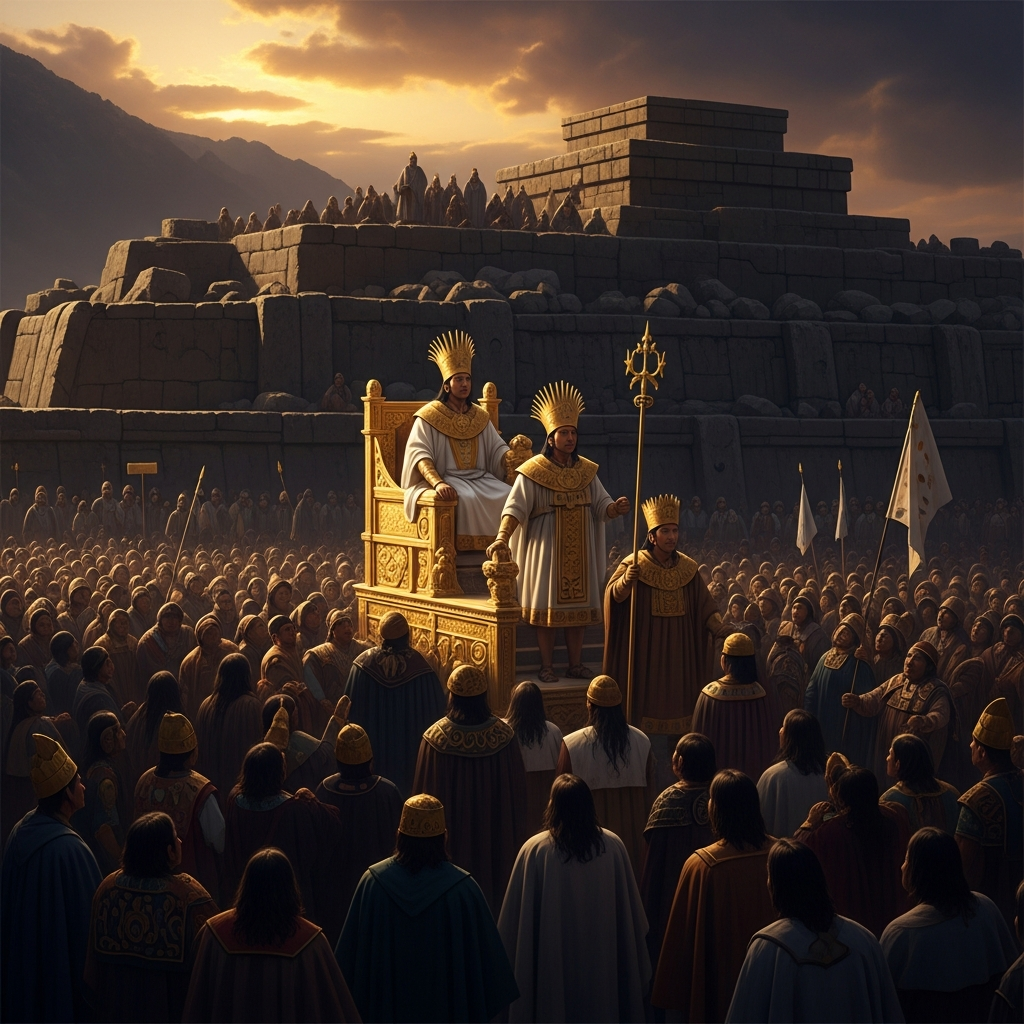
Mama Ocllo and Manco Cápac call the people who already live in the valley. They teach: the arts of agriculture, the disciplines of the calendar, the organization of labor into mit’a — the reciprocal work-tax that is not a tax but a participation in the imperial body. The city rises not from the labor of slaves but from the logic of Andean reciprocity: you give work to the collective, the collective gives you security, food in the storehouses, the llamas for your ceremonies, the protection of the empire’s roads.
The four brothers are now four suyus — four quarters of the empire that will eventually stretch from Colombia to Chile, from the Pacific coast to the Amazon rainforest edge. Ayar Cachi’s power is in the northwest quarter, the mountain that shears. Ayar Uchu’s witness is in the southwest, the high place that confirms. Ayar Auca’s boundary is in the northeast, the wall that holds. And Manco Cápac’s founding is at the center — the navel from which all four directions extend, the place where the staff went in and did not come back out.
The golden staff is still in the earth. It has always been in the earth. The valley grew over it, the city grew over it, the empire grew over it, and the Spanish built their cathedral over it, and it is still there, under the Cathedral of Cuzco, in a soil that accepted it once and has not let it go.
Every subsequent Sapa Inca — every divine emperor who followed — was understood not as Manco Cápac’s heir but as Manco Cápac continuing, the same solar mandate extended through time, the staff still planted and still authorized, the children of the sun still living in the only valley in the Andes that the earth itself chose.
Scenes
Eight children of the sun emerge from Pacaritambo — the House of Dawn — carrying a golden staff that catches the early light of the altiplano, their shadows long across Lake Titicaca as Viracocha's mandate begins
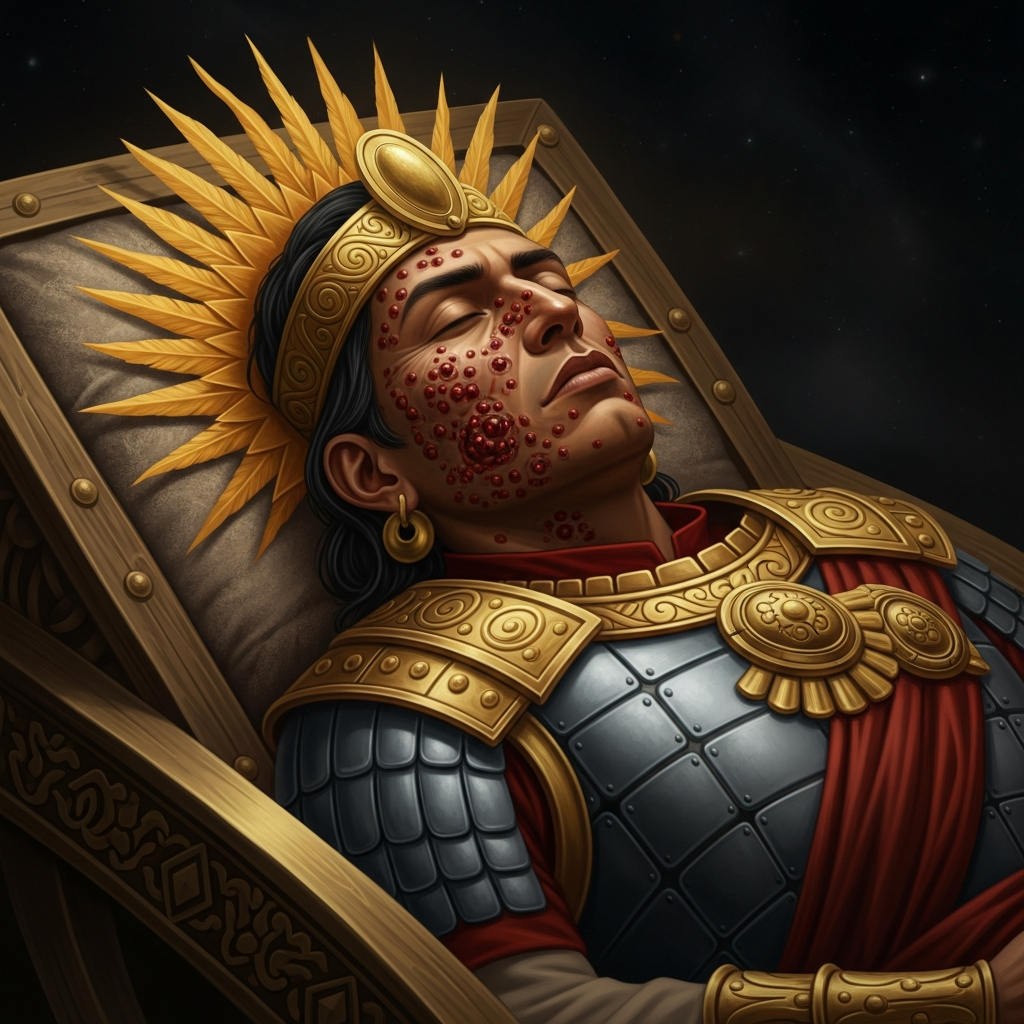
Generating art… One by one the Ayar brothers are transfigured: Ayar Cachi sealed into the mountain by his siblings' fear, Ayar Uchu crystallizing to stone on the heights above Huanacauri, Ayar Auca turning to a stone marker at the valley's edge
 Generating art…
 Manco Cápac drives the golden tupayauri into the floor of the Valley of Cuzco with a single thrust and watches it sink
 Generating art…
 Echoes Across Traditions
Entities
- Manco Cápac
- Mama Ocllo
- Ayar Cachi
- Ayar Uchu
- Ayar Auca
- Viracocha

Sources
- Pedro Sarmiento de Gamboa, *Historia de los Incas* (1572)
- Juan de Betanzos, *Narrative of the Incas* (1557)
- Bernabé Cobo, *History of the Inca Empire* (1653)
- Garcilaso de la Vega, *Comentarios Reales de los Incas* (1609)
- Gary Urton, *The Social Life of Numbers: A Quechua Ontology of Numbers and Philosophy of Arithmetic* (1997)
- Brian S. Bauer, *The Development of the Inca State* (1992)