Viracocha Rises from the Lake
Before time — primordial creation · recorded in Juan de Betanzos, *Narrative of the Incas*, 1557; Pedro Sarmiento de Gamboa, 1572 · Lake Titicaca — Tiwanaku — the Pacific coast
Contents
In the darkness before the sun, Viracocha rises from Lake Titicaca and creates a first race of giants. They displease him. He destroys them in a flood. Then, at Tiwanaku, he speaks the sun and moon and stars into existence and fashions a new humanity from stone — assigning each people to emerge from their own sacred place. He walks northwest across the continent, performing miracles, and vanishes into the Pacific.
- When
- Before time — primordial creation · recorded in Juan de Betanzos, *Narrative of the Incas*, 1557; Pedro Sarmiento de Gamboa, 1572
- Where
- Lake Titicaca — Tiwanaku — the Pacific coast
In the beginning there is only the lake.
Lake Titicaca sits at 3,800 meters above sea level, higher than almost any other lake on earth, its water so cold and so clear that in the darkness before the sun it catches nothing — no light to reflect, no shadow to cast, no color. The Andean world has no word yet for cold because there is nothing else. There is the water and the altitude and the black.
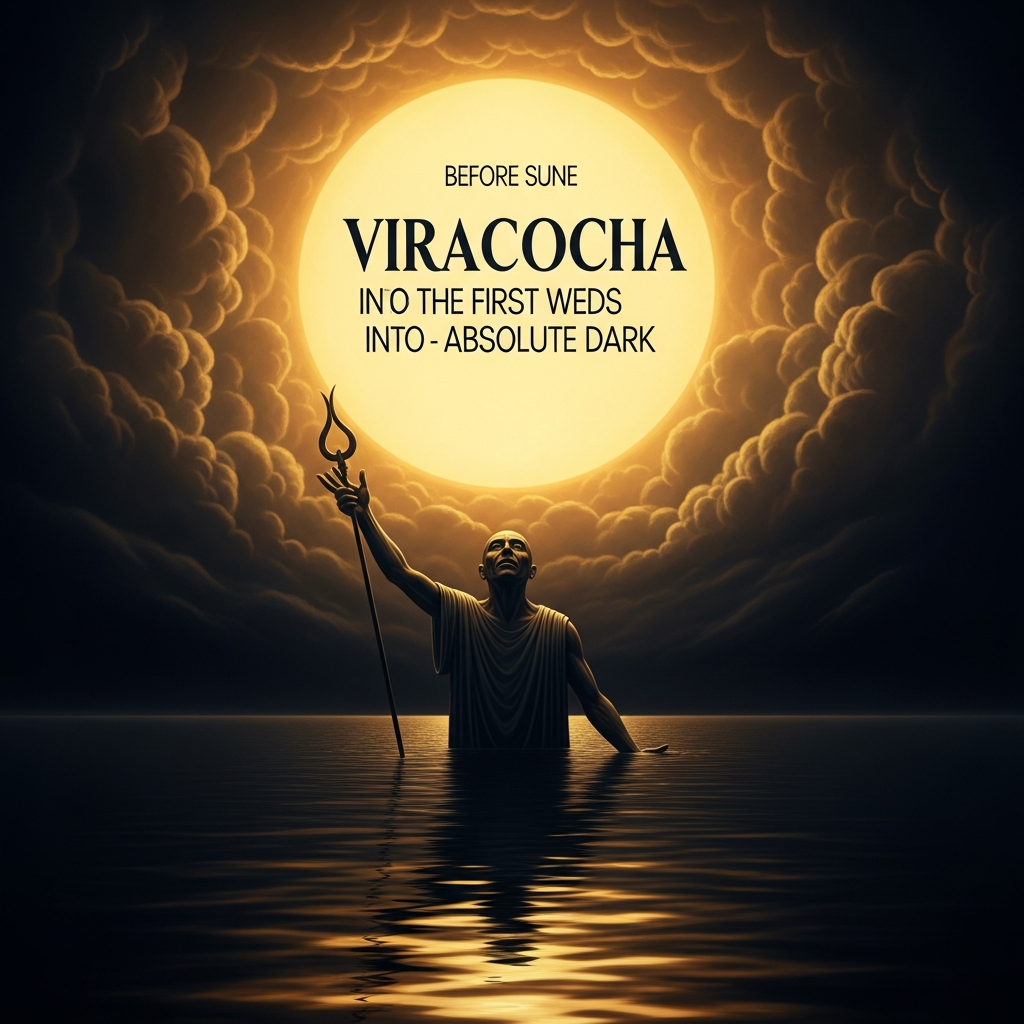
Into this darkness, from the depth of the lake itself, Viracocha rises.
He has no origin. The Quechua sources do not specify where he was before the lake — he is simply the one who was before, the primordial, the unbegun. Con Tiqsi Viracocha Pachayachachic — the sources give him this full title, meaning something like “the ancient foundation, lord, teacher of the world.” He rises from the water and he stands in the darkness, and then he does what creators do: he speaks. He commands light. He commands that the darkness be other than it is.
The darkness does not become day. What he creates first is not the sun — it is fire. A lesser light, a trial light, the warm glow of possibility before the blazing commitment of a permanent star. He creates in stages, testing as he goes, which is why the first race he creates will be wrong and will have to be erased.
The first humans are giants, and they do not work.
Viracocha fashions them from the clay at the lake’s edge and breathes into them, and they are enormous — the Narrative of the Incas by Juan de Betanzos describes them as being of such size that the ancestors regarded them as incomprehensibly large. But size is not the problem. The problem is that they do not order themselves. They do not plant, do not observe the seasons, do not build in the coordinated way that Viracocha envisioned. They are people who use the world as they find it rather than as a system to be tended.
Viracocha watches. He watches with the patience of a god who does not experience time as urgency, who has no deadline, who simply observes until the observation becomes conclusion. The conclusion comes.
They displease him.
What happens next is flood — a unu pachacuti, a “world-overturning water,” a phrase the Quechua speakers used for any catastrophic reversal. The water of the lake rises. The giants, who were made from the lake’s clay, are returned to the lake’s water. Two servants survive — the precise theological role of the survivor in Andean myth is contested, but Betanzos notes them specifically: two figures who stayed close to Viracocha, who witnessed, who would carry forward the knowledge of what the first world had been. They are the memory of the first attempt, preserved so that the second attempt would know it was second.
The darkness returns. The trial light is out. The lake is still.
Viracocha walks to Tiwanaku.
Tiwanaku — Tiahuanaco in the Spanish spelling — sits on the altiplano south of the lake, and it is already a ruin by the time the Inca are recording these stories. The Inca inherit the site as a sacred archive: these enormous stone blocks, these perfectly fitted walls, these monumental doorways with no buildings behind them — clearly the work of gods, because no people they can imagine could have cut and moved such stones. They are correct about the divinity. They misidentify which gods.
At Tiwanaku, Viracocha creates the permanent lights.
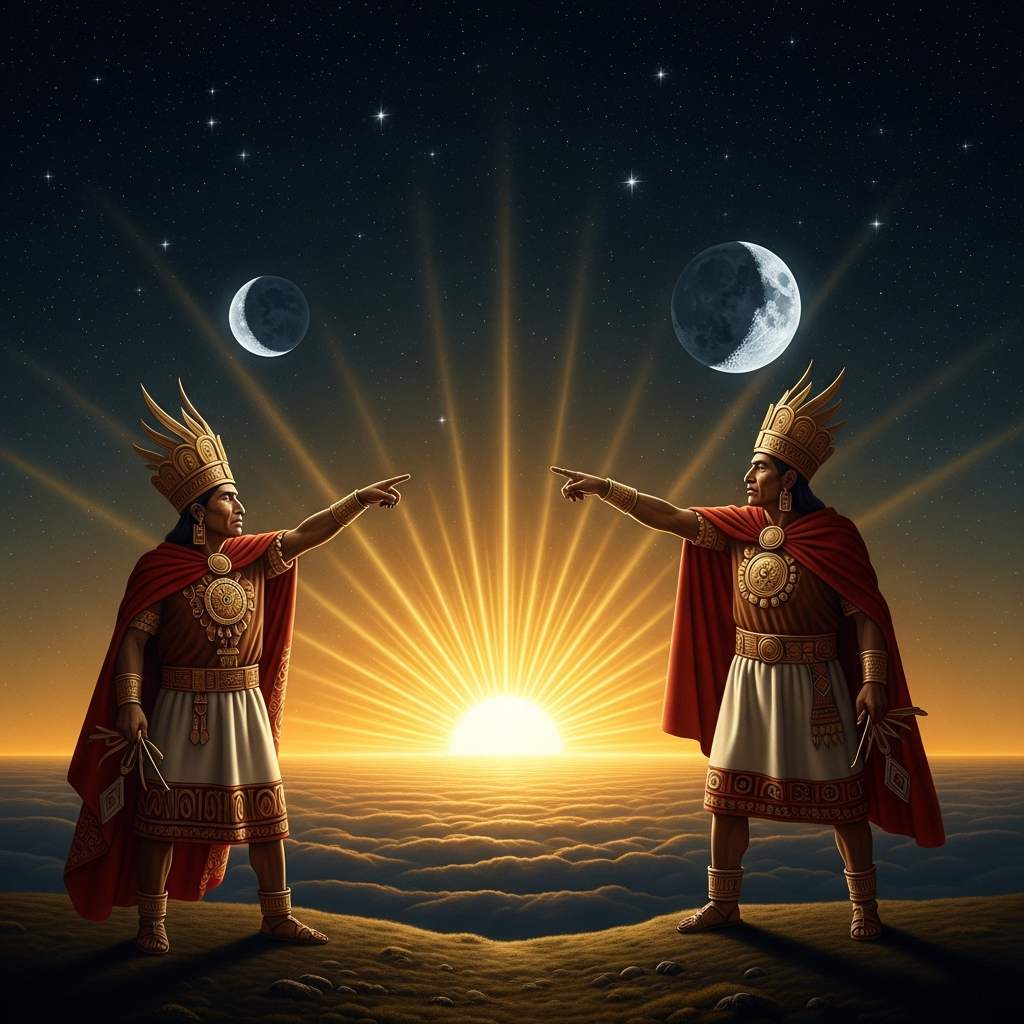
He speaks the sun into existence from the Island of the Sun in the lake, commanding it to rise and follow a specific path — not arbitrary, but calculated, tilted at exactly the angle that produces the seasons the altiplano requires for agriculture. He speaks the moon into its position, dimmer than the sun as he intended, following in the sun’s wake. He names the stars and assigns each one a function: Collca (the Pleiades) to govern the agricultural calendar, Orion to mark the solstice, the celestial river of the Milky Way to mirror the Vilcanota River below.
The sources specify that the sun and moon and stars are not ornaments. They are a calendar. Viracocha does not make the lights because darkness was unpleasant. He makes the lights because an agricultural civilization requires time — requires the ability to know when to plant, when to harvest, when the rains are coming, when the frost will arrive. The creation of the sun is the creation of the capacity for human life to be organized, which is what the giants failed to do.
Then he makes the people, and he makes them from stone.
At Tiwanaku, Viracocha takes stone and models each group of human beings — each community, each future village, each nation — with the exact characteristics they will have: their clothing, their hair, their languages, the distinctive marks of their specific humanity. He paints them and speaks to them the instructions for their lives: this is where you will emerge, this is what you will wear, these are the words you will speak, this is the huaca from which you will come.
Then he sends them underground.
Each group descends into the earth at Tiwanaku — into the hollow interior of the world that the Andean cosmology imagines as inhabited, not empty — and travels through the dark interior until they reach the specific point of emergence that Viracocha has assigned them. Some emerge from caves. Some from rivers, rising from the water as Viracocha himself rose from the lake. Some from the summits of mountains, stepping into the world from the highest point, as if they had grown from the mountain’s body.
This is why every community in the Andes has a huaca. The spring, the cave, the mountain — these are not metaphors for origin. They are the literal doors Viracocha cut for each people, the specific address in the world’s architecture at which a specific community was told to appear. To honor the huaca is to honor the fact of your own existence. To destroy a huaca, as the Spanish missionaries attempted, was to erase the divine authorization of a community’s right to be where it is.
He walks northwest and the world changes as he passes.
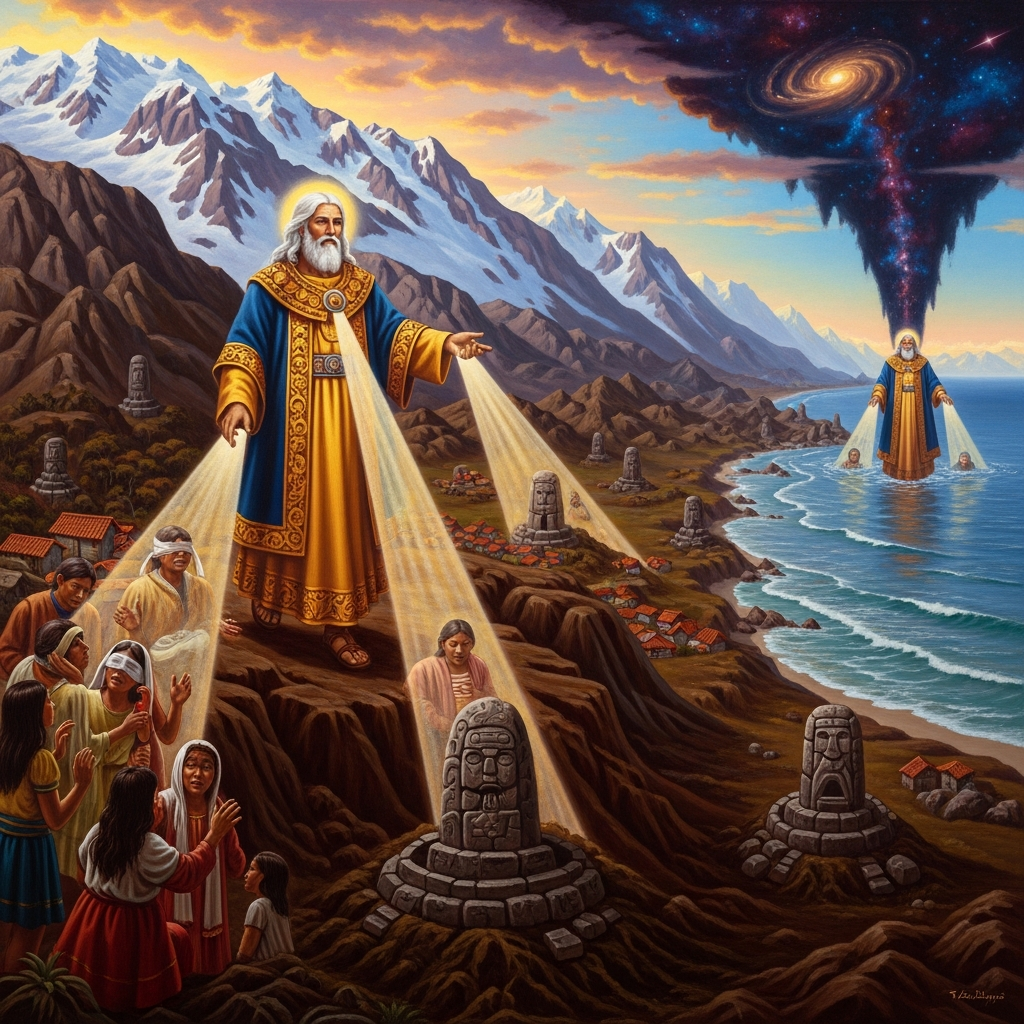
Viracocha does not disappear when he finishes the creation. He walks — with his two surviving servants, Imaymana Viracocha and Tocapu Viracocha, sent along the coast and through the high passes to call communities out of the earth along their respective routes. The three of them travel the full length of the Andean world, and wherever they walk, the sources record the miracles: he heals the blind by touching their eyes, he calls rain from a clear sky, he speaks to communities that have emerged from their huacas and teaches them their own rites, confirms their own instructions, tells them what he had told their stone-images underground.
He is not discovering the world. He is completing it. The creation that he executed in stone at Tiwanaku is made actual as he walks — each step he takes is a ratification of a community that is coming into existence in accordance with the plan.
The sources from Betanzos and Sarmiento de Gamboa and Cobo all agree on the final act: he reaches the coast. The Pacific coast, the western edge of the continent, the place where the land ends and the water begins. He walks to the water. He steps onto the surface of the ocean and continues walking, northwest, across the Pacific.
And he does not come back.
What he leaves behind is the operating system of the Andean world.
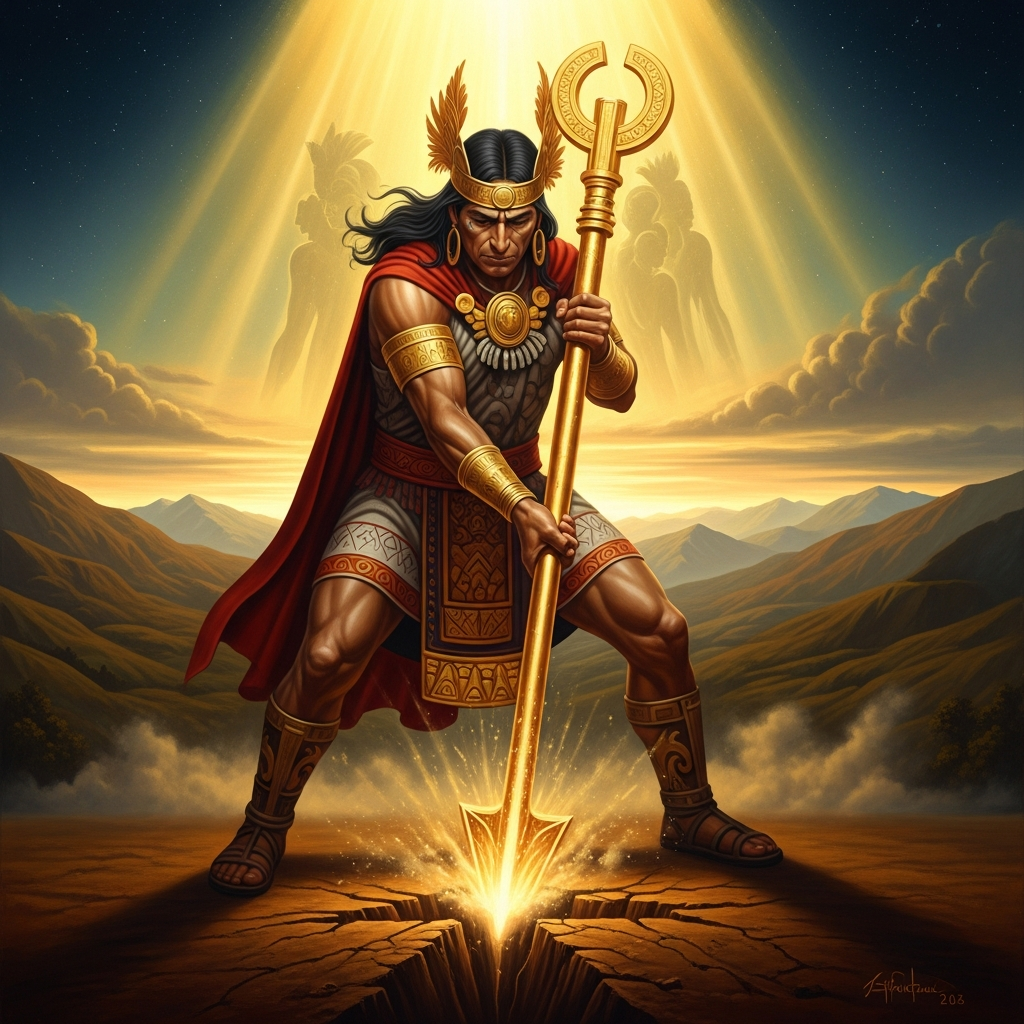
The communities with their huacas. The calendar inscribed in the stars. The agricultural cycle synchronized to the movements of the lights he created. The reciprocal labor system — mit’a — that mirrors the cosmic reciprocity of the sun rising every morning in exchange for the prayers that honor it. The ceque system of Cuzco, the 41 imaginary lines radiating from the Coricancha temple like the spokes of a wheel, each one passing through a sequence of huacas, organizing both the landscape and the calendar — this is Viracocha’s geometry, made concrete in the urban planning of the city that Manco Cápac’s golden staff found.
The Spanish missionaries who encountered the huaca system in the 16th and 17th centuries understood it as superstition — rocks and springs worshipped by people who did not know better. The extirpation of idolatry campaigns, which ran from roughly 1609 to the 1660s in Peru, sent inquisitors into every village to find and destroy huacas, interrogate practitioners, and replace the sacred sites with Christian crosses. They were largely unsuccessful. The huacas were too numerous, too embedded, too constitutive of the communities that had emerged from them.
A god who walks into the ocean and does not return is not a dead god. He is a god whose work is done, whose creation is complete, who does not need to manage what he has made. The sun rises on the schedule he set. The communities emerge from the places he assigned. The calendar turns.
Viracocha is still walking. The Pacific is not the end of the world — it is the continuation of the path. He is walking on the far side of the water, out of sight, and the Andean world continues because he set it in motion correctly and it does not need him to keep going, any more than the sun needs Viracocha in the sky to continue crossing it.
Scenes
Before the sun exists, Viracocha rises from the black water of Lake Titicaca — the highest navigable lake on earth, its surface reflecting nothing because there is no light to reflect — and speaks the first words into the absolute dark
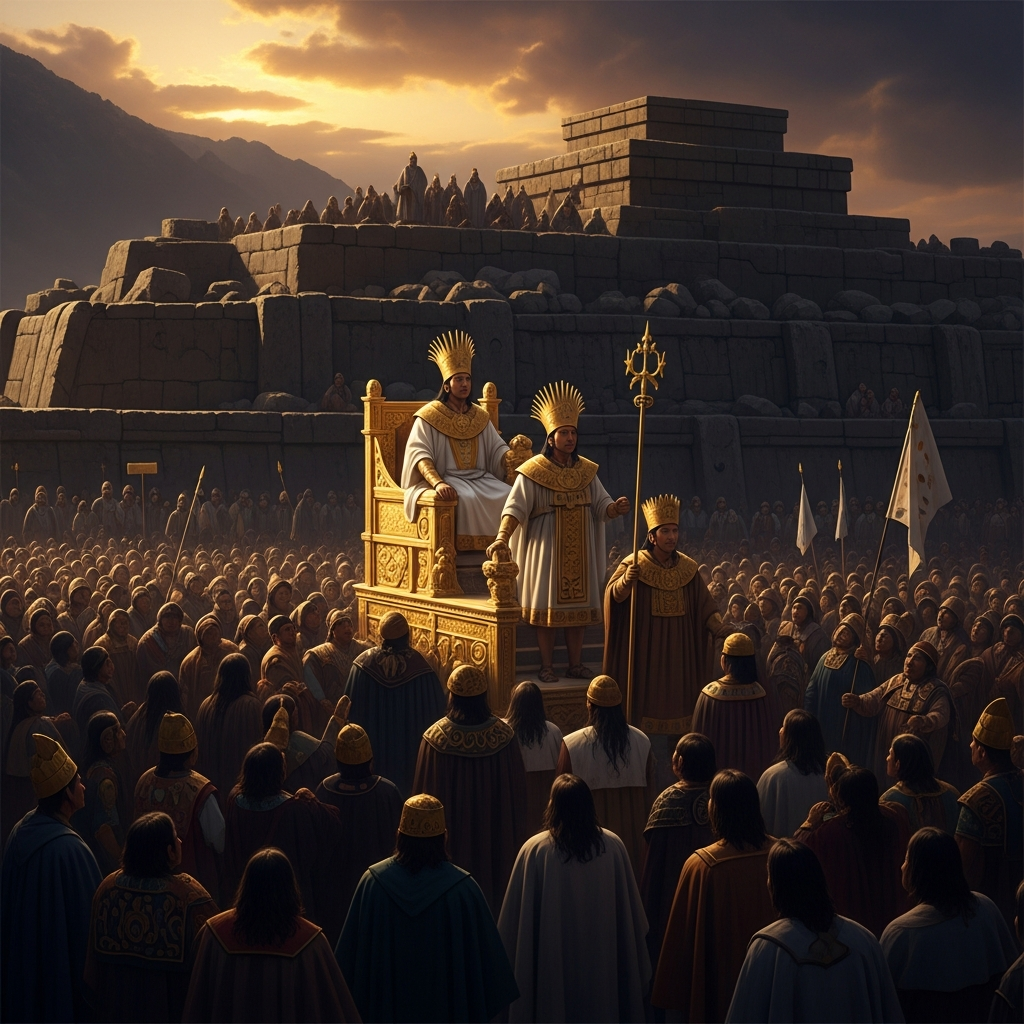
Generating art… At Tiwanaku, Viracocha commands the sun to rise from the Island of the Sun; he commands the moon to take its place in the sky; he populates the darkness with stars, each one assigned a specific task, a specific season, a specific people to watch over
 Generating art…
 Viracocha walks northwest across the Andes, healing the blind and the sick, calling each community out of the earth at its assigned huaca, until he reaches the Pacific coast at Manta — and walks across the water and disappears
 Generating art…
 Echoes Across Traditions
Entities
- Viracocha
- Imaymana Viracocha
- Tocapu Viracocha

Sources
- Juan de Betanzos, *Narrative of the Incas* (1557)
- Pedro Sarmiento de Gamboa, *Historia de los Incas* (1572)
- Bernabé Cobo, *History of the Inca Empire* (1653)
- Cristóbal de Molina, *Account of the Fables and Rites of the Incas* (c. 1575)
- Sabine MacCormack, *Religion in the Andes: Vision and Imagination in Early Colonial Peru* (1991)
- Gary Urton, *At the Crossroads of the Earth and the Sky: An Andean Cosmology* (1981)