Aakulujjuusi and Uumarnituq Rise from the Earth
Before the first human life · Nunavut/Kivalliq oral tradition · The bare tundra — the world before the world had anyone in it
Contents
In the beginning there is no one. From the earth itself, two figures rise. Sila breathes awareness into them. Uumarnituq sings: let us be two, not one — and from their difference, all life descends.
- When
- Before the first human life · Nunavut/Kivalliq oral tradition
- Where
- The bare tundra — the world before the world had anyone in it
In the beginning there is no one.
The tundra stretches in all directions without interruption — flat, treeless, the pale lichens and the dark rock and the endless sky that goes all the way to the edge and then, presumably, keeps going. Wind moves across it. Light arrives and departs in cycles. Animals live and die without a witness. The sea freezes and breaks and freezes again, season after season, and there is no one who knows this is happening, no one to whom the cycle means anything.
The earth holds its breath.
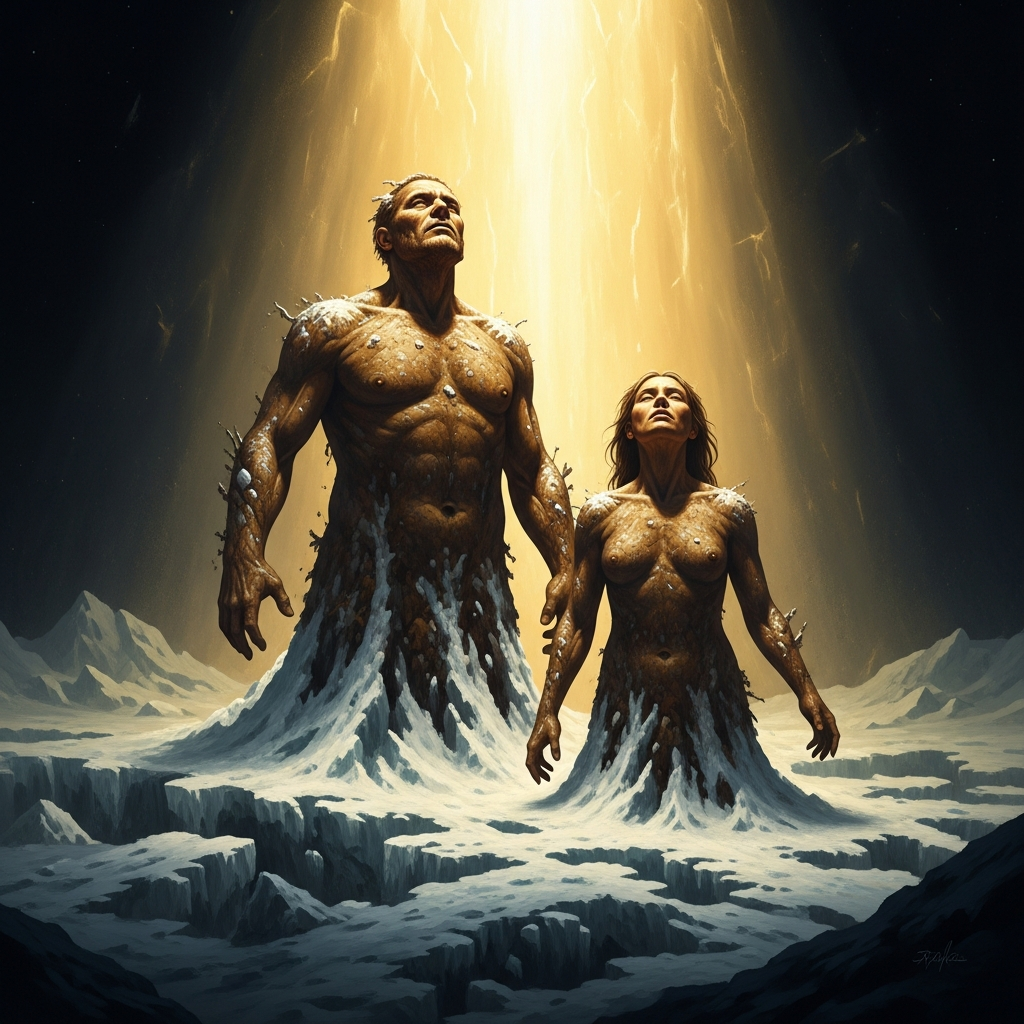
Below the surface, two shapes press upward through the frozen ground. They are not being born from anything — there is no womb, no egg, no divine hand shaping them from clay. They rise the way things rise when the ground is ready to release them, the way spring plants push through a thaw that has been building for months. The permafrost yields. The two shapes push through.
They stand on the tundra and the wind moves across them.
Their names are Aakulujjuusi and Uumarnituq.
They are fully formed — not infants, not incomplete. They have the bodies of adults, the proportions of people who know what cold is and how to stand in it. Their skin still holds the color of the earth they rose from, the ochre and grey of the Arctic ground, and as the air touches it the color shifts slowly toward what human skin will be. They stand a short distance apart and their eyes are open but not seeing — they breathe, their chests move, but there is nothing behind the eyes yet, nothing that knows it is looking.
The wind comes.
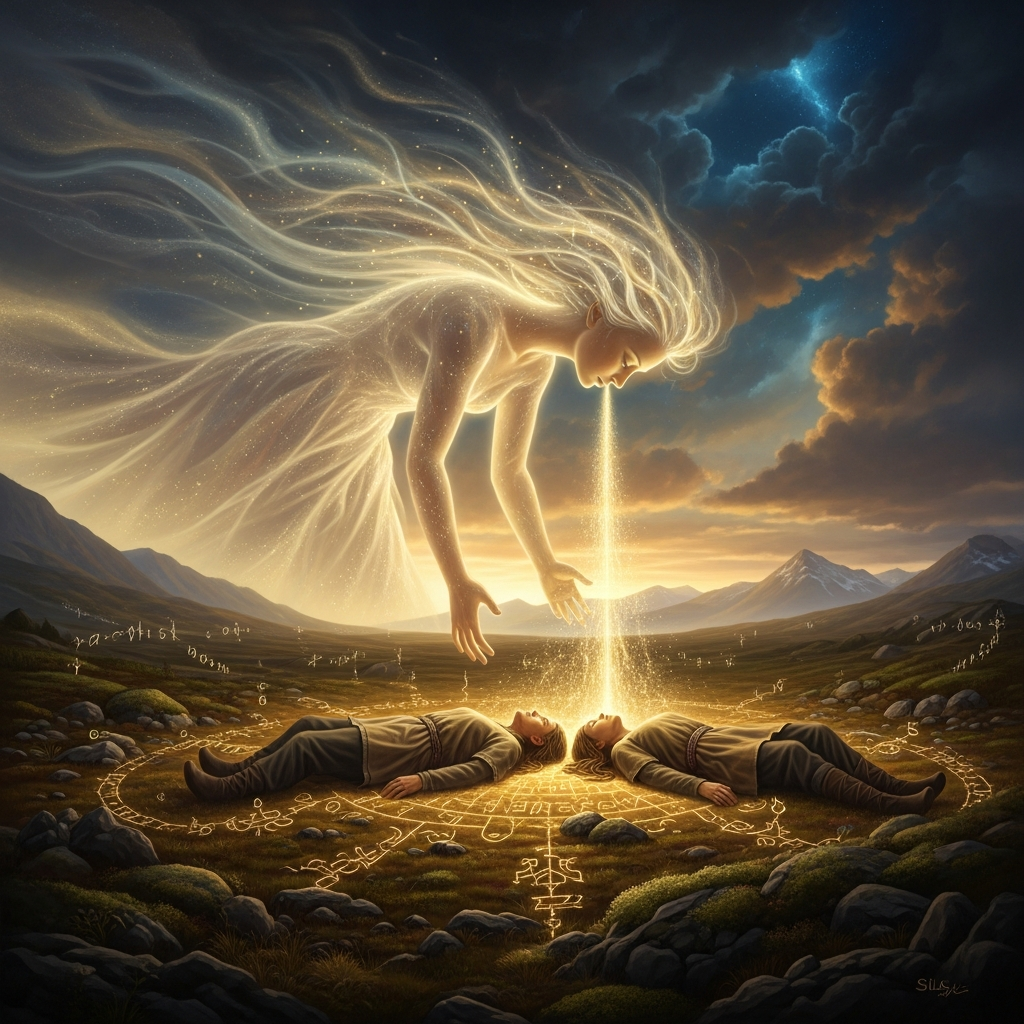
This is Sila. Not a wind like weather — Sila is the spirit of the air and of consciousness together, the force that moves through everything and connects everything, the awareness that lives in all of space. The Inuit understand Sila as the closest thing to a first principle: the consciousness that permeates the world, that makes it possible to know that you are in a world, that gives the thinking-creature its capacity to think. Sila is in the Arctic fox that pauses on the ice and lifts its head, suddenly knowing something is near. Sila is in the hunter who reads the snow and understands what passed over it in the night. Sila is everywhere, and it has no form, and it cannot be contained — and it bends now, in some sense that the language of bending was not invented to describe, toward these two figures standing on the tundra with their eyes open and nothing behind them.
Sila breathes.
Aakulujjuusi’s eyes change first.
One moment they are open and empty — surfaces reflecting the flat light. The next moment something occupies them. Not thought yet, not language, not the full architecture of a human mind — but the raw condition of awareness, the base state that all thought requires. He knows he is standing. He knows the ground is under him and the sky is over him and the wind is moving across his skin. He knows he is not alone.
He looks at Uumarnituq.
She becomes aware a breath after him — Sila’s attention sweeping from one to the other, each receiving what they need to begin. Her eyes shift from empty to occupied in the same instant of transition. She looks at the tundra. She looks at the sky. She looks at Aakulujjuusi.
They stand and look at each other across the short distance between them. They are the only two things in the world that know they are in a world. This is the most alone that two people have ever been, and it is also the most accompanied — there is no one else, but there is an other. They have that. They have only that.
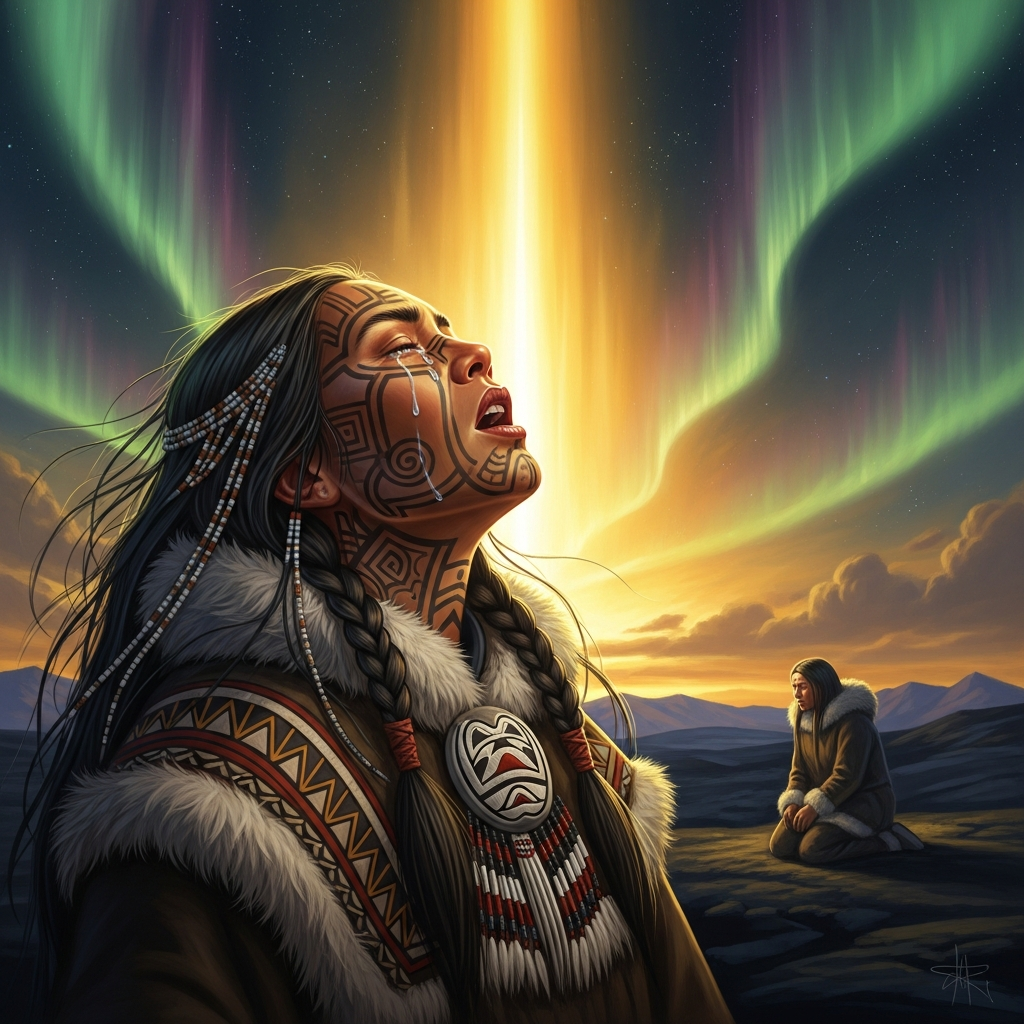
After a while, Uumarnituq begins to sing.
She does not plan the song. She does not decide to sing — the song arrives the way breath arrives, because it is the natural expression of what she knows. She lifts her face to the sky and she sings, and the song carries across the tundra, and there is nothing to stop it in any direction.
What she sings is a claim. A decision, or the assertion of something she understands to be necessary.
Let us be two, not one. Let men and women be different, so life can continue.
The words are not complicated. They do not need to be — this is the first speech ever spoken, and the first speech does not need ornament or proof. She sings it the way a fact is stated: this is what is true, this is what must be, this is the condition on which everything that follows depends. She is not asking. She is not requesting Aakulujjuusi’s agreement, though she will have it. She is naming the structure of the world.
Aakulujjuusi listens.
The tundra listens.
In the versions of this story told among the Kivalliq people, the moment of Uumarnituq’s song is the hinge of everything.
What she names is not merely the difference between a man and a woman — she names difference itself as the condition of continuation. One thing alone does not multiply. One cannot become many by staying one. The universe’s fundamental act is not unity but the original split — the two things that are not the same, leaning toward each other across the short distance between them, finding in their difference the beginning of everything that comes after.
Sila moves between them. The wind crosses the tundra and the two figures move toward each other across the pale lichen, and the world that has been waiting without a witness now has two.
The children they will have will carry Sila in them. Every breath of every Inuit person who will ever live draws on the same awareness that opened these two pairs of eyes on the empty tundra at the beginning of the world. To breathe is to receive Sila. To be conscious is to participate in the same force that looked at two figures of ochre-colored earth and decided it was time.
The tundra does not change when they meet. The wind does not mark the moment. The pale lichen continues. The flat Arctic light goes on being flat.
But the world is different now, in the most important way: it has someone in it who knows it exists.
From Aakulujjuusi and Uumarnituq descend all the people of the land — the hunters who will learn to read the snow, the women who will learn to prepare the skin so it holds warmth, the children who will learn the songs, the angakkuit who will learn to descend to Sedna and come back. The tundra that was empty of witnesses fills, generation by generation, with people who carry Sila in their lungs and walk the same ground their first ancestors rose from.
They are different from each other — that is Uumarnituq’s gift. They are the same in the one way that matters: they all breathe, and in breathing they receive the consciousness that the first wind carried, and they know they are here.
The Nunavut/Kivalliq tradition holds this story alongside the Sedna story and the shamanic journey in a cosmology that is not a single myth but a family of related claims: the world is made from what was lost (Sedna), maintained by relationship and honesty (the shaman’s descent), and begun by the decision to be different (Uumarnituq’s song). The three stories are not contradictory. They are the same theology approached from three angles.
Sila, in contemporary Inuit usage, also means weather — the word covers both consciousness and the physical state of the air. A hunter reading the sky for signs is reading Sila. A shaman receiving spirit-knowledge is receiving Sila. A child drawing the first breath is entering Sila. The connection is not metaphor. In Inuit thought, the distinction between mind and world that Western philosophy has spent centuries trying to resolve was never a distinction at all.
Scenes
From the bare tundra, two forms push upward through the frozen ground — Aakulujjuusi and Uumarnituq, already shaped, already breathing, their skin still holding the color of the earth they rose from
Generating art… Sila — the wind-spirit, the consciousness that moves in all things — bends over the two figures and breathes
 Generating art…
 Uumarnituq lifts her face to the sky and sings the first song — let us be two, not one
 Generating art…
 Echoes Across Traditions
Entities
- Aakulujjuusi
- Uumarnituq
- Sila

Sources
- Knut Rasmussen, *Intellectual Culture of the Caribou Eskimos* (Report of the Fifth Thule Expedition, vol. VII no. 2, 1930)
- Birgitte Sonne, *Worldviews of the Greenlandic Inuit* (Museum Tusculanum Press, 1988)
- Krupnik, Igor, *Arctic Adaptations: Native Whalers and Reindeer Herders of Northern Eurasia* (University Press of New England, 1993)
- Laugrand, Frédéric, and Jarich Oosterens, *The Sea Woman: Sedna in Inuit Shamanism and Art in the Eastern Arctic* (University of Alaska Press, 2008)