The Shaman Descends to Sedna
The deep winter of a failed hunt · oral tradition preserved across Inuit peoples from Siberia to Greenland · The qarmaq — the sod house — and the ocean floor beneath the Arctic sea
Contents
The hunt has failed and the village faces starvation. The angakkuq enters trance, descends to the ocean floor, and combs the tangles from Sedna's hair — each tangle a violation the people must confess.
- When
- The deep winter of a failed hunt · oral tradition preserved across Inuit peoples from Siberia to Greenland
- Where
- The qarmaq — the sod house — and the ocean floor beneath the Arctic sea
The seals have not come.
Three weeks without a seal means the village begins to calculate differently — the weight of each child against the weight of the remaining food, the distance to the nearest other camp, whether the dogs can survive what is needed of them. The hunters go out every day and come back empty. The ice is correct, the season is correct, the harpoons are ready, and nothing comes. This is the particular quality of starvation in winter: it does not announce itself with violence but with a silence, a refusal, the world simply declining to provide.
The elders know what the silence means.
A lead elder walks to the angakkuq’s dwelling and stands at the entrance and waits. She does not need to say what has happened. The angakkuq already knows — has known for days, has been feeling the absence the way a healer feels a fever before the patient knows it is there. She opens the door and the elder comes in. They sit for a while without speaking.
Then the angakkuq says: “Who?”
The elder gives her the list.
The community assembles in the qarmaq before the sun comes up.
The sod house is low and warm — heat from bodies, heat from seal-oil lamps, the smell of people who have been living through a frightening season together. They sit around the walls and the angakkuq sits in the center. The drum is already in her hands. It is a wide, flat drum, the skin of the head so thin that you can see the shadow of your fingers through it when you hold it to the light. She has had it a long time.
She begins to drum.
The beat is slow at first — slower than a heartbeat, slower than breathing, the kind of rhythm that the body has to choose to follow rather than following automatically. It is the rhythm of going under. The people in the room feel it work on them differently than it works on the angakkuq. On them it brings a heaviness, a closing down of the ordinary world, the particular quietness of a room full of people all listening to the same thing. On her it does something else. She is here, and then she is somewhere else, and the drum keeps beating in the room behind her, and her body stays sitting, but the angakkuq herself goes.
She goes down.
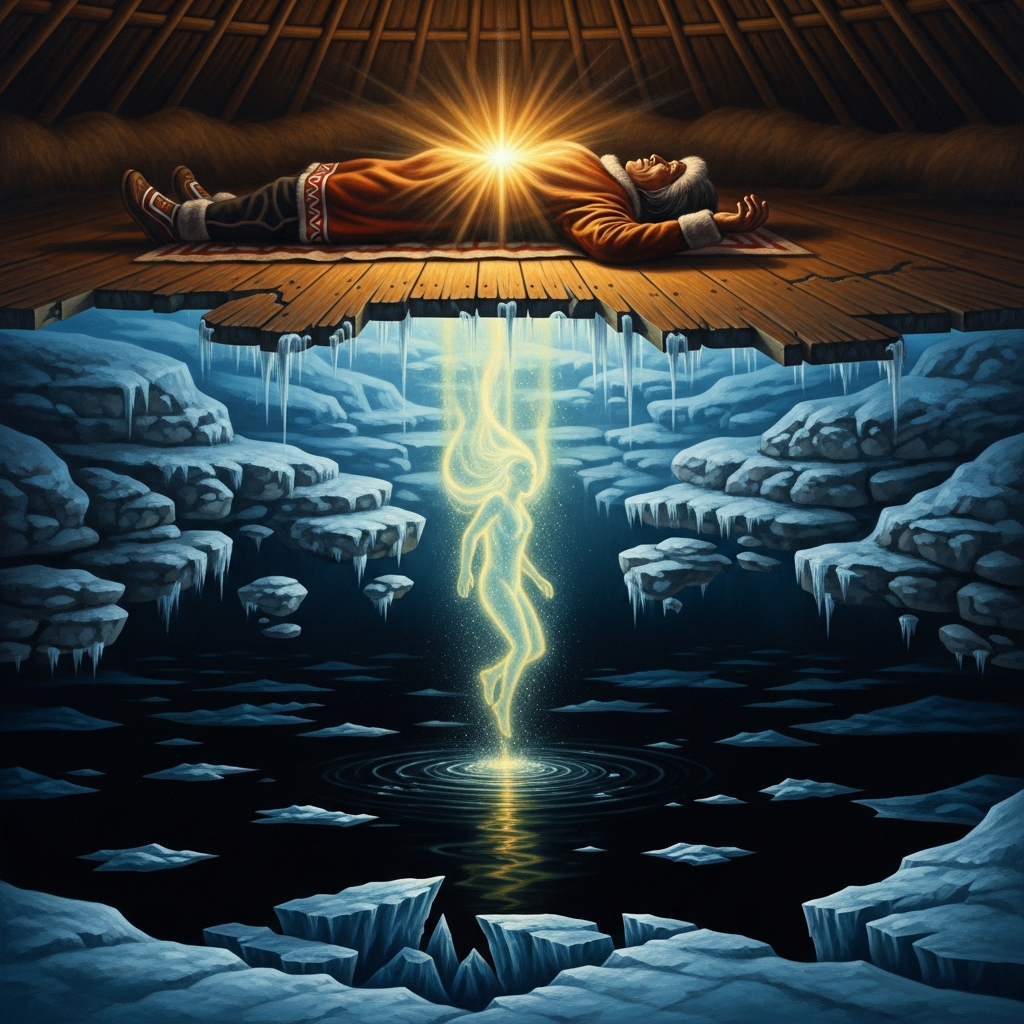
The path is known to her — she has made this journey before, in other winters, and the route is as specific as a route across ice: landmark by landmark, by feel and by what her helping spirits tell her. She goes through the floor of the qarmaq. She goes through the permafrost. She goes through the rock underneath the permafrost, which is not like ordinary rock because it is not the kind of world the living inhabit. She enters the water.
The water is black and very cold and very silent. There is no light. She descends through the water the way a stone descends — directly, without drift, following the pull of what she has come to do. Her helping spirits are with her; she can feel them around her like a flock around a single bird, orienting, steadying, pulling her in the right direction when the dark becomes disorienting.
The bottom appears below her not as a visible thing but as a pressure, a sense of arrival, the way the end of a long journey announces itself before you can see it.
Sedna is there.
The angakkuq has seen her before, but it is always a shock. The hair is everywhere — spreading out from Sedna’s head in all directions, thick with tangles, black with the weight of what it holds. The tangles are not knots of hair alone. Each one holds something: a bone thrown into a fire carelessly, a seal’s bladder punctured before the ceremony, a hunter who mocked an animal, a woman who ate seal meat during her time when the taboo said she should not, a man who lied about his catch, children who played with the ocean’s gifts without respect. The violations of the season are all here, worked into the hair, and Sedna sits at the center of them with her ruined hands in her lap and her face turned away.
She does not look at the angakkuq. She rarely does.
The angakkuq kneels in the black water and takes out the comb and begins to work. The first tangle resists. She holds it and speaks the name of the violation it holds — the specific act, the specific person, the specific animal that went unacknowledged. In the room above, in the qarmaq, someone in the circle flinches. Someone bows their head. The angakkuq feels the moment when the named thing releases its grip and the tangle loosens.
She works through the next one. And the next.
This is the part that takes the longest.
There is no shortcut here. The shaman cannot free the tangles without naming the violations, and the violations cannot be named in the abstract — each one has a specific gravity, a specific person, a specific animal that was owed something and did not receive it. The angakkuq kneels in the dark at the bottom of the sea and combs and names and combs and names, and above her, in the qarmaq, the people listen to the drum beat and they know — because they were told before the ceremony began — that whatever they hear from their own conscience during this time is not coincidence. Something is being asked of them.
One by one, people in the circle begin to speak.
They speak quietly, into their chests, not to the room — the small admissions that people carry through a season of difficulty, the things they did that violated the compact between humans and animals. A hunter says: I took without thanking. A woman says: I wasted what was given. Another hunter says: I felt contempt for the animal I killed and I did not hide it. The room receives each admission without judgment. The drum keeps beating. Each spoken truth rises toward the ceiling and falls through the permafrost and finds its way to the shaman’s hands, and another tangle loosens.
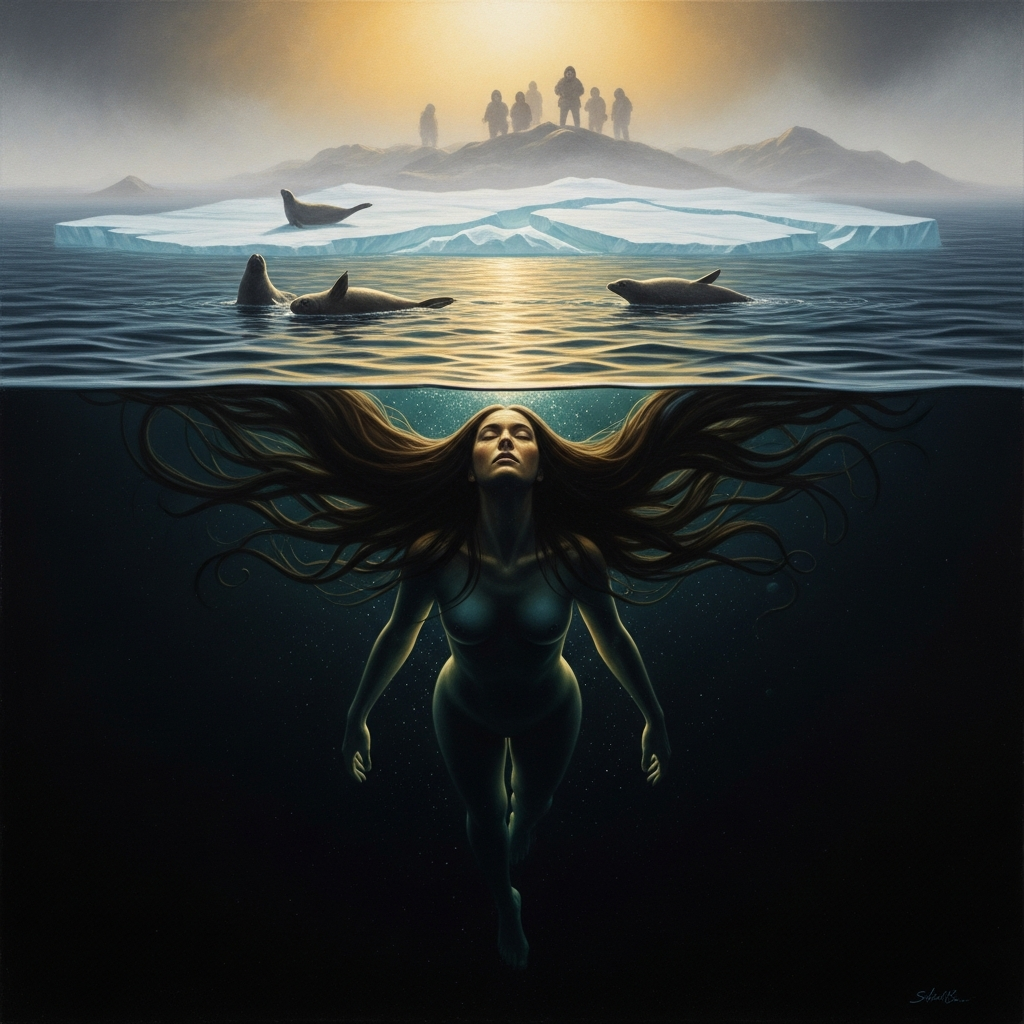
When the last tangle is free, Sedna’s hair spreads out in the black water around her like kelp in a current, weightless, clean.
She does not speak. She does not turn to face the shaman. She does not forgive, because forgiveness implies the debt is paid, and the debt is structural — it is built into the relationship between the living and the animals that feed them, and it will accrue again, and the shaman will return. But the hair is free, and Sedna’s body loses the rigid tension it has been holding, and the angakkuq feels it happen the way you feel a storm pass: not through sight but through the change in the air.
She begins the ascent. Through the water, through the rock, through the permafrost, through the floor of the qarmaq. Her body receives her back. She opens her eyes and the room is there — the people around the walls, the seal-oil lamps, the drum in her hands, the silence that has replaced the admissions of a few minutes ago.
She looks around the circle.
“Go out tomorrow,” she says. “Go out early.”
In the morning the hunters go out on the ice and the seals are in the leads.
They are there the way they always were, the way they will always be — surfacing to breathe in the thin openings in the ice, dark eyes catching the low winter light. The hunters take what is offered, carefully, with the words that need to be said. They return to the village with the weight of what they have been given. The children who were being counted against the food supply are not counted anymore. The calculation reverses.
The angakkuq sits in her dwelling and eats something small and rests. The journey costs. It always costs. The helping spirits require something of her each time, and what they require is harder to name than a physical wound — a piece of the ordinary world becomes less available to her, the texture of the everyday growing slightly thinner, the boundary between her world and the world she descends to wearing a little more transparent. This is the price of being the person the community sends. She pays it every time.
She knew the price when she took the drum.
The angakkuq Aua, interviewed by Knut Rasmussen during the Fifth Thule Expedition in 1921, described the shaman’s relationship to knowledge this way: “We fear the cold and the things we do not understand. We fear the weather. We fear the dead. We fear the spirits of earth and air. All our customs come from the fear of something. We are afraid of everything.”
The descent to Sedna is not a cure for the fear. It is the fear given a procedure — a route through the dark, a specific task at the bottom, a set of words that work if you say them truly. What makes the angakkuq powerful is not the absence of terror but the ability to go anyway, to descend into the place that frightens everyone and come back carrying what the community needs.
The price is always the same: someone must face the truth. The shaman names it in the dark at the bottom of the sea. The people name it aloud in the circle. Sedna releases the seals. This is the theology. This is the whole of it.
Scenes
The angakkuq's soul leaves the body in the drumming dark of the qarmaq and falls through the floor, through the permafrost and stone, into the black water below the ice
Generating art… At the bottom of the sea, the shaman kneels before Sedna and works the comb through tangles that hold the names of every violation
 Generating art…
 When the last tangle is free, Sedna's hair spreads weightless in the black water
 Generating art…
 Echoes Across Traditions
Entities
- the angakkuq
- Sedna
- the helping spirits
- the tuurngait


Sources
- Knut Rasmussen, *Intellectual Culture of the Iglulik Eskimos* (Report of the Fifth Thule Expedition, vol. VII, 1929)
- Mircea Eliade, *Shamanism: Archaic Techniques of Ecstasy* (1951, trans. Willard Trask 1964)
- Merkur, Daniel, *Powers Which We Do Not Know: The Gods and Spirits of the Inuit* (University of Idaho Press, 1991)
- Ann Fienup-Riordan, *Boundaries and Passages: Rule and Ritual in Yup'ik Eskimo Oral Tradition* (1994)