The Angakkuq Learns to See in the Dark
Traditional era, c. 1000 CE (oral tradition; ethnographic documentation c. 1921-24) · Iglulik region, Nunavut; and Caribou Inuit territory, central Arctic Canada
Contents
An Inuit shaman's initiation proceeds in stages no one outside the tradition fully survives describing: the period of isolation in darkness, the terrifying experience of the skeleton — seeing one's own bones from the inside — and the acquisition of the helping spirits called tarriassuit, the shadows. Grounded in Iglulik and Caribou Inuit ethnography recorded by Knud Rasmussen in the 1920s, this is what it costs to become a person who can see what others cannot.
- When
- Traditional era, c. 1000 CE (oral tradition; ethnographic documentation c. 1921-24)
- Where
- Iglulik region, Nunavut; and Caribou Inuit territory, central Arctic Canada
The teacher is an old man who has done this before and the student is young and the first instruction is: go away.
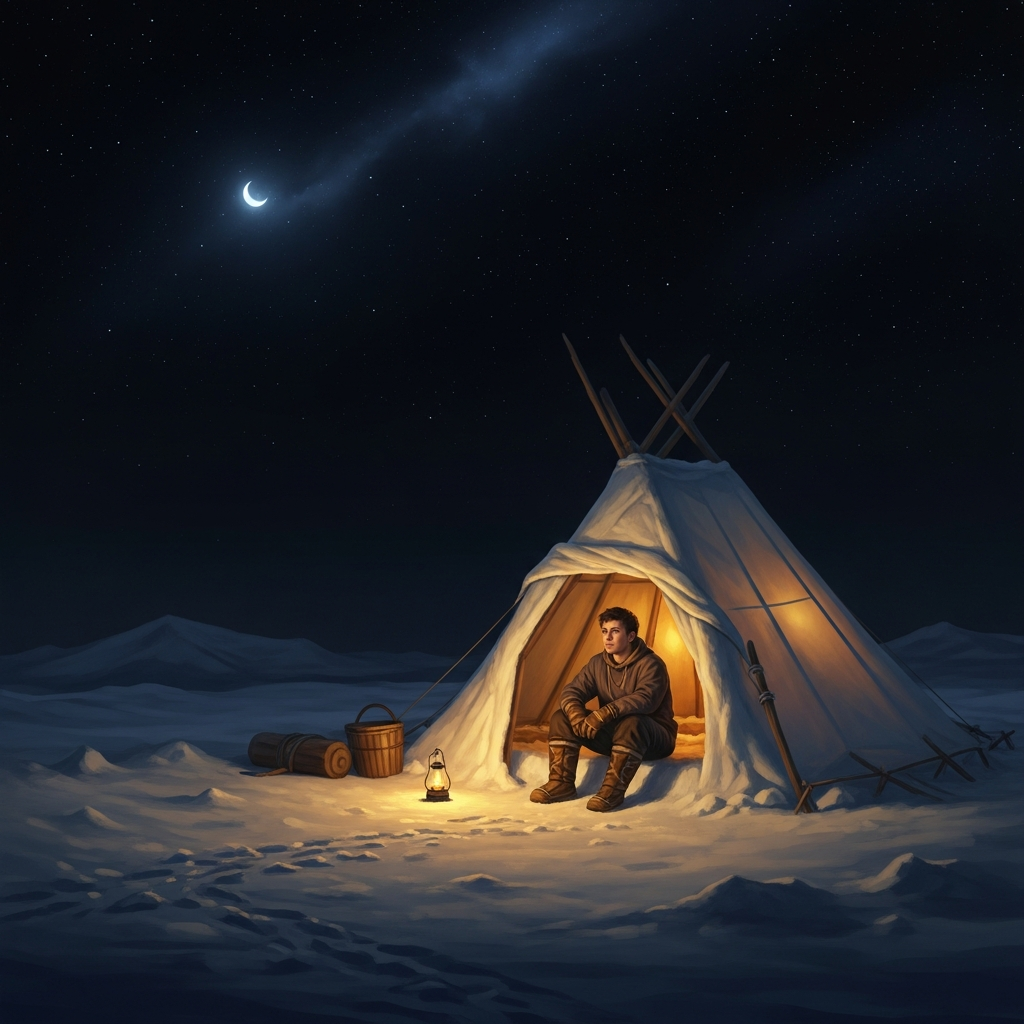
Not permanently. The isolation is bounded — days, sometimes weeks, never indefinitely — but bounded by what the body can endure in the Arctic dark rather than by any calendar. The candidate goes out to a place a sufficient distance from the settlement that the sounds of the camp cannot reach. He brings nothing that would make the solitude comfortable. He sits. He waits. He does not know exactly what he is waiting for because the teacher cannot tell him exactly; what will come must come from the direction that cannot be pointed to.
Aua, the Iglulik angakkuq who explained his initiation to Rasmussen in the winter of 1921, described it this way: “I sought solitude, and here I soon became very melancholy. I would sometimes fall to weeping, and feel unhappy without knowing why. Then, for no reason, all would suddenly be changed, and I felt a great, inexplicable joy, a joy so powerful that I could not restrain it, but had to break into song.”
The oscillation between grief and joy without cause is the first sign. The candidate is learning to hold states that have no object — to feel profoundly without the feeling being about anything. This is the beginning of the shamanic capacity: affect decoupled from ordinary cause.
The skeleton arrives without warning.
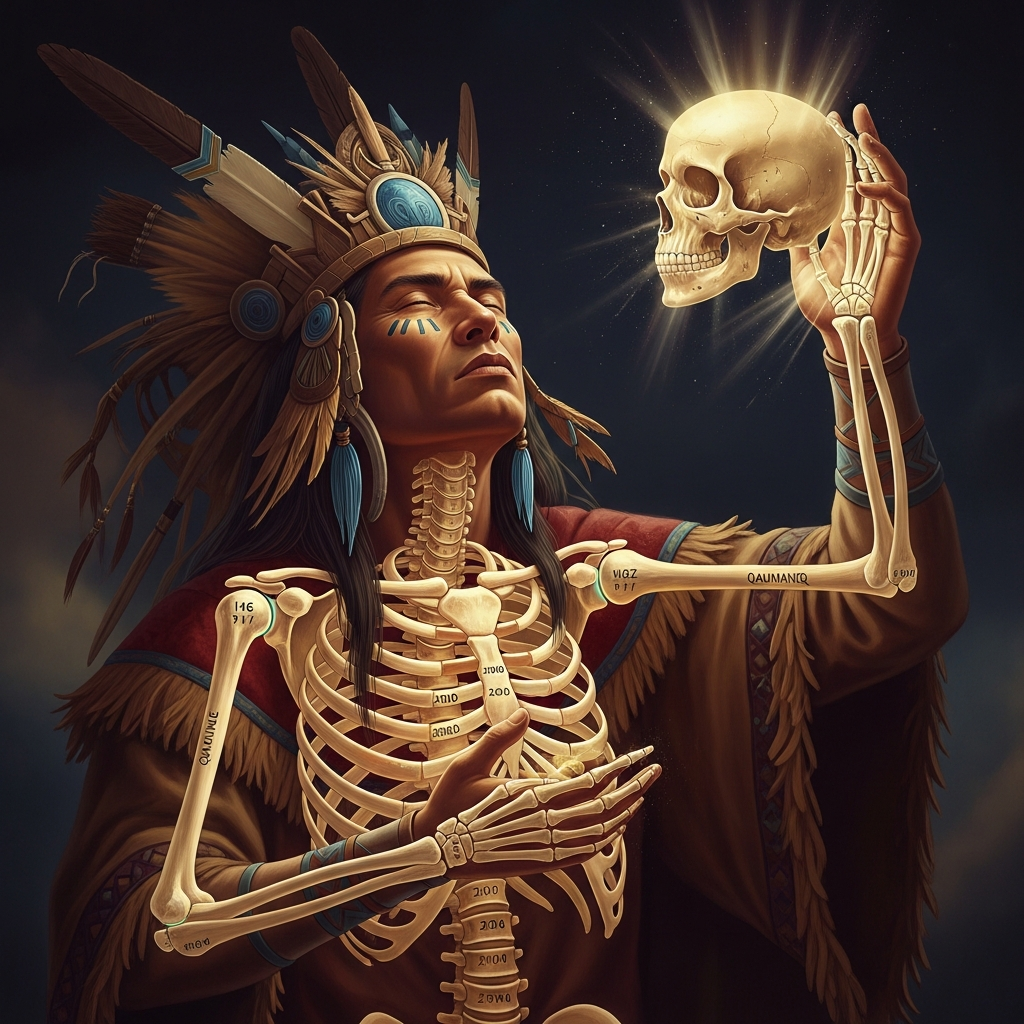
It is not a vision in the visual sense — the candidate does not see himself from outside his body the way a dreamer might. He feels his body from inside, and what he feels is not flesh and warmth and the pressure of sitting on ice but the architecture beneath: bone. The individual bones announce themselves. The Iglulik tradition requires the candidate to be able to name each bone correctly and completely — every joint, every small bone of the wrist and ankle — because the spirits who will become his helpers must be able to find him by his complete structure. If he does not know his own skeleton, the spirits will not trust him with theirs.
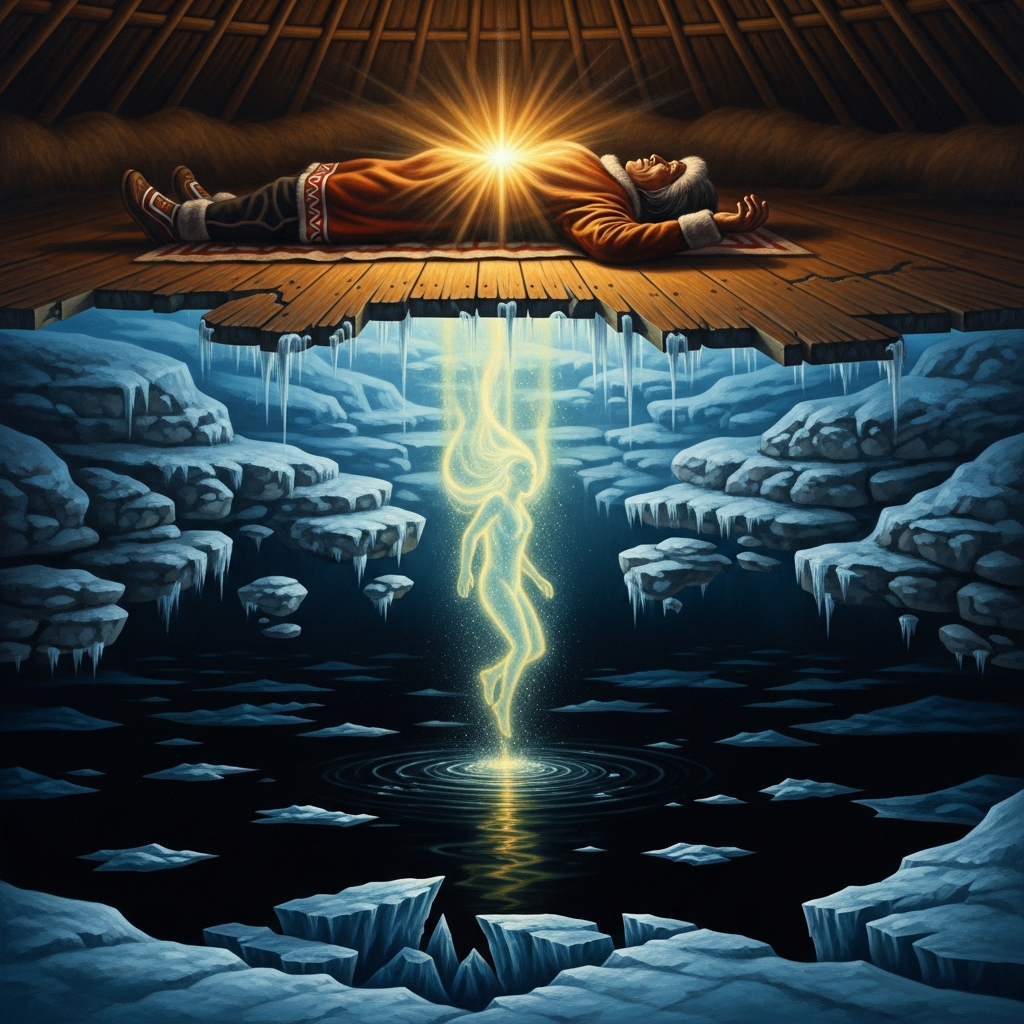
Rasmussen recorded the Iglulik name for this experience: qaumaneq. The shaman-light. The inner illumination. Candidates describe it as the skull filling with light, the light spreading outward through the body, and then — in the most complete versions of the experience — the light visible to others, an actual luminescence around the candidate’s head and hands in the dark.
The phenomenology is more precise than any Western mystical account Rasmussen encountered. The candidate does not describe oneness with the universe. He describes anatomical specificity: this bone, this joint, this connecting tissue named and luminous. The body becomes transparent to itself, and what is revealed is not void but structure.
After the skeleton, the tarriassuit come.
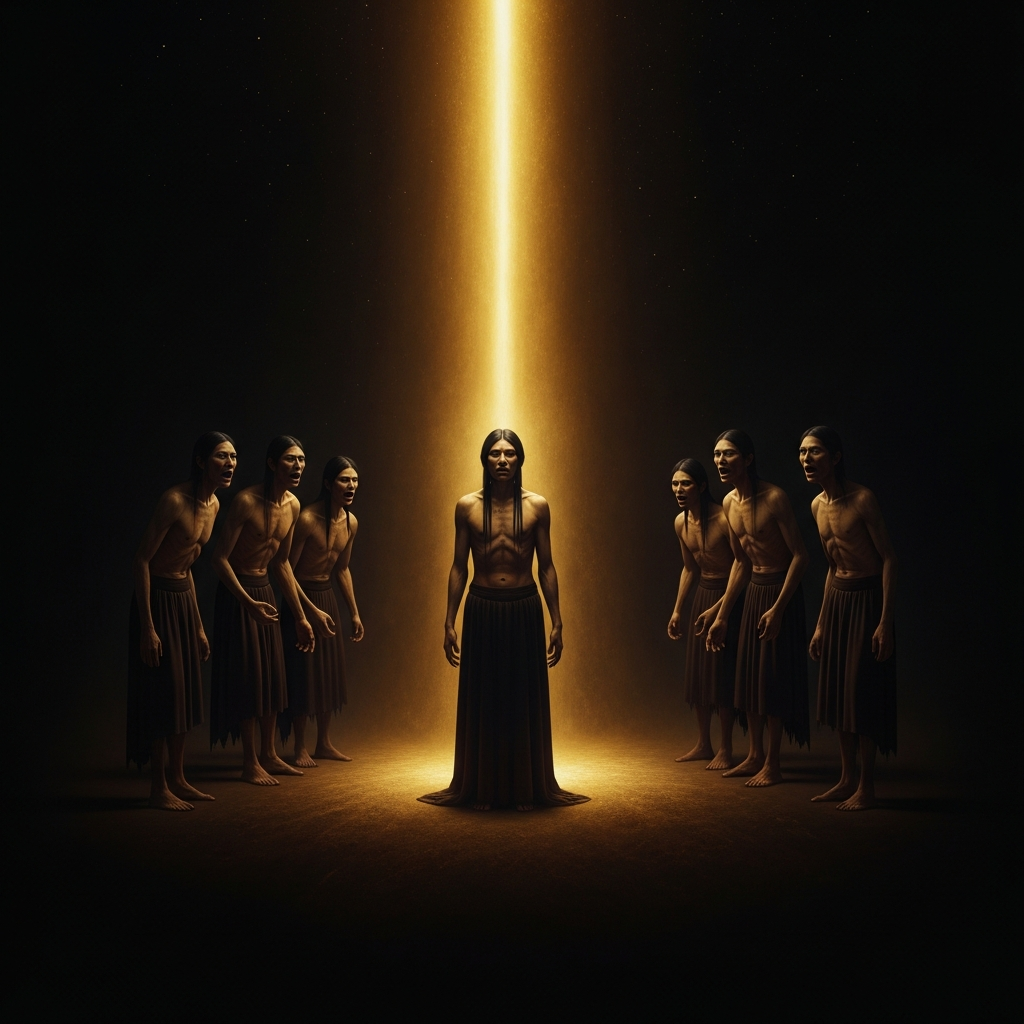
Shadow-beings. The name means literally ‘those that are like shadows,’ which in Arctic darkness where shadows are long and the boundary between a thing and its absence is genuinely unclear is less metaphorical than it sounds. They come one at a time, usually, and they come in the dark — the candidate must receive them without being able to see them clearly, knowing them by the quality of their approach rather than their appearance.
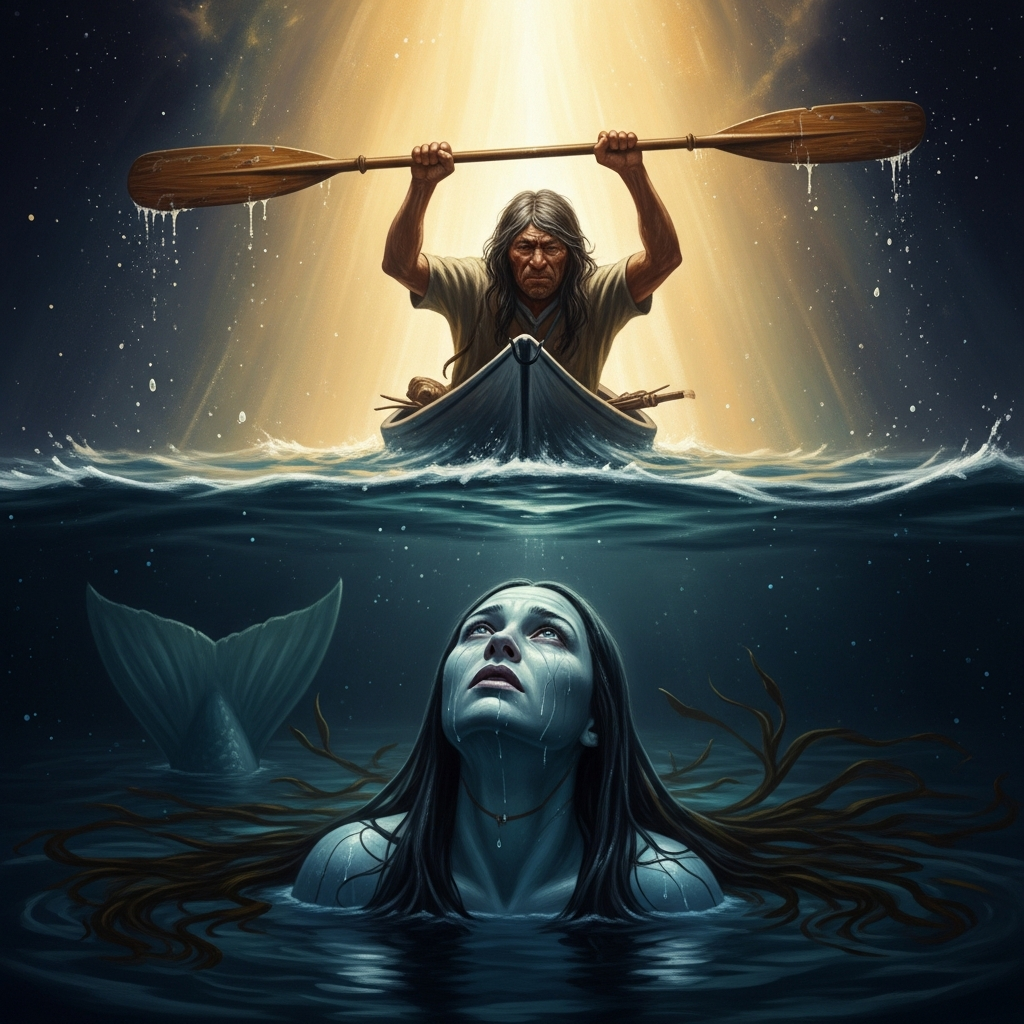
Each one is a distinct entity with its own character and domain. A polar bear spirit carries authority over physical strength and the hunt. A sea spirit mediates access to Sedna’s domain. A spirit associated with weather patterns allows the shaman to read the wind’s intention before it arrives. An ancestor spirit provides connection to the accumulated knowledge of the lineage. The angakkuq with many helping spirits is correspondingly powerful; the one with few is correspondingly limited in what they can do.
The acquisition is not passive. The candidate must demonstrate that he can be present to each arrival without fleeing — not brave in the sense of suppressing fear, but capable of remaining present to an experience that the untrained mind evacuates immediately. Most people flee the dark when things arrive in it. The angakkuq learns not to.
What does the spirit ask in exchange? This varies by account, but the most consistent answer in the Iglulik ethnography is: nothing. The spirit does not bargain. It assesses. If the candidate can hold the encounter without disintegrating, the spirit remains. If not, it departs and may not return. The initiation selects for a quality of attention so steady it remains functional under conditions that would shatter ordinary consciousness.
When the candidate returns to the settlement, the teacher examines him.
The examination is oral — a conversation conducted over days in which the teacher asks what arrived, what each entity looked like, what it communicated, in what order the experiences came. The teacher knows the territory because the teacher has walked it. He can tell whether the candidate is reporting genuine encounter or confabulating from stories heard in childhood. The difference is in the specificity. Stories heard in childhood produce recognizable narrative shapes. Genuine encounter produces details that surprise the candidate, that he does not understand the significance of, that the teacher must explain.
This is the moment of transmission that outsiders consistently misread as merely oral. The teacher is not giving information. He is confirming that the candidate’s experience matches the map. The map is not written anywhere. It exists in the bodies of those who have made the journey and returned, and it is transferred by this comparison — the teacher’s experienced interior held alongside the candidate’s new and shaken one, adjusted, confirmed, corrected.
After the confirmation, the candidate is an angakkuq. He can enter trance, travel to Sedna, comb her hair, negotiate with the spirits that control weather and game, find lost people, diagnose illness by examining the spirit body rather than the physical one. He can also do something that outsiders rarely note: he can teach. The capacity to transmit the map is itself a shamanic function, one that requires the same quality of attention as the descent.
Rasmussen asked Aua: what is it that you actually believe? After all the years, all the journeys, all the sessions with the sick and the grieving — what holds?
Aua’s answer has been quoted in every subsequent study of Arctic shamanism because it resists being simplified. He took Rasmussen outside into a blizzard and pointed to the storm and said: we believe in the Sila — the intelligence the air is made of. We believe in the souls inside every living thing. We believe that human beings must live in a way that does not offend these forces. But as for explanations — as for why any of this is so, why the world is arranged this way — we do not explain. We only try not to lie.
The angakkuq is not a theologian. He does not defend a cosmology. He is a technician of the boundary between the visible and the invisible, trained by a method that produces results — the animals return, the sick person recovers, the lost child is found — without requiring any of the participants to explain the mechanism. The mechanism is not the point. The relationship is the point.
The qaumaneq — the inner light — does not leave the angakkuq when the initiation is over. Rasmussen’s informants described it as a permanent change in the quality of perception, something always present at the edge of ordinary seeing. Not visions, exactly, not hallucinations, but a kind of transparency in things — the awareness that the seal surfacing twenty meters away has a name, that the wind shifting to the northeast is a communication, that the child running toward the tent is carrying something in his body that is not quite right and will need attention before it becomes serious. The initiation does not give the angakkuq supernatural powers. It makes him pay a different kind of attention. In the Arctic, where the margin between correct perception and fatal error is measured in hours, that difference is everything.
Scenes
A young man sits alone in a small snow structure far from the camp, no lamp burning, no sound
 Generating art…
 The shaman in mid-initiation, his eyes open but seeing inward: the vision of his own skeleton, every bone named and counted, the joints luminous, the marrow a living light
 Generating art…
 The tarriassuit come in the dark — not as visions but as presences, each one distinct, some frightening, some matter-of-fact
 Generating art…
 Echoes Across Traditions
Entities


Sources
- Knud Rasmussen, *Intellectual Culture of the Iglulik Eskimos: Report of the Fifth Thule Expedition 1921-24*, vol. VII (Gyldendalske Boghandel, 1929)
- Knud Rasmussen, *The Netsilik Eskimos: Social Life and Spiritual Culture* (Gyldendalske Boghandel, 1931)
- Merkur, Daniel, *Powers Which We Do Not Know: The Gods and Spirits of the Inuit* (University of Idaho Press, 1991)
- Laugrand, Frederic and Jarich Oosteran, *The Sea Woman: Sedna in Inuit Shamanism and Art in the Eastern Arctic* (University of Alaska Press, 2008)
- Eliade, Mircea, *Shamanism: Archaic Techniques of Ecstasy*, trans. Willard Trask (Princeton University Press, 1964)