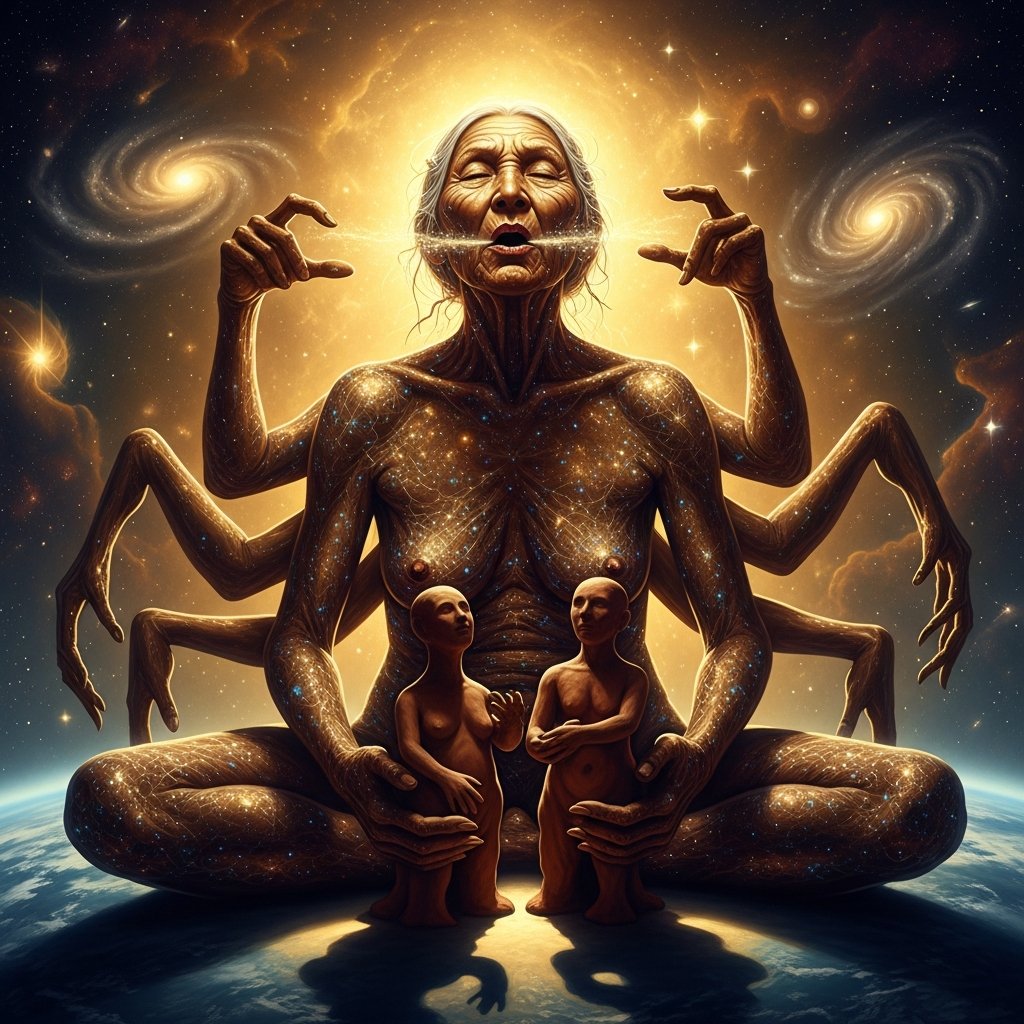
The Kachina Return to the San Francisco Peaks
Time beyond memory; ceremony ongoing · Hopi Mesas, Arizona; San Francisco Peaks
Contents
From winter solstice until July, the kachinas — ancestral spirit beings — come down from their home in the San Francisco Peaks and live in the Hopi villages, bringing rain, participating in ceremony, giving dolls to the children. In the Niman ceremony of late July, they must leave. This is the story of what happens in those six months, and what the dolls are actually for.
- When
- Time beyond memory; ceremony ongoing
- Where
- Hopi Mesas, Arizona; San Francisco Peaks
At winter solstice, the kachinas arrive.
They come from the San Francisco Peaks — the sacred mountains that rise twelve thousand feet from the Painted Desert floor sixty miles west of the Hopi mesas, the mountains that the Hopi call Nuvatukya’ovi, the place of snow on top. The kachinas are the spirits of the ancestors, the clouds, the natural forces that sustain life in the desert: the rain-bringing Crow Mother, the fierce warrior kachinas who police the boundaries of proper behavior, the clown kachinas who expose human pretension through merciless comedy. There are hundreds of them, each with a specific identity, a specific mask, a specific song, a specific role in the ceremonial calendar.
They come down in December and they live in the villages for six months.
This is not metaphor. The Hopi understand the kachinas to be genuinely present in the villages from winter solstice to the end of July. When a man puts on the mask, the kachina enters him; he becomes the kachina for the duration of the ceremony, setting aside his ordinary identity completely. The mask is not a costume. The mask is a face, and putting it on is an act of transformation that requires ceremonial preparation, physical discipline, and the maintained intention of a man who understands himself to be a vessel rather than a performer.
The Soyal ceremony at winter solstice is the opening of the kachina season.
It is conducted in the kiva — the underground ceremonial chamber that is the axis of Hopi village life, entered through a hole in the roof down a ladder, warm and smoky with the fire, its walls marked with the painted figures of spirits. The Soyal opens the kachina season the way a door is opened: formally, with the correct words, with the understanding that the opening creates an obligation on both sides. The kachinas are invited and they come, and because they come, the ceremonies must be conducted properly through the entire season until the Niman sends them home.
Each ceremony in the cycle is for a specific purpose, addressed to specific forces. The Powamuy in February is for the purification of the community and the initiation of children into the kachina society — their first formal instruction in what the masked figures actually are. The summer solstice ceremonies bring rain, or ask for rain, which in the Hopi understanding are the same thing: to ask correctly is to create the conditions under which the rain can come. The asking and the arriving are not separate events connected by divine decision; they are two phases of the same act.
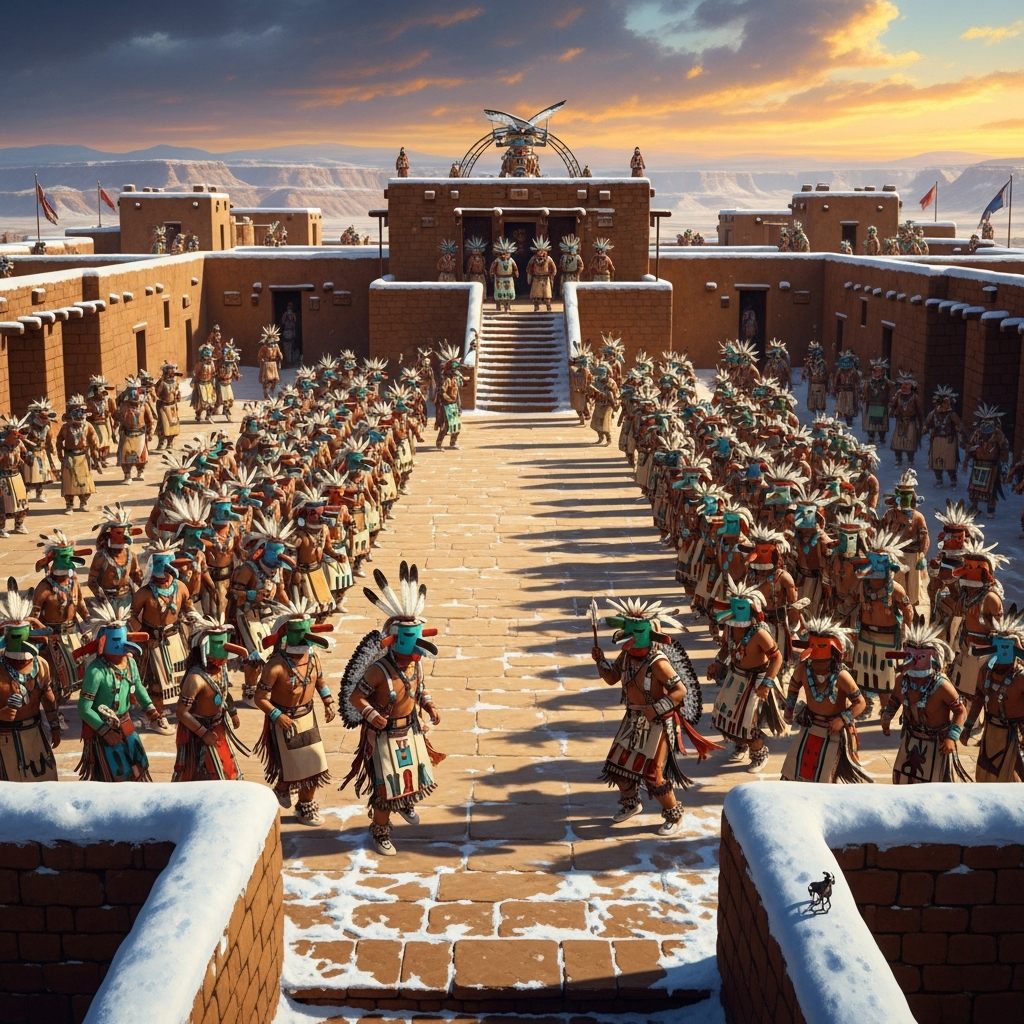
Through all of this, the kachinas dance in the plaza, their masks brilliant with paint and feathers, their bodies wrapped in ceremonial costume, their feet beating the same pattern into the same stone that their predecessors’ feet have beaten for a thousand years.
The children watch and receive.
At intervals throughout the kachina season, the dancers give children carved cottonwood figures — tihu, often called kachina dolls by people outside the tradition, though the word doll misrepresents them. The tihu is not a toy. It is a teaching object, a three-dimensional study guide, a way of learning to recognize the specific identity of each kachina — their colors, their masks, their regalia — so that when they appear in the plaza, the child can name them correctly.
A child who can name the kachinas can participate in the ceremony properly, can follow the logic of the ceremonial calendar, can understand what is being asked for and by what means. The tihu is the first stage of an education that continues through initiation into the kachina society and then, for some, through the entire life of ceremonial responsibility.
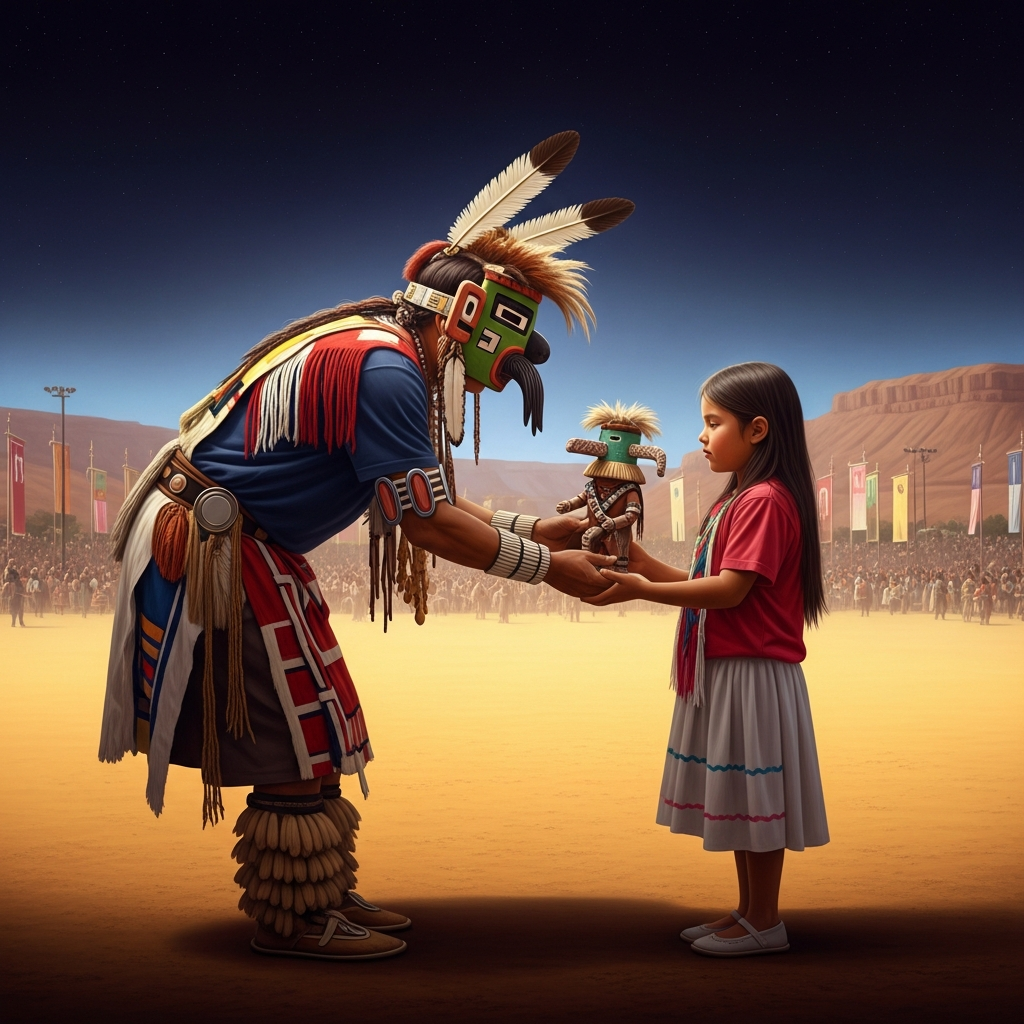
When a kachina bends to hand a tihu to a small girl in the plaza, bending from within the mask, the enormous painted face coming down to her level, she takes it with both hands. She is learning to recognize a face that will be in her life from now until she is old, that will come back every winter solstice and leave every July and come back again, the same face, new dancer, unbroken continuity.
The face is not the dancer’s face.
This is the thing to understand about the mask: it protects both directions. It protects the kachina’s identity from the ordinary world, and it protects the ordinary world from the full force of the kachina’s presence. The two are in a relationship that requires mediation. The mask is the medium.
July comes, and the corn is high, and the Niman ceremony begins.
Niman means homegoing. It is the last ceremony of the kachina season, conducted over sixteen days in the late summer heat, and it has two movements: the last dances in the plaza, with gifts for the children — tihu, bows and arrows, green corn — and then the departure.
The departure is conducted by Eototo, the chief kachina, and Aholi, his companion. They lead the kachinas out of the village in the late afternoon, moving west toward the edge of the mesa. The people watch from the rooftops and from the plaza’s edges. There is no waving, no casual farewell: the departure is a ceremony, conducted with the same precision as every ceremony that preceded it, and its precision is the point. The kachinas are being released from their obligation to the village properly, with gratitude, with the acknowledgment of everything they brought through the six months of their presence.
They walk to the mesa’s edge. They go over it.
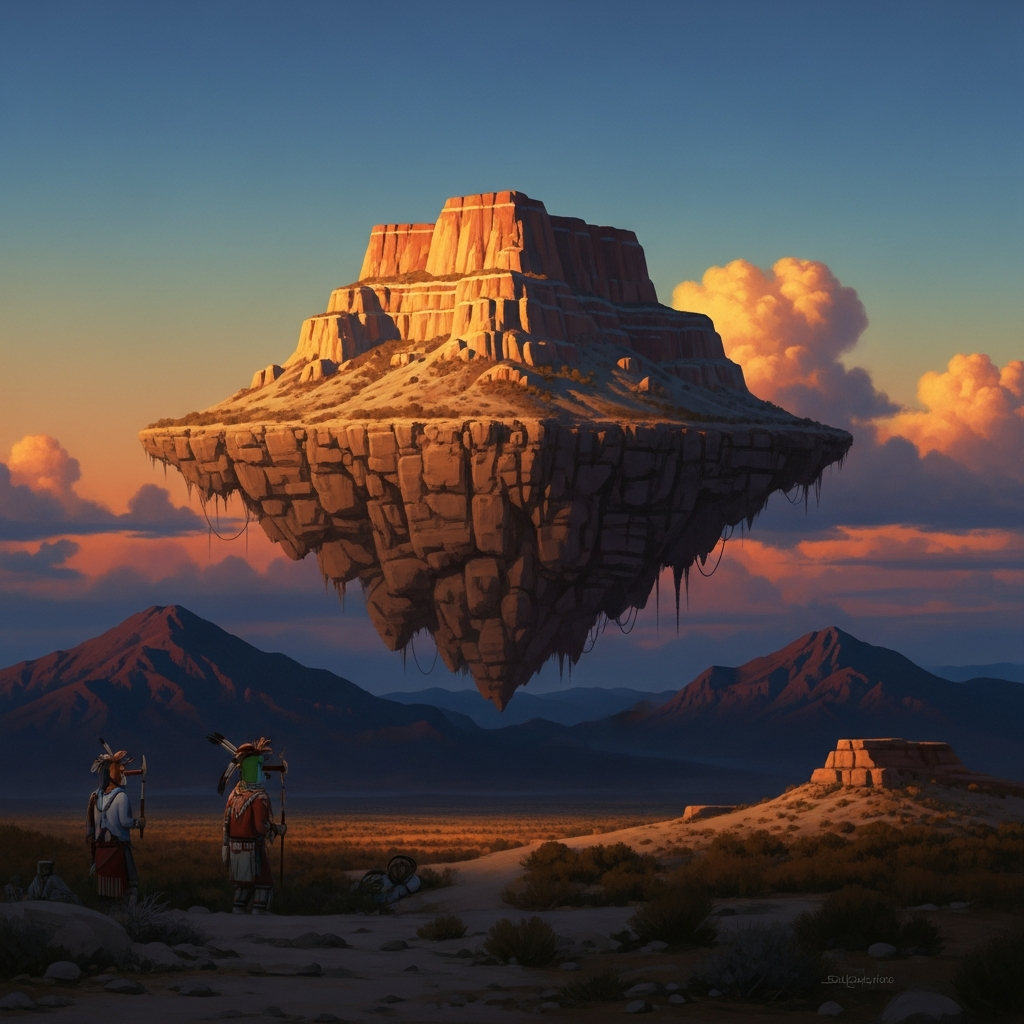
They are going home to the San Francisco Peaks, where they will be through the dry months of August and September and October and November, doing whatever it is that ancestral spirits do in their mountains when they are not in the villages. They are not gone in the sense of disappeared. They are in their mountains, which are visible from the mesas on a clear day, a blue silhouette on the western horizon.
In December, they will come back.
The San Francisco Peaks are also called Humphreys Peak and they are in the Coconino National Forest and they are managed by the U.S. Forest Service, which in 2005 approved a plan to expand the Arizona Snowbowl ski resort on their slopes, including the use of reclaimed wastewater to make artificial snow for the mountain that the Hopi, the Navajo, and eleven other tribes consider the home of the kachinas and the most sacred site in their religious geography.
The Navajo Nation and the Hopi Tribe filed suit. The case went to the Ninth Circuit Court of Appeals, which ruled against the tribes. The snow began falling in 2012.
This is the world in which the Niman ceremony happens now. The kachinas go home in July to a mountain that has reclaimed wastewater blown onto it in the winter months to extend the ski season. The Hopi maintain the ceremonies. The faces come back every December. The tihu are handed to children who are learning to recognize the faces that will be in their lives until they are old.
The continuity of the ceremony is not indifference to what has happened to the mountain. It is the answer to what has happened to the mountain.
A kachina doll in a museum vitrine is not a kachina doll anymore. It is an object that resembles a kachina doll and was a kachina doll once and is now something else — evidence, souvenir, study object, disputed property.
The tihu that still hangs on the wall in a Hopi home, given to the woman who lives there when she was six years old, is still a tihu. She can still name every kachina on it. She was in the plaza when it was handed to her by a figure with an enormous painted face who bent down to her level, and she took it with both hands, and she has known since then that the faces come back every winter.
They are on their way back now.
Scenes
The Hopi plaza on First Mesa at midwinter
 Generating art…
 A kachina dancer — masked, costumed, his identity fully subsumed into the spirit he embodies — bends to hand a small carved cottonwood figure to a Hopi girl of perhaps six
 Generating art…
 The San Francisco Peaks at dusk, seen from the Hopi mesas sixty miles east
 Generating art…
 Echoes Across Traditions
Entities
- the Kachinas
- Soyal
- Niman
- Aholi
- Eototo
Sources
- Alfonso Ortiz, *The Tewa World: Space, Time, Being, and Becoming in a Pueblo Society* (University of Chicago Press, 1969)
- Peter Nabokov and Robert Easton, *Native American Architecture* (Oxford University Press, 1989)
- Barton Wright, *Hopi Kachinas: The Complete Guide to Collecting Kachina Dolls* (Northland Press, 1977)
- Mischa Titiev, *Old Oraibi: A Study of the Hopi Indians of Third Mesa* (Peabody Museum Papers, 1944)
- Frederick J. Dockstader, *The Kachina and the White Man* (Cranbrook Institute of Science, 1954)