Spider Grandmother Sings the World
Before the beginning — the creation of the Fourth World, foundational in Hopi oral tradition · The earth's navel — below the ground of the present world; the *sipapu* emergence point in the Colorado Plateau region
Contents
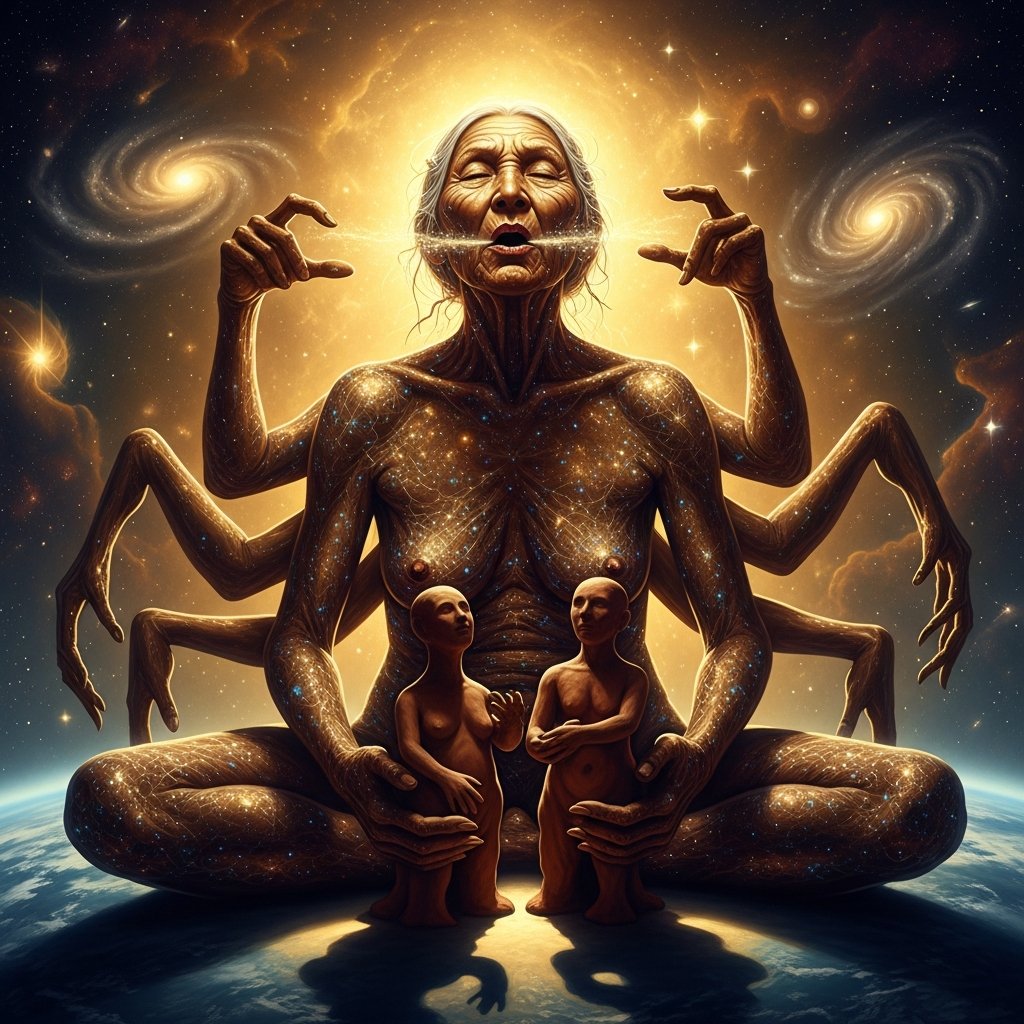
At the beginning of time, Spider Grandmother sits in the earth's navel and fashions two brother helpers from clay. She sings over them and they breathe. She creates human beings the same way — clay, song, breath — and teaches them to emerge through the *sipapu* into this Fourth World. Before she goes, she tells them: when you need me, look for me in the corner as a small spider.
- When
- Before the beginning — the creation of the Fourth World, foundational in Hopi oral tradition
- Where
- The earth's navel — below the ground of the present world; the *sipapu* emergence point in the Colorado Plateau region
In the beginning there is no above.
There is only below — the womb-dark of the First World, the Second World, the Third World, each one ending when the people made it wrong and had to go deeper until they were very deep indeed. But Kokyangwuti — Spider Grandmother — has been here since before the worlds had numbers. She sits in the navel of the earth, the place where all the worlds connect, and she is small, and she is old, and she is not sleeping.
She is thinking.
Her thinking is creative in a way that human thinking is not: when she thinks of a thing, it begins to exist. Not completely, not yet, but the outline of it appears. The thought of the two helper brothers appears, and it is enough of an appearance that her hands know what to do.
She reaches for clay.
She shapes two figures.
Not large figures — Pöqanghoya and Palöngawhoya, the twin brothers who will be her helpers and the world’s protectors, are small. She works with her fingers the way a woman works dough — pressing, smoothing, pulling the form out of the formlessness of clay. The heads, the hands, the feet. She is not hurried. She has been here long enough to understand that creation cannot be rushed. The correct form takes the time it takes.
When the figures are finished she holds them in her cupped hands and looks at them.
They are clay. They are exactly right. They are not alive.
She lowers her face over them.
She sings.
The song she sings is not a song about them — it is the song that is them, the specific vibration that matches the specific being she has made. Every living thing has a song that is its true name and its essential nature, and Spider Grandmother knows every song because she was present when everything decided what it was. She sings the brothers and the sound goes through the clay the way warmth goes through stone: slowly, completely, from the outside in.
The elder brother’s chest moves.
The younger brother opens his eyes.
They sit up in her cupped hands and look at her, and she looks back at them, and the first thing they see in existence is the old woman’s face — creased and small and entirely attentive — and that is why, the Hopi say, every being born into the world opens its eyes seeking a face that is already looking back.
“I am your grandmother,” she tells them. “You will help me with what comes next.”
What comes next is the First People.
She gathers clay from the four directions. The clay from the east she works in her right hand, and the clay from the west in her left, and she sings over them as she shapes them — the round heads, the ten fingers, the feet that will learn to walk on corn pollen paths. She makes women and men. She makes the four colors that the Hopi know the peoples of the earth to be: yellow, white, red, black. Each color is a direction, a season, a gift.
She breathes over each one.
They do not move yet.
She wraps them in her white-cotton cloak and sings more — longer, lower, the song going down into the clay through the weave of the fabric — and when she lifts the cloak away the figures are breathing on their own, looking at their own hands, turning their hands over and back with the specific astonishment of a being discovering it has a body.
“You are alive,” she tells them. “This is the gift. It comes with responsibilities.”
She teaches them everything before she sends them up.
She teaches them the names of the stars and the movements of the sun, which will tell them when to plant and when to harvest. She teaches them the kachina ceremonies — the sacred dances that keep the world in balance, that ask the ancestor spirits and the cloud beings and the rain people to remember the humans who live on the dry plateau and need water. She teaches them how to grind the corn and weave the cotton and make the sacred pahos, the prayer sticks, that carry intentions upward.
She teaches them the most important thing: that they live in relationship with everything. With the corn, which is a relative. With the rain, which is a gift that must be received with gratitude. With the dead, who are not gone but transformed into clouds that return as rain. With the kachinas, who are not gods but ancestors and spirit helpers who live in the San Francisco Peaks and come down into the plazas when they are called.
And she teaches them the sipapu — the small hole in the floor of every kiva, the ritual lodge, that marks the point of emergence. Not the actual sipapu, which is a sacred spring somewhere in the Grand Canyon’s depths, but a reminder: this is where you came from. The earth is your mother. You emerged from inside her. You do not own this world; you were invited into it.
“Go up now,” she tells them. “The Fourth World is ready. It is difficult — cold and dry and full of testing. But it is the world you were made for.”
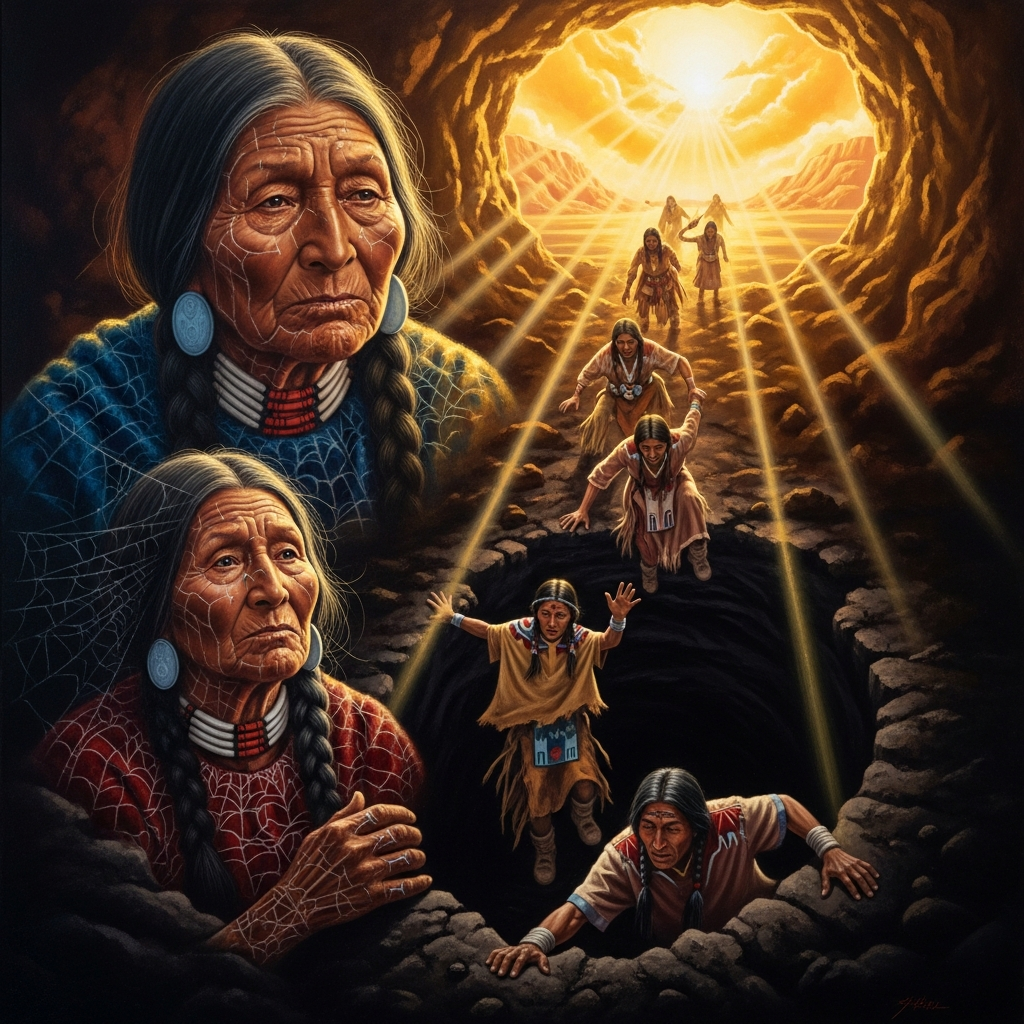
The people climb.
Up through the sipapu, up through the reed that reaches from the underworld to the surface, climbing hand over hand in darkness that grows lighter the higher they go. The light at the top is so violent after the womb-world that the first ones to emerge weep. They stand on the rim of the emergence place — the Colorado Plateau, the high dry country of the four sacred mountains — and the light is blinding and the wind is cold and the corn does not yet exist in this world and they are afraid.
Spider Grandmother comes up last.
She stands among them, small and old and entirely calm, and she looks at the world they have emerged into and she nods slightly as if it is exactly what she expected.
“This is it,” she says. “This is the Fourth World. You will not always understand why it is the way it is. But I will be here. When you need me, look for me.”
They look around them. Where is she?
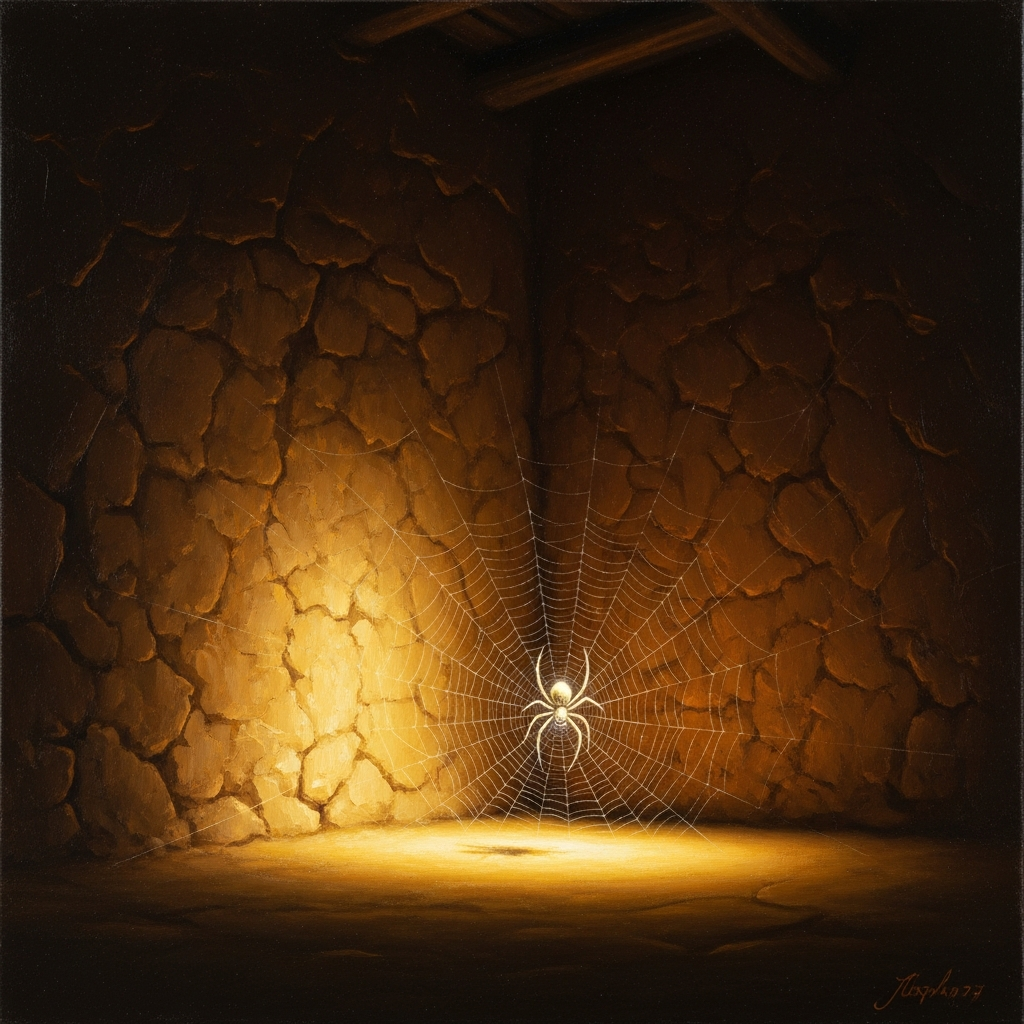
“In the corner of the room,” she says. “Look in the corner of the room. A small spider. That is me. I will always be there.”
Every Hopi house has corners. Every kiva has corners. In those corners, occasionally, there is a small spider in a small web.
The Hopi do not kill the spider in the corner. The spider in the corner is the grandmother. She was there before the house was built and she will be there after it falls. She holds the thread that connects this world to the world below and the world above. When you are sick and alone and do not know what to do, look in the corner.
She is looking back.
Scenes
Spider Grandmother sits in the earth's navel at the start of time
Generating art… The First People climb up through the *sipapu*, the emergence hole, from the underworld into the dazzling light of the Fourth World
 Generating art…
 In the corner of a Hopi room, barely visible, a small spider sits in her web
 Generating art…
 Echoes Across Traditions
Entities
- Kokyangwuti (Spider Grandmother)
- Pöqanghoya (elder brother helper)
- Palöngawhoya (younger brother helper)
- Tawa (Sun Spirit)
- the First People
Sources
- Frank Waters, *Book of the Hopi* (1963; transcribed from Hopi elders)
- Harold Courlander, *The Fourth World of the Hopis* (1971)
- Ekkehart Malotki and Michael Lomatuway'ma, *Hopi Coyote Tales* and *Earth Fire: A Hopi Legend* (1987)
- Peter Nabokov, *Where the Lightning Strikes: The Lives of American Indian Sacred Places* (2006)
- Alfonso Ortiz, ed., *Handbook of North American Indians, Vol. 9: Southwest* (1979)