Ñamandú Speaks the World Into Being
Before time — primordial Guaraní cosmogony · Ayvu Rapyta recorded by Leon Cadogan, 1959 · The Guaraní homeland — Paraguay, southern Brazil, northeastern Argentina
Contents
Before there is anything to stand on, before there is darkness or light or the concept of before, Ñamandú the First Father opens from within himself and creates the world in a specific order: language first, then the earth, then the other gods, then humanity. The Guaraní call this the ayvu rapyta — the foundation of human speech — and they still perform it in religious ceremony. The world was not made. It was spoken.
- When
- Before time — primordial Guaraní cosmogony · Ayvu Rapyta recorded by Leon Cadogan, 1959
- Where
- The Guaraní homeland — Paraguay, southern Brazil, northeastern Argentina
There is nothing to stand on.
This is the most important thing to understand about the beginning of the Guaraní world: it does not begin in chaos, it does not begin in water, it does not begin in a void that is simply the absence of something. It begins in a condition the Mbyá-Guaraní language has a word for and most languages do not — the state before the concept of absence, before there is anything to be absent from. Leon Cadogan, the ethnographer who spent thirty years living with the Mbyá-Guaraní of Paraguay and who was finally trusted with the ayvu rapyta in the 1950s, described it as a conceptual challenge that defied both Spanish and academic Portuguese: there was not even the framework for there to be nothing.
Into this condition — or, more precisely, as this condition, because he is not in it but is it — Ñamandú opens.
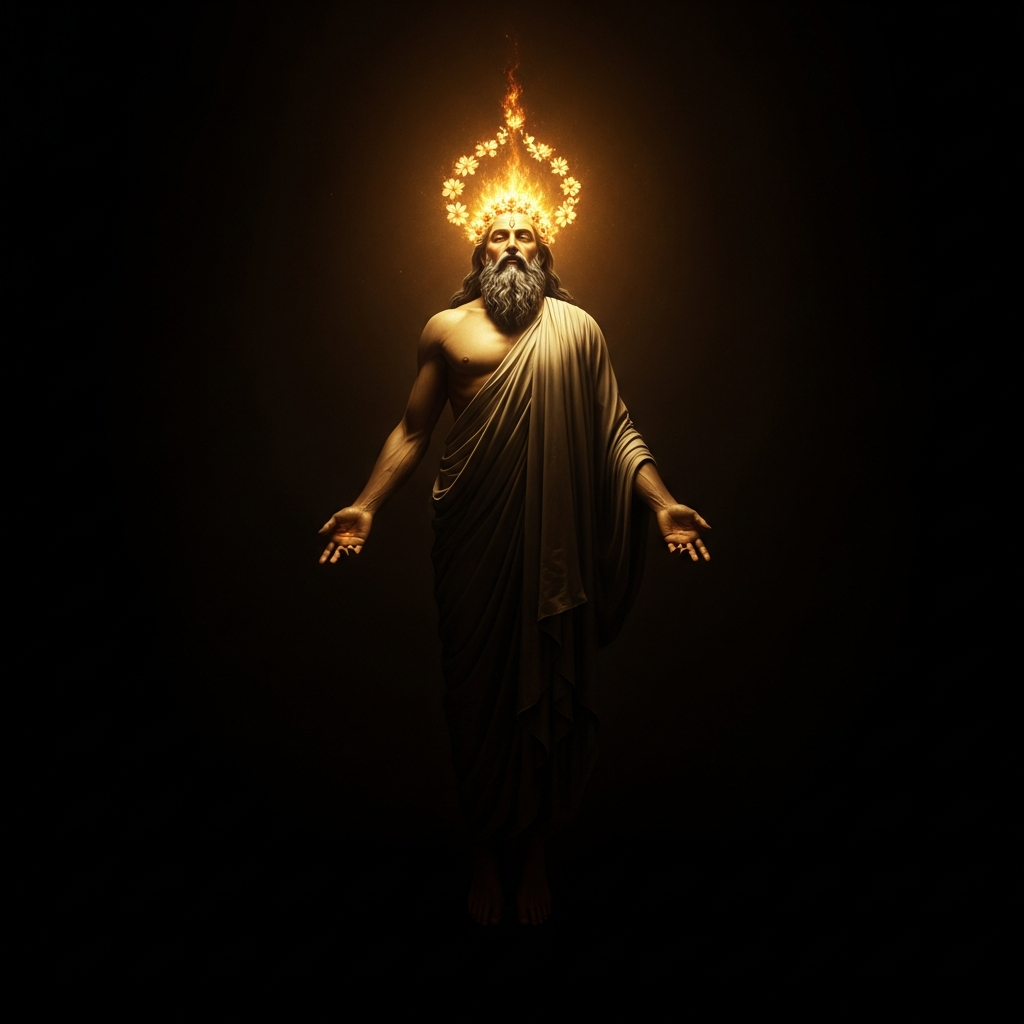
Ñamandú Ru Ete — the True First Father, the father who is first not in the sense of temporal sequence but in the sense of originary substance, the one from whom all fathering proceeds. He does not arrive from elsewhere. He does not wake from sleep. He unfolds from within, the way a seed unfolds, except there is no soil for the seed, no warmth, no moisture — the unfolding is its own condition for unfolding.
And the first thing he creates is light.
Not from fire. Not from the sun, which does not exist yet. The light comes from the divine flowers blooming from the crown of his head — mba’e kua’a, the first flowering, a light that is a form of knowledge emanating from within his own being. He illuminates himself with himself. The first light in the Guaraní universe is the light of self-recognition, the moment in which the creator becomes aware of his own existence.
He creates language before he creates the earth.
This is the radical move in the Guaraní cosmogony, the thing that distinguishes it from almost every other creation account in human religious history. In Genesis, the earth exists first (formless and void) and God speaks into it. In the Enuma Elish, the primordial waters exist before the gods. In the Vedic tradition, the primal ocean precedes the creator. Almost universally, there is some substrate into which the creative act is made.
In the ayvu rapyta, there is no substrate. There is only the creator and his speech, and the speech creates the substrate.
Ayvu — this word is the theological center of the entire tradition, and Cadogan spent years trying to understand it well enough to translate it and concluded that it cannot be translated exactly. It means word. It means soul. It means the divine essence that is common to language and to life, the recognition that the thing which makes a person alive and the thing which makes speech meaningful are the same thing. The ayvu is the word-soul, the soul that is constituted by language, the language that is the form of the soul.
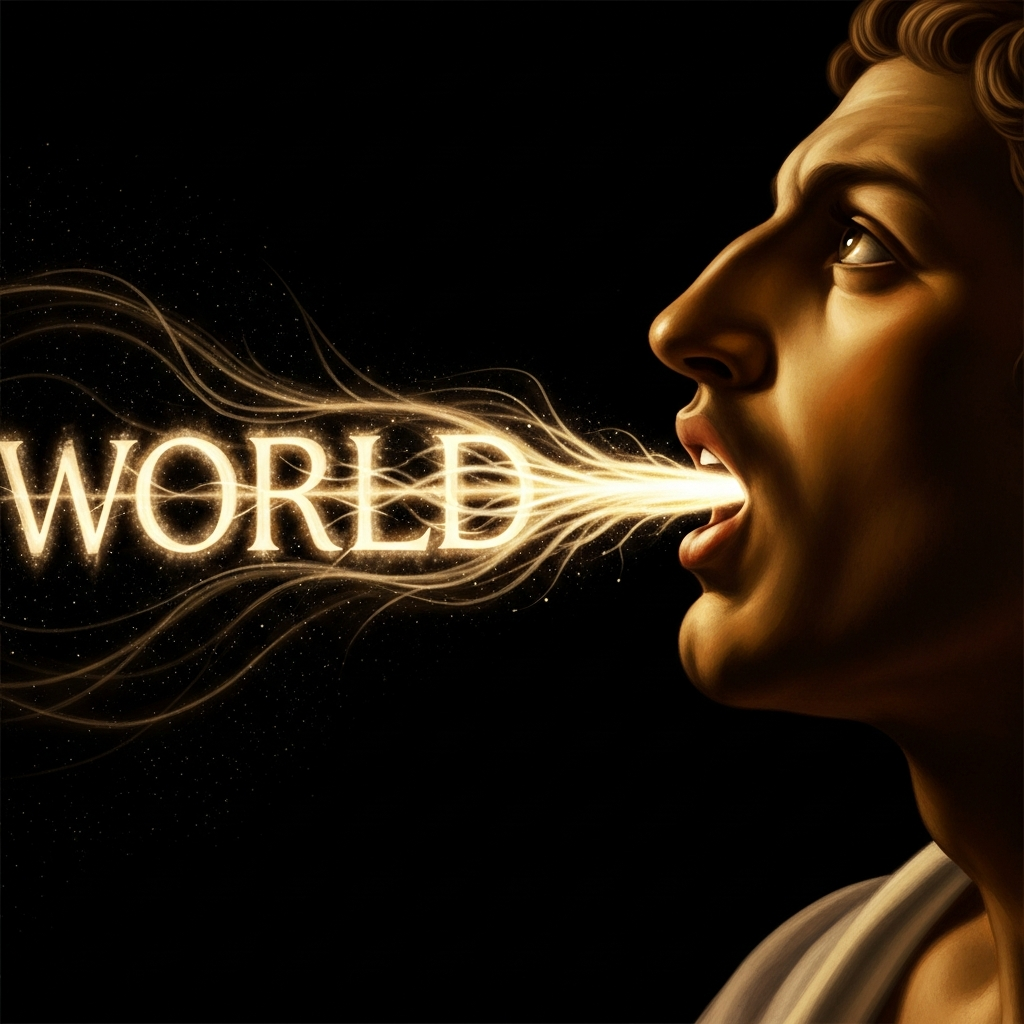
Ñamandú creates ayvu from his own heart before the earth exists. He takes the divine knowledge that flowers from his head and fashions it into speech, and the speech is the first thing in the world. Not the first audible thing — there are no ears yet to hear it. The first thing, period. The substance of which all subsequent things will be made.
Then, from the speech, he unfolds the earth.
This sequence is not accidental. The Mbyá-Guaraní theological tradition holds that language is not a human invention layered onto a preexisting world but the condition of possibility for the world to be experienced at all. Without the word-soul, there is no world to know — not because the physical reality is absent but because physical reality without the capacity to name and understand it is not yet a world in any meaningful sense. Ñamandú creates the capacity to know before he creates the thing to be known.
He creates the other gods from loneliness.
Or, more precisely, from the recognition that creative work is inherently collaborative — that to make a world you need more than one perspective on it. The ayvu rapyta describes Ñamandú’s creation of his divine companions with the same intimate quality that characterizes the whole text: he calls them into being from himself, the way an elder calls students, the way a singer calls a song.
Karai Ru Ete — the True Father of Sacred Flame — created to be the god of fire, of purification, of the sacred energy that burns away what is not essential. Tupã Ru Ete — the True Father of Divine Sound — created for the rain and thunder, the voice of the sky in storm, the water that feeds the earth. Jakaira Ru Ete — the True Father of Mist — created for the gentleness between things, the vapor at dawn that softens the boundary between earth and sky, the in-between quality that makes transitions possible.
These three are not subordinate to Ñamandú in the way that minor gods are subordinate in hierarchical pantheons. They are his extensions, his specificities. He is the whole of which they are the parts. Cadogan’s text records their creation with a quality of mutual delight — the creator recognizing in each created divinity a capacity he had not known he contained until it emerged.
Between the four of them, the world is now managed: origin and word, fire and purification, water and sky-voice, mist and transition. The complete cosmological palette.
Then they create the first human souls.
The human soul is a fragment of divine speech.
This is the ayvu teaching in its most specific application, and it is the doctrine that the Guaraní shamans who perform the ayvu rapyta ceremonies are most careful to transmit correctly: each human being is constituted by a fragment of Ñamandú’s original creative speech, sent from above as the person is born. The soul is not created at birth — it is sent. It pre-exists the body. It comes from the divine speech-world and enters the infant, and this entry is what makes the infant a person rather than a body.
The shaman’s role — the karaí, the person of the sacred word — is to be attentive to the soul’s origin and to maintain its connection to the divine speech from which it came. This is why Guaraní religious ceremony is so comprehensively organized around language: the chants, the purahéi (sacred songs), the prayers that the karaí sings in a ceremonial register distinct from everyday speech. Every ceremony is a re-performance of the original creative act, a renewal of the connection between the human word-soul and the divine word-source.
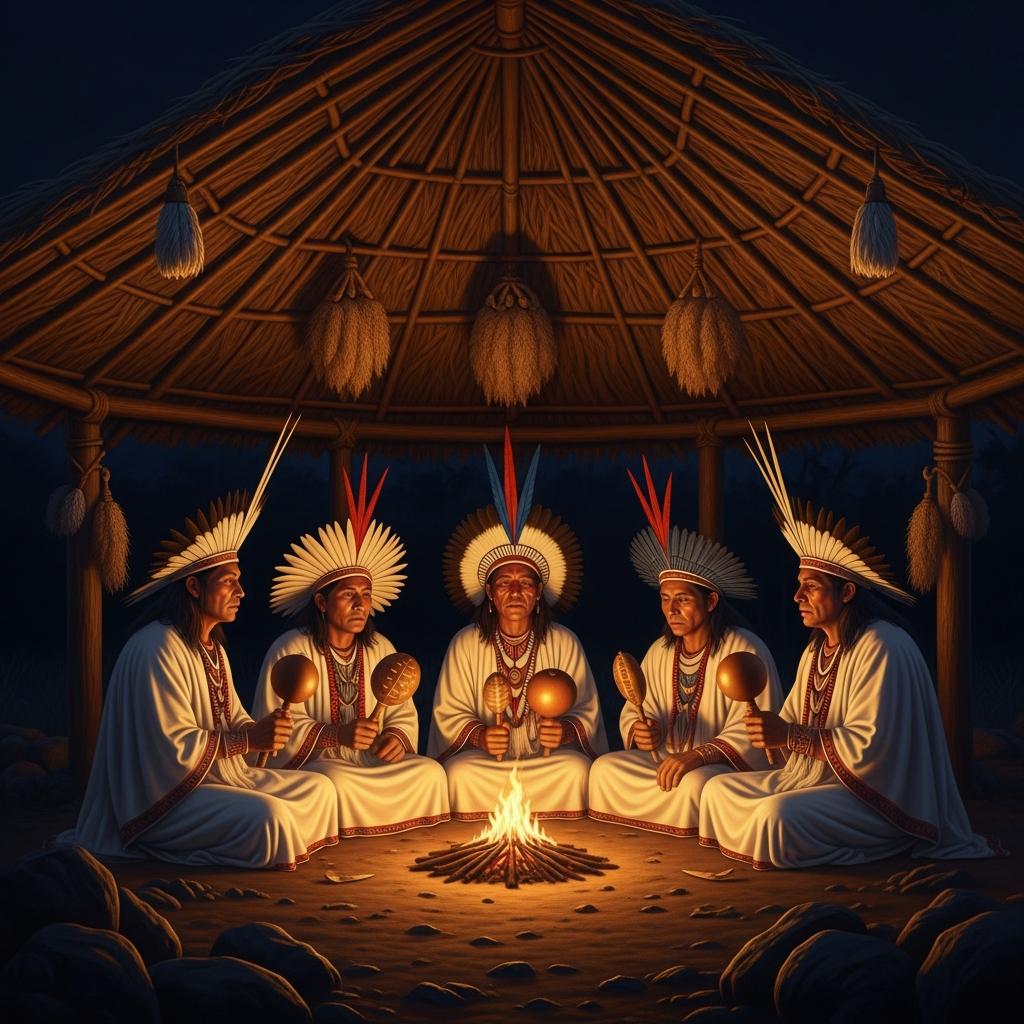
The opy — the prayer house — is built with its entrance facing east, toward the rising sun, toward the direction from which the souls descend. When the community gathers in the opy for ceremony, when the karaí begins to chant in the pre-dawn darkness, the movement is directional: back toward the east, back toward the source, back toward the moment of creation that is always present because it was language and language cannot be exhausted.
The great religious movement of the Guaraní is the yvy marãe’y — the land without evil.
For centuries, perhaps millennia, Guaraní communities have moved east in response to prophetic instruction, seeking the land without evil that exists at the edge of the world, the paradise where the word-soul can live without the corruption that physical existence brings to it. The maino’i — the sacred way of moving, the pilgrimage — is not escape. It is return: the community trying to find its way back to the condition that existed before the physical world was laid over the divine speech.
The Spanish missionaries and the colonial administrators found the maino’i movements baffling and threatening. Communities would suddenly abandon their villages and move, sometimes thousands of kilometers, following a karaí whose visions had shown the direction of the land without evil. Some groups walked to the Atlantic coast and then kept walking into the ocean, expecting the water to part, expecting the land without evil to be just beyond the horizon of the visible world.
They did not find it. Or, more precisely, they found it in the walking itself: in the ceremony, the chant, the maintenance of the sacred speech that Ñamandú spoke before the earth existed and that the karaí speaks now in the opy while the fire burns and the gourd rattles sound and the community’s word-souls listen for the origin.
The Mbyá-Guaraní communities of today — in the forests of Paraguay, in the Atlantic Forest remnants of southern Brazil, in the Misiones province of Argentina — are among the most pressured indigenous communities in the western hemisphere. Deforestation, land theft, poverty, and the constant encroachment of agricultural expansion have reduced the forest they have lived in for millennia to isolated patches. Their population is small. Their material circumstances are desperate.
They still perform the ayvu rapyta.
The ceremony happens in the opy before dawn, because dawn is the direction of the souls’ origin and the earliest light is the closest thing in the visible world to the light that flowers from Ñamandú’s crown. The karaí chants in the sacred register that is distinct from any other speech — slower, more deliberate, carrying the weight of the original creative act. The gourd rattle sounds. The community listens.
What they are doing is what Ñamandú did before there was anything to stand on: they are speaking the world into being. Not the physical world — they cannot speak forests into existence to replace the ones being cleared — but the world in the sense that matters to the ayvu teaching: the world that is a relationship between the word-soul and the divine source, the world that exists as long as the sacred speech is maintained, the world that was created before the earth and will outlast the earth.
The Guaraní understood something about the nature of creation that most theological traditions have to work hard to articulate: that the world is not a thing but a process, not a noun but a verb. Ñamandú did not make a world and leave it. He began a speech and the world is the consequence. As long as the speech continues — as long as the karaí chants in the opy before dawn and the community’s word-souls attend — the creative act is ongoing. The world is not finished. It is always in the process of being spoken. And this means that the ceremony is not remembering the past. It is participating in the present moment of creation, the moment that has been continuous since before the earth existed and will be continuous until the speaking stops.
Scenes
Ñamandú the First Father alone in absolute void — no earth, no sky, no light except what emanates from him, a figure of immense luminous presence floating in total darkness, flowers of divine fire blooming from the crown of his head, creating the first light from his own being before anything else exists
 Generating art…
 Ñamandú in the moment of creating divine speech — his mouth open, the first word visible as luminous substance flowing outward into the dark void, the word taking shape as both sound and light, the beginning of the world as a spoken act of the sacred heart
 Generating art…
 A Guarani religious ceremony in the deep Atlantic forest of Paraguay — shamans in the opy prayer house chanting the ayvu rapyta, wearing white garments and feathered headdresses, gourd rattles in hand, the interior lit by a single fire, the words of Ñamandú being spoken into the living world
 Generating art…
 Echoes Across Traditions
Entities
- Ñamandú
- Karai Ru Ete
- Tupã Ru Ete
- Jakaira Ru Ete
Sources
- Leon Cadogan, *Ayvu Rapyta: Textos Miticos de los Mbyá-Guaraní del Guairá* (Universidade de São Paulo, 1959)
- Bartomeu Melià, *El Guarani: Experiencia Religiosa* (Centro de Estudios Paraguayos Antonio Guasch, 1991)
- Pierre Clastres, *The Guaraní Quest for the Land Without Evil* (originally in *La Société contre l'État*, 1974)
- Egon Schaden, *Aspectos Fundamentais da Cultura Guarani* (Universidade de São Paulo, 1954)
- Hélène Clastres, *The Land Without Evil: Tupi-Guarani Prophetism* (University of Illinois Press, 1995)