Coyote Creates Death
The time of creation — before human beings reached their present form, in the mythic period when animals were also people · The Pacific Northwest and Great Basin — the Columbia Plateau, the Great Basin desert, the lands of the Wishram, Nez Perce, Okanagan, Shoshone, and Ute peoples
Contents
The people are multiplying and there is not enough food. Coyote argues that death must enter the world. The other creators want everyone to return after dying. They agree to a contest — the first to knock a bundle off a distant post wins the argument. Coyote cheats. Death enters the world. Coyote's own son is the first to die. He howls to undo it. He cannot.
- When
- The time of creation — before human beings reached their present form, in the mythic period when animals were also people
- Where
- The Pacific Northwest and Great Basin — the Columbia Plateau, the Great Basin desert, the lands of the Wishram, Nez Perce, Okanagan, Shoshone, and Ute peoples
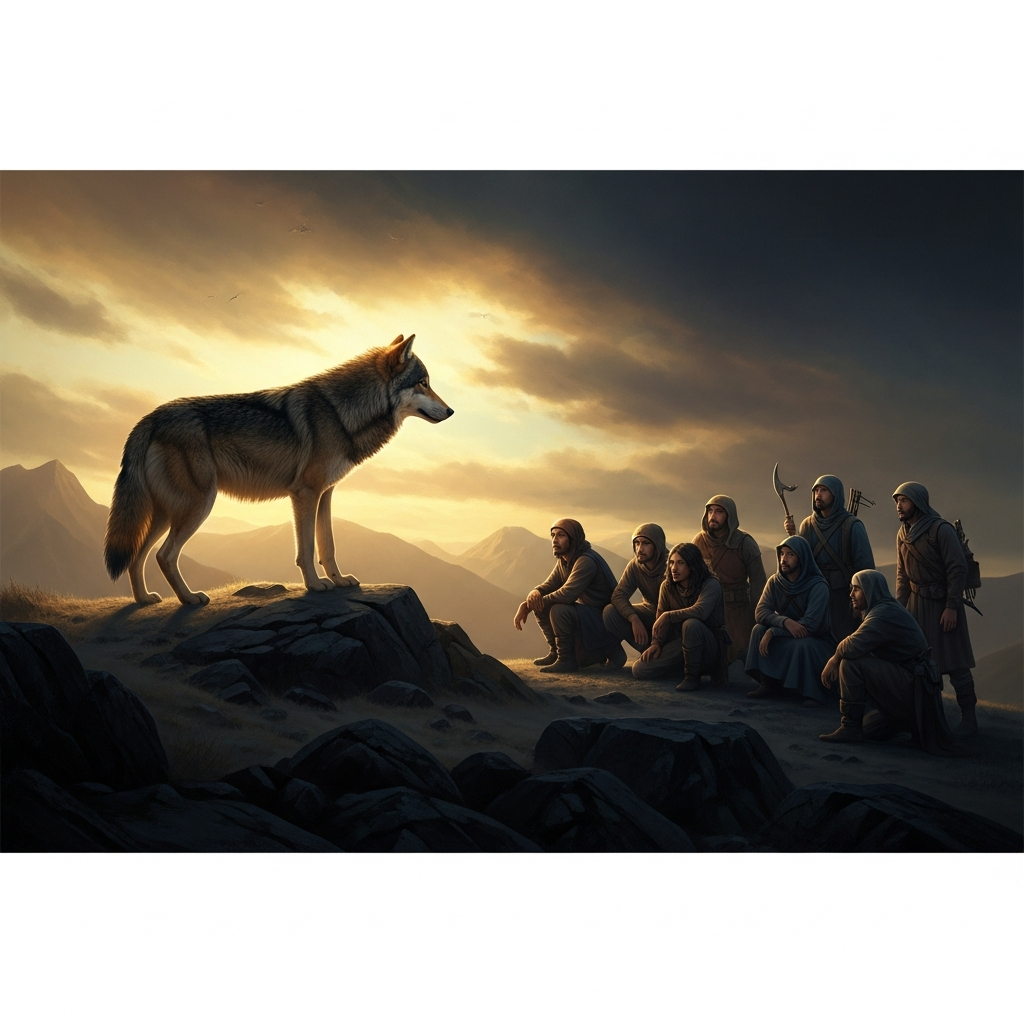
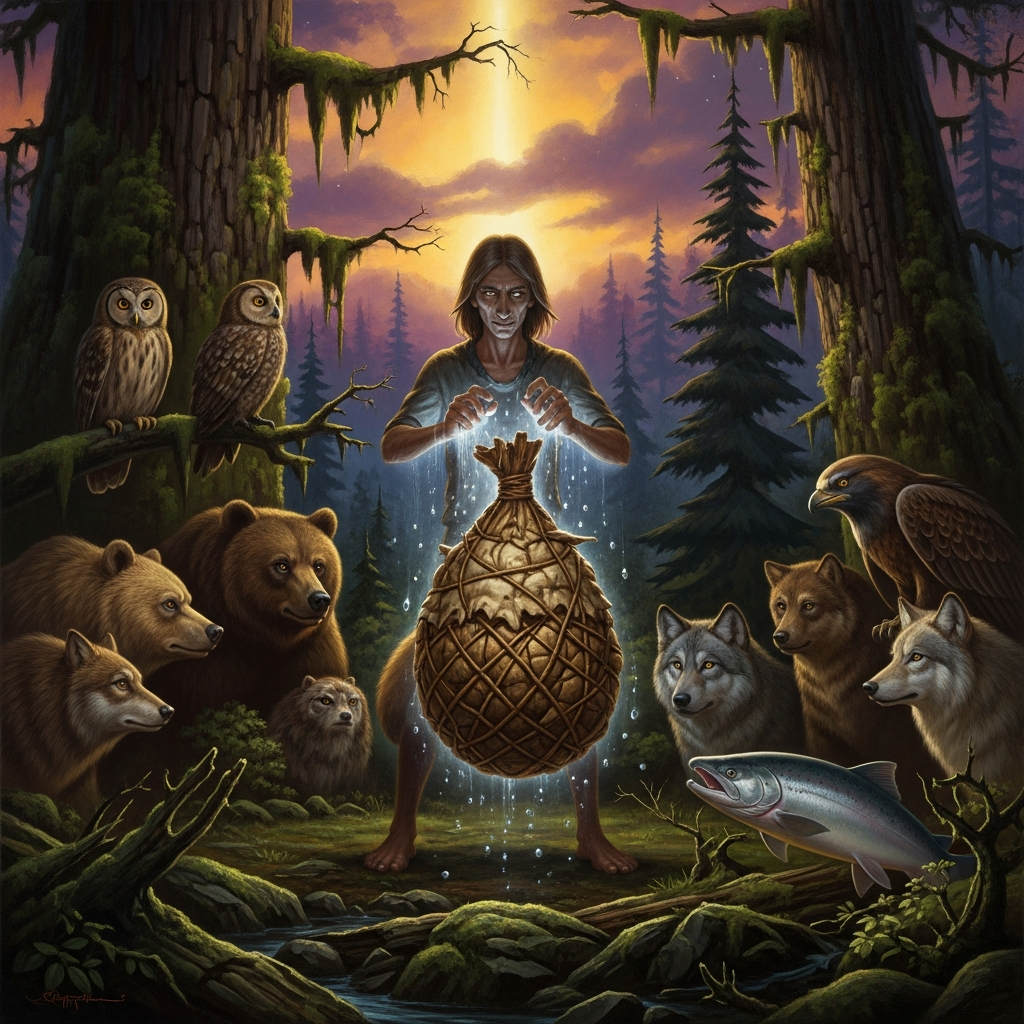
In the time when the world is still being decided, the animals gather in council.
They are not entirely animals yet and not entirely people — they are the First Ones, the ones who hold the powers that will later be distributed among all living things. Eagle is here, and Bear, and Salmon, and Frog, and the others, and Coyote is here, too, sitting at the edge of the circle with his tail wrapped around his feet and his eyes moving in the way Coyote’s eyes always move, which is to say in every direction at once.
The problem is this: the people are multiplying. There are more people every year, more babies, more mouths. The world is not getting bigger. The elk and the camas root and the salmon are exactly as plentiful as they have always been, but the people eating them grow more numerous by the season, and a calculation is becoming visible that no one wants to perform.
Eagle speaks first. “When people die, they should come back. After four days, they should return. This is the right way.”
There is nodding around the circle. This seems right. This seems merciful.
Coyote speaks.
“No,” he says. “If people die and come back, the world will fill up. There will be no room. No food. Everyone will starve. Death must be real. It must be permanent. When people die, they must stay dead.”
The council looks at him.
“Someone has to say it,” Coyote says. “You are all thinking it. You are all just too afraid to say it.”
Eagle shakes his great head. “It is too hard. Death without return is too much to ask of the people. Grief will break them.”
“Grief will make them,” Coyote says. “They will love each other better, knowing the time is short. They will live more carefully. They will not waste a day.”
This argument goes back and forth until the council decides: a contest. They will set a bundle on a pole at the far end of the plain. The first one to knock the bundle off its pole — the first voice whose wish reaches it — wins. Eagle’s wish, if it reaches first, and people will die and return. Coyote’s wish, if it reaches first, and death will be permanent.
They line up at the near end of the plain. They fix their eyes on the bundle.
Coyote does not wait for the signal.
He begins to send his wish the moment he understands the terms of the contest. Before anyone says go, before the signal comes, Coyote’s wish is already running across the plain like water running downhill, taking the path that Coyote always takes, which is the path that gets there fastest by going sideways through every rule. His wish is not precisely a cheat. It is Coyote’s interpretation of fairness, which is to say: fairness is a concept Coyote understands perfectly and ignores completely when the outcome matters.
Eagle’s wish goes out at the signal, large and clean and fast. It crosses the plain like a hawk stooping — straight, powerful, honest.
It is not fast enough.
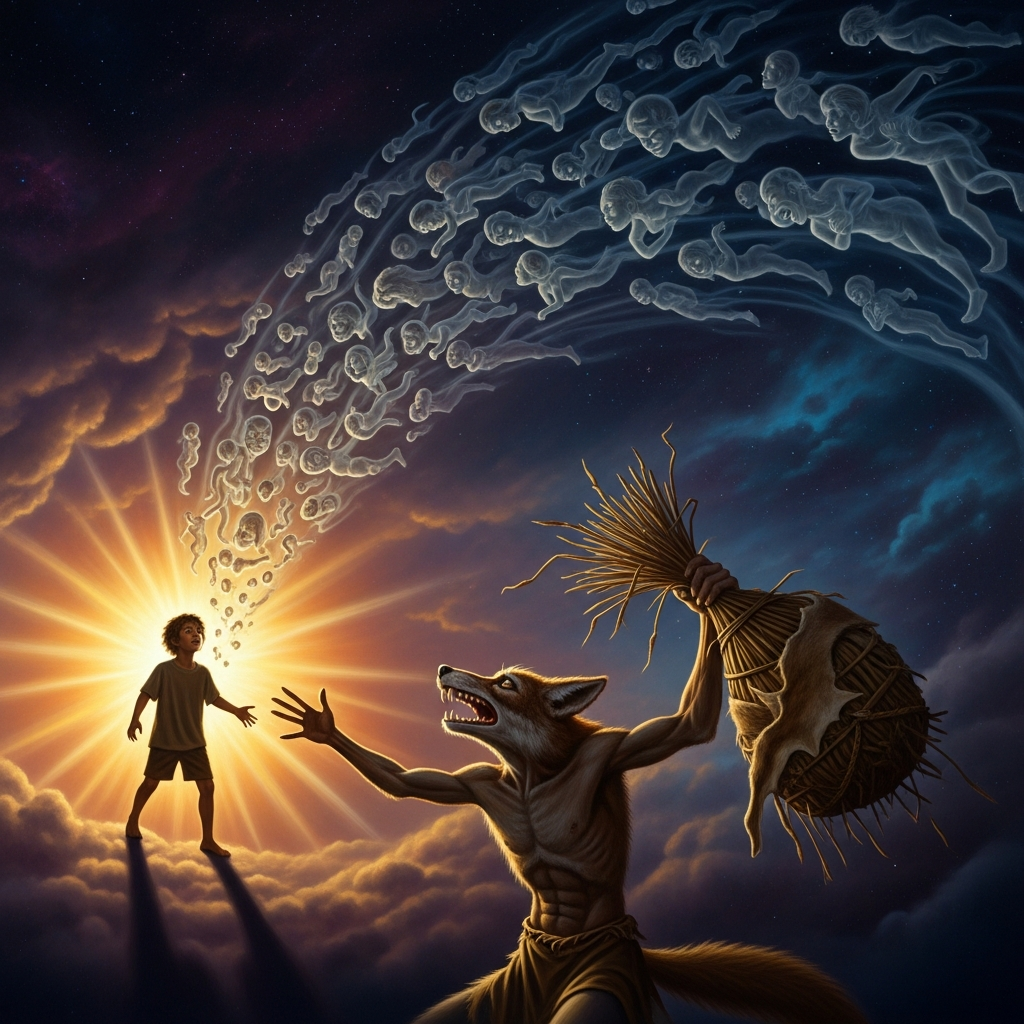
The bundle tips from the pole. It falls to Coyote’s side. It hits the ground.
The air changes. Something releases. Something that was theoretical becomes actual. The world shifts in the direction of all things ending, and it cannot shift back.
“It is decided,” Coyote says.
He goes home satisfied.
He is correct, after all. He won the argument fairly — or fairly enough; the details of how, exactly, his wish arrived first are something he does not examine closely. He is right about the math. He is right about the world filling up. He is right that grief will teach the people things that the expectation of return would not. He has done the world a service. He walks home through the afternoon light with his tail held at the angle that means a job concluded.
His son is sitting by the fire when he arrives. Young Coyote, his son — a good young man, keen-eyed, already showing the quicksilver intelligence of the father.
His son falls over.
He does not stand back up.
Coyote sits next to his son and waits.
He waits because there must be some mechanism. Some return route. Even he, who argued for permanent death, assumed that there would be some category of exception — not for everyone, but surely for this, surely for his own child, surely for this specific case which is different from the abstract principle he was arguing about.
There is no mechanism.
His son is gone. Not sleeping, not unconscious, not temporarily absent — gone. The body is there but the person is not, and no amount of waiting changes this, and Coyote knows this because he understands, now, from the inside, what he argued the world needed.
He was right. He cannot undo it.
He runs to the council.
“I have changed my mind,” he says. “We should do it the way Eagle said. People should come back after four days. I made a mistake. I want to undo it.”
Eagle looks at him for a long time.
“You won,” Eagle says. “The bundle fell. The world is decided.”
“I was wrong.”
“You were not wrong about the math.”
“I was wrong about what it meant to be right.”
Eagle looks at him again, and in Eagle’s eyes there is something that is not cruelty and not satisfaction but the specific sorrow of the one who told you it was too hard and was not listened to.
“It cannot be undone,” Eagle says. “This is what death means. You argued for it well. Now you know it.”
Coyote goes back to the body of his son.
He picks up his head and throws it back and out of him comes a sound that has never existed in the world before — a sound that is grief and rage and the specific anguish of being right in principle and wrong in fact, of having won a contest and lost everything that mattered. The sound goes up into the night sky and the night sky does not answer.
He does it again.
He does it all night.
When morning comes he is still there, still throwing his head back, still making the sound. The other animals hear it across the valley and some of them come to see what it is, and when they see it they stay, not because they can help but because this is what you do when a person makes that sound — you come and you stay.
No one speaks.
The sun comes up. Coyote’s son does not return.
This is why Coyotes cry at night. Every coyote, everywhere, carries the memory of that first howl — the one that proved the argument true and found it insufficient. The sound is not simply sadness. It is the sound of a mind that knew the right answer and did not know the cost of being right.
The story does not condemn Coyote. Death is, in fact, necessary. The world did fill up. The people did love each other better, knowing time is short. The argument was sound.
But there is a difference between knowing something is necessary and living inside its necessity. Coyote learned the difference the hard way — the only way, perhaps, that anyone learns it — by winning the argument and going home to find the argument already fulfilled.
He howls because he cannot undo it. He howls because he was right. He howls because being right was not enough.
Scenes
Coyote stands before the animal council at the edge of the world and makes his argument
Generating art… The bundle tips from the distant post and falls to Coyote's side
 Generating art…
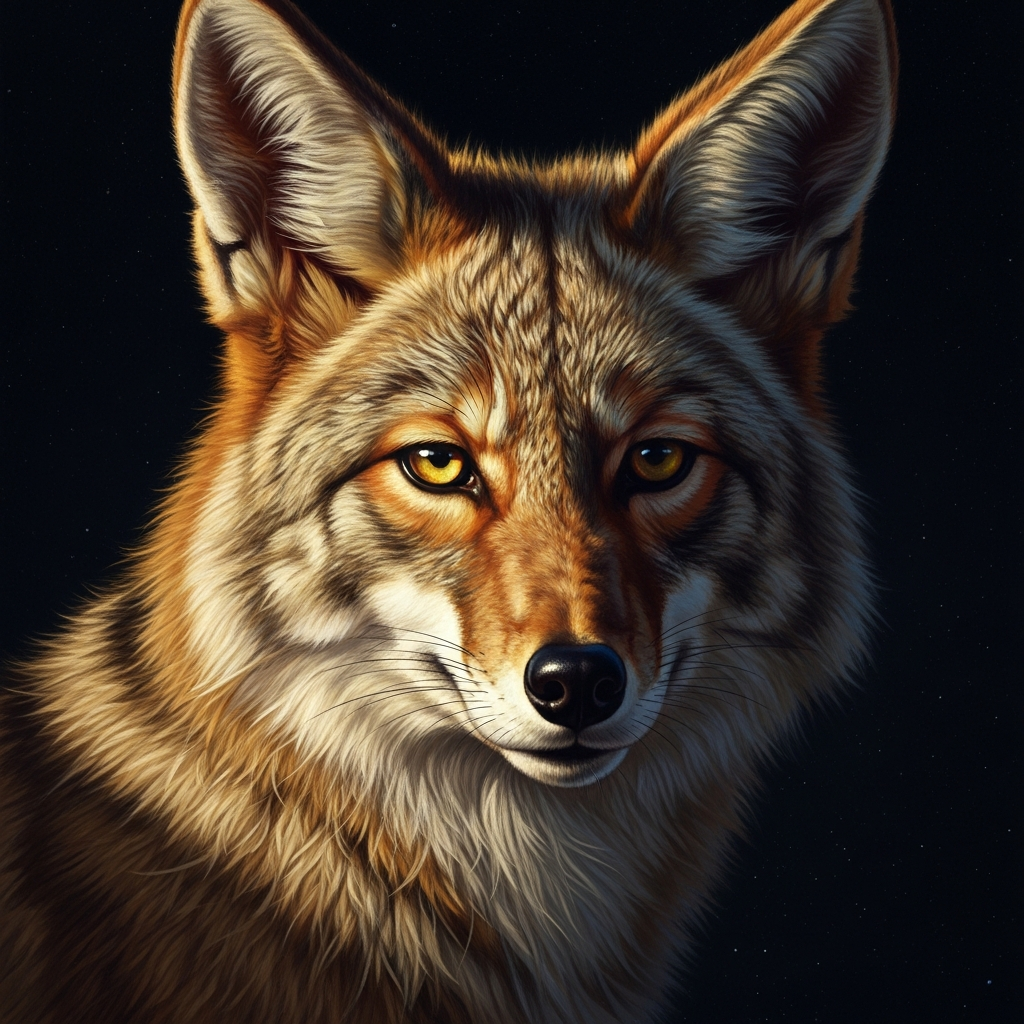
 Coyote's son lies still on the ground
 Generating art…
 Echoes Across Traditions
Entities
- Coyote
- the Animal Council
- Eagle
- Coyote's Son
- the Messenger Spirit

Sources
- Ella E. Clark, *Indian Legends of the Pacific Northwest* (1953)
- Mourning Dove (Humishuma), *Coyote Stories* (1933)
- Jarold Ramsey, *Coyote Was Going There: Indian Literature of the Oregon Country* (1977)
- Barry Lopez, *Giving Birth to Thunder, Sleeping with His Daughter: Coyote Builds North America* (1977)
- Karl Kroeber, ed., *American Indian Persistence and Resurgence* (1994)