The Wolf Teaches Humans to Hunt
In the time before humans knew how to survive · pan-Subarctic and First Nations oral tradition · The boreal forest and the open tundra — the world when wolves and humans were new to each other
Contents
Before humans knew how to hunt, the Wolf taught them. The Wolf showed them the art of the pack — how to read the terrain, how to run together, how to bring down what one alone cannot take.
- When
- In the time before humans knew how to survive · pan-Subarctic and First Nations oral tradition
- Where
- The boreal forest and the open tundra — the world when wolves and humans were new to each other
Before the humans know how to hunt, they are hungry.
They can fish in the shallows and gather what the forest gives up willingly — roots, berries, the small things that do not run. But the large animals move away from them. The elk changes direction a quarter mile before the first human comes in sight. The caribou travels overnight and is gone from the valley by morning. The humans walk through the same landscape as the herds and cannot touch them. They are always one step behind the knowledge they need, and the gap between what they can take and what they need to survive grows wider as the winters get colder.
The Wolf watches this.
The Wolf is not watching out of pity — the Wolf is not a sentimental creature. The Wolf watches because it is watching everything, always, reading the landscape with the particular quality of attention that evolution built into the species over millions of years of needing to be right about what moves in the brush. The humans interest the Wolf the way a strange scent interests it: not with warmth but with a focused alertness, the sense that something is here that has not been properly understood yet.
One wolf separates from the pack and moves closer to the humans than any wolf has moved before.
The humans are afraid.
This is the correct response to a wolf in close proximity. The wolf is large and fast and has lived in this landscape far longer than the humans have, and it knows things the humans do not know. Fear is the appropriate register for encountering something that knows more than you do. The humans hold still. The wolf holds still. They look at each other across the short distance between them with the particular quality of two species trying to figure out what the other one is.
The wolf turns and walks into the forest.
It walks slowly enough to be followed. This is the detail in the story that is hardest to translate into the language of accident or instinct — the wolf moves at following-speed, not fleeing-speed. Whether this is intention or something that function like intention doesn’t matter; the effect is the same. The humans look at each other. One of them follows.
The others follow the first one.
The wolf teaches them the way a wolf teaches its own pups — not by instruction but by doing, by showing, by making them watch the moment of the teaching until it is held in the body.
It teaches them the wind first. Not by explaining wind but by stopping, orienting, waiting, and demonstrating through repetition that the direction of travel is always into the wind when approaching prey, and that the prey knows you are there before any other sign reaches it if you forget this. The humans learn this the way animals learn it — by failing enough times in the presence of the wolf’s reaction to the failure. The wolf does not correct them with words. It shows them the tracks of an animal that has just moved away, and they understand.
It teaches them the terrain. The ridge lines, the river crossings, the natural channels that funnel moving animals, the high ground that gives sight at the cost of scent cover. It teaches them the difference between a trail and a fresh trail, between a worn path and a path used this morning. It teaches them that the animal going downhill is easier to take than the animal going up, and that the animal separated from its herd is carrying a reason for the separation, and that the reason is often something the hunter can use.
It teaches them the pack. This is the hardest teaching and the most important: that what one wolf alone cannot take, three wolves together can, and that the three wolves move as one thing, each reading the others’ positions, each adjusting without signal, the whole operation running on a shared intelligence that requires each wolf to give up its individual plan in favor of the pack’s plan. The humans watch this. They begin to practice it.
The hunts begin to work.
The change is not immediate — the first few attempts with wolves present are chaotic, the humans still defaulting to individual action, losing the coordination at the critical moment. The wolf watches this and does not show impatience. It simply tries again. The humans are slow learners by wolf standards, but they are learners, and that is what the wolf is looking for.
By the third season, the partnership is running.
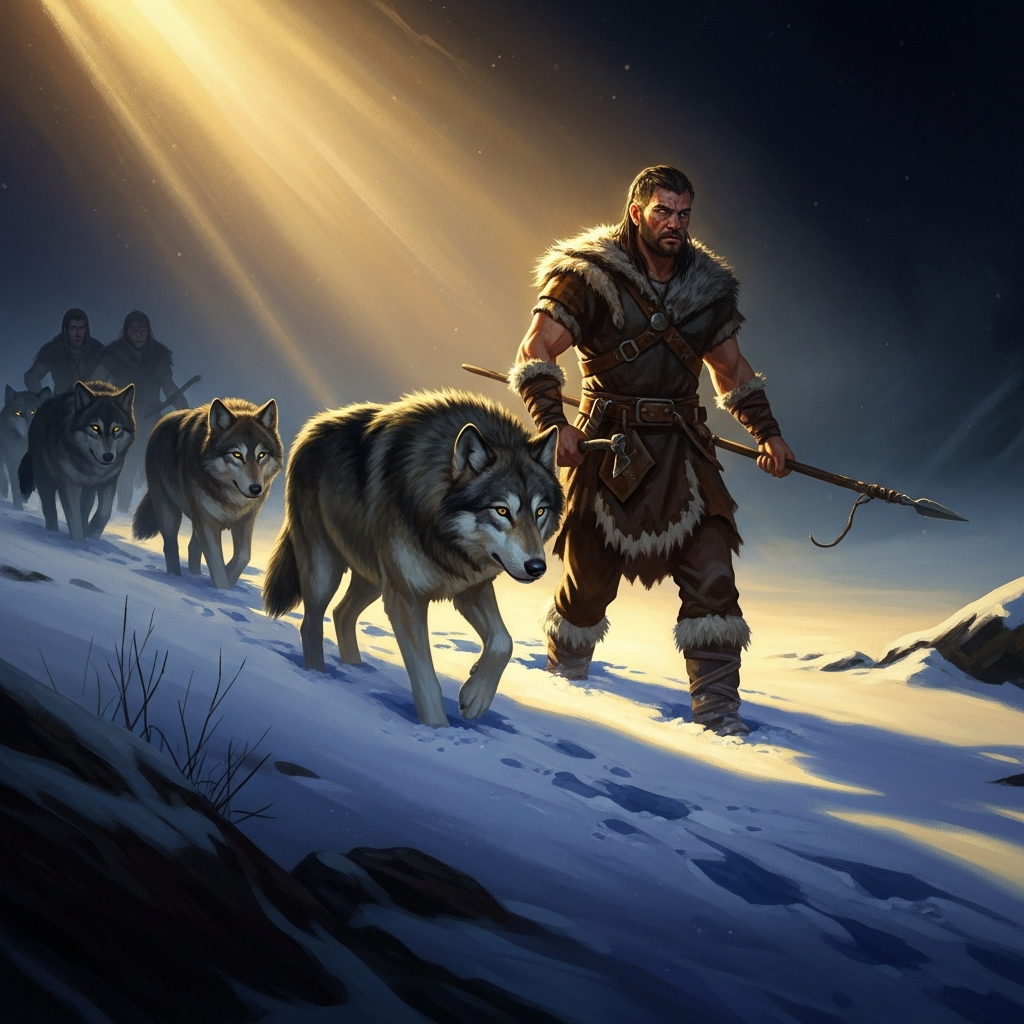
A group of hunters moves across the tundra in the pre-dawn dark with wolves at the edge of sight — close enough to read, far enough to not confuse — and together they read the same herd, identify the same weak animal at the flank, split the approach without speaking. The wolves take the front. The humans close from behind. The elk that would have been beyond them is not beyond them. The hunters bring it down.
They share the kill. This is not automatic and it is not obvious — it is a negotiation that has to be worked out, and in different communities it is worked out differently, and the specific terms of sharing determine the specific terms of the relationship. But sharing is what the relationship requires, and in most tellings the humans understand this. What is taken together belongs to together.
The question the story eventually arrives at is the question that changes everything: some wolves do not return to the pack.
It is not all wolves. Most wolves, after a hunt, return to their own kind — to the den, to the pups, to the social structure of the pack. They are wolves. The relationship with humans is useful and interesting but it is not their world. They move back into the forest and live as wolves live, and they will be back next season, and the partnership will continue on its original terms.
But some wolves stay.
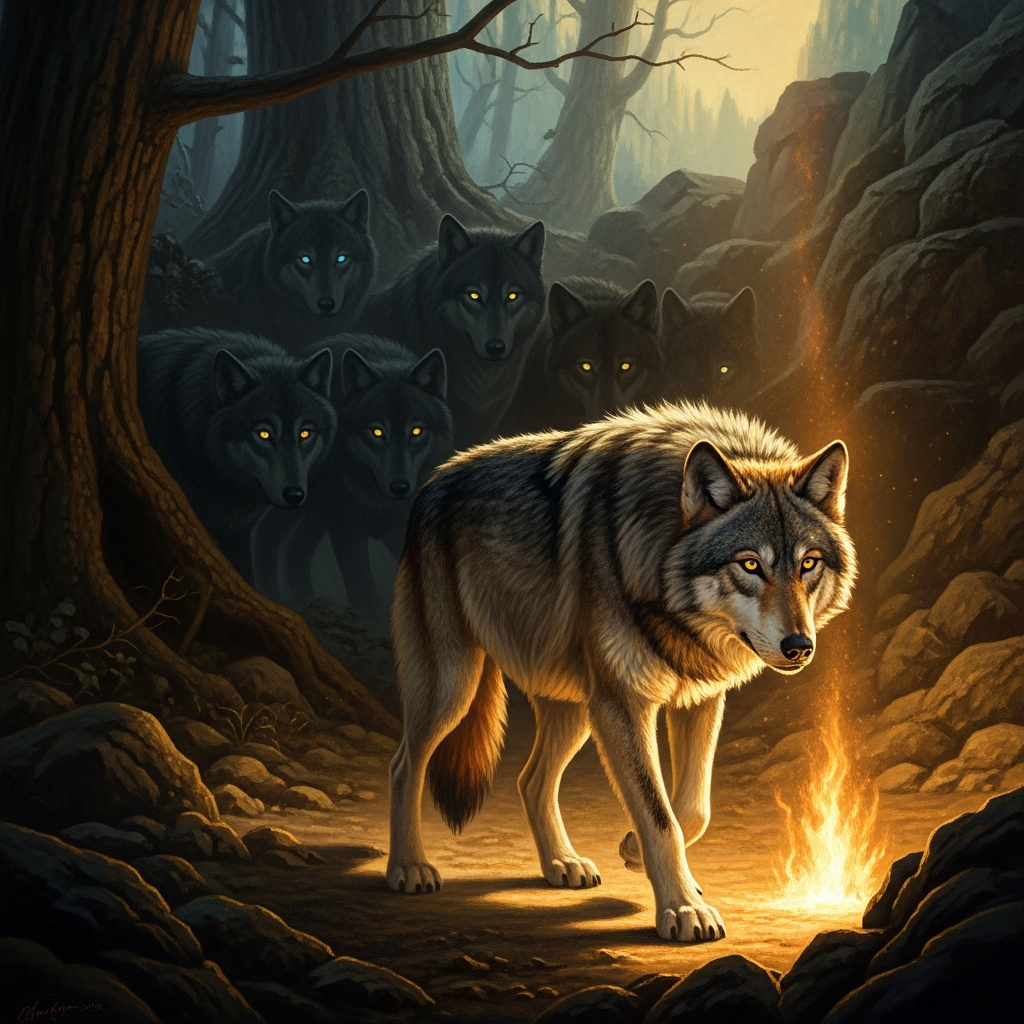
They stay because they have made a choice that the story takes seriously: the choice between wildness and the fire. The humans have fire, and at the edge of the firelight at night there is something the wolves without fire do not have — warmth and safety and the particular security of being known. Some wolves move into that circle and do not move back out.
This is where the dog comes from.
The wolf who steps into the firelight crosses a line that has no reverse direction.
Not immediately — the first generations are still wolves in nearly every respect. But the choice initiates a trajectory, and the trajectory runs forward across ten thousand years of winters next to human fires, sleeping inside human shelters, eating what humans leave, being fed by human hands, being bred by human preference. The wild wolf’s edge softens. The fear that keeps a wild animal alive is replaced, slowly, by the trust that keeps a domestic animal safe. The body changes. The face changes. The relationship to humanity changes from partnership to dependence.
The wolves who stayed wild watch this happen from the forest. They are the wolves who chose differently — who kept the hunt and the pack and the cold and the full terror of wildness over the warmth of the fire. They are not wrong to have chosen this. The dog is not more evolved than the wolf, not further along some inevitable progression. It is simply the outcome of a different choice made at the beginning of history, and both choices are still here: the wolf at the edge of the forest, and the dog at the edge of the fire, both descending from the animal that walked up to the first humans and showed them how to follow.
Richard Nelson, the anthropologist who spent years with Koyukon Athabascan hunters in Alaska, wrote that the best hunters he knew moved through the forest the way wolves move — reading the same signs, thinking in the same spatial terms, operating on an attentiveness to terrain and animal behavior that had the quality of a different kind of intelligence. He called it the intelligence of long relationship. The hunters he knew were not imitating wolves. They had learned what wolves know, and they had been learning it for as long as their people could remember, and the learning went back to the beginning.
The wolf at the edge of the treeline and the dog at the edge of the fire are not two different stories. They are the same story, told from two different points of the same departure. The teaching passed between them at the beginning remains the most important knowledge humans have ever been given: how to move together through a landscape too large and cold and indifferent for any one of us to survive alone.
Scenes
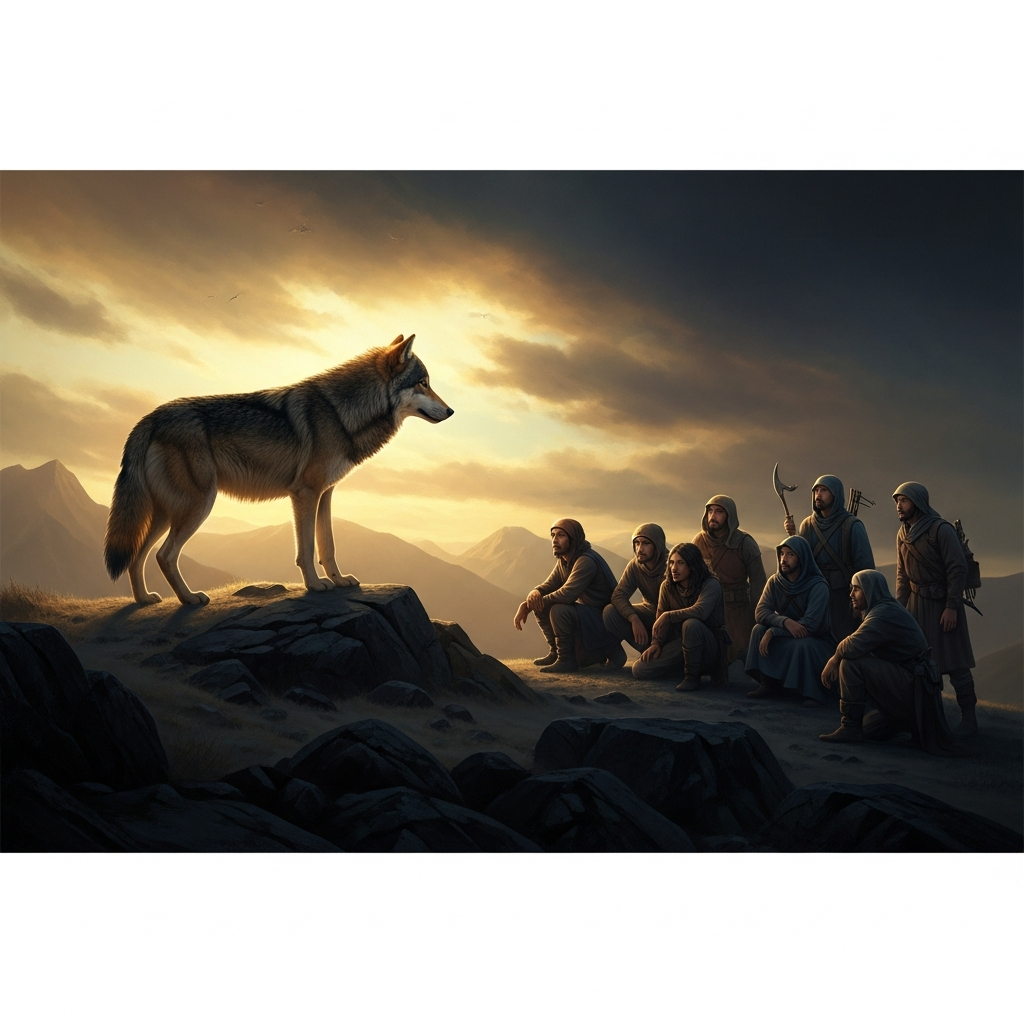
The wolf stops on the ridge and looks back
Generating art… The pack moves across the snow in the pre-dawn dark — wolf and human together, reading the same track, following the same logic
 Generating art…
 At the edge of the firelight, one wolf steps forward and does not leave
 Generating art…
 Echoes Across Traditions
Entities
- the Wolf
- the first hunters
- the dog
Sources
- Richard Nelson, *Make Prayers to the Raven: A Koyukon Athabascan View of the Northern Forest* (University of Chicago Press, 1983)
- Robin Wall Kimmerer, *Braiding Sweetgrass: Indigenous Wisdom, Scientific Knowledge, and the Teachings of Plants* (Milkweed Editions, 2013)
- Paul Shepard, *The Others: How Animals Made Us Human* (Island Press, 1996)
- Mark Derr, *How the Dog Became the Dog: From Wolves to Our Best Friends* (Overlook Press, 2011)
- Barry Lopez, *Of Wolves and Men* (Charles Scribner's Sons, 1978)