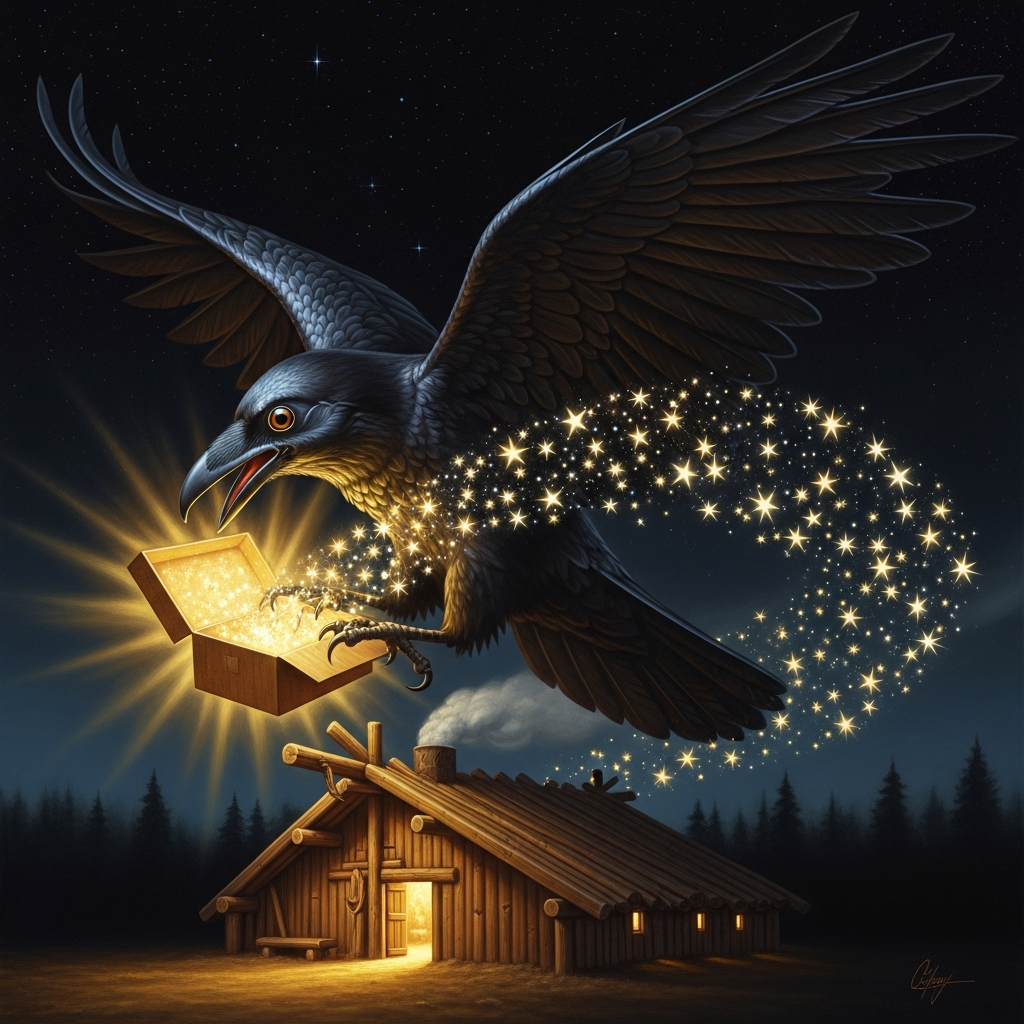
Raven Steals the Light
In the time before light · Haida and Tlingit oral tradition, Pacific Northwest Coast · The world before the world — the vast house of a chief who holds the only light in existence
Contents
In the beginning, a powerful chief locks the light of the world in a box. Raven wants it. He becomes a spruce needle, is swallowed, is born, and cries until the box is opened — and then he shatters the darkness.
- When
- In the time before light · Haida and Tlingit oral tradition, Pacific Northwest Coast
- Where
- The world before the world — the vast house of a chief who holds the only light in existence
In the beginning, the world is dark.
Not the dark of night that gives way to morning — there is no morning, no night, no difference between them. The world is uniformly, absolutely lightless, in all directions, without interruption. No fire, no star, no reflected gleam from any surface. Creatures live in this darkness and move by other means — by smell, by sound, by the map of familiar ground underfoot. They have always lived this way. Most of them do not know that anything else is possible.
Raven knows.
Raven has heard — in the way that Raven hears things, which is not entirely by listening — that somewhere, in the house of a chief who is very old and very powerful, there is a box. Inside the box is a smaller box. Inside the smaller box, nested down through several more boxes that grow smaller the deeper you go, is the light of the world. The chief keeps it because he can. He has always kept it. The darkness is the condition of his power.
Raven wants the light. Not because the people need it — Raven rarely begins with the people’s need. He wants it because it is the most locked-up thing in the world, and Raven has a relationship with locked-up things.
He finds the chief’s house by following the smell of something hidden.
He perches above the stream where the chief’s daughter comes every morning to drink, and he thinks for a long time. The chief’s house has no door he could use. The smoke-hole is watched. The chief’s daughter is the only vulnerability — she comes to the stream alone, every morning, and she kneels to drink, and she does not look carefully at the water before she lifts it to her lips.
Raven makes himself very small.
He is many things, Raven — messenger, thief, transformer, the one who moves between what is and what is not yet. He pulls his body down into a point, compresses the feathers and the beak and the black intelligence of his eyes into the tiniest possible shape, and he becomes a spruce needle. He floats in the stream. He waits.
The daughter comes. She kneels. She cups the water in her hands and lifts it. The spruce needle turns slowly in the current at the heart of the water she has chosen, and she does not see it, and she drinks.
Months later, she gives birth to a son.
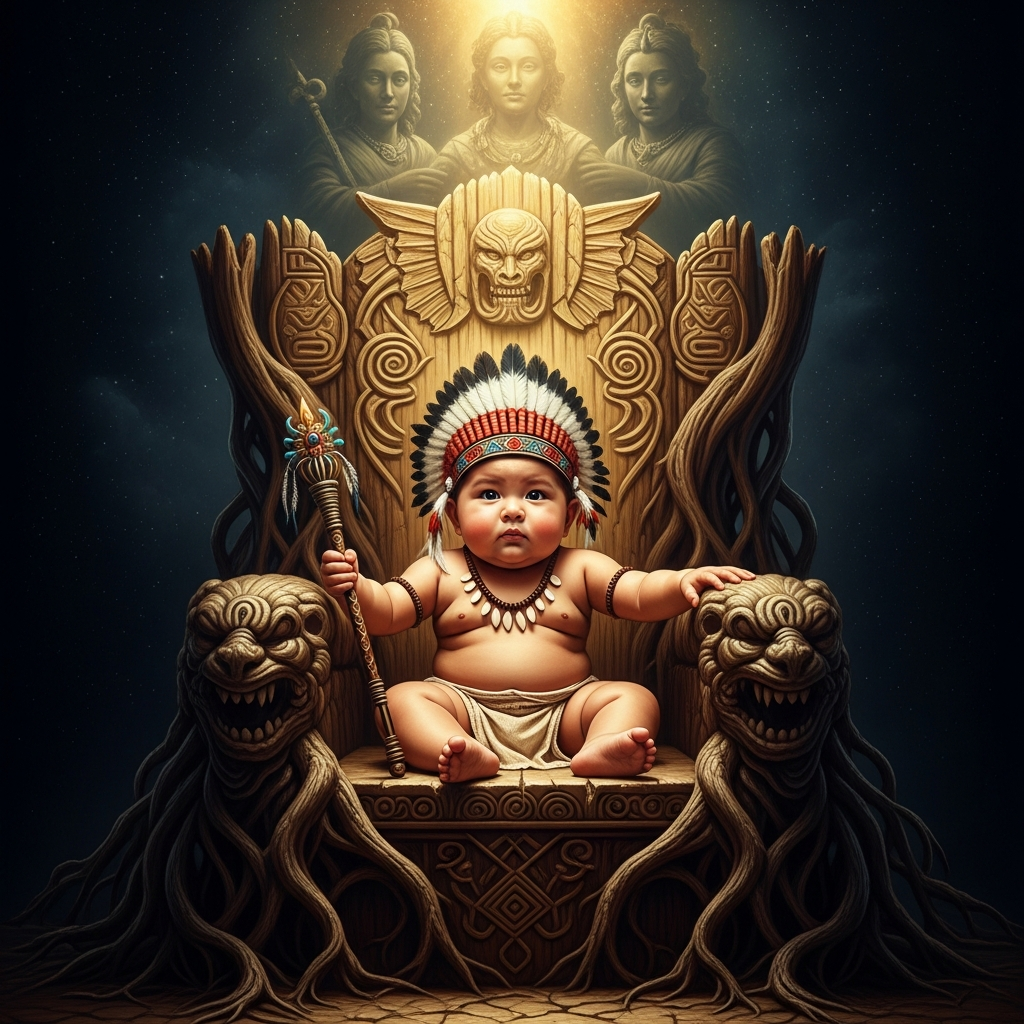
The chief is delighted — a grandchild, a boy, a continuation. He holds the baby and the baby looks up at him with eyes that are unusual. The pupils are very dark. The eyes are very bright. The grandfather is a man who has lived a long time in a house full of secrets and he recognizes, somewhere below thought, that there is something wrong with how much this baby already knows. But it is his grandchild. He holds it anyway.
The baby cries.
Not the ordinary crying of an infant who is hungry or cold — a relentless, specific, purposeful screaming that the household cannot quiet by any ordinary means. Food does not stop it. Warmth does not stop it. The baby is held, sung to, walked in the darkness of the great house, and it screams without interruption and without tiring, and the chief’s daughter cannot sleep and the chief cannot think and the household is desperate.
The baby reaches, always, in the same direction.
The chief understands what is happening. He has understood it for some time. The baby’s arm extends toward the corner where the boxes are stacked — the nested boxes, the smallest of which contains the thing the chief has spent his entire long life protecting. He looks at his grandson’s too-bright eyes and he sees something there that he should fear.
He brings down a box.
The baby stops crying. It examines the box with complete attention, turning it over, studying it, and then — when it becomes clear that this is not the right box — the screaming resumes, worse than before. The chief brings down another box. And another. The household watches. The chief’s daughter watches. The chief brings down the boxes one by one, each time hoping this is the last one, each time watching his grandson determine that it is not and resume the screaming that is taking years off everyone’s life.
Finally there is only one box left.
The chief holds it. He holds it for a long time. He looks at his grandson’s eyes — too bright, too old, already knowing — and he makes the decision that love makes, which is the wrong decision, which is the only decision. He gives the baby the box.
The baby’s hands close on the wood.
For one moment the house is silent. The baby sits with the box in its lap and its too-bright eyes are closed and it is the most peaceful thing anyone has ever seen. The chief exhales. Perhaps this is enough. Perhaps just holding it is enough for whatever strange child this is.
Then the baby opens its eyes.
They are no longer a baby’s eyes. They are Raven’s eyes — black, absolute, old as the world that does not yet have light in it. The body in the grandfather’s house stretches and reshapes. Feathers push through skin. A beak replaces the soft infant face. Raven stands in the chief’s house with the box in his talons, and the box is already open, and the light coming out of it hits the interior of the great house for the first time in all of time, and everyone in it recoils.
Raven is already gone through the smoke-hole.
He rises above the world with the light in his talons and he opens his wings and below him, for the first time, there is a world to see.
Mountains. Rivers. The faces of the people. The sea, which is green and vast and looks entirely different from above than it has ever looked to anyone touching it from below. Raven flies over all of it, and as he flies he opens the boxes one by one — the box of stars he flings outward in every direction and they hold their positions in the dark sky; the box of the moon he releases and the moon begins its slow circuit; the sun he lets rise, and the world below responds as if it has been waiting its entire existence for this specific warmth, and perhaps it has.
The chief stands in his ruined house. The darkness he has protected for all of time is gone. He is no longer the man who holds the light. He is an old man in a house with the smoke-hole open, standing in the sudden morning.
Below him, the people see each other’s faces for the first time.
Raven does not stay to be thanked. This is the consistent detail in every version of the story — Haida, Tlingit, Tsimshian, all of them. The transformer does not need gratitude. He needed the theft. He needed to break the most locked-up thing in the world, and he broke it, and now the world has light, and that is where his interest ends. The people can do what they want with it.
The chief is rarely mentioned after the moment of loss. He is the figure the story does not finish — the old man in the empty house, holding the power he kept so long he forgot it was supposed to be for everyone. Raven did not punish him. The morning did.
Scenes
Raven bursts through the smoke-hole, the box of stars open in his talons
Generating art… Raven shrinks himself into a spruce needle, spinning slowly in the stream where the chief's daughter kneels to drink
 Generating art…
 The baby sits in the chief's house with eyes that are wrong — too bright, too knowing, pupils like black mirrors
 Generating art…
 Echoes Across Traditions
Entities
- Raven
- the Chief Who Owns the Light
- the Chief's Daughter

Sources
- John Swanton, *Haida Texts and Myths* (Bureau of American Ethnology, 1905)
- John Reed Swanton, *Tlingit Myths and Texts* (Bureau of American Ethnology, 1909)
- Bill Reid and Robert Bringhurst, *The Raven Steals the Light* (Douglas & McIntyre, 1984)
- Nora Marks Dauenhauer and Richard Dauenhauer, *Haa Shuká, Our Ancestors: Tlingit Oral Narratives* (1987)