Combat Profile
Celestial Theft
Raven steals the sun, moon, or stars themselves, redistributing cosmic light and shadow to reshape the world's fundamental order.
Boundary Walker
Raven exists between states of being, shifting freely between creation and chaos, transforming all who encounter him while remaining untouched by consequence.
Vanity and greed; his black feathers are a mark of his theft (he was once white, in some tellings, and was scorched by the sun he stole)
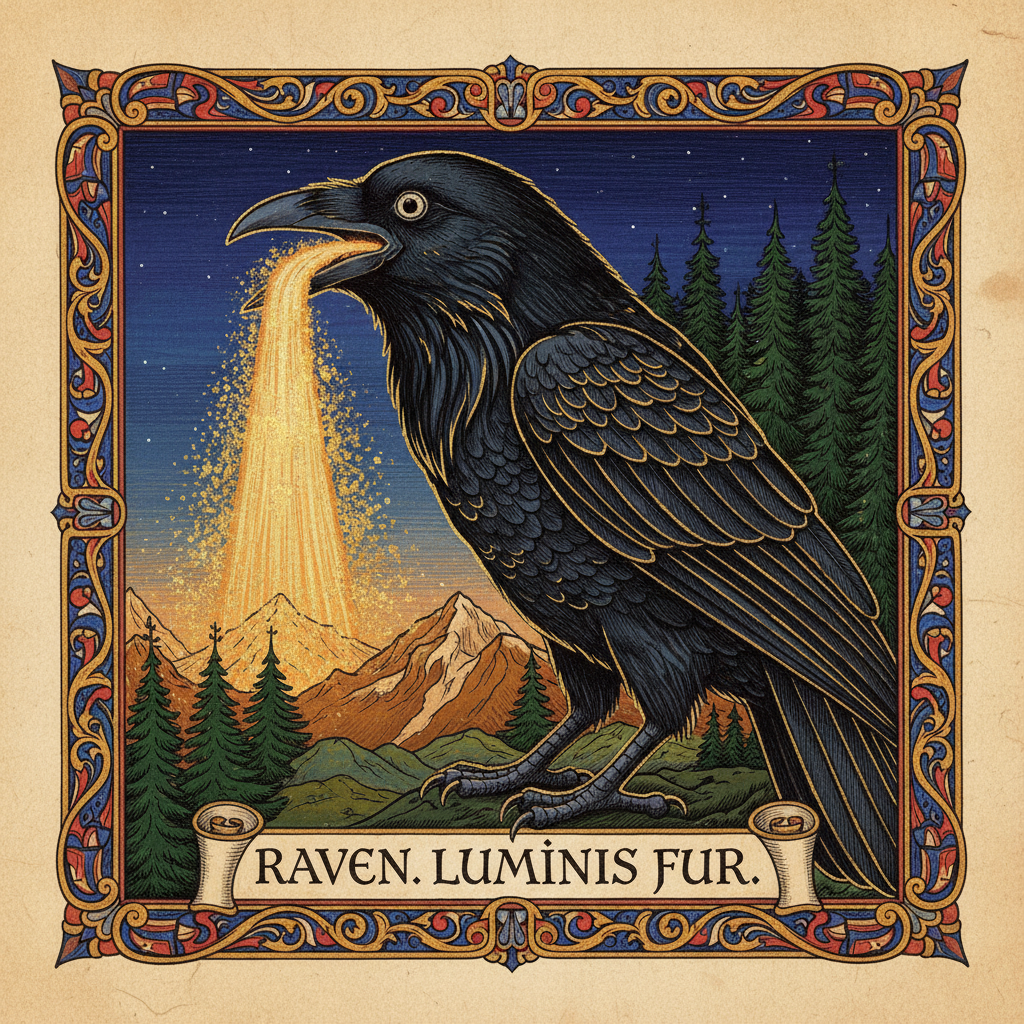
“Raven was so hungry for light that he swallowed the sun. And then, because he could not contain it, he opened his beak, and the world was bright.”
Lore: In the traditions of the Pacific Northwest — Tlingit, Haida, Tsimshian, Kwakiutl — Raven (Yel in Tlingit, Nankil’slas in Haida) is the supreme trickster and, in many traditions, the creator of the world. The central Raven narrative is one of the great stories in world literature: a powerful chief hoarded the sun, moon, and stars in three nested boxes in his house, keeping the world in darkness. Raven transformed himself into a hemlock needle (or a speck of dust) and was swallowed by the chief’s daughter in a drink of water. He was born as her child — a strange, demanding baby with bright eyes. The doting grandfather gave the baby anything it cried for. First the box of stars. The baby opened it and the stars flew up through the smoke hole. Then the moon. Then the sun. When the baby-Raven got the sun box, he transformed back into Raven and flew out the smoke hole, carrying the sun in his beak, releasing light to the world.
This story operates on multiple levels simultaneously. It is a creation narrative (explaining the origin of light). It is a trickster tale (cleverness defeating power). It is a story about the redistribution of hoarded resources (the wealthy chief keeping light from the people). And in Tlingit and Haida cultures, where Raven is a moiety crest figure, it is a charter for social identity — you are either Raven clan or Eagle/Wolf clan, and your entire social, marital, and ceremonial life flows from that division.
Parallel: Raven stealing the sun is structurally identical to Prometheus stealing fire from the gods — both are acts of theft from a hoarding power that benefit all of humanity. Maui (Polynesian) lassoed the sun to slow it down, another act of trickster-heroism involving the sun. But Raven’s method — disguising himself as an infant, being reborn to infiltrate the house of power — has no direct parallel. It is a uniquely Pacific Northwest narrative innovation: the thief who becomes the grandson of the thing he is stealing from.
2 min read
Eagle (the noble counterpart); his own cleverness trapping him
Erdoes & Ortiz, *American Indian Myths and Legends*; Bringhurst, *A Story as Sharp as a Knife: The Classical Haida Mythtellers*; Swanton, *Tlingit Myths and Texts*