Combat Profile
Primordial Deluge
Inundates the world to cleanse creation and reset the cosmic order, from which Turtle Island emerges anew.
Cyclical Renewal
Destruction and rebirth are inseparable; the Great Flood perpetually transforms rather than merely destroys, ensuring eternal regeneration of the Earth.
N/A
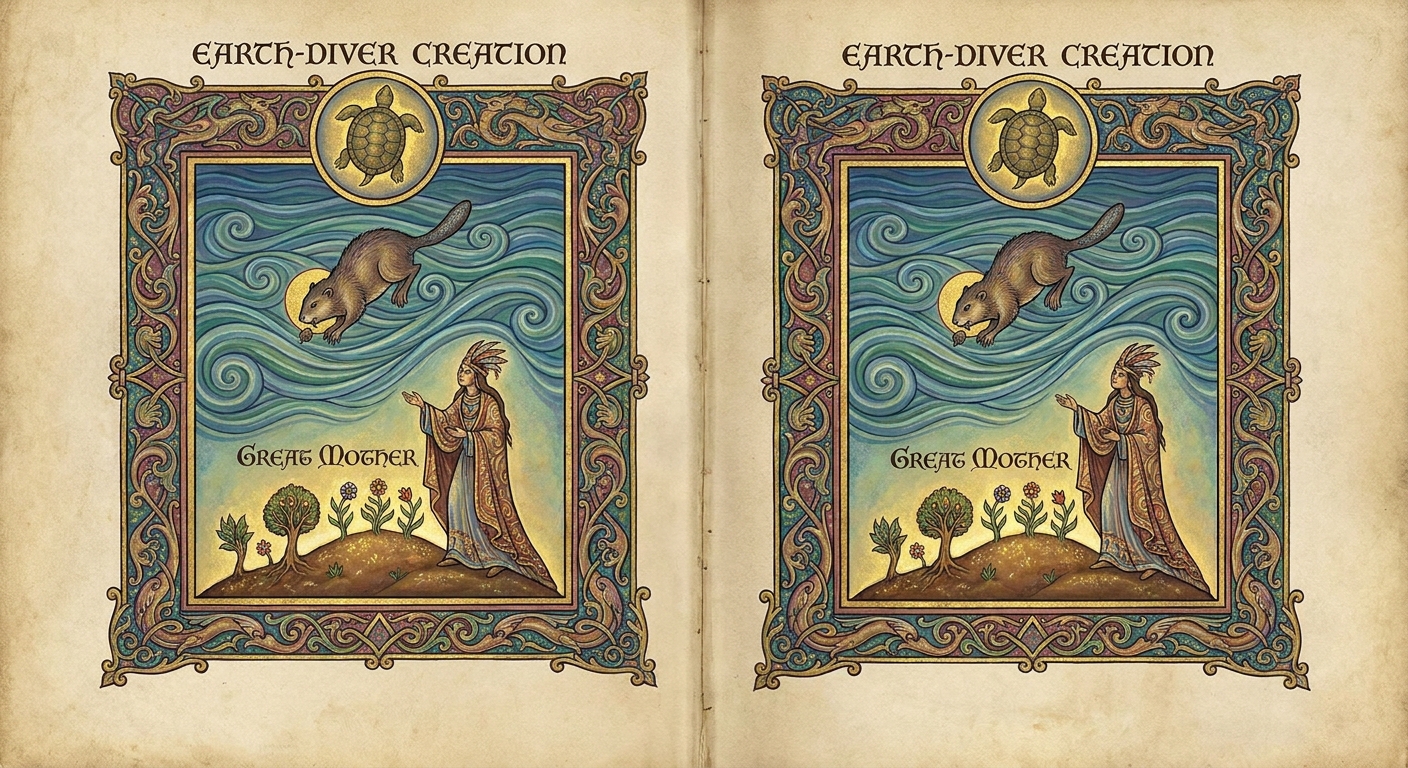
Lore: The flood narrative is arguably the most widespread story in human civilization, and Native American traditions contain some of its most distinctive versions. The “earth-diver” motif — in which an animal dives to the bottom of primordial waters to retrieve a piece of earth from which the world is rebuilt — appears in dozens of Native American traditions: Ojibwe, Cree, Cherokee, Arapaho, Blackfoot, Crow, and many others. What distinguishes the Native American flood narratives from their Near Eastern counterparts (Noah, Utnapishtim, Deucalion) is the emphasis on animal cooperation and the insight that the humble succeed where the powerful fail. It is not the eagle or the bear who saves the world. It is the muskrat. The smallest, least impressive creature gives its life to bring back a handful of mud, and from that handful, the entire world is reborn.
The “Turtle Island” motif — the earth resting on the back of a great turtle — connects the flood narrative to a broader indigenous understanding of the earth as a living being. You do not merely live on the earth. You live on the back of a being who carries you. This is a fundamentally different relationship than the Abrahamic “dominion over the earth” (Gen 1:28).
1 min read
N/A
Thompson, *Tales of the North American Indians*; Erdoes & Ortiz, *American Indian Myths and Legends*; Dundes (ed.), *The Flood Myth*