Combat Profile
Boundary Breaker
Coyote crosses between worlds and states of being, rewriting rules of reality itself to expose truths through chaos and creative destruction.
Sacred Fool's Wisdom
All apparent failures and tricks conceal deeper teachings; Coyote's chaos births new stories and transforms death into renewal.
His own appetites -- lust, hunger, curiosity, pride. He outwits everyone, then falls into his own trap. He is the smartest being in the story and the stupidest, often in the same scene
“Coyote is always out there waiting, and Coyote is always hungry.”
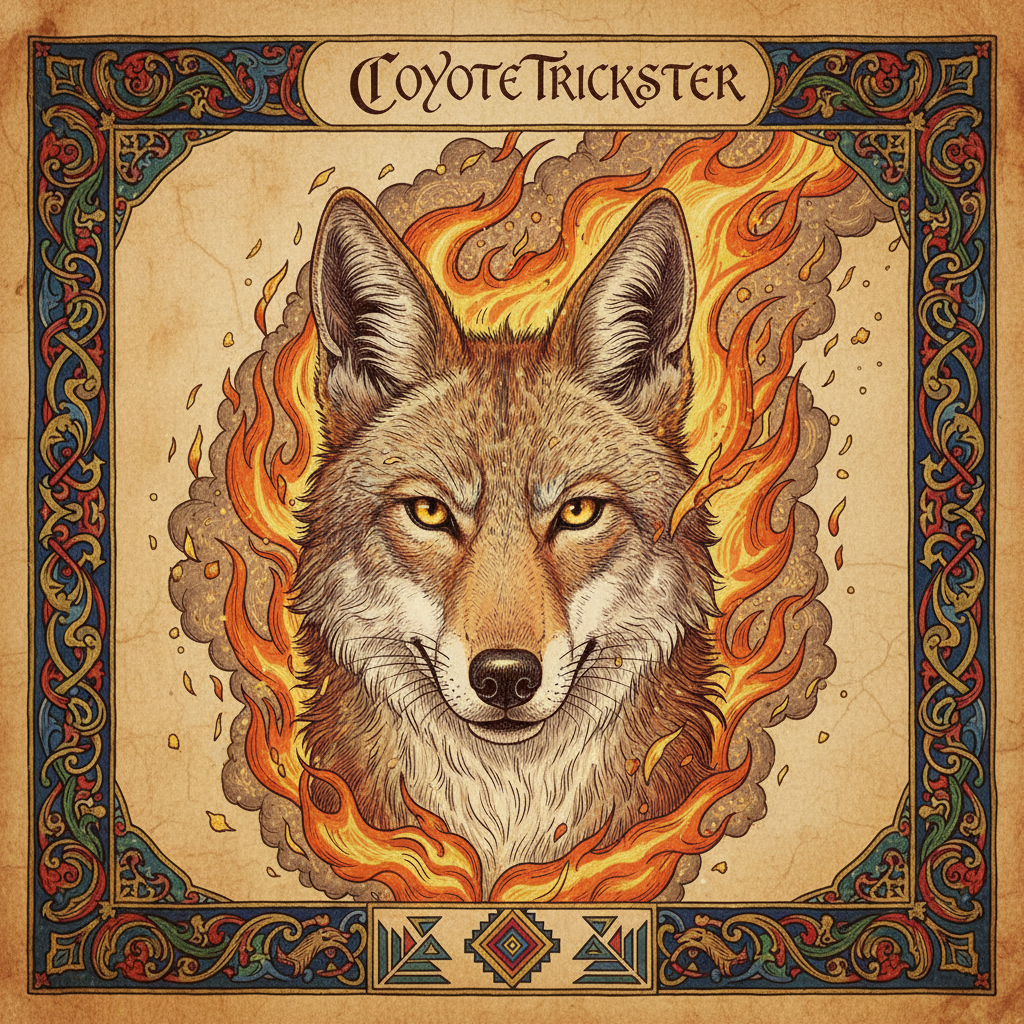
Lore: Coyote is THE trickster of North America — appearing in the sacred narratives of the Navajo, Lakota, Crow, Nez Perce, Salish, Pomo, Maidu, Miwok, and dozens of other traditions under various names (Ma’ii in Navajo, Mica in Lakota, Isily in Crow). He is not one character but a constellation of characters, shaped by each nation’s storytelling, yet remarkably consistent in his essence: he is the being who breaks the rules, and in breaking them, makes the world what it is.
In many traditions, Coyote stole fire for humanity — running a relay with other animals to carry a burning brand away from the fire spirits who hoarded it. In this, he is Prometheus. But unlike Prometheus, Coyote did not steal fire out of noble self-sacrifice. He stole it because he was cold, or because he wanted to show off, or because someone told him he could not. His gifts to humanity are accidents of ego.
He also introduced death. In one widely-told variant, Coyote argued that the dead should stay dead, because the world would become too crowded otherwise. He won the argument. Then his own son died, and he begged for the rule to be reversed. It could not be. The being who created death was the first to mourn it. This is not a flaw in the story. This is the story. Coyote teaches through failure. He shows you what happens when you act on impulse, when you let your appetites rule you, when you are clever but not wise. He is sacred precisely because he is profane.
Parallel: Coyote belongs to the universal trickster archetype — a figure that appears in virtually every human culture. His closest cousins in this compendium are Loki (Norse), who escalates from prankster to world-ender; Eshu (Yoruba), the divine messenger who must be honored first; Hermes (Greek), the charming thief who became a god; Sun Wukong (Chinese), the Monkey King who fought heaven itself; and Anansi (Akan/West African), who tricked all the stories from the sky god. But Coyote is distinguished by his amorality. Loki turns evil. Eshu is a necessary intermediary. Hermes is domesticated into Olympian society. Coyote never reforms. He never learns. He is chaos itself, wearing fur.
2 min read
Himself. Coyote is always his own undoing. Also Eagle, who often represents the disciplined counterpart to Coyote's chaos
Erdoes & Ortiz, *American Indian Myths and Legends*; Lopez, *Giving Birth to Thunder, Sleeping with His Daughter*; Radin, *The Trickster*; Bright, *A Coyote Reader*