Combat Profile
Weave of Worlds
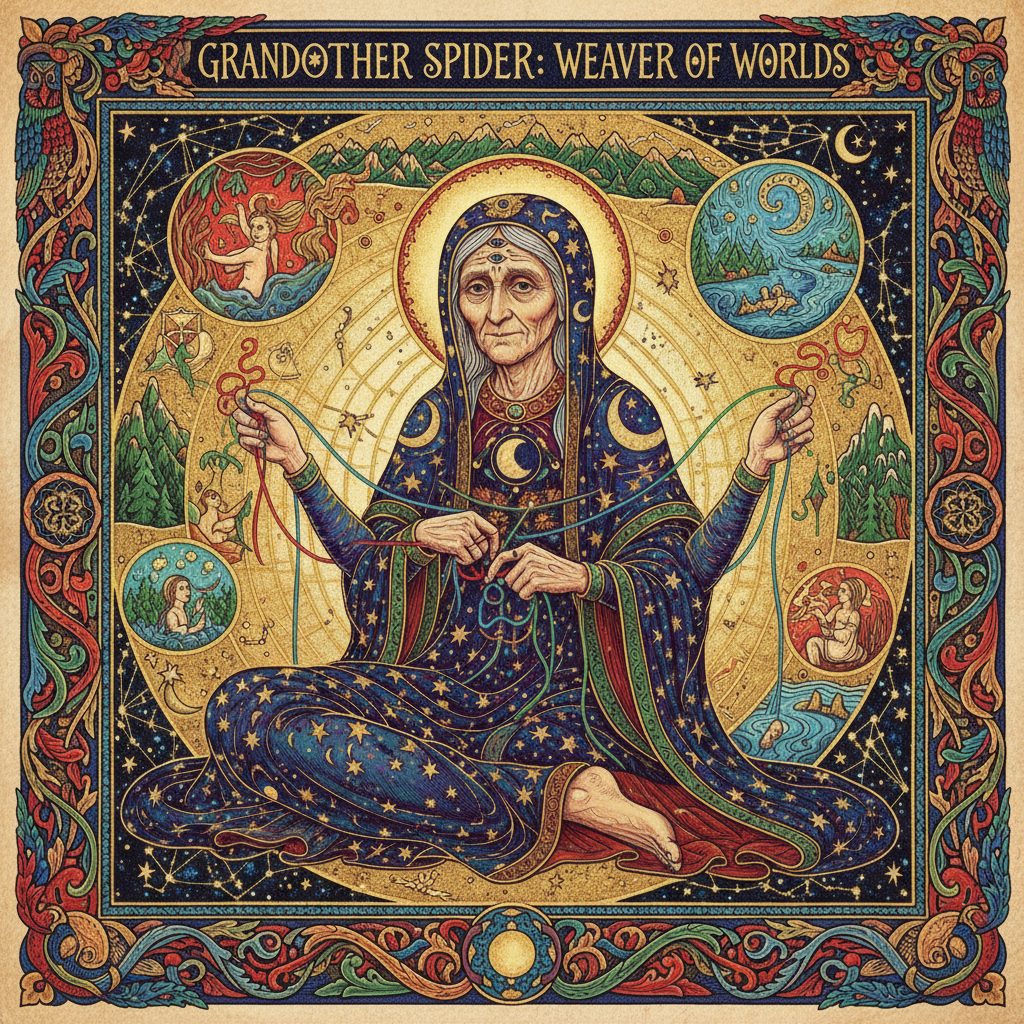
Spider Woman instantly rewrites the threads of fate and reality within her domain, reshaping circumstance and consequence to align with her ancient design.
Grandmother's Wisdom
All allies within her presence gain enhanced understanding and clarity; Spider Woman perceives all connections and intentions as visible threads she has already woven.
Her creations have free will; she guides but cannot compel
“In the beginning there was only darkness, and Spider Woman. She sat in the darkness and thought. And from her thoughts, she began to weave.”
Lore: Spider Woman (Tse Che Nako in Keresan, Na’ashje’ii Asdzaa in Navajo) is one of the most important creator figures in the traditions of the American Southwest. In Hopi tradition, she is Kokyangwuti — Spider Grandmother — who, together with the deity Tawa (the Sun), created the world. But her method of creation is distinctive and theologically profound: she thinks the world into existence, then weaves it. Creation is an act of intellect and craft simultaneously.
In the Hopi emergence narrative, Spider Woman guides the people through a series of underworlds — the First World, Second World, Third World — each destroyed because humanity forgot to live in balance, each succeeded by a climb upward into a new reality. She is the one who leads them, who knows the way, who carries the thread of connection between the worlds. When the people emerge into the Fourth World (the present world), she instructs them in proper living. She teaches women to weave, and the loom itself is understood as a model of the cosmos — the warp is the earth, the weft is the sky, and the weaver recapitulates the act of creation with every blanket.
Parallel: The concept of creation as weaving or thinking — rather than speaking or commanding — sets Spider Woman apart from most creator figures in this compendium. The closest parallel is Sophia/Wisdom in Gnostic and Jewish Wisdom literature, who was present at creation as God’s co-worker and whose creative act is intellectual. Athena (Greek) shares the weaving connection and the association of textile craft with cosmic wisdom. The Norse Norns, who weave fate at the base of Yggdrasil, echo the idea that the fundamental structure of reality is a woven thing. But Spider Woman’s uniqueness lies in her combination of cosmic power and intimate domesticity — she who wove the universe also sits in the corner of the room, small and patient, teaching a woman how to make a blanket.
2 min read
Chaos and forgetting -- when humanity forgets the old ways, her web frays
Erdoes & Ortiz, *American Indian Myths and Legends*; Mullett, *Spider Woman Stories*; Waters, *Book of the Hopi*