Combat Profile
World Reshaper
Nanabozho floods and remakes the world itself, fundamentally altering reality to correct cosmic imbalance.
Trickster's Wisdom
Each mistake and transformation teaches a lesson; Nanabozho gains power from failures and uses cunning to survive impossible odds.
Grief and rage -- when his brother Chibiabos was killed by underwater spirits, Nanabozho's fury triggered the Great Flood
“Muskrat floated to the surface, dead, but in his tiny paw was a handful of mud. And from that mud, Nanabozho made the whole world again.”
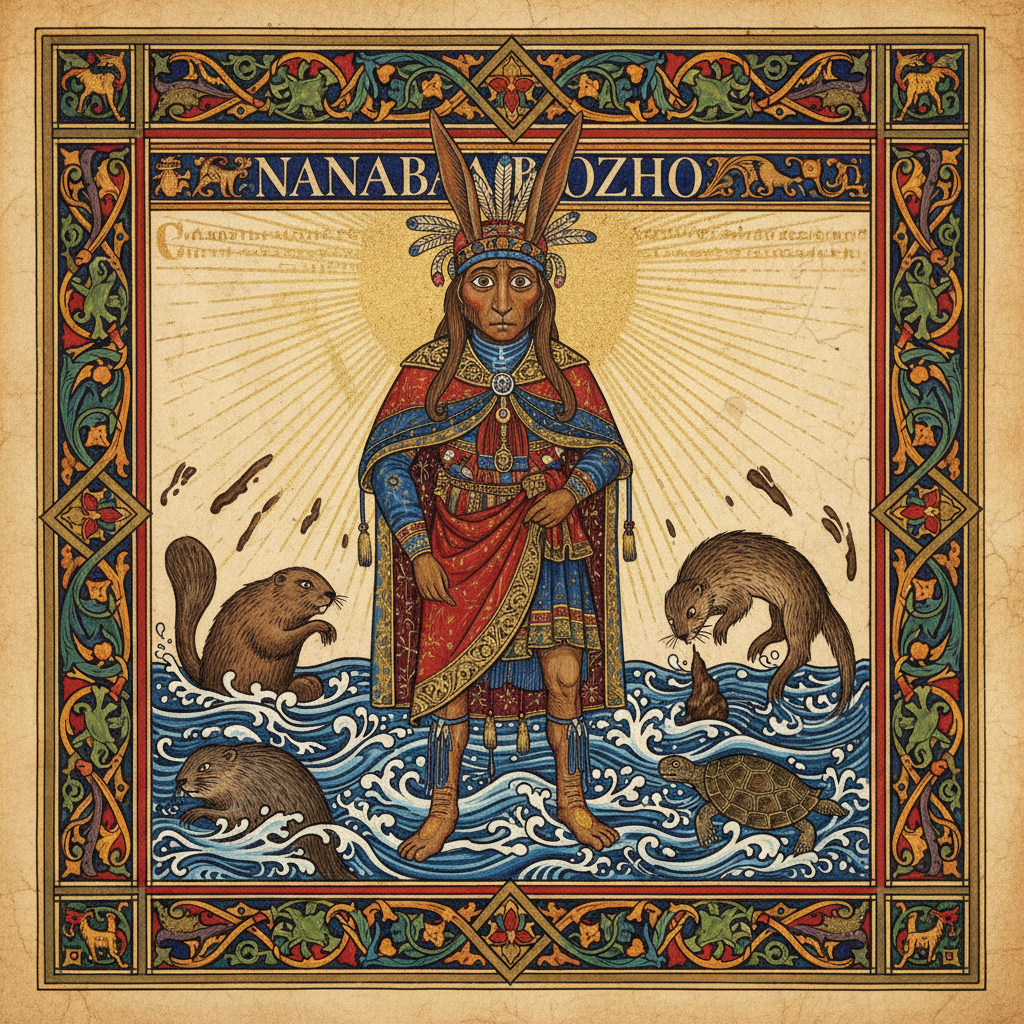
Lore: Nanabozho (also Nanabush, Wenabozho, Manabozho) is the central trickster-hero of the Ojibwe (Anishinaabe) people and related Algonquian nations. He is sometimes depicted as a giant rabbit or hare, sometimes as a man, sometimes as both at once — a shapeshifter whose form matches the needs of the story. He is the original Anishinaabe, the being who taught the people how to live.
His most important narrative is the flood story. After the underwater manitous killed his brother Chibiabos (or, in some versions, his nephew), Nanabozho attacked them in fury, and they retaliated by flooding the entire world. Nanabozho climbed the tallest tree, then clung to a log as the waters rose. With him were the surviving animals. He asked who could dive deepest to find earth beneath the floodwaters. The great swimmers — Otter, Beaver — tried and failed, returning exhausted and empty-handed. Finally, small, humble Muskrat dove. He was gone so long they thought him dead. He surfaced, lifeless, but in his tiny clenched paw was a ball of mud from the bottom. From this mud, placed on the back of a turtle, Nanabozho recreated the earth. This is why many Algonquian and Iroquoian peoples call North America Turtle Island.
Parallel: The flood narrative of Nanabozho is one of the most important data points in comparative mythology, because it contains motifs found across the planet: the universal flood, the single survivor on a vessel, the sending of animals to find land, and the recreation of earth from a small fragment. Compare: Noah sends a raven and a dove (Genesis 8:6-12); Utnapishtim sends a dove, a swallow, and a raven (Epic of Gilgamesh, Tablet XI); Deucalion and Pyrrha recreate humanity from stones (Greek); Manu is saved by a fish who is actually Vishnu (Hindu Matsya Purana). The earth-diver motif — an animal diving to retrieve mud from beneath primordial waters — is specifically found across Siberian, Central Asian, and North American traditions, which may suggest an origin in the deep Paleolithic past, carried across the Bering land bridge.
2 min read
The underwater spirits (the manitous of the deep waters) who killed his brother and flooded the world
Erdoes & Ortiz, *American Indian Myths and Legends*; Johnston, *Ojibway Heritage*; Radin, *The Trickster*; Thompson, *Tales of the North American Indians*