Viracocha Paints the Nations into Being
Primordial time · Andean creation tradition · recorded by Juan de Betanzos, 1557; Pedro Sarmiento de Gamboa, 1572 · Lake Titicaca and Tiahuanaco (Tiwanaku), Bolivia/Peru
Contents
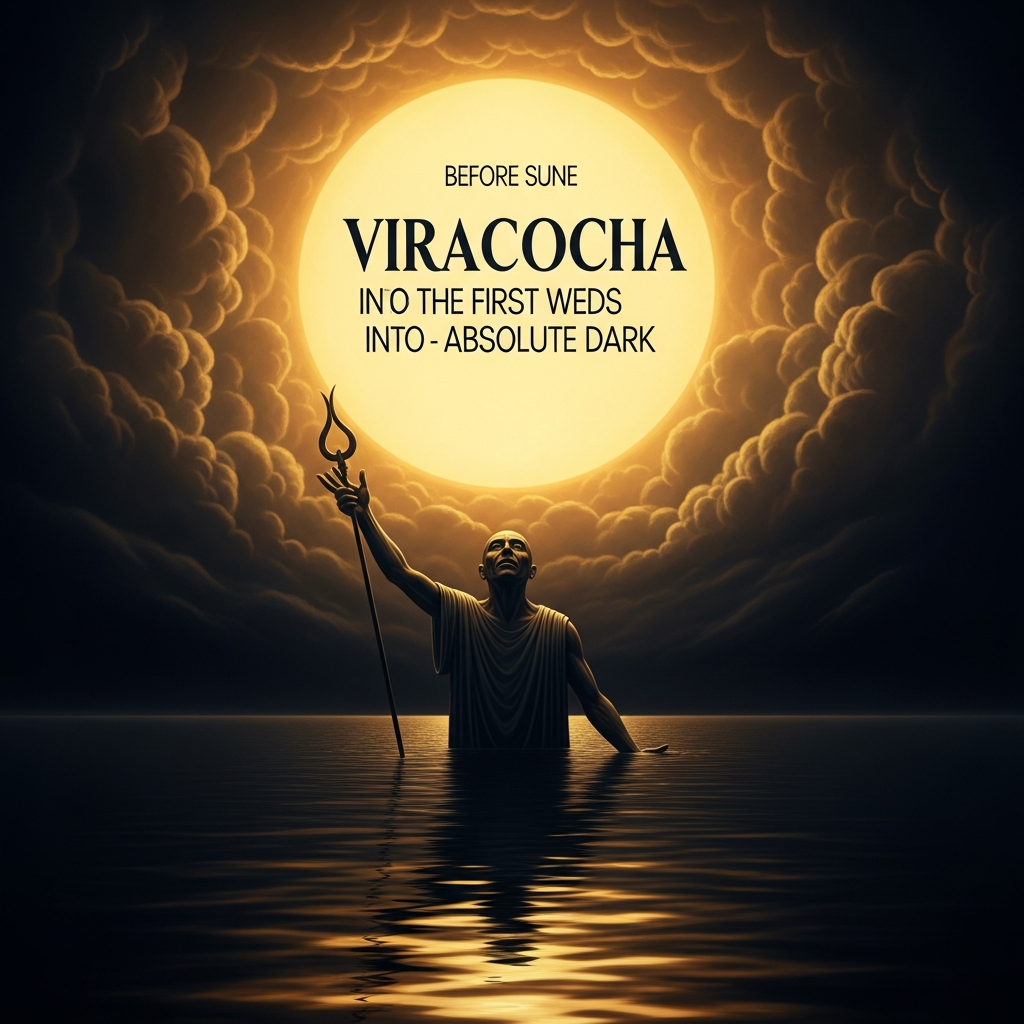
At the shore of Lake Titicaca, in the darkness before any sun exists, Viracocha kneels over rows of clay figures and paints each one — the colors of their cloaks, the cut of their hair, the dialect that will rise in their throats. He breathes them alive. Then he sends them underground to emerge, each nation, at the sacred place he has already chosen for them. The world is not found. It is designed.
- When
- Primordial time · Andean creation tradition · recorded by Juan de Betanzos, 1557; Pedro Sarmiento de Gamboa, 1572
- Where
- Lake Titicaca and Tiahuanaco (Tiwanaku), Bolivia/Peru
He begins with the clay.
The shore of Lake Titicaca at 3,800 meters is cold in a way that has no other name — not the cold of winter or night but the cold of altitude, permanent and structural, the cold that is simply what air is at this height. The lake is the highest navigable body of water on earth, and in the darkness before any sun exists, its surface catches nothing: no light to reflect, no color, only the blackness of altitude and the faint chemical smell of reed beds and silt. Viracocha moves at the water’s edge. He kneels. His hands go into the clay.
He works deliberately, the way a master craftsman works: without urgency, without error, without the wasted motion of someone learning as they go. He has the complete image in mind before the first handful of clay is lifted. He knows exactly what each figure will look like — the specific cut of the cloak, the exact curl or straightness of the hair, the proportions of a highland face versus a coastal face versus a forest face. He knows these things because he is not imagining them. He is remembering the design.
Con Tiqsi Viracocha Pachayachachic — the ancient foundation, the lord, the teacher of the world. The full title that the Quechua sources preserve tells you who he is: not a monarch, not a warrior, not a god of lightning or war, but a teacher. A craftsman. The one who knows how things should be made and makes them correctly.
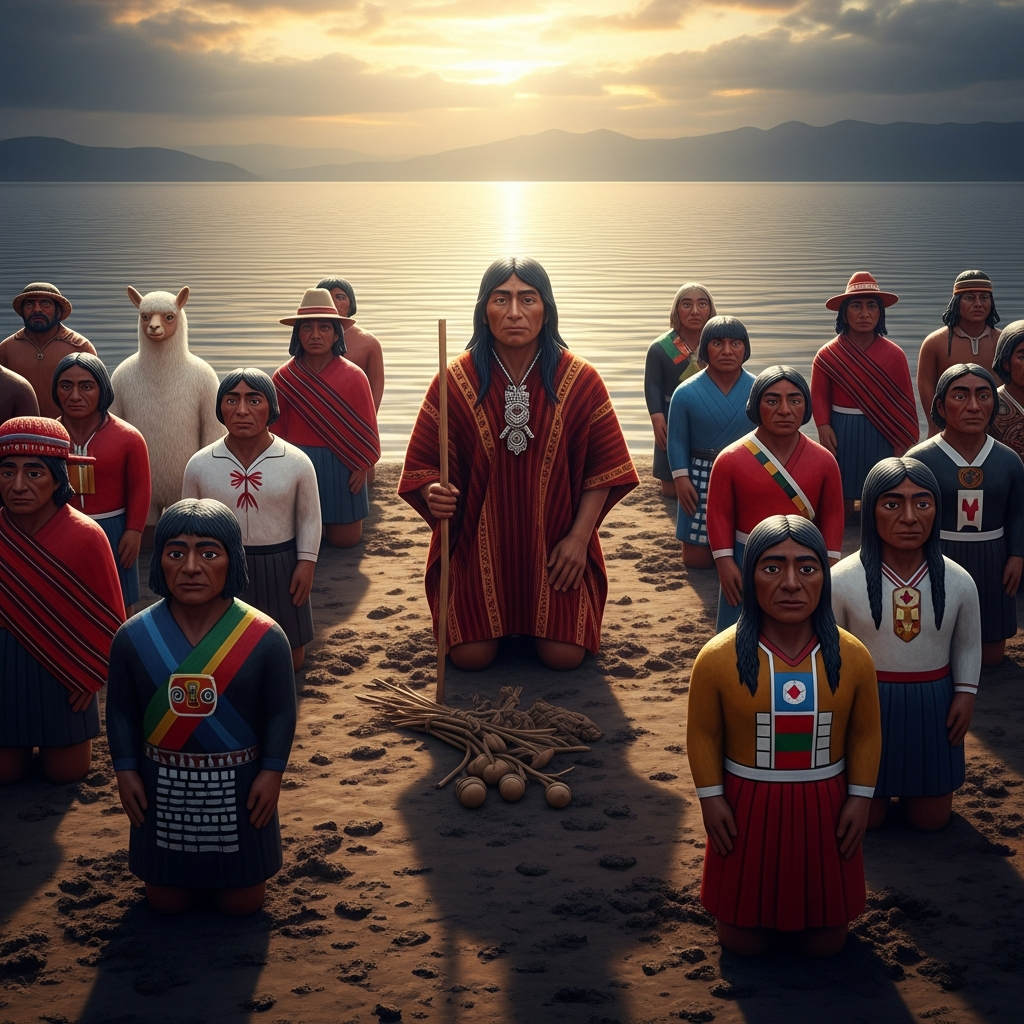
He lays the figures out in rows.
This is what the sources specify, and it matters: not a single human prototype from which variations will emerge, but a full complement of distinct types, each one already differentiated, laid side by side on the mud flat in the dark before the sun. Juan de Betanzos, writing in 1557 from testimony he received from Inca nobles, records the act with unusual specificity: Viracocha creates the figures and paints them, and the painting is not ornamentation. The clothing painted on each clay body is the clothing that people will wear. The faces are the faces they will have. The languages implied by the particular shape of the throat and mouth are already built in.
Each figure is a nation.
Not a nation in the modern sense — not a political unit, not a state with borders — but a people, a community with a shared pacha, a shared time-space, a shared relationship to the specific land they will emerge from. The Colla who live on the altiplano. The Yungas who live in the forest valleys below. The coastal fishermen whose bodies are shaped differently by generations of salt air and rowing. The highland weavers whose fingers will be long and precise. Each one is already contained in the clay. The painting makes visible what the design already decided.
Viracocha works through the figures one by one. The sources do not say how long this takes because in mythic time before the sun there is no way to measure duration. He is not tired when he finishes. He sets the last figure down in the row and looks at them — forty, four hundred, four thousand nations laid out in the dark at the lakeside — and the arrangement is correct. The world is complete in miniature.
Now the breath.
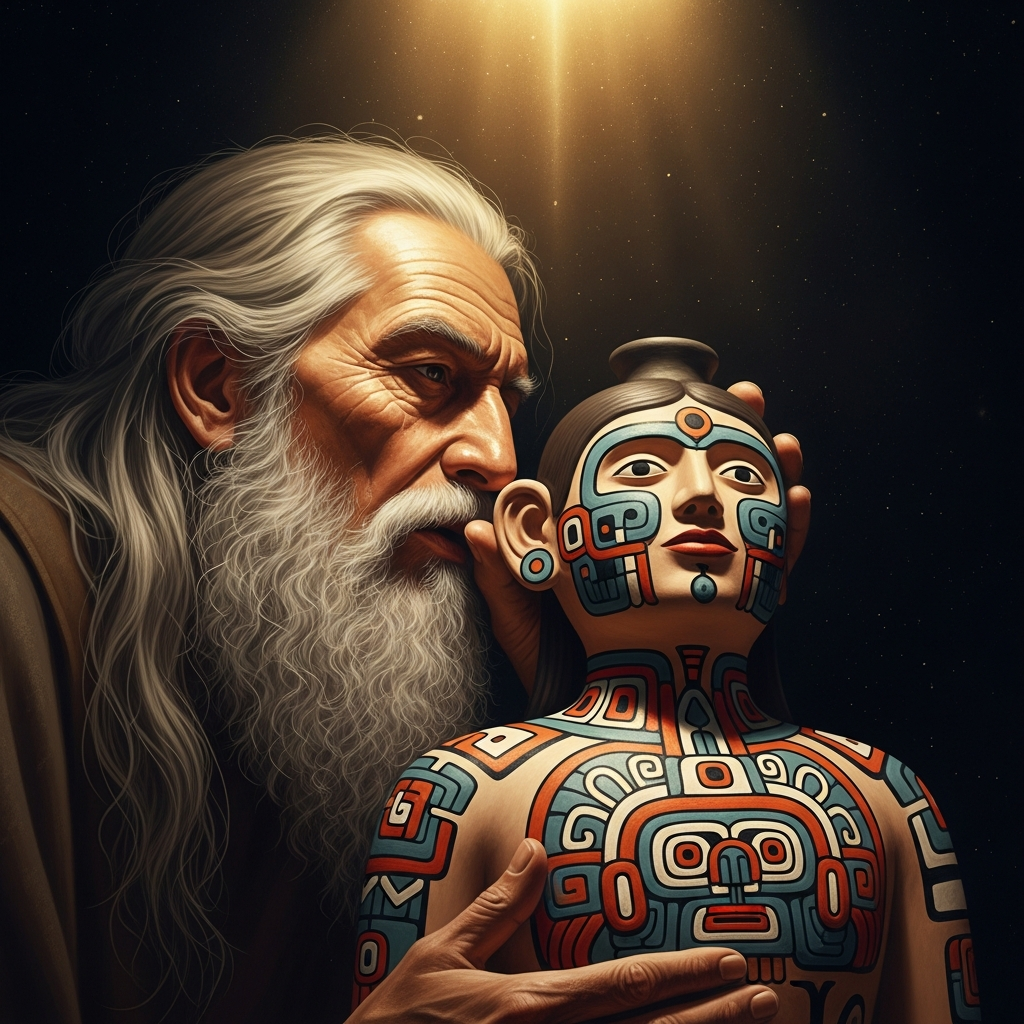
He leans over the first figure and speaks directly into the clay.
This is not a grand gesture. The sources describe it intimately: Viracocha bending close, his mouth near the clay ear, speaking the instructions and breathing the life together in a single act. What he speaks is not just the animating word but the specific charge: this is who you are, this is where you will go, this is the place that is yours. The clay figure’s fingers flex. The eyes open into the darkness and see the creator’s face before they see anything else. The first knowledge of every nation is the face of the maker.
He breathes them all, figure by figure, and each one wakes with the same orientation: knowing its own name, its own clothing already on its body in the colors he painted, its language already in its throat, its destination already written into its bones like a magnetic orientation, the pull of a specific cave or spring or mountain summit calling from somewhere to the north and south and east and west.
Then he sends them underground.
This is the part of the myth that sounds strangest to a modern ear and was most completely the theological core of the Andean world: each group descends into the interior of the earth at Tiahuanaco, into the hollow world-body that the Andean cosmology understands as inhabited rather than empty, and travels through the dark interior to its assigned place of emergence. Some will travel days. Some will travel longer. Each group follows the pull in its bones, the direction Viracocha built into the clay, navigating the dark interior of the world like seeds moving through soil toward the light.
They carry their clothing and their language and their face and their name through the darkness, unchanged.
The huaca is the door he cut for you.
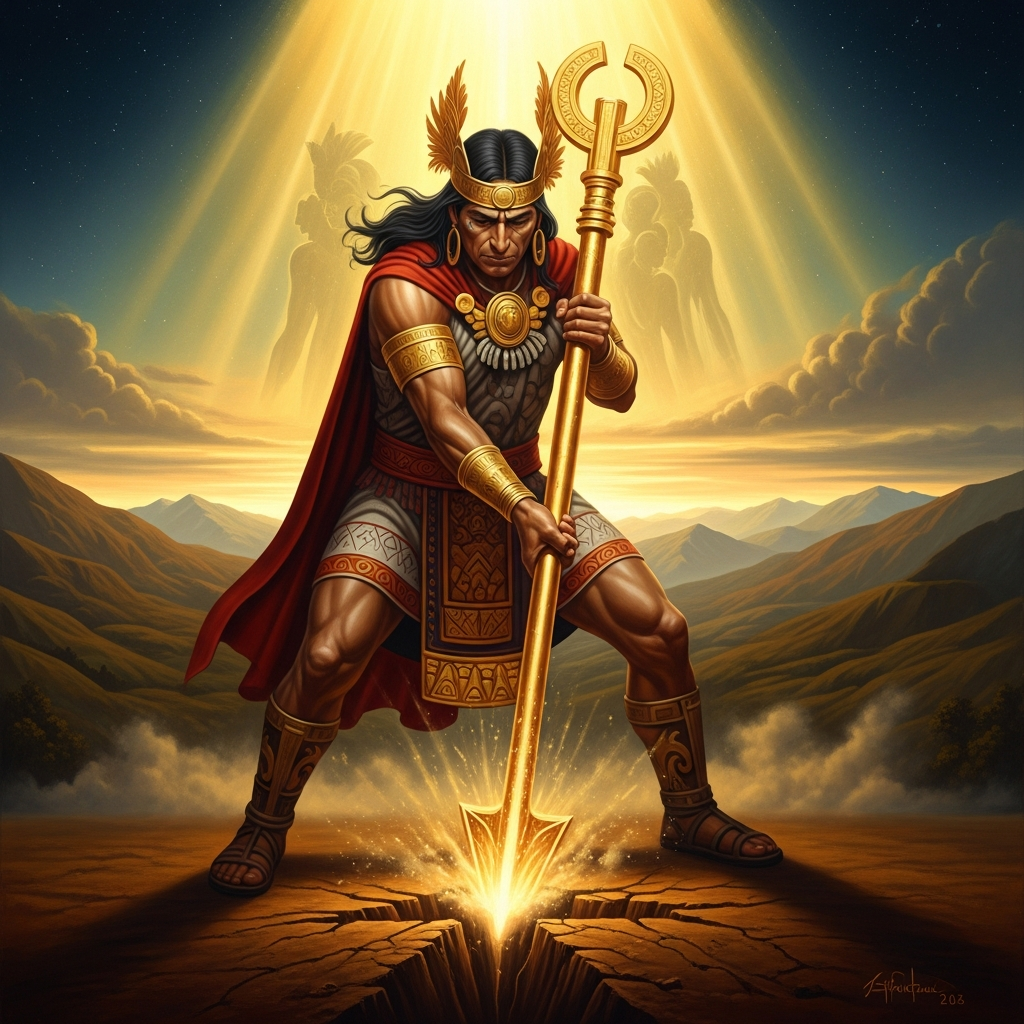
Every community in the Andes, in the centuries before the Spanish arrive, has a huaca — a sacred place of emergence, a specific feature of the landscape that the community understands as the point at which their ancestors first appeared in the world. A spring. A cave. The summit of a particular mountain, its peak cracked at exactly the angle at which the first mother stepped through. A river bend where the water swirls counterclockwise and the reeds grow in the pattern of a doorway. A flat rock with handprints worn into it from ten thousand years of touching.
The huaca is not a metaphor. In the Andean understanding, it is the literal architectural feature of Viracocha’s creation — the specific address in the world’s surface that he cut or chose or designated as the emergence point for a specific people. To honor the huaca is not superstition. It is the acknowledgment that your community’s presence in this place is not an accident, not the result of conquest or migration or hunger that drove you across a mountain, but the fulfillment of a design. Viracocha painted you. He breathed you. He sent you here specifically. The huaca is the proof.
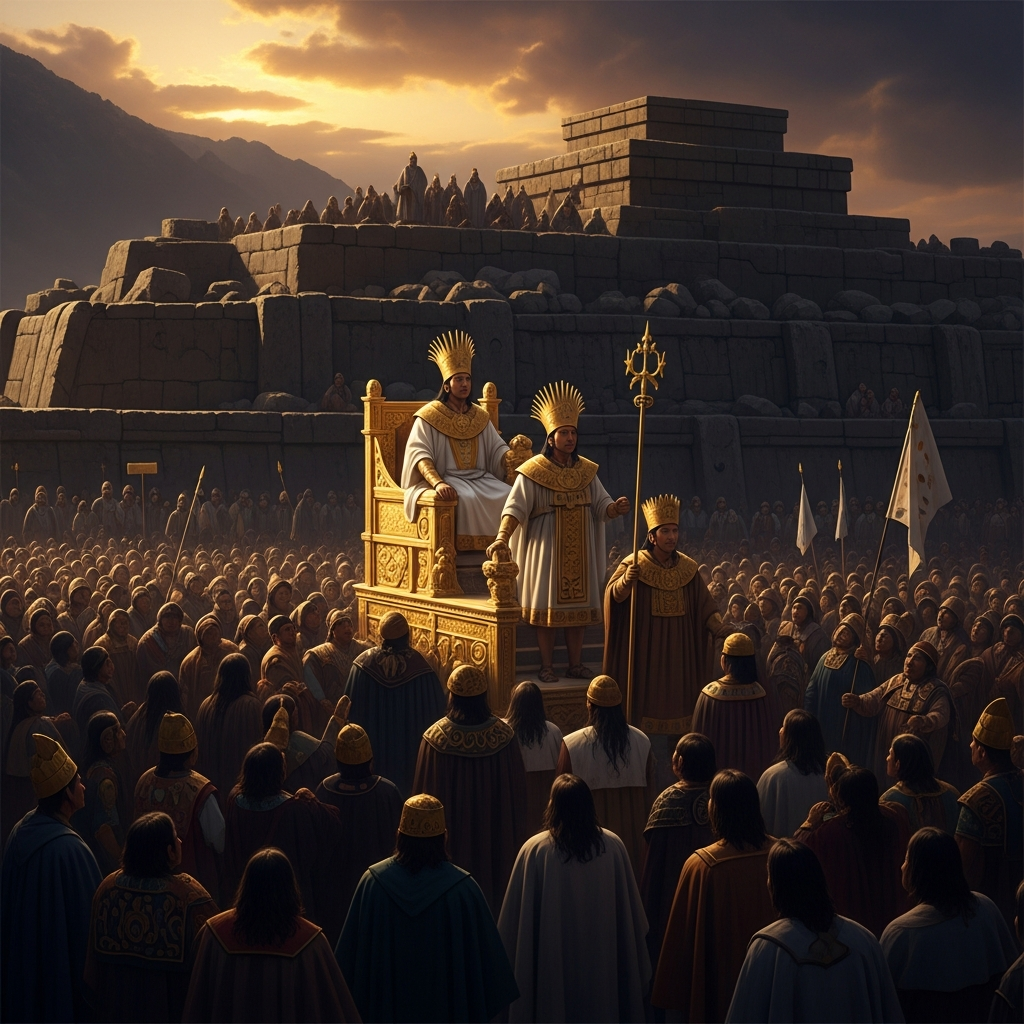
Ceque — the system of 41 imaginary lines radiating from the Coricancha in Cuzco, each one threading through a sequence of huacas in the surrounding landscape — is the map of this intention. Each line is a memory of the network of emergence points, a chart of Viracocha’s geography of creation, maintained in living practice by the families assigned to tend each huaca on each line. The ceque system is not superstition organized. It is theology made spatial: the city of Cuzco as the center of Viracocha’s creation, the lines running out from it to every point at which his design touched the earth.
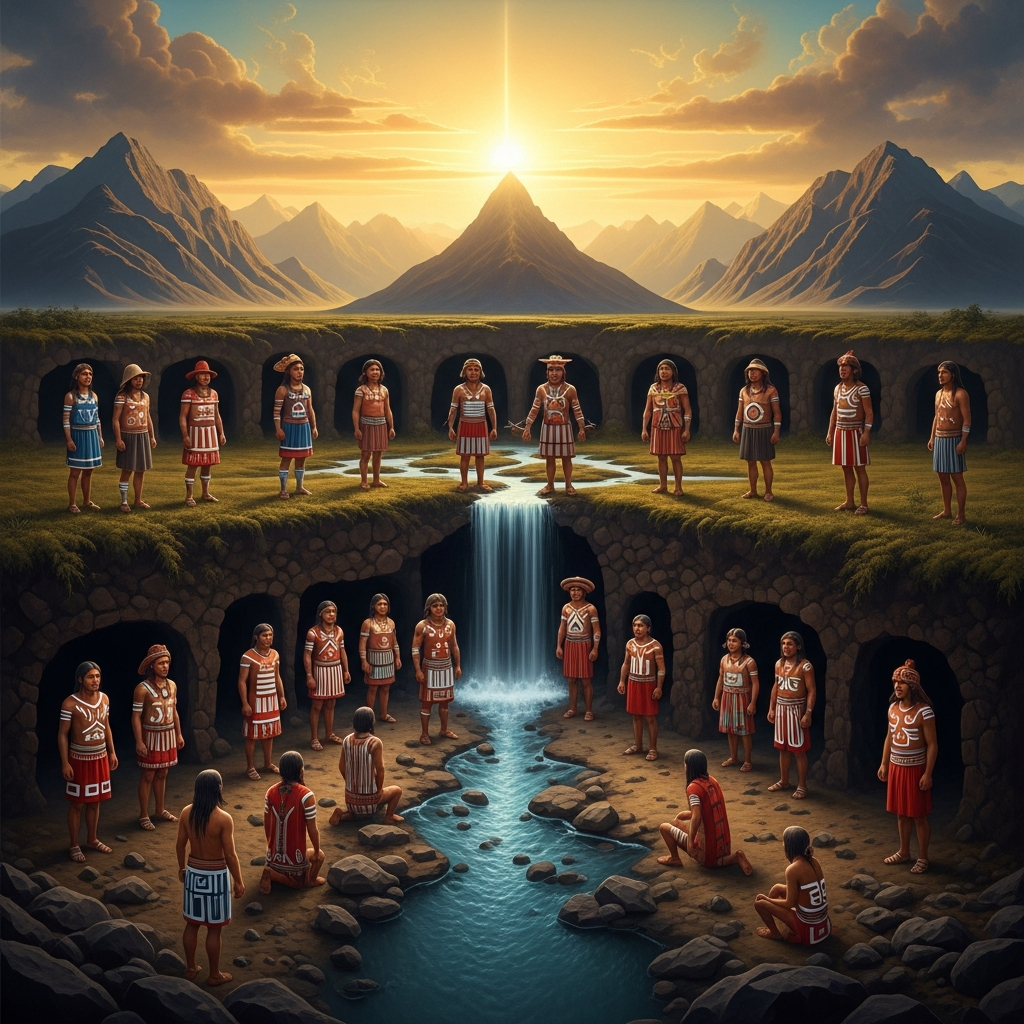
They emerge into the first light.
The sun that Viracocha creates — he creates it from the Island of the Sun in the middle of the lake, speaking it into existence and setting it on the path it will travel forever — rises for the first time on the same morning that the nations emerge from their places. This synchronization is not coincidence. It is direction: the sun created to light the world at the moment the world’s people step into it.
Across the altiplano, from the high desert valleys to the river gorges to the coastal lowlands, people step out of caves and rise from springs and appear on mountain summits wearing exactly the clothing their creator painted them in. The Colla emerge onto the open plain, their llama-wool cloaks in the colors of the altiplano’s grasses. The forest peoples come up from river banks, their bodies already adapted to the humidity. The coastal peoples appear at the edge of the sea, which they have never seen but which their bones already know the smell of.
Each community looks around at the landscape they have emerged into — the specific valley, the specific altitude, the specific sky — and recognizes it. Not because they have been here before. Because Viracocha described it to the clay, and the clay remembers, and the clay is now their body.
They begin the work of the world.
The Spanish missionaries who encountered the huaca system in the 1600s understood it as the most stubborn and irrational form of indigenous resistance to conversion. Pablo José de Arriaga, the Jesuit who directed the extirpation campaigns in Peru from 1621, identified the huacas as the primary obstacle: as long as communities maintained their sacred emergence points, the Inca cosmology maintained its structural integrity and Christian conversion remained superficial. He was correct about the mechanism. He was wrong about the solution.
The extirpación de idolatrías — the Extirpation of Idolatry campaigns — sent inspectors through every village in the Viceroyalty of Peru to find and destroy the huacas, confiscate the conopas (household sacred objects), interrogate community members under threat of flogging, and replace the sacred sites with crosses. They destroyed thousands of objects. They flogged hundreds of practitioners. They built churches over the most important huacas.
The churches stand on the huacas.
The huacas are still below.
A people whose right to exist in a place is written into the design of the place itself cannot be evicted from the design by demolishing the surface marker. The spring still flows below the church. The cave still opens on the mountainside. The rock still has the worn handprints. And the people whose bones were made from Viracocha’s clay still feel the pull of the specific emergence point their creation encoded, and they still go there, and they still touch the stone, and they still pour the chicha and leave the coca and feel the ground receive it.
Viracocha painted the nations and breathed them into the world and the paint did not wash off. Five hundred years of colonial theology has not removed the clothing he painted onto the clay. The faces are still the faces. The languages, though damaged and sometimes erased, are still present in the throat-shapes he designed. The emergence points are still in the landscape, still in the bones. The world he created at Tiahuanaco is still the world that the Andean people live in — because design precedes event, and the design was correct, and Viracocha does not make mistakes twice.
Scenes
Viracocha kneeling at the clay shore of Lake Titicaca before dawn, rows of man-sized clay figures laid out before him on the mud flat, each one painted with the distinct clothing and features of a different Andean nation — llama-wool cloaks in red and black, different haircuts, different faces — all still and waiting for the breath of life, the water of the lake silver-black behind him
 Generating art…
 Viracocha leaning over a painted clay figure, his mouth close to its clay ear, breathing the first breath — the figure's fingers beginning to flex, its eyes beginning to open, a faint warm glow at the point of breath as if the air itself is changing character
 Generating art…
 Across the Andean altiplano at dawn, people emerging from caves and rivers and mountain summits in the exact clothing they were painted in underground — each nation stepping into the light at the sacred place Viracocha assigned them, the mountains golden in the first sun
 Generating art…
 Echoes Across Traditions
Entities
- Viracocha
- Imaymana Viracocha
- Tocapu Viracocha

Sources
- Juan de Betanzos, *Narrative of the Incas* (1557; translated by Roland Hamilton and Dana Buchanan, University of Texas Press, 1996)
- Pedro Sarmiento de Gamboa, *Historia de los Incas* (1572; translated by Brian Bauer and Vania Smith, University of Texas Press, 2007)
- Bernabé Cobo, *History of the Inca Empire* (1653; translated by Roland Hamilton, University of Texas Press, 1979)
- Cristóbal de Molina, *Account of the Fables and Rites of the Incas* (c. 1575; translated by Brian Bauer et al., University of Texas Press, 2011)
- Gary Urton, *At the Crossroads of the Earth and the Sky: An Andean Cosmology* (University of Texas Press, 1981)