Inti Raymi — The Sun Returns
Annually at the June solstice · festival practiced throughout the Tawantinsuyu empire; suppressed by Spanish 1572, revived 1944 · Sacsayhuamán — Cuzco — the Coricancha (Temple of the Sun)
Contents
At the June solstice, the Sapa Inca — divine son of the Sun — stands at Sacsayhuamán fortress above Cuzco and calls his father back from the southern extreme. A sacred llama dies; its entrails speak; a golden mirror lights the new fire. For nine days the entire empire stops and feasts. If the king fails to perform this ceremony correctly, the sun will not turn. The world will freeze and starve.
- When
- Annually at the June solstice · festival practiced throughout the Tawantinsuyu empire; suppressed by Spanish 1572, revived 1944
- Where
- Sacsayhuamán — Cuzco — the Coricancha (Temple of the Sun)
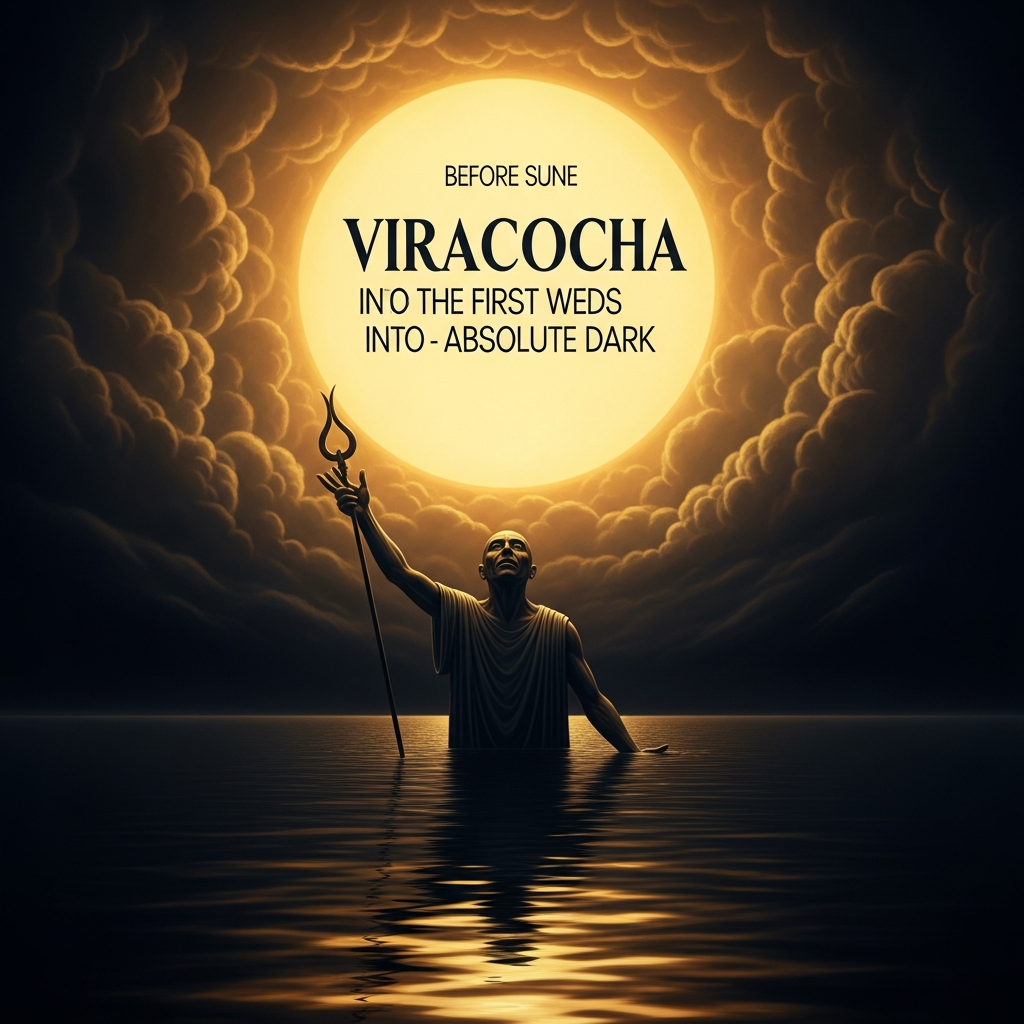
Before the sun rises, the darkness at Sacsayhuamán is absolute.
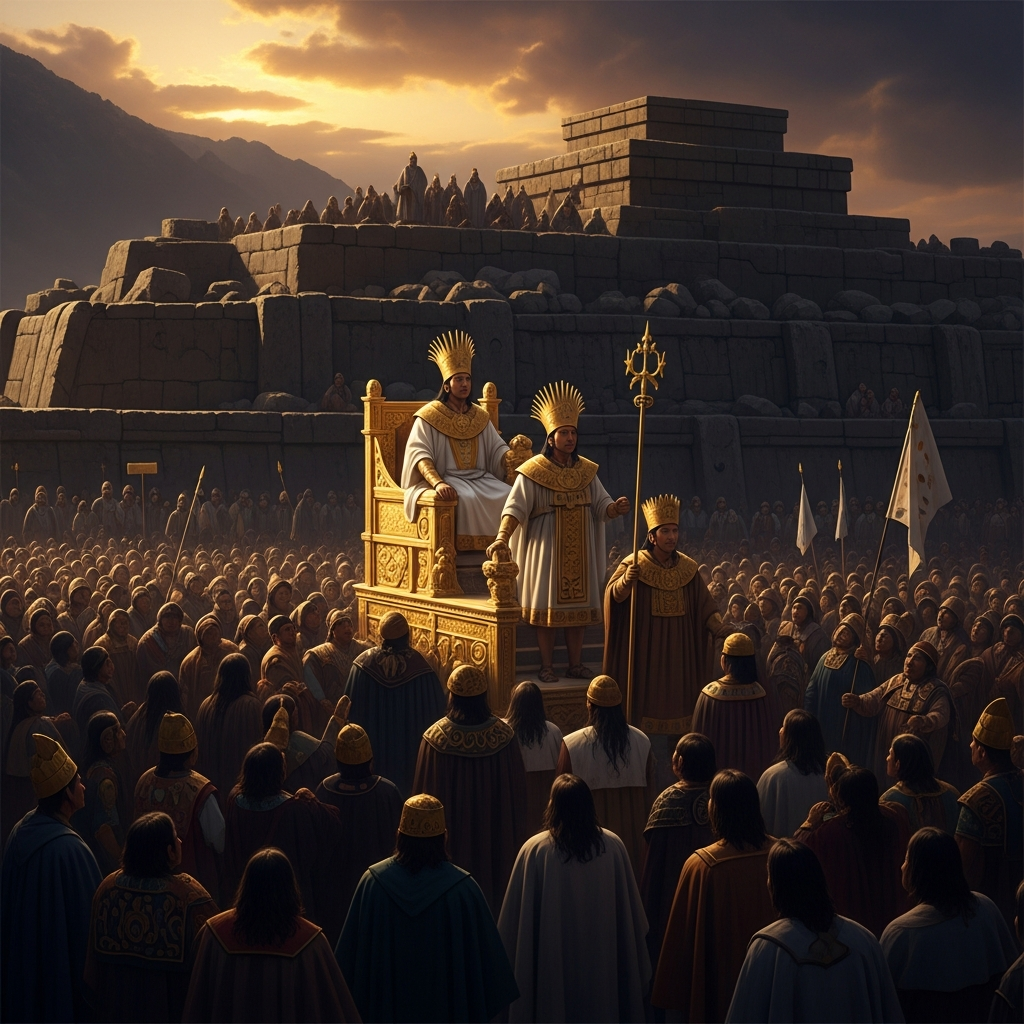
The stone walls of the fortress rise in three tiers above the valley of Cuzco — enormous zigzag courses of fitted limestone, some blocks weighing three hundred tons, joined without mortar in a pattern that has withstood every earthquake for seven centuries. Ten thousand people stand in the darkness below the walls, and they are silent. The silence is mandatory. Before the Sapa Inca speaks, no human voice may break the pre-dawn dark. This is not ceremony’s theatricality. It is theology: the son of the Sun must be the first voice, and the first voice must call his father.
The Sapa Inca arrives on his golden litter. The crowd does not look at him directly. To look at the Sapa Inca is to look at the Sun, and the Sun blinds — not as metaphor but as fact. He descends at the ceremonial center of the plaza and he faces east, toward the horizon where the sky is beginning to separate from the mountains, a blue-black gradation that in the altiplano comes fast, the Andean dawn having no gentle overture.
He opens his arms.
The ceremony at its core is a conversation between a son and his father.
Inti — the Sun — is not an abstraction in Inca theology. He is a person. His image in the Coricancha, the Temple of the Sun in Cuzco, is a golden disk with a human face, radiating in all directions, and it is treated as a living being: fed, clothed, consulted. The face on the disk has eyes. The sources from Betanzos and Cobo describe the Coricancha’s inner sanctum as oriented to receive the rising sun’s light through a specific window during the solstices, the beam traveling across the floor to illuminate the golden image’s face directly — a solar alignment engineered into the architecture to make the conversation visible once a year.
At the June solstice, the sun reaches its southernmost point. From the Inca perspective — from the southern hemisphere’s perspective — the sun has been walking away. Each day since December it has moved slightly south, its arc crossing the sky at a lower and lower angle, its warmth less committed, until this moment when it stands at the far edge of its southward wandering and hesitates.
The Sapa Inca calls it back.
Inti, my father. Do not go further. The world requires your warmth. Your children are cold. Turn and come back.
It is not prayer in the Christian sense — supplication from below to a higher power. It is address between relations. The Sapa Inca is the Sun’s son, conceived in the same act that founded Cuzco. He speaks as an heir speaks to a parent who has wandered too far from home: not commanding, not begging, but claiming the relationship.
The llama is white and unblemished and it knows nothing of what it carries.
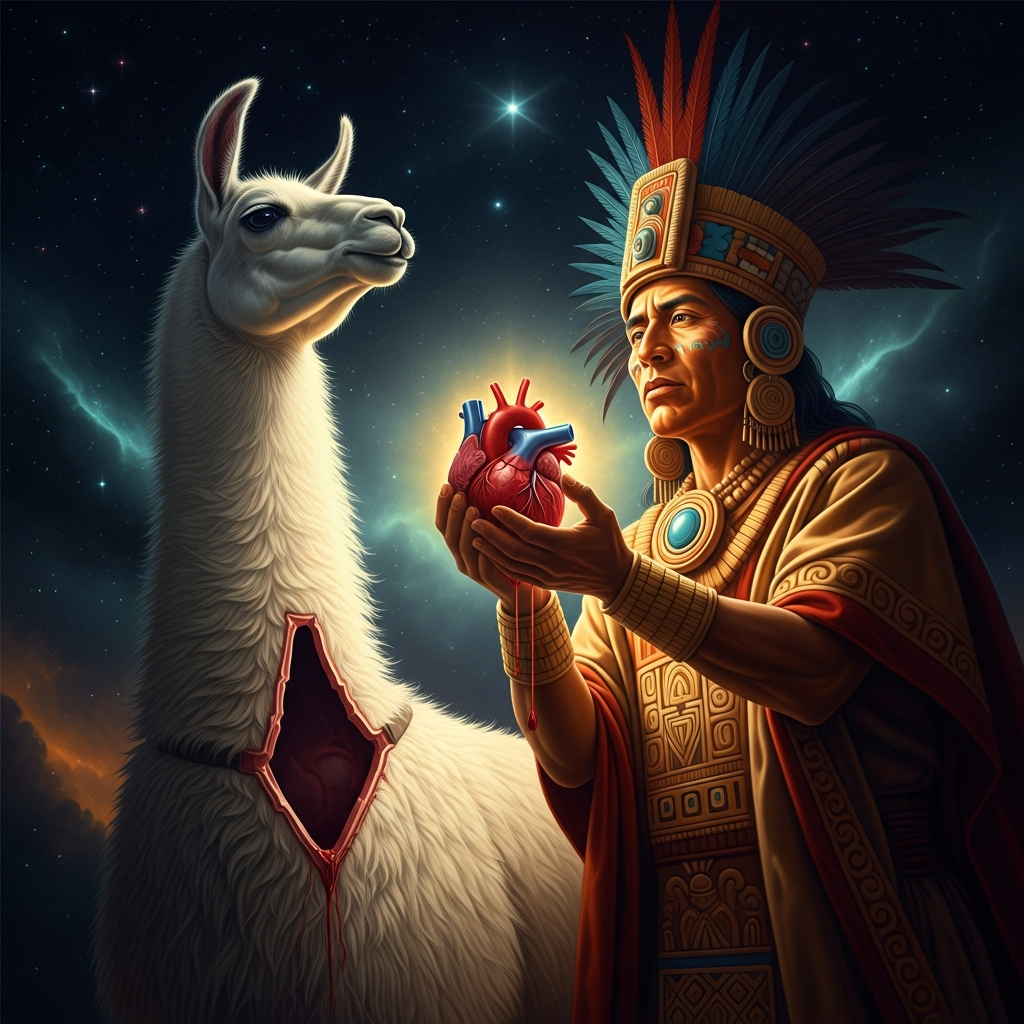
The Villac Uma — the high priest, the “head who speaks,” the voice of Inti on earth — approaches the animal while it is still alive and opens it. The sequence is precise: the animal must be alive when the heart is reached, because the organs speak only when they are still warm, still operating, still in the process of their function. Dead animals tell you nothing. Living ones tell you everything — or rather, they display what the universe has already decided, the year’s outcome written in the arrangement of flesh, the coloration of the liver, the pattern of the lung as it stops.
The lungs are removed while still inflating and deflating from the last heartbeats, and the Villac Uma reads the branching bronchial patterns, the color of the pleura, the weight of the tissue. This is calpa — the art of divination by anatomical observation — and it is not superstition in the Inca framework. The llama was raised on the Sun’s own herds, fed the Sun’s own pastures. Its body is the Sun’s body. What the Sun intends for the coming year is written in the body of his own animal.
The reading takes time. The ten thousand on the plaza wait. The sky lightens. The omen is a full technical report: which provinces will have rain, which will face drought, whether the empire’s armies will meet resistance or find easy passage, whether the coast’s fishing will be abundant. Bernabé Cobo, who watched these ceremonies in the early colonial period before they were fully suppressed, noted that the omen-reading was taken seriously by everyone present — not as theater, but as the most important information the empire would receive all year.
The Sapa Inca takes the golden mirror.
It is not large — perhaps the size of a man’s face, slightly concave, burnished to a precision that catches light and focuses it. The Inca metallurgists who made it understood optics not as a science but as a prayer-technology: a mirror that concentrates sunlight is a tool for bringing the sun’s body into contact with the earth, for making the solar and the terrestrial touch in a controlled point.
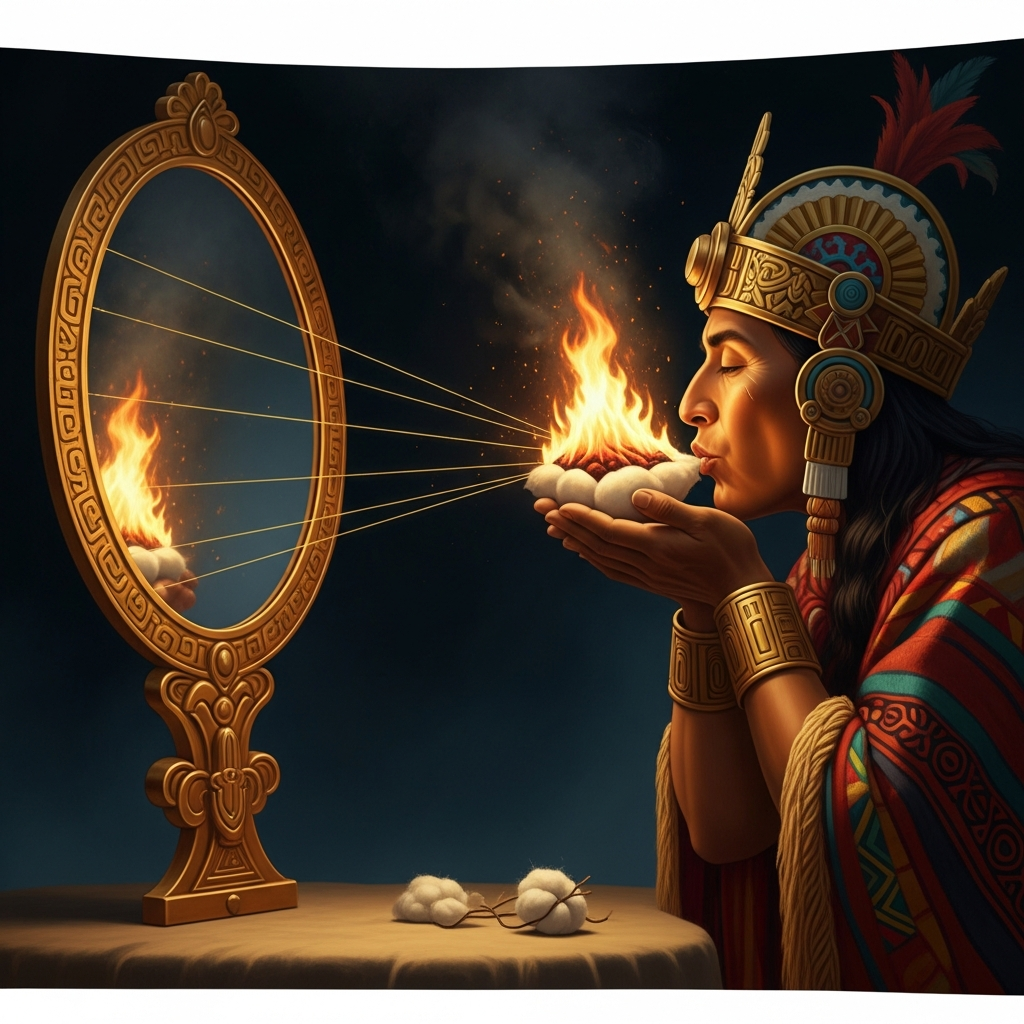
The sun clears the horizon. The Sapa Inca raises the mirror and angles it until the reflected beam — brilliant, white, focused — falls on a wad of fine cotton that has been prepared on a ceramic bowl. The cotton smolders. It catches. The Sapa Inca leans forward and breathes on the ember.
The flame rises from his breath.
The sacred fire of the new solar year comes into existence through the union of three things: the sun’s light, the mirror’s focusing, and the son’s breath. It is not started by friction or by spark. It is started by relationship: the son calling his father’s energy into the world by lending his own body as the last step in the transmission. The fire is then carried to the Coricancha, to the Temple of the Moon (Mama Quilla), to the Acllawasi where the chosen women live, to the army camps in every corner of the empire — the same fire, divided and carried, a solar network of ignition that takes days to complete.
For nine days the empire stops.
Nothing moves in the Tawantinsuyu — the Four Quarters — during the nine days of Inti Raymi.
The roads, which normally carry the most sophisticated relay-runner communications system in the pre-Columbian world, fall silent. The chasqui runners rest. No new orders issue from Cuzco. No armies march. No justice is administered, no disputes adjudicated, no executions carried out. The bureaucratic machinery of an empire that administered perhaps twelve million people across the length of western South America simply stops, and the stopping itself is the ceremony.
Every province feasts on the imperial storehouses. The qollqa — the great circular and rectangular storehouses that the Inca built on every hillside near every administrative center — are opened, and the freeze-dried potatoes and charqui and chicha corn beer that have been accumulating since the previous harvest are distributed. The feast is not a reward. It is the cosmic mechanism of reciprocity completing its cycle: the people gave labor to the empire through mit’a, the empire held the surplus, and the surplus returns to the people at the moment of the solar renewal. The empire is a circulation system, and Inti Raymi is the heartbeat.
The chicha — corn beer, sacred beverage, offered first to the Sun before any human drinks — flows in quantities the Spanish chroniclers describe with barely concealed amazement. Cobo estimates that the festivals consumed what a Spanish city of comparable size would need for a year. But this is the point: the surplus exists to be consumed at the solar crisis, because consuming it is the act of trust that the sun will return and the next harvest will come, and trust in the sun’s return is precisely what the Sapa Inca has just demonstrated by calling his father back from the south.
The ceremony that the Spanish banned in 1572 returned in 1944.
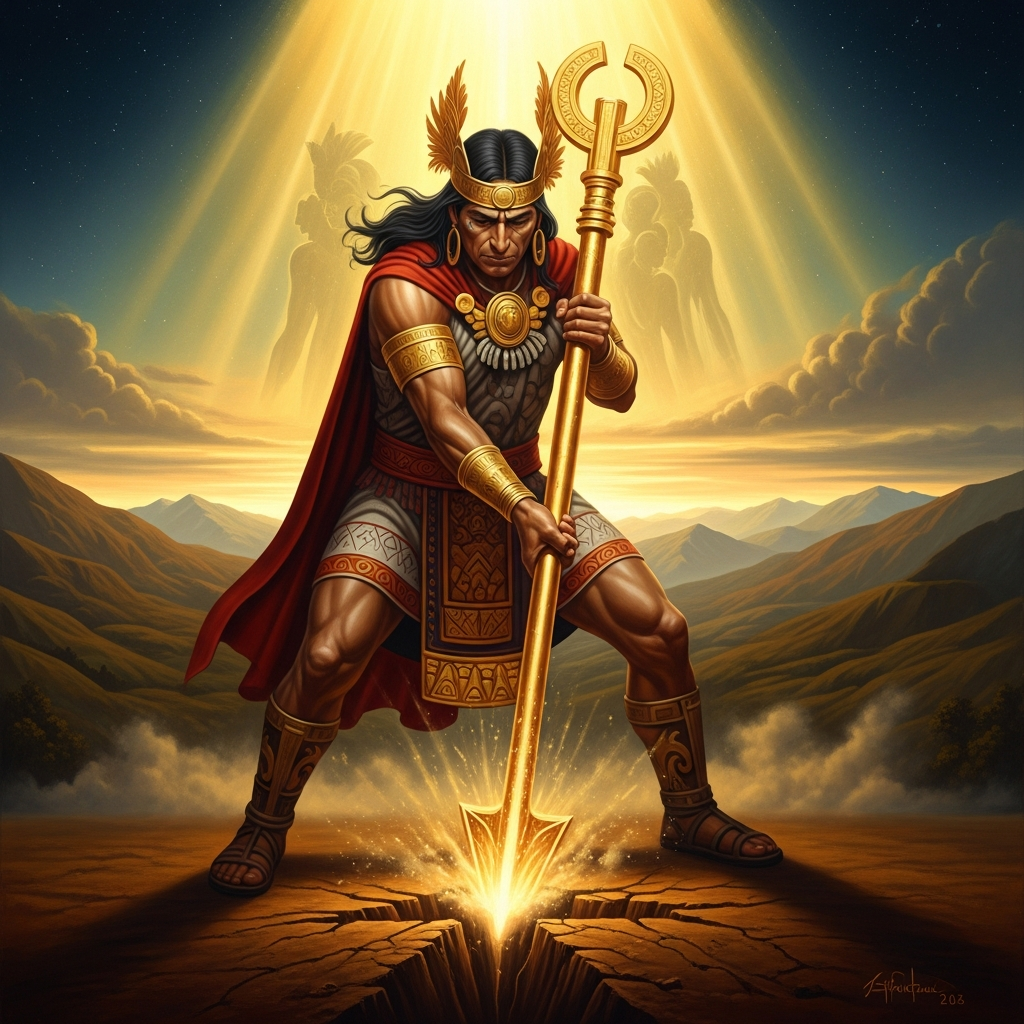
It was revived by a Peruvian actor and playwright named Faustino Espinoza Navarro, who staged a reconstruction in Cuzco using Quechua-speaking performers and period costumes. He had no priest’s authority, no Sapa Inca to call the sun. What he had was the place — Sacsayhuamán, still there, the stones still fitted, the zigzag walls still rising in three tiers — and the calendar, which Viracocha had set into the sky and which the Spanish had been unable to alter.
The revival is now the largest festival in South America. Tens of thousands attend. The Sapa Inca is played by an actor. The Villac Uma is played by an actor. The llama sacrifice is mimed, not performed — a concession to contemporary sensibilities that the original ceremony would not have recognized as either necessary or meaningful. But the golden mirror is real, and the sun still rises on the June solstice at the same angle it has always risen, and the actor-Inca still raises the mirror and angles it, and if the sky is clear, the beam still falls.
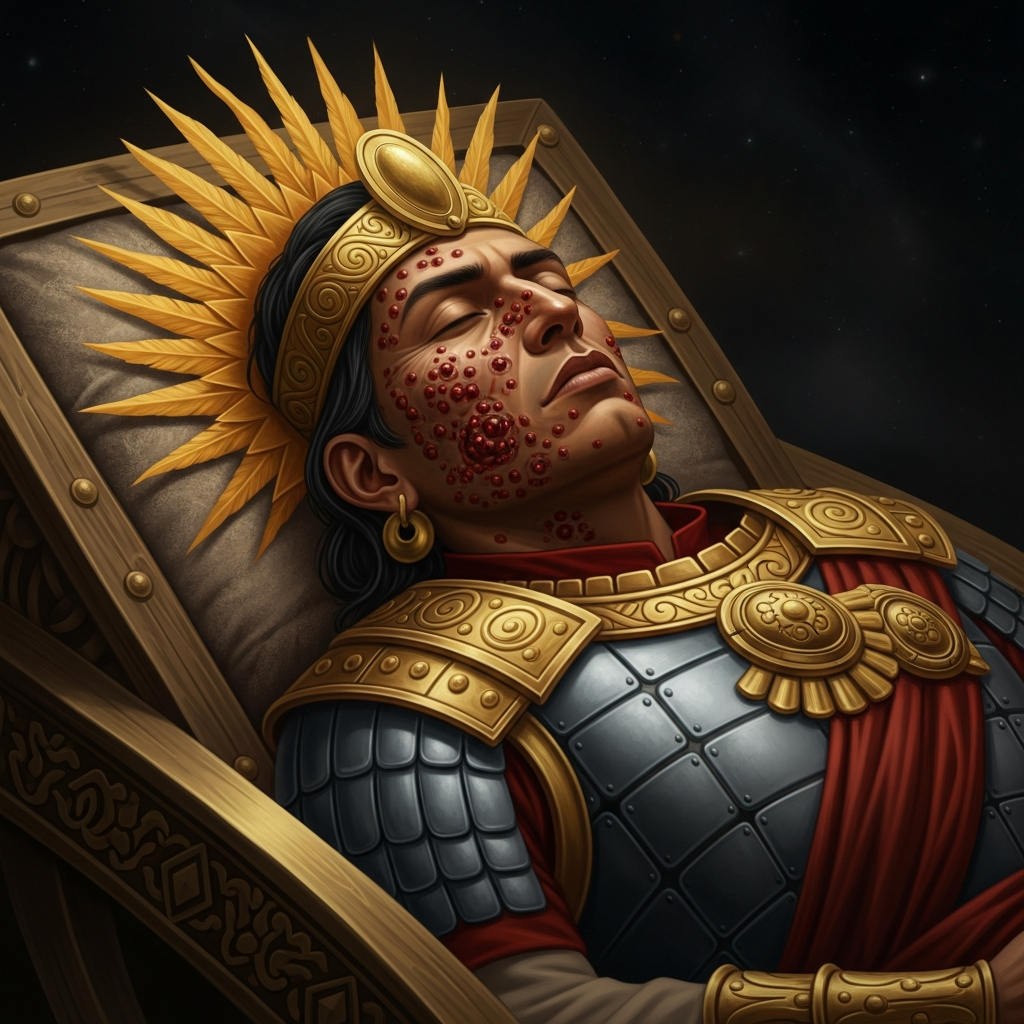
What the Spanish understood in 1572, when they banned the ceremony, was that Inti Raymi was not entertainment or cultural expression — it was the mechanism by which the Sapa Inca’s divine authority was renewed each year, the sun confirming his son’s mandate by showing up on schedule to receive his son’s call. To ban the ceremony was to sever the connection. They were right that severing it mattered. They were wrong that it could not be repaired. The sun still rises at Sacsayhuamán, and there is still someone in the plaza below calling to it, and the sun, as it always has, turns back toward the north.
Scenes
At Sacsayhuamán, ten thousand gathered in the dark before dawn as the Sapa Inca descends from the royal precinct in his golden litter, the crowd parting in absolute silence, no one permitted to look directly at the Son of the Sun
Generating art… The sacrifice: the white llama is brought forward, its heart removed while still beating; the Villac Uma — high priest — reads the convulsions of the still-living organs for the omens that will govern the next year's agriculture and war
 Generating art…
 The golden mirror catches the first direct rays of the solstice sun and focuses them onto a wad of fine cotton until it smolders and catches; the Sapa Inca breathes on the ember; the sacred fire of the new solar year enters the world through the king's breath
 Generating art…
 Echoes Across Traditions
Entities
- Inti (the Sun)
- Sapa Inca
- Villac Uma (High Priest)
- Mama Quilla (the Moon)
- Pachamama (Earth Mother)
Sources
- Cristóbal de Molina, *Account of the Fables and Rites of the Incas* (c. 1575)
- Bernabé Cobo, *History of the Inca Empire* (1653)
- Polo de Ondegardo, *Errors and Superstitions of the Indians* (1559)
- Garcilaso de la Vega, *Comentarios Reales de los Incas* (1609)
- Anthony Aveni, *Skywatchers of Ancient Mexico* (1980)
- R. Tom Zuidema, *Inca Civilization in Cuzco* (1990)