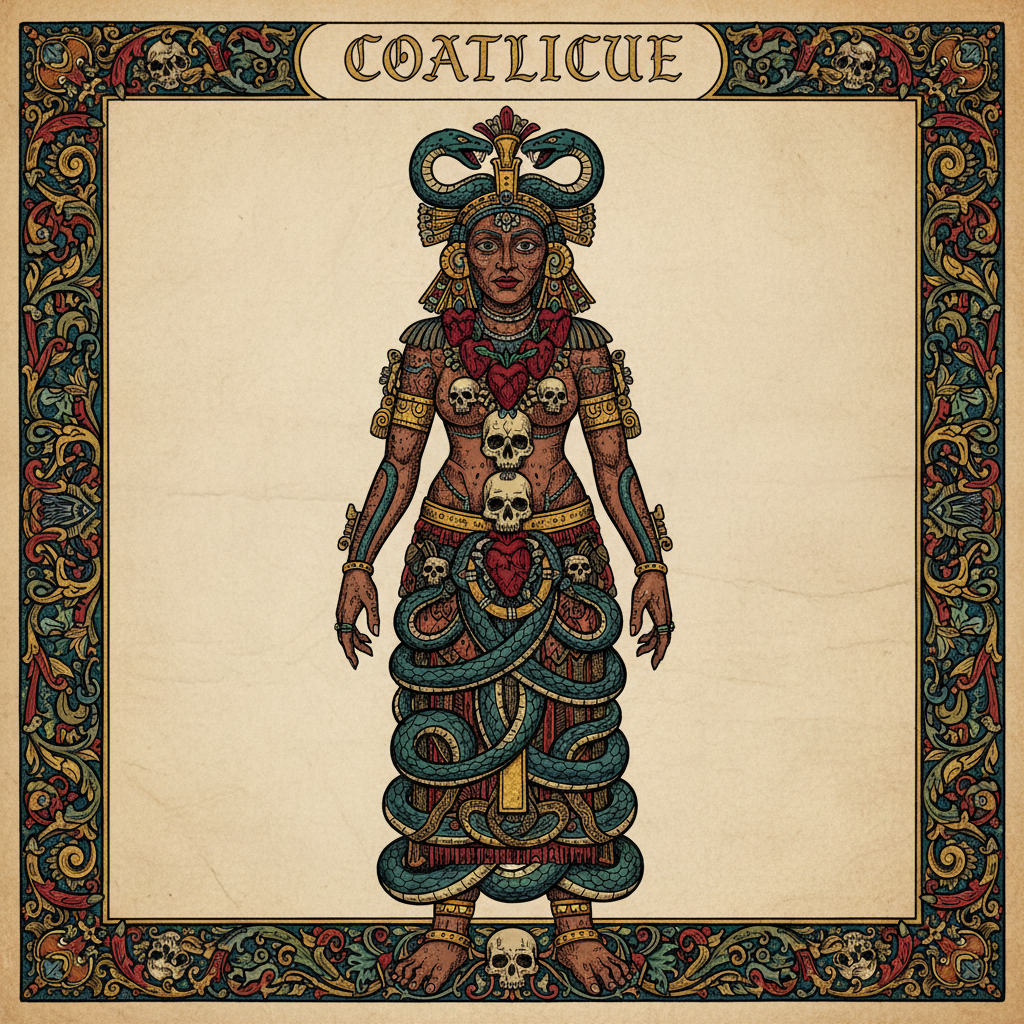
Coatlicue Swept the Temple
Mythological time — the beginning of the fifth sun era · Coatepec (Serpent Mountain), Mexico
Contents
The earth mother who conceived Huitzilopochtli from a ball of feathers while sweeping the temple, was attacked by her four hundred children, and was defended by Huitzilopochtli springing forth fully armed. The birth as cosmological war.
- When
- Mythological time — the beginning of the fifth sun era
- Where
- Coatepec (Serpent Mountain), Mexico
She sweeps the temple every morning.
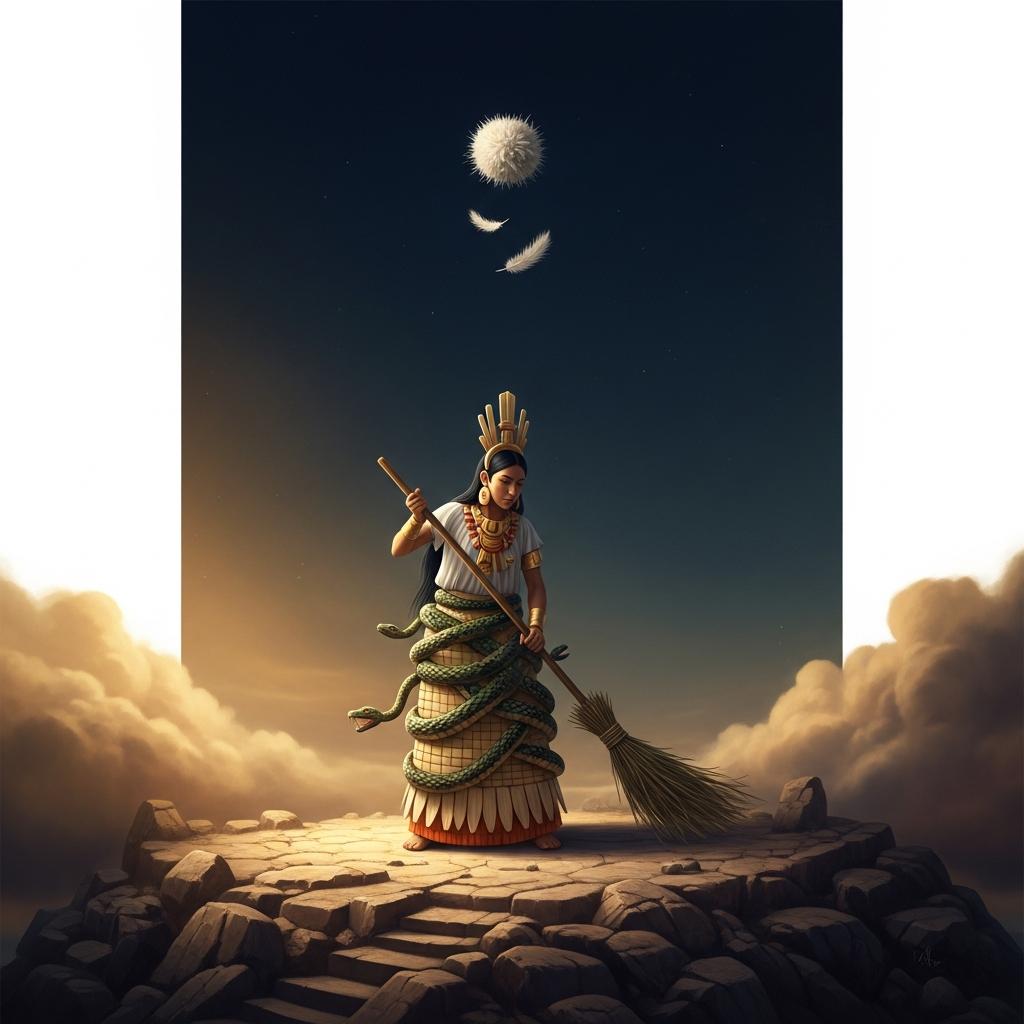
This is her function and her dignity: Coatlicue, She of the Skirt of Serpents, keeps the summit of Coatepec clean. Her skirt is made of interlocked snakes, their scales catching the low light as she moves. Her face, when you look at it directly — the great stone sculpture found in Mexico City in 1790 makes this clear — is made of two serpent heads facing each other, two confronted profiles that together form a single frontal visage. She is not ugly in the sense of failed beauty. She is something prior to the category. She is the earth before it decides what to grow.
She sweeps every day and has swept every day since before the current world age began. The mountain she tends, Coatepec — Serpent Mountain — is the axis around which the myth turns. High up on the mountain, in the pre-dawn dark when the stars are still at full strength and the four hundred sons of the south, the Centzon Huitznahua, are still the dominant lights in the sky, she sweeps.
Then the feather descends.
It comes from above, which is to say from nowhere that the sweep of a broom can explain, a small ball of white down that the sources describe as tochomitl — the fine loose fiber of feathers, the part that floats. It lands against her chest as she bends, and she tucks it under her garment to keep it safe until she finishes sweeping. She intends to deal with it later. When she straightens, she has already been changed. The feather is gone, absorbed, and she is pregnant.
Coatlicue is a widow, or she has no husband — the sources are not clear on this point and the myth does not require clarity. What the myth requires is that the pregnancy have no human father, because what is growing inside her is not human. The Florentine Codex says she knew it immediately, or she knew when her body began to tell her. She had already raised the Centzon Huitznahua, the four hundred star-children of the south, and their sister Coyolxauhqui, She Whose Cheeks Are Painted with Bells — the moon goddess, the eldest daughter, the one who inherited her mother’s role of keeping order among the siblings.
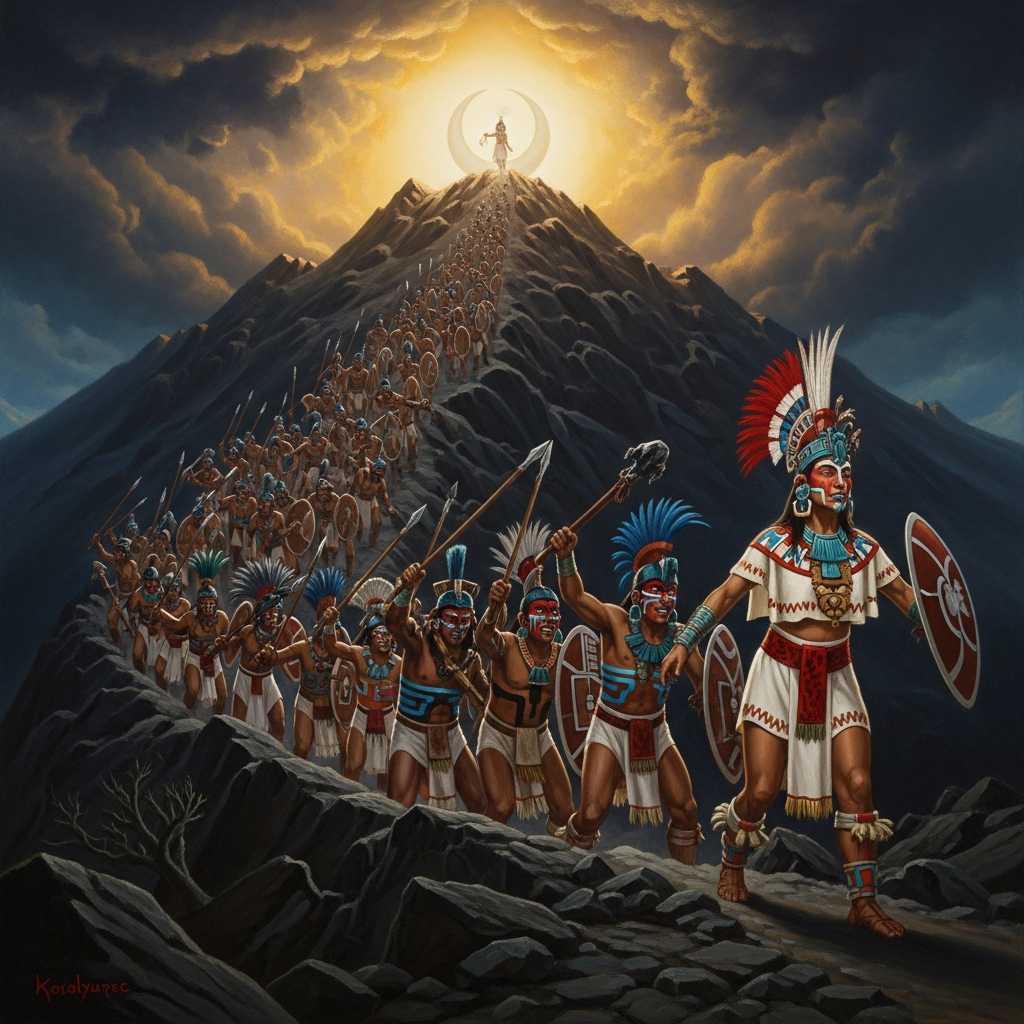
Coyolxauhqui is furious. The story the sources tell is that she learned of the pregnancy and felt it as a dishonor — to the family, to the protocols of divine birth, to the cosmic order she has spent her existence maintaining. She calls the four hundred brothers together and tells them what has happened and they agree with her: this must not be allowed. They prepare weapons. They paint themselves for war. They begin the descent toward the summit of Coatepec, where their mother is still sweeping, slower now, her body already thickening with what is coming.
One of the four hundred breaks ranks and runs ahead to warn her.
She hears the sound of their approach on the mountain — four hundred war-equipped stellar beings, bronze and fire, their bells ringing in the pre-dawn dark — and Coatlicue weeps, or shakes, or does both simultaneously. Inside her, the voice of Huitzilopochtli says: Do not be afraid. Do not be troubled. I know what I must do.
He is speaking from inside her womb. He has not been born yet.
The Centzon Huitznahua reach the summit. Coyolxauhqui is at their front, her weapons raised, her bells chiming with the movement of her arms. She is the moon at full power, the light that rules the night, the goddess who has never been defeated. The four hundred surround their mother.
Then the birth.
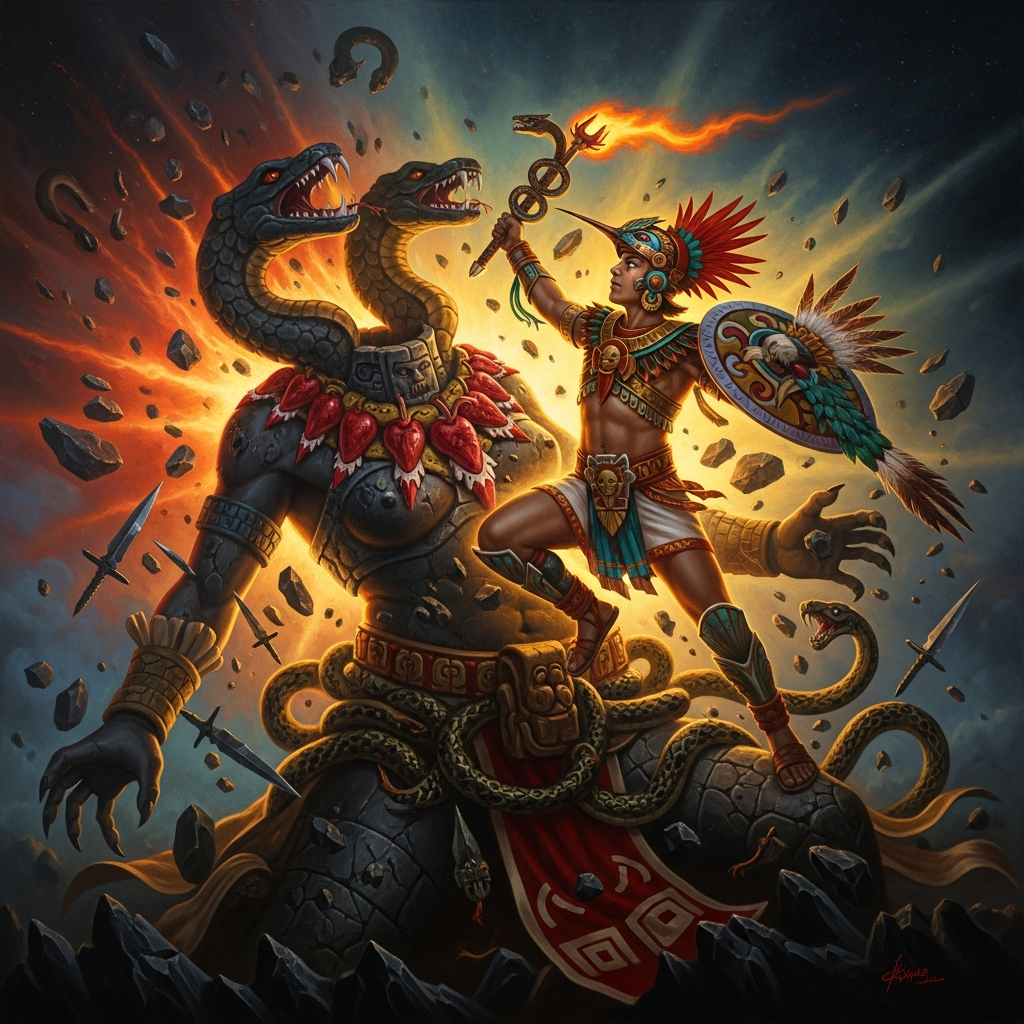
It is not like any birth the mythology describes elsewhere. Huitzilopochtli does not emerge from the womb in the way of mortal children. He is born fully formed, fully armored, his left leg feathered in hummingbird plumage that is both beautiful and terrible, his face painted in stripes, his shield and darts already in his hands. In his right hand he carries the Xiuhcoatl, the fire serpent — not an actual serpent but a weapon of condensed lightning, the instrument the sun uses to cut the darkness at dawn.
He turns it on his sister.
Coyolxauhqui dies on the summit, but that is not the specific thing the myth needs. What the myth needs is what happens to her body. Huitzilopochtli cuts her to pieces: head, arms, legs, torso, all separated from each other and thrown down the slope of the mountain, tumbling in the dark to the foot of Coatepec where they land in the scattered arrangement the stone sculptor captured four thousand years later in the great disc found beneath the Templo Mayor.
The disc is remarkable. She is on her back, dismembered, her limbs arranged around a central torso, the cut points decorated with snakes and smoke and the precise iconography of cosmic violence. She wears her bells. Her face is still beautiful, still powerful, the face of the moon goddess who was right about everything except the outcome. She is at the base of the mountain. The sun is at the top.
Then the four hundred. He routs them — most flee, a few are killed, they scatter to the south and become the southern stars. The sky is cleared. Dawn breaks. The sun has won.
This happens every morning. The myth is not past tense. Each sunrise is Huitzilopochtli fighting through the night sky, dismembering the moon, routing the stars. Each dawn is a military victory. Each day the sun rises, it has just barely prevailed.
The Templo Mayor at Tenochtitlan is Coatepec.
This is not metaphor or analogy. The great double pyramid at the center of the Aztec capital is the mountain in the myth, architecturally. Two shrines at the top: one for Tlaloc, one for Huitzilopochtli. The Coyolxauhqui stone at the base, facing west, where the bodies of sacrificial victims landed after being thrown or rolled down the steps. The sacrificial victims are the enemies defeated by Huitzilopochtli. Their blood is the blood the sun requires to win tomorrow morning.
David Carrasco reads the Templo Mayor as a machine for enacting the myth spatially — a built argument that the sun’s daily victory is not guaranteed, that the cosmos requires active maintenance, that the violence performed on the pyramid steps is not cruelty but cosmic necessity, the same necessity that produced Huitzilopochtli from the feather that landed on his mother’s chest in the dark before dawn.
Coatlicue sweeps the summit in the myth. Real priests swept the real summit of the real pyramid every morning, before the sun rose, before the first ceremony of the day. The broom is the oldest tool in the story.
The great stone Coatlicue figure unearthed in Mexico City in 1790 was so disturbing to colonial-era observers that it was reburied after its first viewing. Too much head, too many serpents, too frank about what the earth is — not a mother in the tender sense but a process, a skirt of serpents, a face made of confronted fangs. What she sweeps off the mountain every morning is the darkness. What is born from her is the light that costs everything to produce.
Scenes
Coatlicue in her skirt of woven serpents, sweeping the summit of Coatepec with a broom of grass
 Generating art…
 Coyolxauhqui leading the four hundred southern stars down the slopes of Coatepec, weapons raised, their war paint bright in the pre-dawn dark
 Generating art…
 Huitzilopochtli bursting from Coatlicue's womb already armored, the fire-serpent Xiuhcoatl blazing in his hand
 Generating art…
 Echoes Across Traditions
Entities
- Coatlicue
- Huitzilopochtli
- Coyolxauhqui
- Centzon Huitznahua


Sources
- Bernardino de Sahagún, *Florentine Codex: General History of the Things of New Spain*, Book III (trans. Anderson and Dibble, 1952)
- Inga Clendinnen, *Aztecs: An Interpretation* (Cambridge University Press, 1991)
- David Carrasco, *City of Sacrifice: The Aztec Empire and the Role of Violence* (Beacon Press, 1999)
- Cecelia Klein, 'Fighting with Femininity: Gender and War in Aztec Mexico,' *Estudios de Cultura Nahuatl* 24 (1994)
- Eduardo Matos Moctezuma and Felipe Solis Olguin (eds.), *Aztecs* (Royal Academy of Arts, 2002)