Huitzilopochtli Born on Coatepec
Mythic Time · Aztec cosmogony, recorded post-1519 CE from pre-Columbian oral tradition · Coatepec — Serpent Mountain, near Tula
Contents
The earth goddess Coatlicue becomes pregnant from a ball of feathers while sweeping the temple. Her daughter Coyolxauhqui leads four hundred brothers to kill their mother for the dishonor. At the moment of death, Huitzilopochtli bursts fully armed from her womb, slays his sister, and throws her body down the mountain in pieces.
- When
- Mythic Time · Aztec cosmogony, recorded post-1519 CE from pre-Columbian oral tradition
- Where
- Coatepec — Serpent Mountain, near Tula
Coatlicue is sweeping.
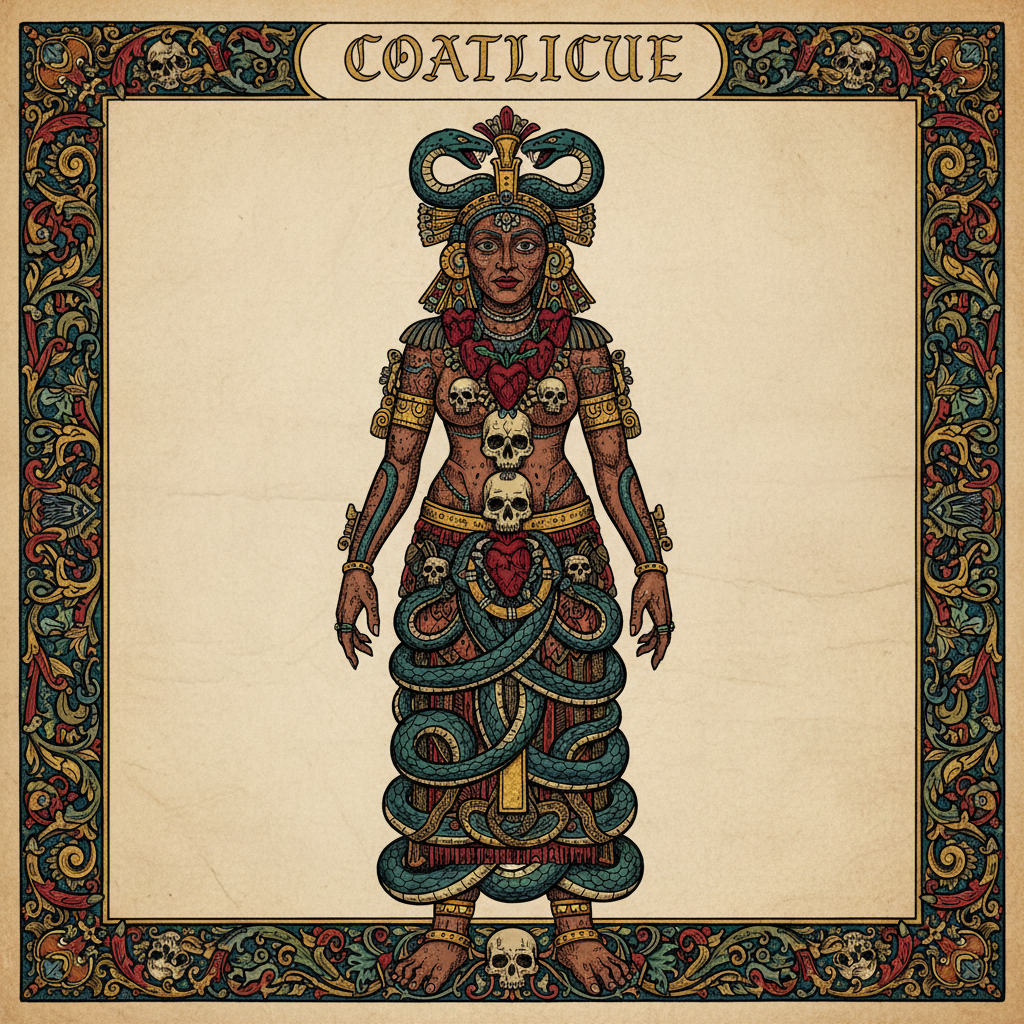
This is her role on Coatepec, the Serpent Mountain, the sacred hill where the gods maintain their presence in the world: she sweeps the temple. She is the earth herself — her skirt is made of serpents braided together, her necklace is a string of human hearts and hands with a skull pendant, her face is two serpent heads facing each other across the gap where a human head should be. She is not beautiful by any human standard. She is accurate. She is what the earth actually is: the source of life and the receiver of the dead, fecundity and consumption in one body, the ground that grows the maize and accepts the corpse. She sweeps the temple because someone must.
A ball of feathers falls from the sky and touches her chest.
The feathers enter her and she is pregnant.
There is no consent and no violation here — the Florentine Codex presents it as a natural event, the way pollen enters a flower, the way lightning enters the earth. The divine seed finds the divine womb and the result is what the myth requires. Coatlicue tucks the feathers into her breast and continues sweeping. When she realizes she is with child, she does not know the child’s name yet, only that something is growing in her that has no precedent and cannot be explained in the ordinary terms of maternity. She goes about her duties on Coatepec. The mountain waits.
Her daughter notices first.
Coyolxauhqui — Golden Bells on Her Cheeks, the moon goddess, the warrior daughter, the one who wears her power as jewelry and leads the four hundred Huitznahua, the four hundred warriors of the southern sky — Coyolxauhqui looks at her mother and sees the pregnancy and constructs the logic of it: there is no father anyone knows. The mother has dishonored the family. The family must act. She calls the four hundred brothers together on the lower slopes of Coatepec and she speaks, and the Florentine Codex gives her the words the commanders always give: We cannot let this stand. We must kill her.
The four hundred brothers arm themselves and begin to climb.
They are arrayed for war — arrows, atlatl darts, obsidian-tipped spears, the full arsenal of the Huitznahua who are the stars of the southern sky, the night warriors, the ones who wage the battle against the sun every evening. Coyolxauhqui leads them up the switchback paths of Coatepec, past the maguey and the pine, toward the temple where their mother stands with her broom. The plan is straightforward. The four hundred are enough. The old earth goddess sweeping a temple alone is not a military problem.
But one brother, Quauitlicac, breaks ranks in the dark and runs up ahead of the formation. He finds a crack in the mountain wall and calls through it to the unborn child inside Coatlicue: They are coming. They are almost here. The voice that comes back through the stone is already fully formed, already general-level, already planning: I hear you. I know. Do not be afraid. I know exactly what I am doing.
At the moment of Coatlicue’s death, her son is born.
Coyolxauhqui reaches the summit. She raises the weapon. Coatlicue falls. And in the instant of the fall — the Florentine Codex stacks these events so tightly they cannot be separated — Huitzilopochtli erupts from his mother’s womb fully formed and fully armed. Blue-painted, wearing the hummingbird helmet of the left-sided sun, carrying in his right hand the Xiuhcoatl, the Fire Serpent, the blazing weapon that is both spear and lightning and the path of the sun itself. He does not need a moment to orient himself. He does not need to learn to stand. He is born fighting, born at war, born at the exact moment when war is required, which is his entire theological point: he is the sun in the instant of dawn, emerging from darkness into conflict, the moment of daily birth that is always also a battle.
He turns to his sister.
Coyolxauhqui is magnificent and she loses anyway.
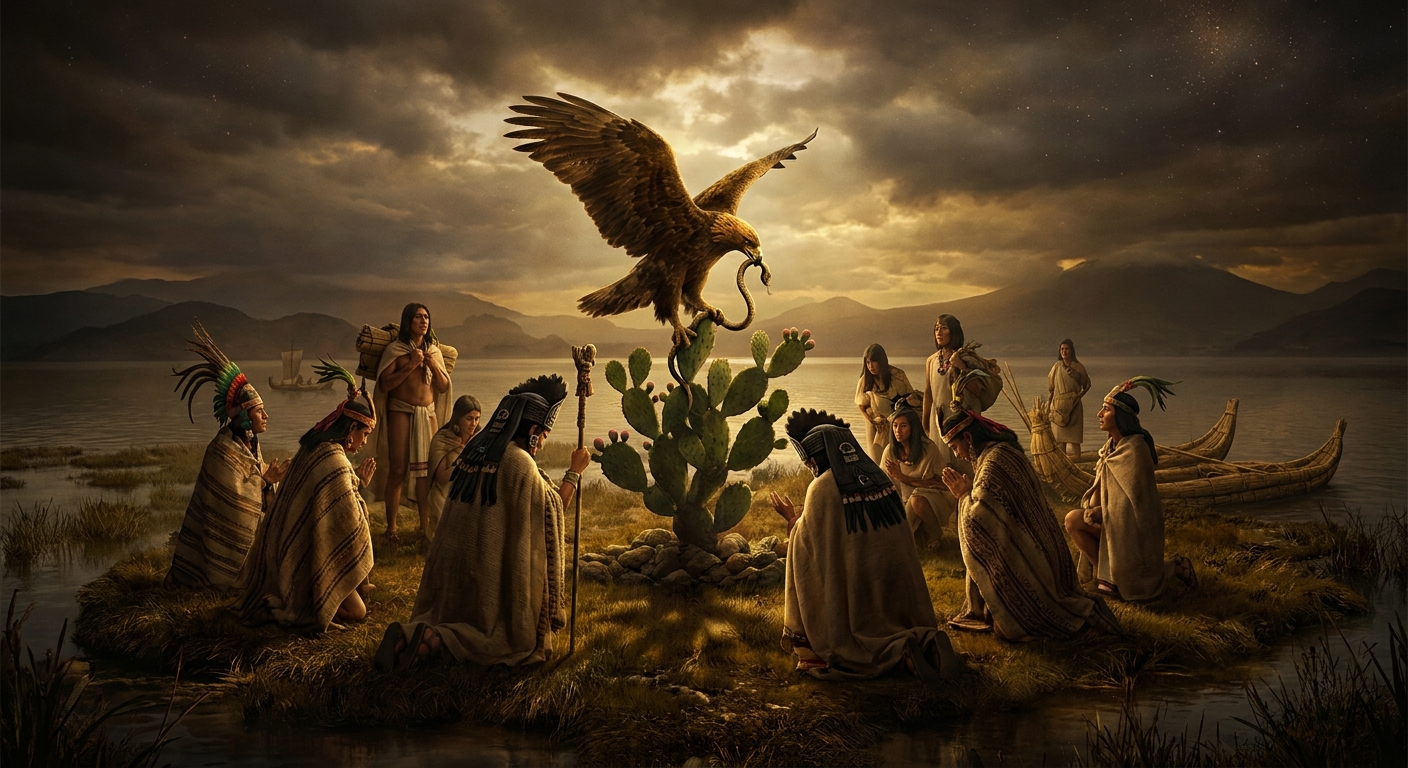
The Xiuhcoatl finds her and the blow is final. Her body separates: head here, arms here, legs rolling down the slopes of Coatepec, hands scattered among the rocks, torso tumbling past the pine trees to the base of the mountain. The four hundred Huitznahua scatter in all directions across the sky, which is why the stars are where they are, driven to the far positions by the sun’s violent birth. Huitzilopochtli does not pursue them. He has what he came for: the dawn. The sun rises. The battle of Coatepec is every morning’s battle, and every morning the sun wins, and every morning the moon and the stars retreat, and the world gets its day.
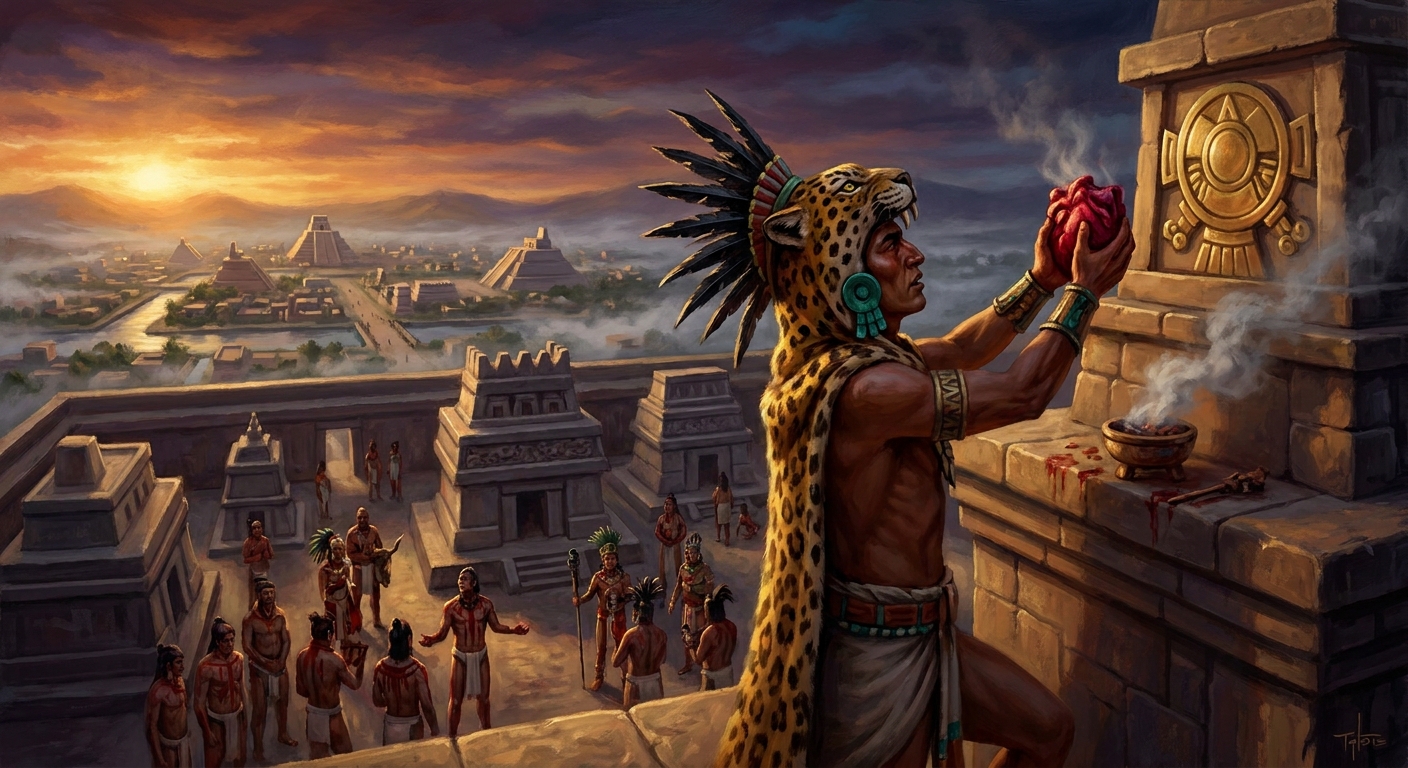
When the Aztecs build the Templo Mayor at Tenochtitlan — the great double pyramid at the center of the capital of the known world — they build it as Coatepec. They place a massive carved stone disc at the pyramid’s base: Coyolxauhqui, dismembered, her body arranged in pieces around a central point, her face still wearing the golden bells. Every captive sacrificed at the summit falls, as she fell, and lands, as her body landed, at the base of the mountain. The myth is not a story they tell. It is the building they inhabit. It is the architecture of an empire.
The Coyolxauhqui stone was found by electrical workers in downtown Mexico City in February 1978, three meters below a street, and the discovery triggered one of the most significant archaeological excavations in the history of the Americas — the excavation of the Templo Mayor itself, a pyramid that had been built on, built over, and buried beneath the colonial city for four hundred and sixty years, waiting.
Scenes
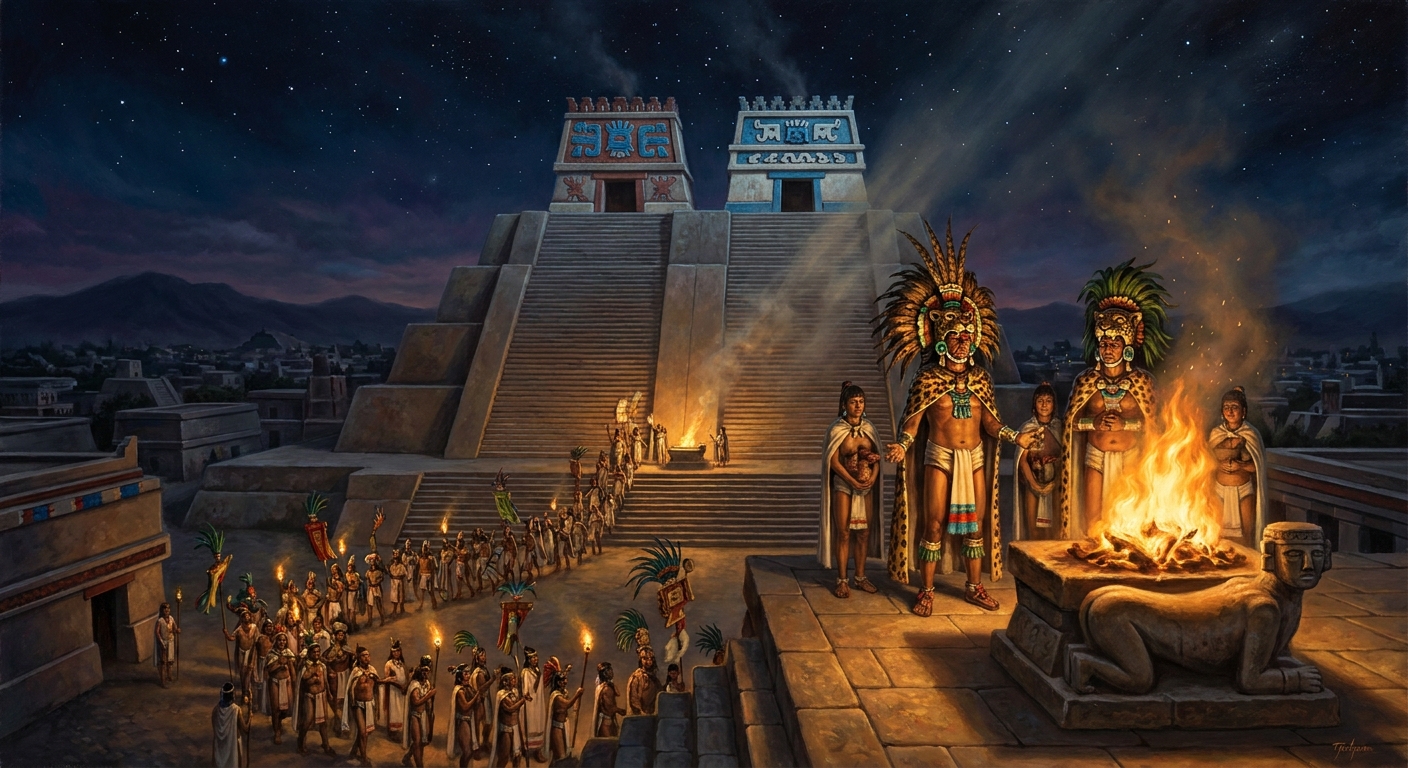
Coatepec — Serpent Mountain — rises against the sky where Huitzilopochtli will be born
 Generating art…
 The moment of birth: Huitzilopochtli erupts from Coatlicue's womb fully formed, blue-skinned, wearing the hummingbird helmet, the fire serpent Xiuhcoatl blazing in his right hand
Generating art… Coyolxauhqui's dismembered body rolls down Coatepec in pieces
 Generating art…
 Echoes Across Traditions
Entities
- Huitzilopochtli
- Coatlicue
- Coyolxauhqui
- the Centzon Huitznahua (Four Hundred Southerners)
- Paynal


Sources
- *Florentine Codex*, Book 3 — Bernardino de Sahagún (~1580)
- *Crónica Mexicayotl* — Fernando Alvarado Tezozomoc (c. 1609)
- *Historia de los Mexicanos por sus pinturas* (c. 1535)
- Cecelia Klein, 'The Ideology of Autosacrifice at the Templo Mayor,' in *The Aztec Templo Mayor* (1987)
- Eduardo Matos Moctezuma, *The Great Temple of the Aztecs* (1988)
- Inga Clendinnen, *Aztecs: An Interpretation* (1991)