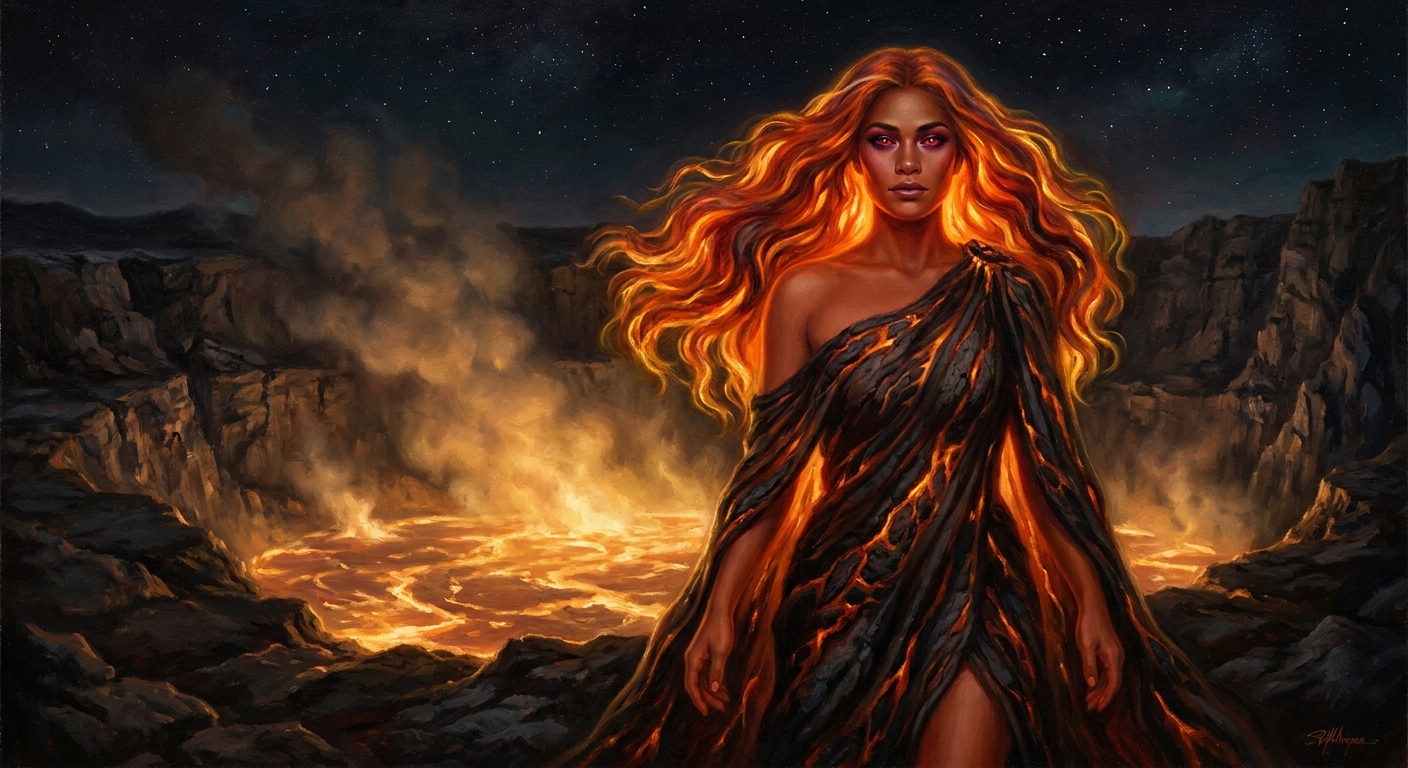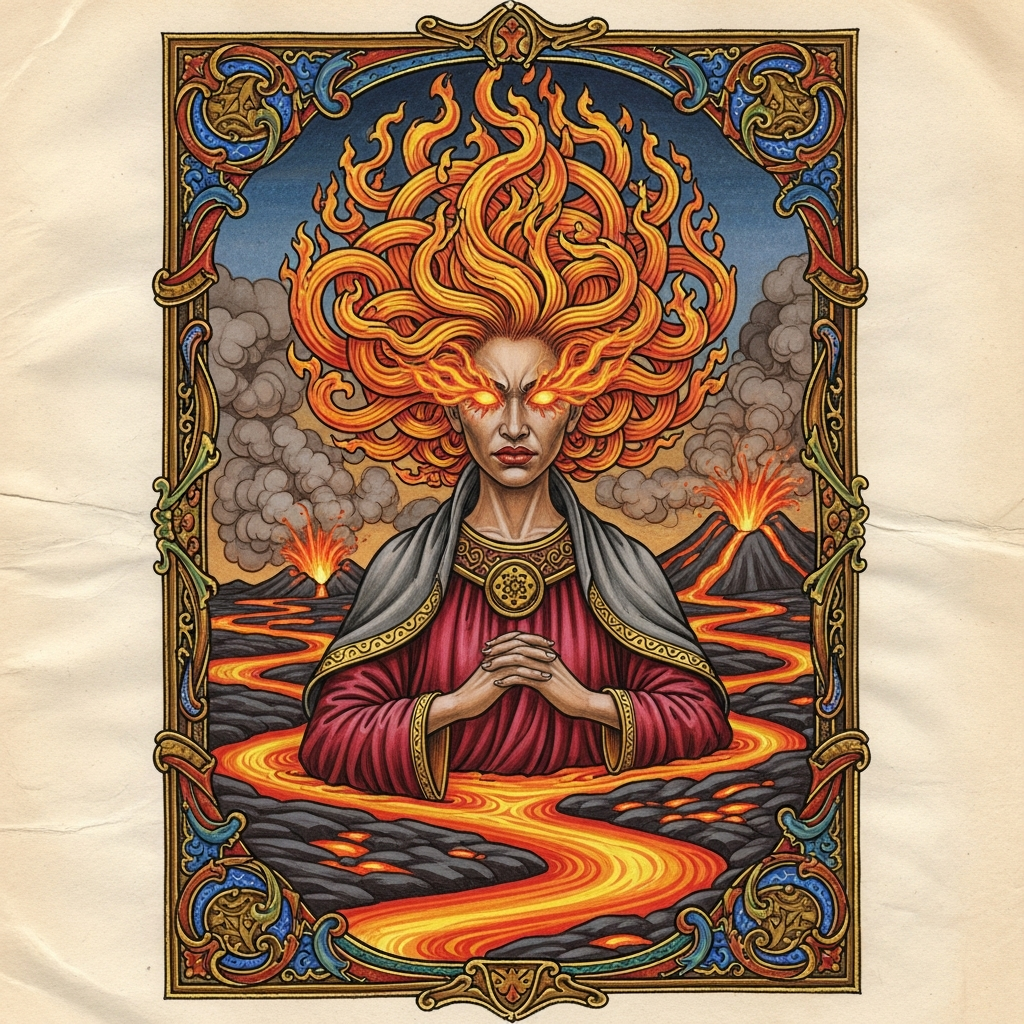
Hiʻiaka Walks Through Fire for Her Sister
Mythic time · oral tradition recorded by Nathaniel Emerson, 1915 · From Kīlauea caldera on Hawaiʻi Island northwest through the island chain to Kauaʻi — a journey of four hundred miles through the Hawaiian archipelago
Contents
Pele falls in love in a dream and sends her youngest sister on a forty-day journey through monsters and sorcery to bring the man back — a journey that reshapes the islands and tests whether devotion survives the distance.
- When
- Mythic time · oral tradition recorded by Nathaniel Emerson, 1915
- Where
- From Kīlauea caldera on Hawaiʻi Island northwest through the island chain to Kauaʻi — a journey of four hundred miles through the Hawaiian archipelago
Pele dreams her way across the ocean.
She lies in the lava pit at Halemaʻumaʻu — the fire-pit at the heart of Kīlauea, the home she dug when she came from Kahiki and the sea finally stopped following her — and her body stays there, tended by her sisters. But her spirit-body, her aka, lifts free and rides the night wind northwest along the chain of islands: past Hilo and Maui and Molokaʻi and Oʻahu, over the dark channels and the reef-smash and the frigate-birds sleeping on the updrafts, all the way to Kauaʻi, the oldest island, the green one.
There, in the village of Haʻena, a chief named Lohiʻau is playing his nose-flute at the edge of the sea.
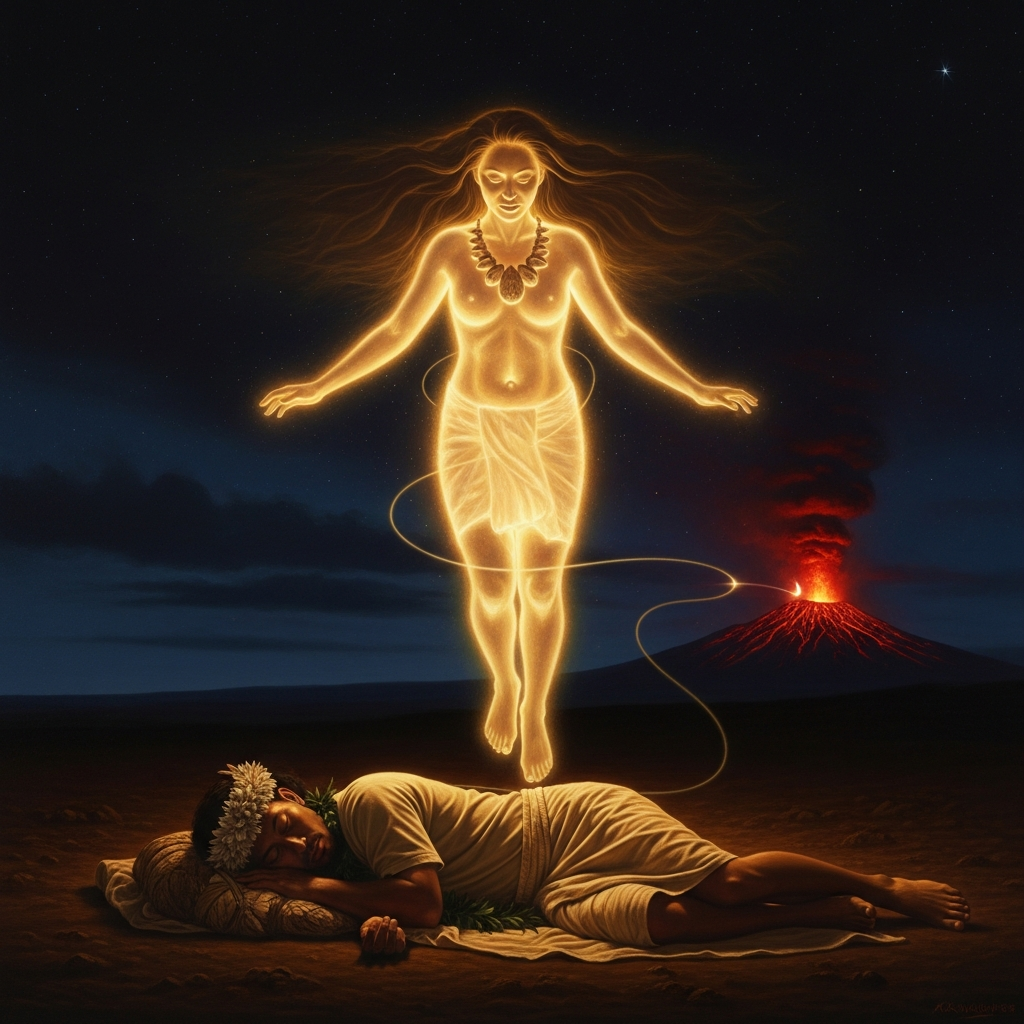
His music crosses the water and catches the spirit-body of Pele the way a hook catches a fish — suddenly, completely. She settles beside him in the dark, and he cannot see her, but he hears something in the air near him that is not wind. They spend three nights this way, the chief and the spirit of a goddess, and by the third morning Pele’s spirit-body begins to thin, pulled back to Kīlauea by the weight of the body left behind. She tears herself away. She goes back.
When she wakes in the fire-pit, she is in love.
She goes to her youngest sister.
Hiʻiaka-i-ka-poli-o-Pele — Hiʻiaka who was born in the egg that Pele carried from Kahiki in her armpit, Hiʻiaka who hatched into the world already knowing how to be a healer, already knowing the chants that kill demons and restore the almost-dead. She is the youngest and the favorite, the one Pele trusts with the inner things.
Go to Kauaʻi, Pele says. Find the chief Lohiʻau. Bring him back to me in forty days.
It is a five-day journey to Kauaʻi, and the islands between are full of things that eat travelers, and Pele has never sent her favorite sister this far before. Hiʻiaka knows all of this. She also knows that Pele is asking.
She asks for two things in return: permission to use her lightning powers on the journey, and Pele’s promise to protect her dearest friend Hōpoe — who lives in a grove of dancing lehua trees on the lava flow below Kīlauea — while she is gone.
Pele grants both. Hiʻiaka takes Wahineʻōmaʻo as her companion and they start walking north.
The islands, on the ground, are not what they look like from a dream.
The ʻōhiʻa forest on the windward slopes of Hawaiʻi Island is not forest as the word suggests — open, traversable, with a clear floor. It is a wall of trunk and root and dripping fern, with swamps hidden under the fern-mat that swallow a person to the waist, and with things living in the swamps that are not water. The mōʻō — the great lizard-goddesses, the water-dragons — have been using the crossings of streams and the edges of marshes as ambush-sites for generations. Travelers disappear there. Entire communities have been made tributary to them.
Hiʻiaka walks into the swamps on purpose.
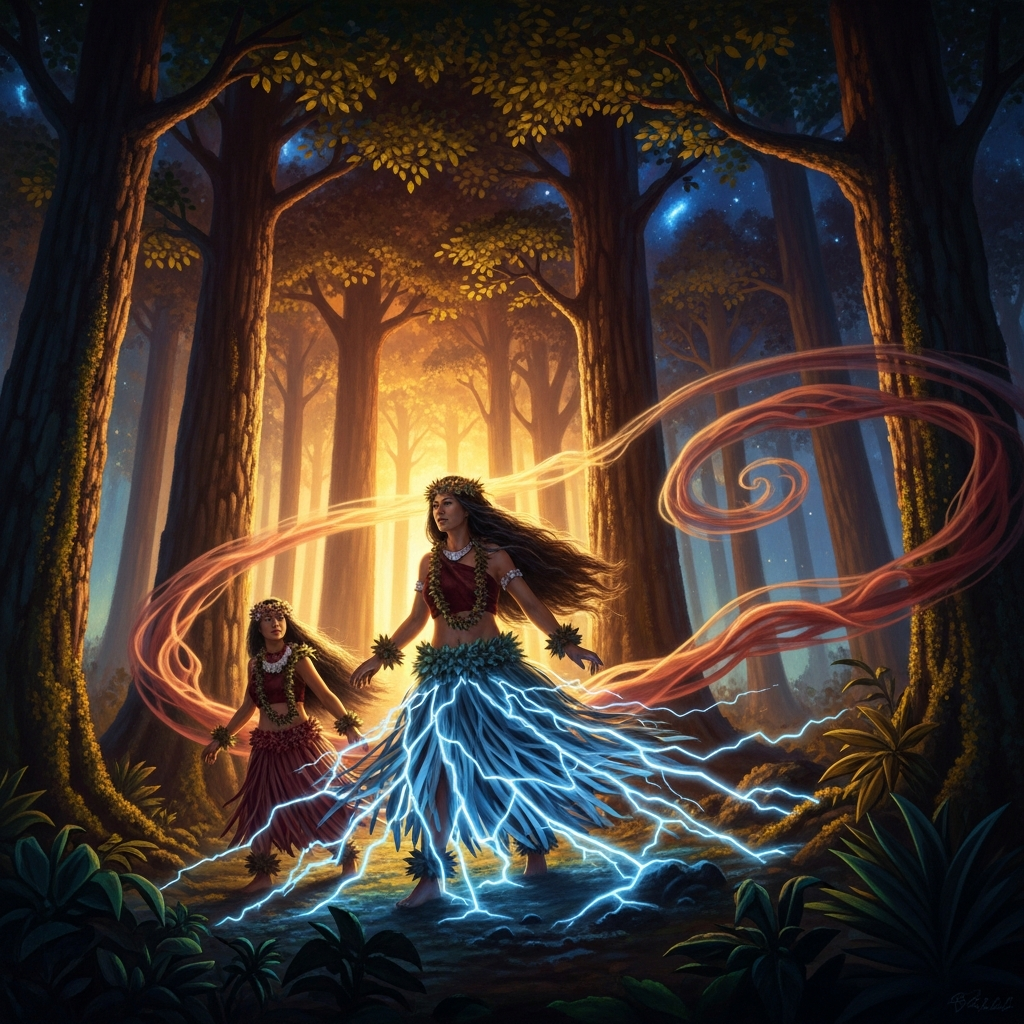
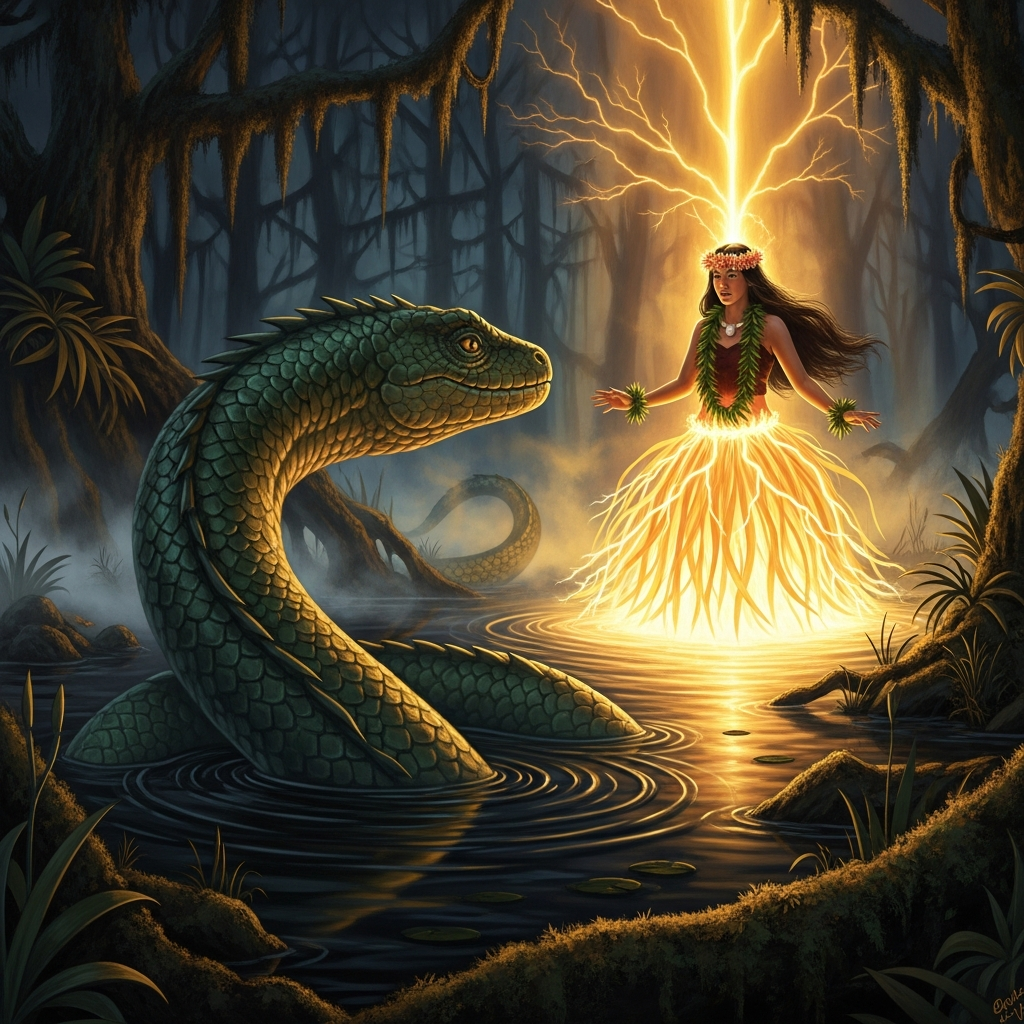
She chants as she walks — not quietly, not to herself, but loudly, the chants designed to name and therefore bind the beings she is about to encounter. The mōʻō hear their own names in her mouth and rise to meet her, which is exactly what she wants. She wears the pā-ʻū, the lightning-skirt her sister gave her, and when she needs it she lets it go — a crackling discharge that fills the swamp with blue light and kills the mōʻō where they surface. She stops after each killing to memorize the place in a chant, to give the land a name and a story so that travelers who come after her will know what was here and know that it is gone.
She is not just traveling. She is editing the islands.
By the time she reaches Oʻahu, the count of things she has killed is considerable.
There is the sea-demon in the channel between Maui and Molokaʻi. There is the cliff-woman on the Pali who has been pushing travelers off the edge with her breath. There is the sorcerer on Oʻahu who sits beside the road and kills by touch — Hiʻiaka spots him, names his nature in a chant before he can act, and he shrivels. She restores two men she finds dead on the trail who should not be dead — not sacrificed, not old, simply killed by the unchecked supernatural that has been allowed to accumulate on the route between the islands because no one has passed this way with the authority to clear it.
Wahineʻōmaʻo watches all of this and walks and does not complain. She carries the supplies. She keeps the count of days.
On the twenty-fifth day they reach Kauaʻi.
Lohiʻau is dead.
He died of love.
In the weeks since Pele’s spirit-body left him, he had refused to eat. He had sat at the shore playing his nose-flute into air that no longer contained the goddess, and he had thinned, and died. His people had wrapped him in kapa cloth and placed him in a cave on the cliff above the village. His mourners are still camped at the base of the cliff when Hiʻiaka arrives.
She climbs the cliff without telling anyone she is going to. She finds the cave. She finds Lohiʻau — three weeks dead, the body still in its wrappings, the soul still nearby the way a soul will linger around a violent or bewildered death. Hiʻiaka knows what this requires. She begins to chant.
She chants for a day. She chants through the night, alone on the cliff with the wrapped body and the lingering soul. The soul resists — it has been dead long enough to start forgetting the body — but Hiʻiaka’s chants are the kind that recall and compel. On the second morning, Lohiʻau breathes.
She carries him down the cliff herself.
They reach Kīlauea on the fortieth day — late, six days past the promise.
Pele, watching from the fire-pit, had stopped believing they were coming. And she had done what Pele does when she stops believing: she had destroyed the thing Hiʻiaka loved. The grove of dancing lehua trees where Hōpoe lived is buried in cooling lava. Hōpoe is inside it. Pele had promised to protect her and had instead burned her, and what is left is a lava field.
Hiʻiaka stands at the edge of the new lava and looks at the place where her friend used to dance.
She brought back the man Pele asked for. She walked through forty days of monsters and sorcery and a dead man on a cliff. She kept the bargain. The bargain was not kept for her.
She puts her arms around Lohiʻau. She embraces him at the rim of the fire-pit, where Pele can see. It is not a seduction. It is a statement — the one act she knows will reach across the lava and be understood.
The volcano responds. But that story belongs to another chant.
The Hiʻiaka myth was recorded most completely by Nathaniel Emerson from Hawaiian sources in the 1880s and published in 1915. His text preserves 283 individual chants — the poetry that Hiʻiaka composes throughout the journey, naming every mountain, every sea-channel, every wind she passes through. The chants are a form of cartography: the Hawaiian islands as Hiʻiaka experienced them on foot, from the ground, killing the things that needed killing and singing everything else into a name so it could be remembered.
Mary Kawena Pukui, one of the great Hawaiian scholars of the twentieth century, described the Hiʻiaka cycle as the closest thing the Hawaiian tradition has to an epic — not because it is the story of a war, but because it is the story of a woman transforming a landscape through the responsible exercise of enormous power, and paying the price for it when the person who sent her lacks equivalent responsibility.
The lehua flower — the red blossom of the ʻōhiʻa tree, the tree that grows first on cooling lava — is said to be Hōpoe, still dancing inside the lava. You are not supposed to pick it near Kīlauea. If you do, rain will follow you all the way home.
Scenes
Hiʻiaka moving through the ʻōhiʻa forest with Wahineʻōmaʻo at her side — her lightning-skirt cracking in the undergrowth, her chant trailing behind her like smoke
Generating art… Pele's spirit-body on Kauaʻi, hovering above the sleeping chief Lohiʻau — her dream-self tethered to the lava pit on Kīlauea by a cord thinner than breath
 Generating art…
 Hiʻiaka confronting the great lizard-goddess in the swamp — the *pā-ʻū* lightning-skirt blazing, the mōʻō uncoiling from the black water, the chant already working
 Generating art…
 Echoes Across Traditions
Entities
- Hiʻiaka-i-ka-poli-o-Pele
- Pele
- Lohiʻau
- Wahineʻōmaʻo
- Hōpoe


Sources
- Nathaniel B. Emerson, *Pele and Hiiaka: A Myth from Hawaii* (1915) — the primary English-language source, with Hawaiian text
- Martha Beckwith, *Hawaiian Mythology* (1940), ch. 12–13
- Mary Kawena Pukui, *ʻŌlelo Noʻeau: Hawaiian Proverbs and Poetical Sayings* (1983)
- Rubellite Kawena Johnson, *Kumulipo: The Hawaiian Hymn of Creation* (1981)
- Adrienne Kaeppler, *Hula Pahu: Hawaiian Drum Dances* (1993)