Combat Profile
Volcanic Wrath
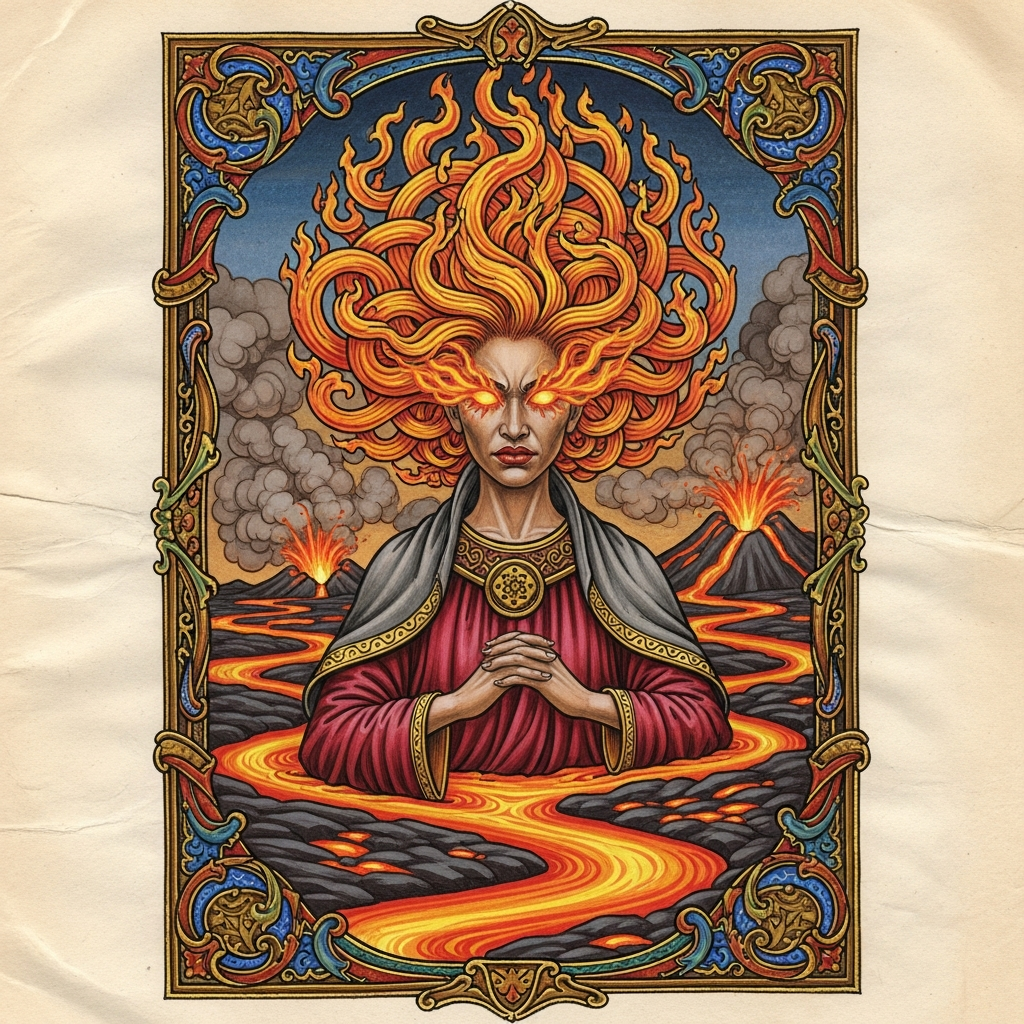
Pele erupts in devastating magma flows that consume landscapes, dealing massive damage in an expanding radius while leaving burning terrain that persists.
Divine Passion
Pele's presence intensifies emotions and volcanic activity; her anger manifests as literal fire, and her love reshapes the land itself.
Her temper is volcanic -- literally. Her jealousy and rage are as destructive as her creative power. Her rivalry with her sister Na-maka-o-kaha'i (goddess of the sea) drove her across the Pacific
“Those who say Pele is a myth have never stood at the edge of Halema’uma’u when the lava rises.”
Lore: Pele is the Hawaiian goddess of volcanoes, fire, and creation through destruction. She is one of the most actively worshipped deities in the Pacific today. When Kilauea erupts — and it has erupted repeatedly, including major events in 2018 — practitioners understand this as Pele’s direct action, not as geology. Offerings are left at the crater rim. Chants are performed. Her presence is felt.
Pele’s origin story is a migration narrative: she traveled from Kahiki (the mythological homeland, possibly Tahiti) across the Pacific, fleeing her sister Na-maka-o-kaha’i (goddess of the sea), digging fire pits on each island she reached. Each time, Na-maka flooded the pit with seawater. Pele moved on — Kaua’i, O’ahu, Moloka’i, Maui — until she reached the Big Island of Hawai’i and dug deep enough into Kilauea that her sister could not reach her. There she remains. The geological reality supports the myth in reverse chronological order: the Hawaiian Islands do get progressively older from southeast to northwest, formed by the Pacific Plate moving over a volcanic hotspot — the same hotspot now feeding Kilauea. Pele’s migration from island to island mirrors the geological sequence exactly.
The Pele-Hi’iaka cycle is one of the great epics of Polynesian literature. Pele falls in love with a chief, Lohi’au, whom she has seen in a dream. She sends her youngest and most beloved sister, Hi’iaka, to fetch him, with the command not to touch him. The journey is long and perilous. Hi’iaka and Lohi’au develop feelings for each other. Pele, watching in her fire and consumed by jealousy, destroys Hi’iaka’s beloved lehua groves before Hi’iaka can return. When Hi’iaka arrives with Lohi’au, she sees the destruction and, in defiance, embraces Lohi’au in full view of Pele. Pele kills Lohi’au with lava. The cycle continues through death, resurrection, reconciliation, and further conflict — a family drama enacted in fire and ocean.
The most famous modern expression of Pele’s power is Pele’s Curse: the belief that anyone who takes lava rocks, sand, or other natural materials from Hawai’i will suffer terrible misfortune until the items are returned. The Volcanoes National Park receives thousands of packages every year — lava rocks mailed back by tourists who experienced runs of bad luck, illness, financial ruin, or relationship collapse after taking souvenirs. Whether you believe in the curse or not, the sheer volume of returns is remarkable. Do not take lava rocks from Hawai’i.
Parallel: Pele is the most direct parallel to the Greek Hephaestus (god of the forge and volcanic fire) and the Roman Vulcan, but she is far more complex — she is not merely associated with fire but is the volcano. Her creative-destructive duality mirrors the Hindu Shiva, who dances the Tandava to both create and destroy worlds. The Pele-Hi’iaka rivalry-and-love echoes the Demeter-Persephone dynamic in Greek mythology — a bond between divine women that is stronger than death but perpetually tested by desire and loss. The closest parallel in emotional and religious terms may be the Holy Spirit as experienced in Pentecostal worship: a divine fire that is present, active, and dangerous, not safely contained in scripture or history.
2 min read
Na-maka-o-kaha'i (sea vs. fire -- water quenches lava, but lava builds new land from the sea); Hi'iaka (her beloved sister, whose loyalty she tests to destruction)
Beckwith, *Hawaiian Mythology*; Emerson, *Pele and Hiiaka*; Westervelt, *Hawaiian Legends of Volcanoes*; Nimmo, *Pele, Volcano Goddess of Hawai'i*