Combat Profile
Snare the Sun
Maui temporarily slows time itself, allowing him to outmaneuver overwhelming odds and reshape fate through cunning intervention.
Divine Defiance
Maui's schemes and thefts succeed with supernatural frequency, and he recovers from seemingly impossible situations through sheer ingenuity and ancestral favor.
Mortal. For all his power and cunning, he cannot escape death. His final quest -- to win immortality for humanity by crawling through Hine-nui-te-Po -- ends in failure when the fantail bird laughs and wakes the goddess, who crushes him between her thighs
“Maui was born premature, wrapped in his mother’s topknot, and cast into the sea. The jellyfish nursed him. The waves carried him. The gods themselves did not want him, and that is why he was the greatest of them all.”
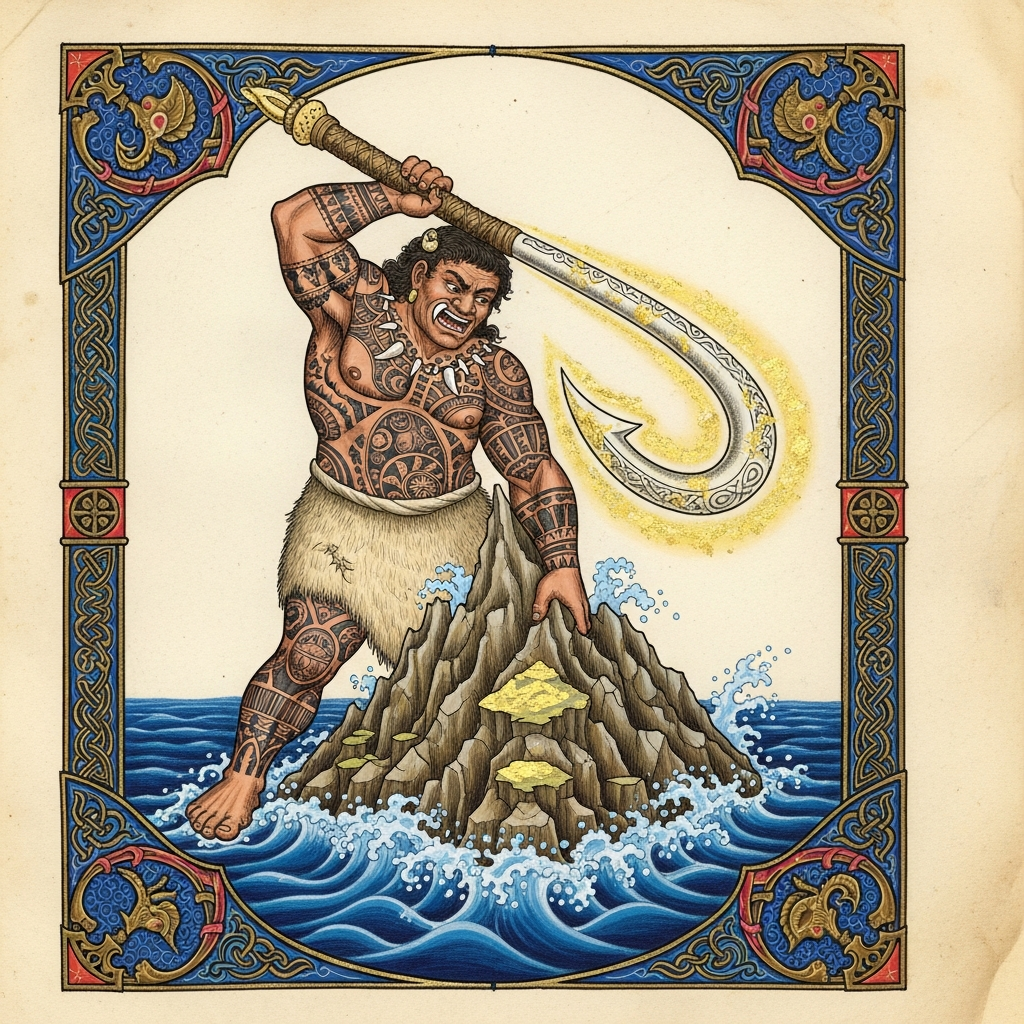
Lore: Maui-tikitiki-a-Taranga is the supreme culture hero of all Polynesia. He appears in every tradition across the triangle — from Hawai’i to Aotearoa to Rapa Nui to Samoa — and his exploits are among the most celebrated in Pacific literature. He was the last-born son of Taranga, born prematurely, so small and sickly that his mother wrapped him in a knot of her hair (tikitiki) and cast him into the ocean. He should have died. Instead, he was carried by currents, nursed by sea creatures, found and raised by his ancestor Tama-nui-ki-te-rangi. He returned to his mother, reclaimed his place among his brothers, and proceeded to reshape the world.
Maui is not a god in the way Tane or Tangaroa are gods. He is a demigod — part divine, part human — and it is precisely this liminality that makes him dangerous. He does not accept the world as the gods made it. The days are too short? He lassoes the sun and beats it until it agrees to move more slowly. There is no land? He baits his grandmother’s magic jawbone as a fishhook and hauls islands up from the ocean floor. Humans have no fire? He descends to the underworld and tricks the fire goddess Mahuika into giving up her flames, one fingernail at a time. The world is broken? Maui fixes it — not through prayer or obedience, but through cunning, audacity, and sheer refusal to accept limits.
But his final quest fails. Maui decides to conquer death itself by crawling through the body of Hine-nui-te-Po (the goddess of death) while she sleeps — entering through her birth canal and emerging from her mouth, thereby reversing death’s passage. He instructs the birds to remain silent while he makes the attempt. He enters the sleeping goddess. But the fantail bird (piwakawaka) — that small, absurd, twitching bird — sees the sight and cannot contain itself. It laughs. Hine-nui-te-Po awakens and crushes Maui between her obsidian thighs. And so humanity remains mortal. Death wins not because it is stronger than Maui, but because a bird laughed at the wrong moment.
Parallel: See the Centerpiece below for the full comparative analysis.
2 min read
Hine-nui-te-Po (death itself -- the one force that trickery, strength, and cleverness cannot overcome)
Grey, *Polynesian Mythology*; Beckwith, *Hawaiian Mythology*; Orbell, *Illustrated Encyclopedia*; Best, *Maori Religion and Mythology*; Luomala, *Maui-of-a-Thousand-Tricks*