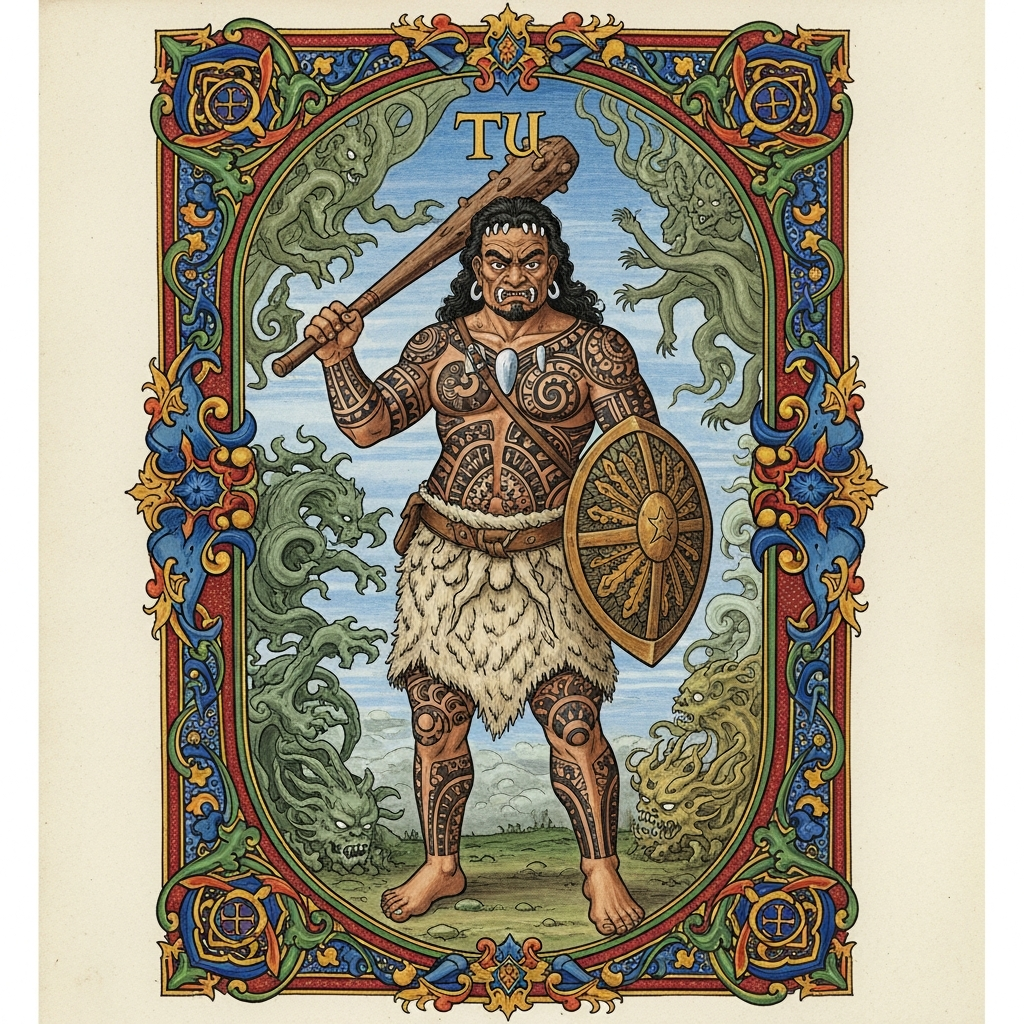
Combat Profile
Tūmatauenga's Wrath
unleashes devastating offensive power that multiplies damage based on number of enemies engaged, reflecting his dominion over all forms of combat
Ancestor of Humanity
grants offensive bonuses to all mortal-descended allies and provides immunity to fear effects, embodying his role as progenitor and protector of mankind
His ferocity is indiscriminate -- he proposed killing Rangi and Papa rather than separating them. He consumed the children of his brothers as vengeance for their cowardice
“Tu alone stood when the storm raged. Tu alone did not run. And because his brothers cowered, their children became his food.”
Lore: Tu-matauenga (Ku in Hawaiian) is the god of war and the ancestor of humanity in Maori tradition. When the brothers debated how to deal with their confinement between Rangi and Papa, Tu’s proposal was blunt: kill them. He was outvoted — Tane’s plan to separate them prevailed. After the separation, the storm god Tawhirimatea (who had opposed it) attacked his brothers in fury. Tangaroa fled to the sea. Tane’s forests were shattered. Rongo and Haumia hid in the earth. But Tu stood his ground and fought. Because every other god ran, Tu gained the right to consume their domains — and this is why humans (Tu’s children) hunt birds (Tane’s domain), catch fish (Tangaroa’s), harvest crops (Rongo’s), and dig fern-root (Haumia’s). War, in this theology, is not merely destruction — it is the fundamental assertion of human agency against a world of gods who failed to show courage.
Parallel: In Hawaiian tradition, Ku is the god of war and one of the four great gods. The war temple (heiau) system and the practice of human sacrifice were associated with Ku worship. This parallels the Aztec Huitzilopochtli and the Vedic Indra — war gods whose worship demanded the highest sacrifices. Tu’s unique theological function — explaining human dominion through divine cowardice — has no direct parallel elsewhere. It is a remarkably unsentimental creation theology: humans rule not because God gave them dominion (Genesis 1:28) but because their ancestor was the only one brave enough to stand and fight.
1 min read
Tawhirimatea (the storm god who alone opposed the separation and attacked the other brothers; Tu stood and fought when all others fled)
Grey, *Polynesian Mythology*; Best, *Maori Religion and Mythology*; Orbell, *Illustrated Encyclopedia*