Combat Profile
Nocturnal Engineering
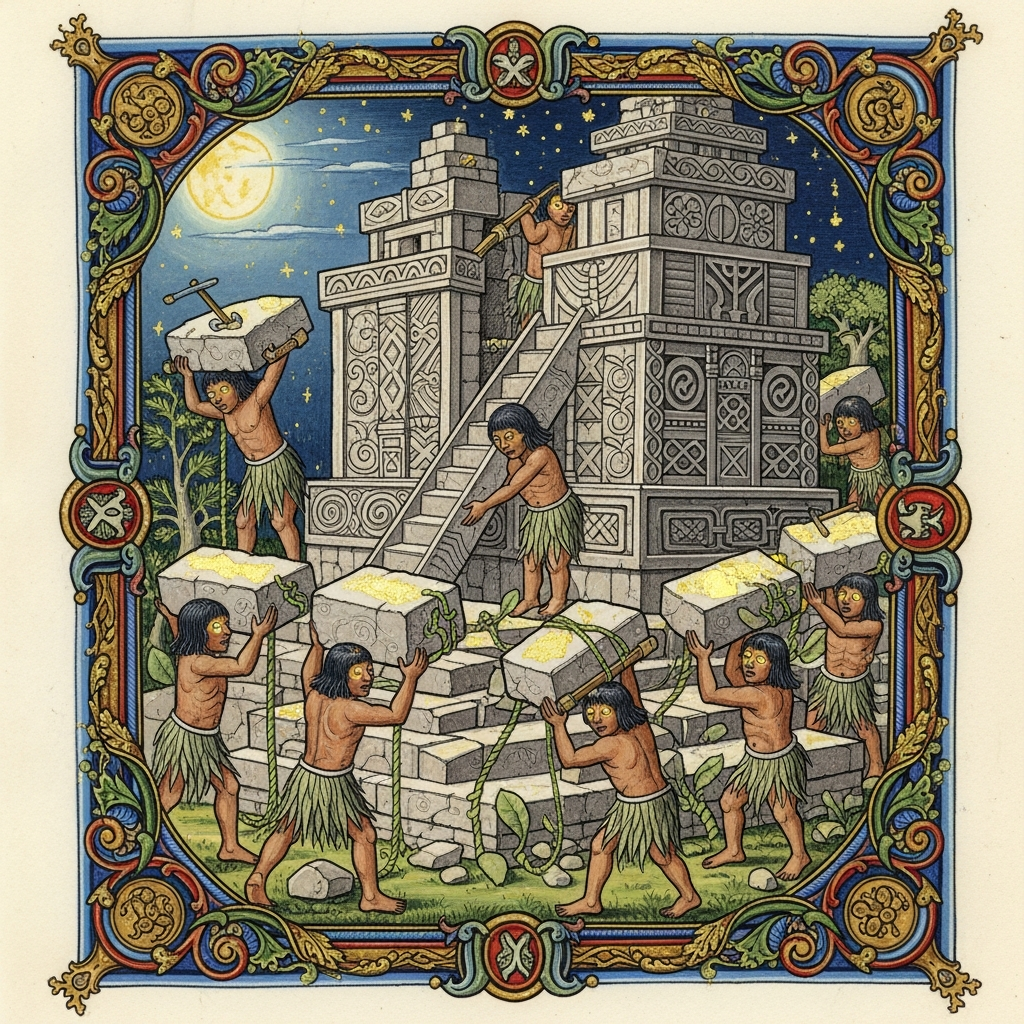
summon a crew of Menehune workers to complete monumental construction projects in a single night, creating permanent structures of exceptional durability.
Hidden Labor
all crafting and construction tasks take half the normal time and require no mortal supervision when performed during darkness.
Shy, nocturnal, and easily driven away by human encroachment. If their work is observed before completion, they abandon it
“The Menehune work only at night. If the work is not finished by dawn, it is left forever incomplete. Listen — do you hear the sound of small stones being fitted together?”
Lore: The Menehune are a legendary race of small, skilled builders in Hawaiian tradition. They are described as small in stature (roughly two to three feet tall), immensely strong for their size, and possessed of extraordinary engineering skill. They work exclusively at night, in vast coordinated labor gangs, and can complete massive construction projects — fishponds, roads, irrigation channels, temples — in a single night. If the project cannot be finished before dawn, it is abandoned. The Alekoko Fishpond on Kaua’i, a sophisticated aquaculture structure, is traditionally attributed to the Menehune, who are said to have built it in a single night by forming a double line stretching miles to a quarry, passing stones hand to hand.
The scholarly debate over the Menehune is fascinating. One theory holds that they represent a dim cultural memory of an earlier, pre-Polynesian population encountered by the arriving Polynesians — the Marquesas settlers who preceded the Tahitian migration. In this reading, the “small people” are not supernatural at all but a real (if later mythologized) indigenous population displaced by the newcomers. The 1820 Hawaiian census actually listed 65 people in the Wainiha Valley of Kaua’i as “Menehune,” suggesting that the term may have originally referred to a real, marginalized population later mythologized. Another theory sees them as entirely mythological, related to the manahune (common people) class in Tahitian society — a social category that was mythologized into a race of spirits. The truth may combine both.
Parallel: Races of small, skilled, nocturnal builders appear across world mythology with remarkable consistency: the Norse dwarves (who forged Mjolnir, Gungnir, and the Brisingamen), the Irish Tuatha De Danann (later diminished into fairies and leprechauns), the Slavic domovoi, and the various “little people” traditions of Native American cultures. The pattern of a displaced earlier population being remembered as supernatural small folk is so widespread that it likely reflects a genuine recurring historical process: when one people displaces another, the displaced become, in cultural memory, the mysterious builders of the ancient works whose origins the newcomers cannot explain.
2 min read
Daylight and discovery; they cannot tolerate being seen
Beckwith, *Hawaiian Mythology*; Luomala, *The Menehune of Polynesia*; Kirch, *Feathered Gods and Fishhooks*