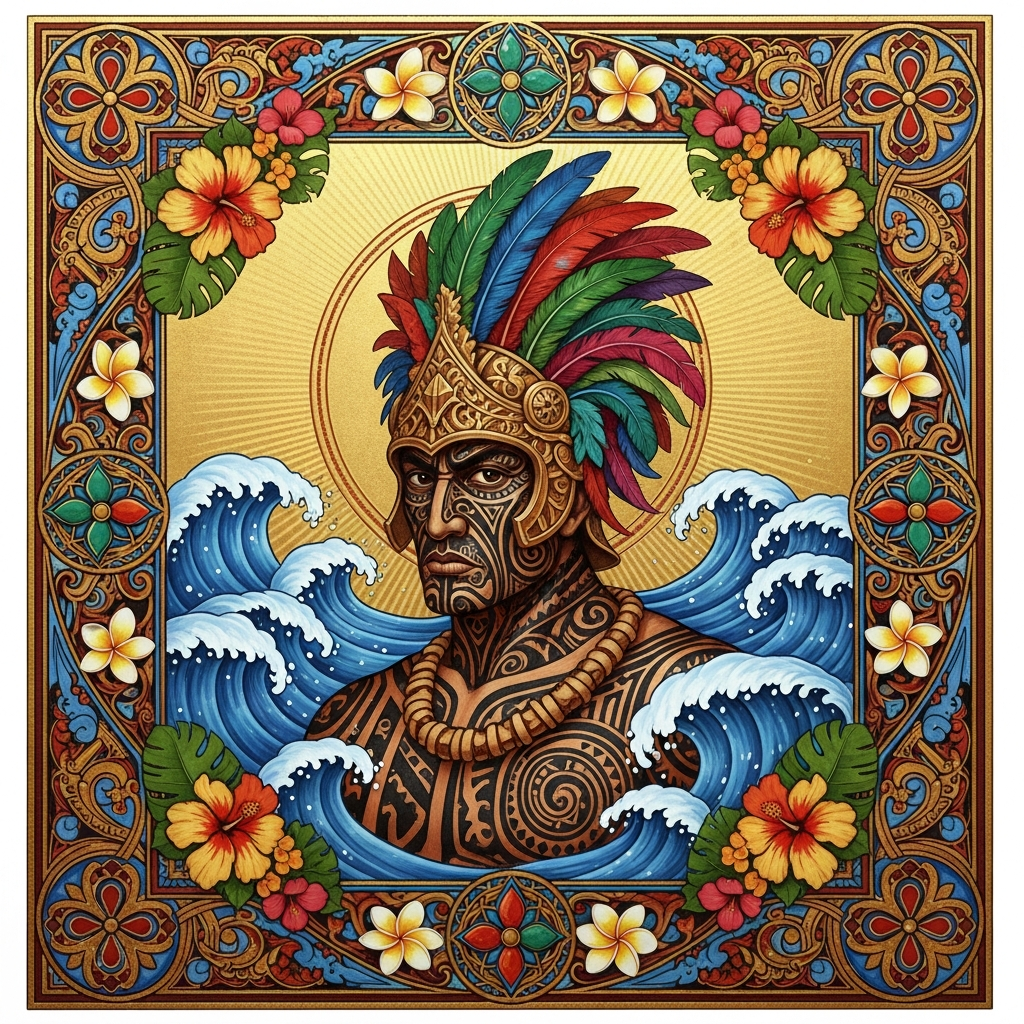
Combat Profile
Moku's Wrath
Grants the wielder devastating combat prowess and military conquest, turning entire battles in favor of those bearing his favor.
War-Manifest
Kū's presence strengthens warriors and ensures victory flows to the strategic and bold; fishing nets and forests bend to those he blesses.
His worship demands the highest price -- human sacrifice at the luakini heiau (war temple). His power is fueled by death, and chiefs who failed in war could face the collapse of his cult
“The feathered god opened its mouth and the men who carried it ran forward screaming, and the enemy saw the god coming and some of them ran and some of them stood and none of them were ready for what the god carried in its eyes.”
Lore: Kū-ka’ili-moku (Kū-the-snatcher-of-islands) is the Hawaiian form of Tu, the war god known across the Polynesian triangle, but the Hawaiian expression of this deity developed into something uniquely elaborate and terrifying. Where the Maori Tu is a theological principle — the ancestor whose courage in battle earned humanity dominion over nature — the Hawaiian Kū became the center of a sophisticated war-cult whose material culture was among the most visually powerful in the Pacific. The ki’i akua, the feathered god-images associated with Kū worship, are among the most technically extraordinary religious objects produced in human history: three-dimensional portraits of divine fury, their surfaces covered with thousands of tiny feathers from now-extinct Hawaiian birds (ʻōʻō, mamo) applied in patterns that created a shimmering, living surface. Their mouths are open in a snarl. Their eyes are pearlshell. They were carried into battle on litters, the physical presence of a war god marching with the army.
The luakini heiau (war temple) system was Kū’s institutional home. These large stone platform temples were constructed by chiefs before major military campaigns, dedicated to Kū with elaborate rituals that included human sacrifice — mohai kanaka, the offering of men, typically prisoners of war or taboo violators, whose deaths were understood to fuel the god’s power and ensure military victory. The great chief Kamehameha I, who unified the Hawaiian Islands under a single rule between 1795 and 1810 in campaigns of devastating military effectiveness, was a devoted worshiper of Kū-ka’ili-moku. He received the feathered god-image from his dying uncle Kalani’ōpu’u. The unification of Hawaii — the only successful military unification of any Pacific island group — was accomplished under Kū’s banner, with the feathered god carried before Kamehameha’s armies at every battle.
Parallel: The war god as a portable divine presence carried into battle — a martial deity whose physical image concentrates divine power and whose worship requires the highest sacrifices — appears across the ancient world with striking consistency. The Ark of the Covenant carried into battle by the Israelites (1 Samuel 4) is both militarily and theologically parallel: a sacred object whose divine presence was expected to guarantee victory, carried before the army, captured by enemies with catastrophic results. The Aztec Huitzilopochtli, carried as a deity bundle by Mexica warriors and fed by human sacrifice, is the closest functional parallel to Kū-ka’ili-moku — the feathered war god whose appetite is blood and whose reward is empire. The Hawaiian tradition is distinguished by the sheer artistry of its martial theology: the feathered gods are not crude war fetishes but objects of extraordinary craft, beauty, and terror simultaneously — the divine and the lethal fused into a single form, which may be the most honest thing ever said about the nature of war.
2 min read
Lono (whose Makahiki season temporarily suspends Kū's reign; the two gods represent the Hawaiian calendar's alternation between war and peace, conquest and harvest)
Beckwith, *Hawaiian Mythology*; Valeri, *Kingship and Sacrifice: Ritual and Society in Ancient Hawaii*; Kamakau, *Ka Po'e Kahiko: The People of Old*; Bishop Museum collections